Showing posts with label Frederick Duke of York. Show all posts

Friday, May 29, 2009

Tart of the Week: Sarah Countess of Tyrconnel


Sarah Hussey was born into money which meant two thing: a prestigious marriage and scandal. Being a grand heiress, poor-ish nobles were lining up to marry Sarah by the time she was sixteen. The man who won Sarah's hand (and money) was George Carpenter, the earl of Tyrconnel, an Irish peer. George has already been married, which made Sarah his second countess. What happened to the first countess you may ask. Well, Lady Frances was still very much alive; she had just gone through the pricey process of divorce, or rather, George had gone through it, to do away with her.

Sarah picked up where the former Lady Tyrconnel left off. She quickly got bored with her older husband and went out partying and man-scouting. She seemed to have hit the jackpot in 1788 when she began an affair with Prince Frederick, Duke of York. As with just about all royal affairs, the press had a field day, boosting Sarah up to celebrity status. The strangest aspect of the whole affair: both Sarah's father and husband were blooming with pride. When Frederick broke off the affair a year later, the two men were more upset than Sarah. It sounds like something out of The Tudors, no?

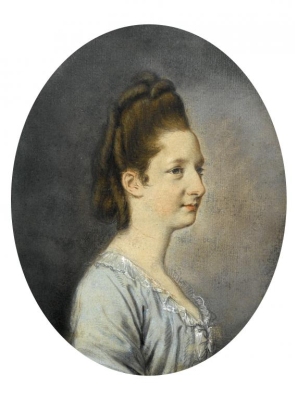
Sarah wasn't one to mope around about broken relationships. She moved on. The next man in her life was John, Earl of Strathmore, son of none other than Mary Eleanor Bowes. Once again, satirical prints loved the pretty little countess' affair and it publicized for all to see. But this time, the affair seemed to mean a little more to Sarah, she loved John. Finally, one day she just up and left George and went away to live in sin with John. Afterall, she was an independant woman. When the artist John Downman was portraying her, he noted such. Sadly, Sarah's legacy was not to last very long. She died in 1800 from a bad cold at the age of thirty-seven. Her final resting place is the illustrious Westminster Abbey.

Friday, January 23, 2009

Tart of the Week: Lady Letitia Lade


Doesn't her name alone just send the message that Letitia was no saint? We can't be sure of the true origins of Letitia, or even what her true name really was. We can infer that she came from humble origins which led her to employment in seedy London as a servant in a brothel. It is here that the young Letitia met the first of her movie-worthy lovers, John Rann. Rann was a dashing highwayman, and we know how irresistible those can be! But bad boys are never good for the long haul. Sixteen String Jack was captured and sentenced to death in 1774. Not one to go down without a show, he came out in a custom green suit, joked around with the executioner and crowd, then danced a jig before he was dropped through the floor. Letitia recovered from her loss and moved on from her romantic bad boy to a rich aristocrat, the Duke of York.

Climbing the social ladder proved to work out well for Letitia. Her connections with the Duke helped her form even more. Soon she was modeling for Reynolds under the name of "Mrs. Smith," the portrait of which was exhibited at the 1785 Royal Academy exhibition. Knowing that a son of the king would eventually tire of her, Letitia began to set her sights on his (and Rann's) friend, the Baronet, Sir John Lade. John was rich, fun, good looking, and friends with the Prince of Wales so he was the perfect target for Letitia. He was was a true horseman, one of the best riders and drivers at the time. He was so into it, that he was constantly wearing his riding gear and even insisted on carrying a whip on his person all the time. No wonder Letitia was interested! She won John over with her own natural horsemanship. Here was a beautiful, vivacious, and slightly dangerous woman who shared his love of the sport. Perhaps he could hone her riding skills and maybe even tame her as well? Their affair lasted quite a while and was scoffed at by his family before John made Letitia "Derby" a honest woman, when he married her in 1787.

I imagine the marriage was actually a fun one. The two were so similar in their tastes. When John's friend, the Prince took interest in Letitia, the two seemed to enjoy the game of his pursuit (The Prince even commissioned Stubbs to paint her portrait). Unfortunately, they also had similar spending habits and were commonly in financial turmoil. Letitia relished her new place among the aristocracy while they, in turn, found her a bit course. Her casual cursing was overwhelming to many and began the phrase, "he swears like Letty Lade!" Her carnal past also was a hot topic and she was said to, "withstand the fiercest assault and renew the charge with renovated ardour, even when her victim sinks dropping and crestfallen before her," and that she never "turned her back against the most vigorous assailant."

In the saddle, Letitia proved to be just as reckless and daring as her expert husband. He himself, had trained her well. Not only did she enter herself in the Newmarket Races one year (scandal!) she also placed a bet on herself as well (the audacity!). The portrait the Prince of Wales commissioned to hang in his London home shows Letitia's talent in the saddle. Her horse rears partially en levade as she sits side-saddle, perfectly balanced in this most challenging of position; a position more difficult for the rider than the horse.

Although financial problems may have forced the Lades to relinquish ownership of some of their prized horses, Letitia lived a fairly happy life. She died in 1825 and was followed years later, by her husband. She stands today as a tartly tamer of beasts!

Friday, January 9, 2009

Tart of the Week: Mary Anne Clarke


Mary Anne Thompson was born into humble beginnings in 1776, but her crafty and ambitious personality would not let her stay there for long. At the age of 18 she married a stonemason and possibly even had a kid or two. As soon as Mr. Clarke's financial history exposed him as bankrupt Mary ditched him. There was no way she was staying with a penniless husband!

The more appealing option Mary chose was to sleep around with rich men in London. She was smart, sassy, and beautiful; a hard tart to resist! Soon enough she was an established courtesan and that is when Frederick, Duke of York took notice of her. Frederick, although not very bright, was the Commander-in-chief of the army. Mary took advantage of Frederick for all that he was worth. She threw extravagant parties in the house he paid for and, if you were willing the pay the price, she used her influence with Frederick to help promote officers. So not only was Mary sponging up Frederick's money, she was also making a business out of sleeping with him. How diabolically clever!

Sadly, things couldn't last and Frederick dumped Mary in 1806, leaving her in a lot of debt. Two years of financial crisis later, Mary resorted to blackmail, threatening to publish Frederick's love letters unless he paid her the annuity he had previously promised. Ironically, this same thing had happened to Frederick's brother, the Prince of Wales, about 20 years prior, when his affair with Perdita Robinson soured. Mary's accusations against the Duke of York brought forth stories about her selling army commissions. Oops. Mary was charged with corruption and had to defend herself in court, which she actually did quite well. Meanwhile London errupted over the scandal. Mrs. Clarke was the talk of the town, and you couldn't pass a print house without seeing one of the satires on her, or read a newspaper without seeing her name.

Eventually, the Duke gave up £7,000 and a life annuity to keep Mary from blabbering. She happily accepted. After being imprisoned for her crime for nine months she happily took her cash and settled in Paris to live out her remaining days.