Showing posts with label Pompeo Batoni. Show all posts

Tuesday, April 10, 2012

Depicting the Duke of Devonshire

When it comes to images of Canis, otherwise known as William Duke of Devonshire, there is generally one that floats around on the web by Batoni showing the Duke on his grand tour adventure. And let's all be honest, most of you probably looked at it and went, "How did he get all that eighteenth-century tail?!"  Which is a totally legitimate question being that the Duke lacked social skills to be smooth with the ladies.  He just looks a bit plain and awkward.  When Anton von Maron painted him at the age of 20 the result was also pretty bad.
Hart would write almost 80 years later that the painting of his father was "so very bad" that Bess "had it altered by (I believe) Mr Rising, the cleaner of pictures..."  I'm sure it surprises none of you that Bess took charge on that!

But my favorite images of the Duke are the lesser-known ones which, ironically, are by one of the two most famous artists of the time, Joshua Reynolds.  One shows how handsome the Duke was around the time that he married Georgiana.  I believe the painting is in bad condition now, but you get a good idea from the print (love that coat!):
However my favorite of the two is rarely seen due to it being hidden away in a private collection.  It shows the Duke at age 19 or 20 although he looks much older and more sophisticated

Tuesday, February 28, 2012

Favorites

Pompeu Batoni, Sir Sampson Gideon and an unidentified companion, 1767

Sunday, July 25, 2010

Yay or Nay? Earl of Charlemont

I thought I throw you all a wild card last week and the results were kinder than I expected.  Although I did expect a overwhelming rejection of Matilda Stoughton de Jaudenes' potted plant hat, you were all able to see beyond that and her her over-accessorizing, and gave her a Yay.  She could have used a best friend to slap the extra baubles out of her hand (or hair, really) couldn't she?  Enough of that frivolity, it's been a while since we examined some menswear, hasn't it?


Pompeo Batoni paints James Caulfeild (1753) in his colorful gold-trimmed 'I'm-traveling-in-Italy outfit.'  Yay or Nay?

[Yale Center for British Art]

Sunday, April 26, 2009

Immortal Companion: Thomas Coke


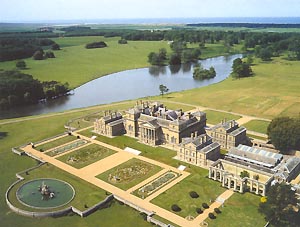
Thomas William Coke was one of the few Georgian men born into money who didn't turn out to be a total brat. Instead of wasting all his money after coming back from the Grand Tour he used it toward, dare I say, productive things. First of all, he set out on improving his estate, Holkham Hall, a task that lasted until his death in 1842. Thomas then involved himself in animal husbandry. He was said to have even made bred a flock a sheep that was superior to the native Norfolk ones, so they soon became all the rage. Thomas' advancements in husbandry were so substantial that he was constantly offered (six times!) a peerage, which he humbly always turned down. It also helped that he was a politician. It was only when Queen Victoria pressed him, that Thomas humbly accepted the earldom of Leicester.

Thomas is pictured here by Batoni in the midst of his Grand Tour. Not only is he quite dashing in his ivory and persimmon Van Dyck-inspired ensamble, he is quite the Enlightened chap as well. Look who stands by his side while he poses. His spaniel, as many dog-owners can relate, is not so interested in posing as he is the fabulous smells coming out of that hat. Is that ostrich, and natural dyes? With a hint of bawdy Roman wench too, I believe! Actually, the dog is a nice compliment to his owner. The flowy qualities of the plumes translates into the dog's fur. The dual-coloured fur mimics Thomas' dual-coloured outfit. He also brings a balance to the painting and aids in the leading the eye to all those important bits. Not only is the spaniel's presence bring a calming sense to the viewer but it also shows the sitter's connection with animals. At this point in Thomas' life his studies in husbandry were just a glimmer of an idea, dogs were more his style at this time.

Tuesday, July 22, 2008

Pompeo Batoni, the Most English of the Italian Painters

When young aristocrats went on the Grand Tour as their rite of passage into manhood they needed to bring back proof of their journey. Artifacts, antiques, and paintings of Vesuvius usually made their way home to decorate their future estates back in the British Isles. But those souvenirs could be things that just anyone picked up! The young masters needed more proof of their completion of the Grand Tour. For that, they would usually go to Pompeo Batoni.

At the age of 19 Batoni moved to Rome and apprenticed with a few of the city's painters. By the 1750's Batoni had established himself with the British tourists as a skilled portrait painter who cost much less than Reynolds and worked faster too. He is now credited with inventing the Grand Tour Portrait. Sitters were usually placed in a luxurious setting, complete with a classical (and recognizable) statue from Rome such as Laocoon. In the distance there was usually an Italian landscape (further proof), possibly with a recognizable structure such as the Coliseum or Vesuvius. These painting were not only meant to document the proof of the sitters' completion of the Grand Tour but also to express their enlightenment. The sitters' dogs commonly accompanied their owners in the portraits as a display of their sensitivity to nature, another Enlightenment value.

Batoni turned into the most sought after Italian painter among the British elite. Because of his many portraits of them, he is often lopped in with the other great English portrait-painters of the century. His style evolved to express this as well. Many of his soft hues darkened to form the rich darker ones that were so popular in the sitters' native land. However, the soft brush still shows through the dark palette revealing this painter-of-the-English's true Italian roots.

Favorites


Pompeo Batoni, The Death of Meleager, 1740-43