Showing posts with label Dance. Show all posts

Tuesday, October 1, 2013

The City in the North's Assembly Rooms


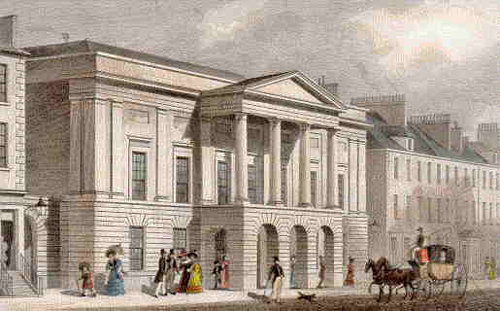
When we think of assembly rooms, we often think of the famous tension-filled dancing scenes from Jane Austen's novels.  However, these early 'function rooms' had been around in some form for some time.  An example of this comes from the story of Edinburgh's Assembly Rooms which had their origins in the 17th century.  The rooms still exist in their Georgian splendor today, but that's only after they had migrated from their original 17th century location.  Before then, balls were held for charity and the matriarchs of Edinburgh organized them, raising funds for noble causes such as the Royal Infirmary.

By the latter-half of the 18th century Edinburgh had established itself as an Enlightenment city and there was a push for it to look as such to reflect its ulta modernity.   The neoclassical suburb of New Town began its constructed in 1765, allowing well-to-do residents an opportunity to get out of the crowded medieval area of the city and establish themselves in new fashionable digs.  This meant there was a new fashion-capital of the town, and an old assembly room would no longer appeal to the targeted clientele; a new, thoroughly modern assembly room must be erected.

Just as with the New Town's plans, a competition was held for the design of the new Assembly Rooms and it was won by John Henderson.  The cost of construction was £6,300 and came from a public subscription.   By 1787 the rooms were finished and could boast being the largest in the country, even surpassing Bath's famous pump room.  Finally, Edinburgh residents felt as though they could rival the entertainments found in the south with the splendor of venues like the Assembly Rooms.  This however, put a bit of pressure on Edinburgh society to maintain this distinction and in 1818 (arguably the height of assembly room entertainment) a grand portico was added because it was thought the building was lacking in splendor.

The Assembly Rooms, much like the rival Bath assembly rooms, still stand today.  After undergoing a recent refurbishment they are now back to the glittering splendor that so impressed guests in 1787.


Monday, September 19, 2011

Come to the Ball

It is truly interesting what fabulous treasures from the past are left behind.  The British Museum houses many of these forgotten treasures that could have been so easily thrown away in their time. 


When viewing the print above from the screen of a computer, it looks like it could have been any sort of print to be displayed in the home or business of a person willing to spend a few shillings.  However this one is a bit more special.  This print was actually a calling card of Harriet, Lady Bessborough.  One the reverse is an invitation to a ball she was holding.  Whoever she invited must have appreciated the gesture enough to save the invitation many years afterward!

Wednesday, June 1, 2011

No Ball Faux-Pas Please!

Those of you have begun reading Evelina have perhaps reached Evelina's first ball in London where the poor girl has made a few social errors resulting in an offended macaroni.  A fatal error!  Just as now, there were many rules of etiquette in Evelina's time; some more obvious than others.  Had she but been schooled in those rules of dance etiquette.

Going to a ball or assembly was not all fun and games, oh no.  Both men and women had obligations, especially the hosts of the party.  Georgiana and Harriet were known to be excellent dancers and Georgiana was known to dance herself into exhaustion due to obligations to the many men who asked her to dance.  It was all part of the toils of the political hostess.  Could you reject a partner who asked you to dance?  Yes; if you had accepted to dance with another gentleman you should certainly decline the invitation; for an invitation to dance was understood to actually be an invitation for at least two dances with your partner.  However, if you wanted to decline, despite not being engaged to another, you should politely beg forgiveness and then sit out for two more dances before considering an invitation from a new partner.  It was almost easier to just accept the dance invitation!  Another reason women may have rarely declined a dance is because it was considered rude on a man's part if he wasn't engaged to a partner to allow a woman to sit out of a dance. In the famous assembly scene in Pride and Prejudice when Lizzie and Darcy meet, Mr Darcy was being rude to not dance when there were ladies without partners.  Of course, if you continue to decline invitations as lady, know that there comes a point when the gentlemen are just being courteous.  Don't be so picky!

Think these dance rules are a breeze?  Take this situational test put together by four lovely ladies at the University of Michigan (although who knows how old this is, they could now be the happy wives of men they picked up with their good dance etiquette these days!).

Friday, January 7, 2011

Tart of the Week: Nancy Dawson


The ongoing trend for celebrities in all ages is to have their great moment of fame and then to be cruelly forgotten, only leaving traces of their celebrity through time.  Such is the case of Nancy Dawson.  Googling the name today will deliver songs, and dances and nursery rhymes such as this one:
  • Nancy Dawson was so fine 
  • She wouldn't get up to serve the swine; 
  • She lies in bed till eight or nine,
  •  So it's Oh, poor Nancy Dawson.

  • And do ye ken* Nancy Dawson, honey? 
  • The wife who sells the barley, honey? 
  • She won't get up to feed her swine, 
  • And do ye ken Nancy Dawson, honey?  
But what do we ken about Nancy Dawson?  What little we do know is a tart-ly tale; certainly not altogether appropriate for children.

Nancy was born around 1728 into a poor situation in life but had aspirations for the stage.  She turned to prostitution for survival and then took up with a traveling puppet company where she learned to dance.  Her natural ability for dance opened up the opportunity to play Columbine, the ballerina in Commedia Dell'Arte and brought Nancy some recognition.  Nancy continued to take different dancing jobs, performing at various coffee houses in Covent Garden.  She was quite the go-go girl of her time.  Her dancing caught the attention of Ned Shuter, a renown comedian and became his mistress.  The relationship opened up more theater opportunities for Nancy.

Nancy was now comfortably situated in Covent Garden taking small acting parts here and there but her big break came in 1759.  In the wildly successful The Beggar's Opera the dancer who would dance to horn pipes in the play was ill and an understudy was needed immediately.  Nancy was given the role and when she pranced onto the stage she brought the house down.  She became such a sensation that she was hired to perform her horn-pipe dances in between the acts of the play.

Songs and poems showered Nancy with praise.  Of course this was 18th century London, so other songs and poems mocked her as well.  The signature song she danced to had the tune of what we know as Pop Goes the Weasel and words were added to immortalize the lady who made the song famous.
  • All the girls in our town, 
  •  black the fair the red the brown,  
  • Who dance and prance it up and down,
  •  There's none like Nancy Dawson!  
  • Her easy mien her step so neat,  
  • She foots she trips she looks so sweet,
  • Her every motion is complete,
  • I die for Nancy Dawson  
Popular sailor songs were song long after Nancy was alive and the Faithless Nancy Dawson was a popular dance which I feel I must have seen in at least one Jane Austen film.

Capitalizing on Nancy's fame were two books which may or may not have been published by her or with her permission; Genuine Memoirs and the appropriately titled, Nancy Dawson's Jests. Although far from a pure woman, Nancy seemed to have a good sense of  humor, a tenacity, and a very fine talent which is what truly made her famous.  After taking a few more rolls as Columbine Nancy retired to a comfortable house in Hampstead where she died in 1767.

*"Ken" is Scottish slang, still used today, meaning "know"

Tuesday, February 16, 2010

Just Dance


Queue the music. Dancing is something humans have done since we could walk upright and beat a rhythm on a tree trunk. It is something people will do regardless of social class or skill. In the great history of dance, the 18th century is far from being omitted as a time period that wasn't big on boogieing down. After all, balls were always a big deal and, if you were in the upper classes, your grace at dancing was a major aspect of how you were judged in multiple areas! Marie Antoinette and Harriet Ponsonby were both known to be exceptional dancers and were also noted for having graceful mannerisms and airs. Of course, when you couldn't dance you could light up the room with some artwork portraying the pastime.

David Wilkie, The Penny Wedding, 1818

David Allan, The Highland Dance, 1780

Johann Georg Weickert, Marie Antoinette and Family Dancing, 1765

Johann Zoffany, The Minuet, ca. 1780-83

William Hogarth, The Dance from The Happy Marriage, 1745

From Wilson's Analysis of Country Dancing instruction manual, 1811

Monday, October 5, 2009

A Night at the Theatre

Going to a play was a much different affair than it is today. Without the simple convenience of nightly entertainment in the form of a television, the theatre was a one-stop shop for something to talk about for the rest of the month. So how would your night go?

The Afternoon-
Pick out your best outfit, do your hair, make sure makeup is immaculate. You only go to the theatre to be seen!

Around 5:00-6:00-
Arrive at the theatre of your choice. Mill about while the opening music plays. Check out who is the best dressed, make faces at those who are better dressed than yourself. See if your rival (political or otherwise) is there and make sure you act appropriately since all the papers will be talking about it tomorrow. Catch the eye of the woman or man you would like to become more intimate with. Is the royal family there tonight? Finally, when all those necessities are out of the way you can make your way to your box. Remember, this could be the most important part of your trip!

Bring on the Show!-
Of course, while you're in your box you should still be keeping your eye out for anything gossip-worthy. The play will begin, hopefully with the best and most fashionable actors of the time. In between acts there could be a comedy routine, singing, dancing, miming, juggling or acrobatics, and even a bit of a sideshow.

After the Play-
You aren't going home just yet! That is, unless you are a gent who has just caught the eye of one of the women working the playhouse! After the play, there is another event to stay in your seat for. Perhaps a little opera is on the menu or even a ballet. Your eyes should still be gracing over the crowd because some people show up just for the Afterpiece since it is half-priced.

The Exit-
By now you've been at the theatre for hours. It could be midnight or later. Perhaps it is time to go home or perhaps it's time for a card game or dinner with friends. After all, going to the theatre might just be the start to your night!

Friday, July 3, 2009

Tart of the Week: Hester Santlow


Hester Santlow exuded so much class during her lifetime that she just barely meets my qualifications as a tart. She is a fascinating woman just the same, and spent years wowing audiences with her skills in dance at a time when most ballerinas came out of Italy or France.

Like many of our tarts born out of the aristocracy, I cannot tell you much of Hester's early beginnings. She was born around 1690. By her early teens she was on stage dancing and by 1706 she had made it to the big time as a dancer on Drury Lane. Hester's rise to the top was based purely on talent and not other naughty means. The lady had some fancy footwork! Of course, it was more difficult to see her skill with her feet due to the dress length, but that is where those ballerina leaps and twirls may have come in.

Those leaps and twirls attracted many fans an admirers. One of Hester's first intimate admirers was John, Churchill, 1st Duke of Marlborough who made her his one and only mistresses (for the time being, anyway). The next in line of intimate admirers was James Craggs the Younger, who was much closer in age to Hester, and much better looking, me-ow! Don't think this was just a quick fling either, James cared very much for Miss Santlow. One night, while at the theatre, Hester was enjoying herself in her private box when a gentleman thought it a good time to join her in order to for some intimate conversation. Well, after listening to his idle chatter for long enough, Hester classily informed her suitor that she would much rather listen to what was on stage than him, thankyouverymuch. The man, apparently not used to rejection, began to berate her in ways no lady should ever hear. He didn't cease either, until Hester gave him the look-of-death (I'm good at that too!), and only then did he retreat to his seat. However, at her next performance, the man made sure he was there to heckle her in the audience and caused a huge disruption. Insulted over the dishonor done to his lady-fair, James demanded satisfaction and a duel was fought in Hyde Park. Hester was a woman worth fighting for! A child, Harriot, was another result of the relationship before the two lovebirds parted ways.

Hester not only danced but turned into a celebrated actress on Drury Lane. She eventually settled down with manager, Barton Booth and the two married in 1719. The stage was her life and she continued on it up through old age. She lived to see her daughter, Harriot marry into aristocracy and prosper well. Hester died peacefully in 1773 after many successful years on stage.

Thursday, July 2, 2009

Ballerinas

There's some beautiful images of dancers (and dances) of the eighteenth century. I couldn't possibly remember them all, but here is a selection of some of the famous ballerinas of the age who enchanted audiences with their grace and beauty.

Giovanna Baccelli, 1782 (Gainsborough)

Barbara Campanini, 1745 (Pesne)

Marie Sallé, 1734

Marie Camargo, 1730

Marie-Madeleine Guimard (Schall)

Hester Santlow (Ellys)