Showing posts with label Maria Fitzherbert. Show all posts

Tuesday, December 23, 2014

A Royal Joke

Poor Mrs Fitzherbert.  Aside from the pain of being attached to the Prince of Wales, the unfortunate woman also seemed to suffer from a deficiency in brains by most accounts...which is likely how she got stuck with the prince to begin with.

Even though the Prince refused to socialise with people who refused to invite his illegal wife to their events, he and his family weren't entirely kind to Maria Fitzherbert Hanover.  Court gossip, Lady Mary Coke's letter tellsof one such occasion that left Maria publicly mortified.  While taking a walk with some of her friends and her husband in Windsor, enjoying the fresh air by the water's edge.  The Duke of Cumberland (the prince's uncle) approached Maria, and making polite conversation, asked her if she could swim.  When she responded that she 'thought she could,' he swiftly pushed her into the water.  Being that this was 1789, you can only imagine the layers upon layers of soaking wet muslin and delicate little shoes that were ruined in this display of 'humour.'  While poor Maria cried, the Duchess of Cumberland (and presumably, her hilarious husband) burst into laughter.  Mrs Fitzherbert wasn't injured, but I am sure her ego surely was.  Lady Mary Coke seemed to have little sympathy for her story's subject either, stating the whole thing was brought about 'by the company she is so desirous of keeping.'

Thursday, April 28, 2011

Tart Weddings: Maria and George Prince of Wales

It's the day before the big day!  The festive occasion bring to mind another English prince who set his eyes upon a another commoner and decided to make her his wife.  Let's hope these latest royals at the alter have better luck!  At least they have the sovereign's backing!

Maria had two husbands under her belt when she first met George Prince  of Wales. The first, Edward Weld, died three months after the wedding; the second, Thomas Fitzherbert, died three years after the wedding.  Maria then went into a sort of state of retirement and began a socialite life in London, it was there that she met the young prince.  Prinny was almost instantly smitten with Maria and pulled out all his tricks to seduce her.  But Maria wasn't going to budge, she was not interested in filling the role of "royal mistress." The prince would have to resort to more desperate measures.

One night while Maria was kicking up her heels at home there was a sudden desperate pounding on her door.  It was two messengers come to tell her that the prince had stabbed himself almost to death. His dying wish was to see Maria.  She flew to her carriage but not before asking to make a stop on the way to Carlton House.  That stop was Devonshire House.  Georgiana was enjoying drinks on the balcony with friends when she was called away and explained that her presence was needed and it was of dire importance.  Feeling as though she had no choice in the matter Georgiana handed party-duties off to her sister and joined Maria on the trip to Carlton House.  There they found the prince covered in blood, dramatically begging for Maria's hand in marriage.  She accepted, but a ring was needed to seal the deal which Georgiana begrudgingly provided.  The next day, Maria realized the magnitude of what was done (the prince couldn't marry without his father's permission, especially a Catholic) and possibly realized that she had been duped.  She flew to France to hide out in hopes Prinny would forget about her in her absence.

In this case though, absence does make the heart grow fonder and Maria eventually gave in to her yearnings for her socialite life...or a royal husband.  The December 15, 1785 ceremony was sketchy.  The two were married in the drawing room of her London home by Prinny's chaplain whose payment was the £500 bond needed to get him out of debtors prison. Maria's brother and uncle served as witnesses.  Not quite the usual royal wedding.

Of course King Dad was not pleased at all when he found out.  However he considered the marriage null and void since it was illegally done.  That didn't stop Prinny from seeing Maria, especially after his marriage to Caroline of Brunswick.  Maria considered Prinny to be her rightful husband (and a bigamist) until the day she died.  When he died in 1830, he wore and was buried with, a miniature of her around his neck.

Wednesday, March 10, 2010

Bitch Please!

Georgiana may have been an important presence in the nuptials of Maria Fitzherbert and the Prince of Wales but that didn't leave a warm place for her in Maria's heart. For so beloved a duchess, there were three distinct hate-ahs of Georgiana: Jane Duchess of Gordon; her sister in law, Lavinia Countess Spencer, and Mrs. Fitzherbert.

Georgiana just didn't care for Maria's personality and when she found out the socialite's feelings about her, she decided she didn't much like Georgiana either. Truth is, she was probably just jealous of Georgiana and her celebrity lifestyle.

Tea times Maria shared with Mrs. Eleanor Creevy tended to become slightly awkward because they usually culminated with Maria going into tirades against Georgiana. Finding out about her illegitimate daughter, Eliza Courtney was like striking gold for Mrs. Fitzherbert. She proudly boasted the fact to Mrs. Creevy over tea, hoping the words would make it to the venomous tongues of gossipers. It didn't really catch on. Maria's jealousy didn't hinder up until Georgiana's final years; she was still bitching about her in 1805. Mrs. Creevy would go on to quote Maria as saying she knew all the dirt on the duchess because she would read all of her husband's letters. She slyly added as she slowly stirred her tea that the Prince knew everything about Georgiana.

Apparently not enough to ruin Georgiana though! Mrs Fitzherbert's gossip left Georgiana unscathed and she never seemed to pay any mind to the threats of her good friend's jealous wife. Georgiana gracefully avoiding the barbs while at the same time getting her vengeance on Maria: she paid no attention to her.

Wednesday, July 29, 2009

The Duke of Dorset Writes to Georgiana

News from France!

In April of 1786 the Duke wrote to Georgiana to fill her in on the latest gossip. "The little Po [the duchesse de Polignac] is preparing to set out..." for her awaited visit to Georgiana. He reported that "poor Mrs. B" [Marie Antoinette] was in true despair about the loss of her friend and green with envy about not being able to join the happy party in England. In fact, he said, it seemed as if a whole "colony" was going to London. Even the Queen's other favourite, the princesse de Lamballe had requested leave to Brighthelmstone, but the Duke was doubtful whether Antoinette would be willing to part with her. "Mrs. B told her she would think about it before she mentioned her wishes to the King, and yesterday she sent me (Mrs. B) to desire to see me on Saturday morning so I am afraid [her voyage depends upon my advice], which I am sorry for, as I cannot judge the propriety or impropriety of her being in a place with the P. of W. and Mrs. F..." It would appear the antics of the Prince were about to ruin the Princesse's planned holiday!

Thursday, March 26, 2009

Preserving Those 'Fine Eyes' in Miniature

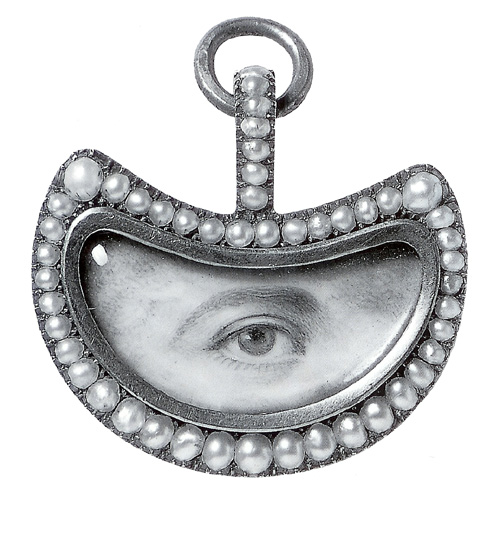
Supposedly it is a person's eyes that we first notice when we fall in love. I'm sure that's what the Prince of Wales was looking at when he first became smitten with the busty Mrs. Fitzherbert. Either way, he presented his shy lover a token of his affection in the form of an eye miniature. Eye portraits became a common lovers' token in the late eighteenth century and into the Regency period. After all, eyes are not as conspicuous as a full miniature. This makes them difficult to identify today. If you find one of these rare miniatures in a museum they seldom know whose eye is depicted. Many letters from the time talk of how supposed lovers had "exchanged eyes."

Eye portraits were created the same way miniatures were and usually by miniature artists such a Richard Cosway (who painted the eye for the prince to give to Mrs. Fitzherbert). The eyes would be placed on jewelery such as brooches or rings to display that the wearer's heart belonged to someone. Some settings even have a wife's eye surrounded by her childrens'. Other eyes were not put on constant display and only shown to select parties, but that usually meant that they already had someone else's eye, if you get my drift, wink wink.

Friday, July 4, 2008

Tart of the Week: Mrs. Fitzherbert


It's time to talk of the black widow, Maria Fitzherbert. Well, I guess calling her the black widow is a bit of an embellishment, she really wasn't that evil. Or even that tartly, but she's a tart just the same. Maria is mostly guilty by association, but don't worry she had some tart-like qualities.

Maria was a Catholic commoner educated in Paris. She married Edward Weld when she was 18 who was almost twice her age. He then died from falling off his horse three months later. Maria recuperated from her grief three years later and married Thomas Fitzherbert who was only ten years older than her. After three years of marriage he died. Maria said "screw this marriage business" and proceeded to London to spend her money on fun things such as balls and pretty shoes. She was a blonde who was ready to have her fun!
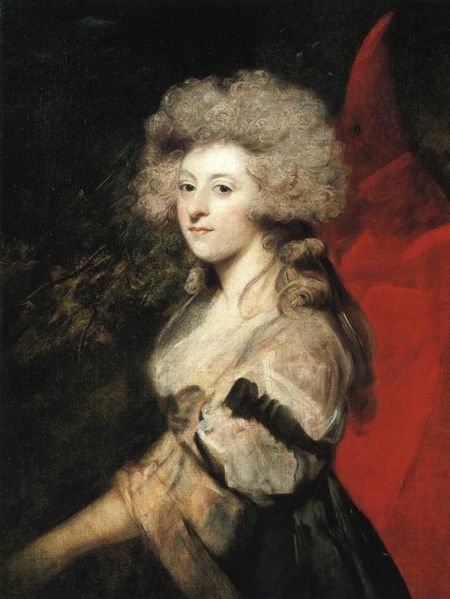
She entered London society and was quickly swept up into it. She has been described as heavy; her figure, her walk, even her conversation was too heavy to be welcomed in the gossiping, light-hearted Devonshire House circle. Still, she fit in well and had an ego to prove it. In 1784, while attending the opera she was introduced to the Prince of Wales and he fell madly in love with her. Which, really, wasn't unusual for him. But, strangely enough, this one was different. Maria welcomed the attention but had no interest in being a royal mistress. This only made George want her more. He offered her marriage and even is reported to have thrown himself at the floor screaming and pulling his hair and proclaiming he would die if she was not his wife (can't you just see this in an episode of Blackadder?). This could obviously not come to be. First of all Maria was Catholic, secondly George needed the king, his father's, permission to wed. Therefore the marriage was impossible.

One nice July evening Georgiana was on a balcony on Devonshire House having a few drinks with some friends. A footman called her inside to inform her two men were waiting to see her. They were the Prince's cronies and they told her George had stabbed himself with his sword and his dying wish was to see Maria who would not go unless Georgiana accompanied her. Georgiana was distressed about the prince but pissed off about Maria, who she really did not care for. The two women were escorted to the bloody dying prince who said in order to die in peace he needed to marry Maria. She panicked and agreed and he insisted on a ring to seal the deal. Everyone looked around blankly at each other and Georgiana rolled her eyes and begrudgingly slipped a ring off her finger. And so they were, ever so illegally, married.

Oh, and the prince was fine.

After this show from the prince Maria had quickly fled to France in hopes of him being diverted with other women. After 18 months she grew bored and lonely and returned to the waiting Prince of Wales. Maria enjoyed her place as the secret and illegal wife of George until 1794, when he agreed to leave her in order to please his father and therefore have his debts paid off. Until then, Maria had been aiding him in the attempt to pay them. He soon married Caroline of Brunswick which proved to be an unsuccessful match. He rekindled their romance and began an affair with Maria in 1800. She didn't see it as such since she had been married to the Prince and felt she still was. The Pope even backed her up on this. However since the married was illegal twice over it was considered null and void.

After George's coronation and subsequent death, the older Maria lived on. King William IV even proposed to make her a duchess after all she had been through as his predecessor's mistress/wife to which she responded that she 'had borne through life the name of Mrs Fitzherbert; that she had never disgraced it, and did not wish to change it.'