Showing posts with label Elizabeth Armistead. Show all posts

Wednesday, December 10, 2008

On the Eighth Day of Christmas Liz Armistead Gave to Me...

Eight lovers in the wings...

Well, I'm sure most of these tarts have a few lovers in the wings, but Elizabeth Armistead had some of the most famous. Not only did she hook up with Charles James Fox (and later marry him) but she also fooled around with the likes of the Earl of Derby, Lord John Cavendish, and the Prince of Wales. But then again, who hadn't fooled around with them. Once, when Cavendish was coming over to enjoy her many talents he barged into her room only to find the Prince hiding behind the door. That Liz was a popular girl!

Friday, November 7, 2008

Tart of the Week: Gertrude Mahon

Gertrude getting dressed for a night out with Grace and Mary

With the introduction of this tart we have closed on the celebrity courtesan quartet of the late 18th century. Gertrude Mahon, known as the Bird of Paradise, along with Mary "Perdita" Robinson, Elizabeth Armistead, and Grace "Dally the Tall" Elliott formed a celebrity team of the most notorious fallen women of the time. They were both friends and fierce rivals. Of these four women, the least is known of Gertrude whose nickname was perhaps the most complimenting.

Gertrude Tilson was born in 1752, the daughter of a couple in both of their second marriages. Her father, James Tilson had already caused a scandal when he married the widowed Countess of Kerry and squandered their money.* The widowed Countess herself, had no better a reputation but had successfully given her first husband an heir so could do whatever she pleased. And so the future courtesan was born, daughter to two persons of bad repute, and half-sister to the Earl of Kerry. She was raised in extravagance beyond her parents' means in London. Rumor has it, that their home was also the home of two extremely spoilt lap-dogs and numerous pet birds; kind of like the Osbourne's house.

Gertrude was very lovely, with black hair and dark eyes and a waist said to be about 18 inches in circumference. She was also notoriously tiny, even by 18th century standards: about 4 feet, 1 inch tall. These looks attracted many suitors but the one that captured Gertrude's fancy was a Mr. Gilbreath Mahon, an adventurous Irishman who was skilled in the fiddle, but not so much in making a good living. Even Lady Kerry would have objected to the gamester so Gertrude opted to run away in the night and elope with her dashing Irish love. The couple made it to Dover and while waiting for a vessel at an inn were apprehended by men who Lady Kerry had sent after them. Gertrude pled exhaustion and asked to nap before the return which was granted. Meanwhile Mahon drowned his sorrows in drink and asked the men to join him. Soon a huge drunken party was downstairs, and Gertrude slipped out of her upstairs room and hurried to the newly-arrived vessel. After drinking the captors under the table, Mahon joined her in Calais.

Gertrude was quickly forgiven by the family but Mahon was never received. The marriage quickly grew sour after the birth of their son and it wasn't long after that Mahon abandoned Gertrude and ran away with some other young girl. Gertrude was not too upset about her husband's abandonment. But a year later, in 1775 she was devastated when her mother fell ill and died. Now Gertrude was left with no means of income or protection. Her dim-witted half-brother refused to even help her. There was only one option for her to put food in her mouth and (pretty) clothes on her back.

Soon Gertrude was seen at all the social hot spots and masquerades. The newly-divorced Grace Elliott was also making appearances at the same time so it was not long before the extremely tall Grace and minute Gertrude were seen arm in arm, laughing gaily together as they sipped their drinks. Her new occupation was not only earning her money, celebrity, and friends in high places...it was a lot of fun too! Her love of bright, colorful clothing and plumage was what earned this courtesan the nickname of "Bird of Paradise." The press delighted in their crafty name and spent many hours coming up with metaphors for her every move, "The Bird of Paradise is seen hopping about in rather a disconsolate manner. We fear she has had too much saffron administered in the waters of her cage lately."

Lovers came and went. She even accompanied one to Newgate when he was imprisoned for their debts. However when a good masquerade was scheduled, she flew the coop. Her estranged husband, who was now in Jamaica, prevented Gertrude from marrying any of her lovers so she was doomed into tart purgatory. For some time she attempted to lure the Prince of Wales to be her lover but didn't seem as successful as her cohorts in this endeavor. When she didn't get his attention in her opera box, she took to the stage. Gertrude had a small stint as an actress, but not a very memorable one.

Eventually debt sent her to retreat to Dublin where she was welcomed with open arms. Here she found some success not only on the stage but also as a fashion icon. She was known in London to always be sporting extravagant headgear and in Dublin her haberdashery set trends.

She returned from Dublin and seemed to settle into a retirement. Her beauty was finally fading but she still would get a part in a play here and there. With every year that passed her name was seen less and less in the papers until she was a forgotten figure. Even the date of her death remains a mystery because the papers, who were so enamored with her in her youth, never published an obituary.

*Other evidence suggests that Gertrude was actually the neice of the earl of Kerry.

Friday, October 31, 2008

Tart of the Week: Elizabeth Armistead


This week's tart is a very special and notorious tart of the late 18th century. She enjoyed a celebrity as the most famous courtesan and slept with just about every famous man in England during her career. Please just try to wrap your mind around that! Not much is known of Elizabeth Cane's humble beginnings except that she was born July 11, 1750. Elizabeth's beauty was able to secure her a career as a model for a hairdresser when she first arrived in London. It has even been rumored that she had been Perdita's dresser when she was an actress at Drury Lane. Either way, her beauty (and large breasts) attracted the attention of well-known madam and soon Elizabeth was a working out of a brothel. So much for the hair modeling business! It was around this time that Elizabeth began going under the name Mrs. Armistead in order to protect her family.

Elizabeth's success as a courtesan can probably be attributed to the fact that she wouldn't let herself get too attached to her clients. Most of them being rakes anyway, Elizabeth saw no need to be bothered with love. Some of her long list of lovers include, the Duke of Dorset, Duke of Ancaster, Earl of Derby, Viscount Bolingbroke, Lord George Cavendish (The Duke of Devonshire's brother), and, of course, the Prince of Wales. Elizabeth must have been very good at her craft! She was even good enough to buy herself the Armistead House. A famous story the Devonshire set like to joke about (along with everyone else) was when Lord George Cavendish came to Elizabeth's house one night after a few too many drinks. When he was refused admittance he barged in anyway. He went straight to her chamber, opened her door and, candle in hand, discovered the Prince of Wales cowering behind the door. Lord George burst out laughing, made a low bow and walked the whole way home, laughing. He had a much better sense of humor than his brother.

One person who was certainly not laughing was Perdita. She was very upset that the prince had spurned her love for that of "The Armistead."* Since both women were both celebrities, the papers capitalized on Perdita's anguish by gleefully supplying stories of the two women's rivalry. Luckily for Perdita, the prince broke things off with Elizabeth and moved on to Grace Dalrymple Elliot. Elizabeth herself moved on to bigger and better fish. That fish just happened to be a Fox.

After a string of lovers later, Charles James Fox was now the sad, rejected lover of Perdita. He somehow found consolation in the arms of Elizabeth. But neither politician nor courtesan thought that they would end up falling in love. For the first time it appeared that Elizabeth was in love with one of her clients, and he loved her back. However, years of drinking, gambling, and womanizing didn't leave Fox with enough money to sustain Elizabeth's pricey lifestyle. She resisted his advances but finally gave in and by 1783 she settled down to a monogomous relationship with Fox. In 1795 they secretly wed. Who would have thought that these two party animals could settle down and become models of marital bliss? But there they were in their cosey London home, hosting dinners and gardening. Yes, gardening!

Fox surprised everyone in 1802, including his best friends, when he revealed that he and Elizabeth had been married for seven years. His true friends, like Georgiana, warmly accepted the "fallen" woman knowing the strength of the couple's love. When Fox lay on his deathbed four years later his last words were to his beloved wife, "It don't signify my dearest, dearest Liz." Although, heartbroken, the ever-independent Elizabeth went on to live for many years, watching many of her and her husbands friends pass into the next world. She died at the ripe old age of 91 in 1842.

For more information on Elizabeth and Fox's love story check out Scandalous Women.


*The papers liked to refer to courtesans as if they were boats, because many men boarded them. This is how the nickname for Elizabeth came to be.

Monday, June 16, 2008

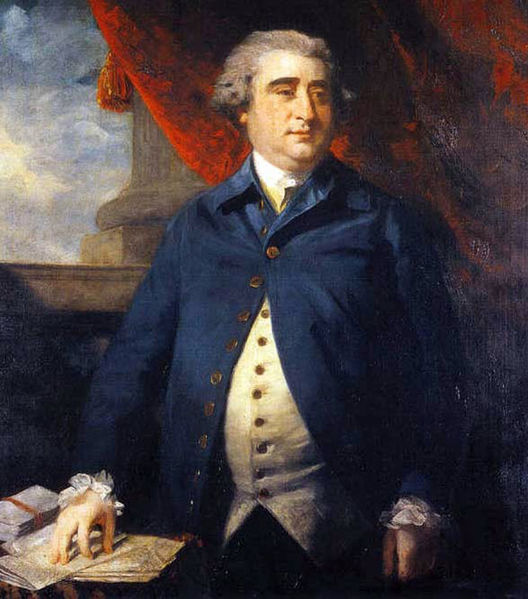
Charles James Fox

I've been putting off profiling Fox for a while, don't ask me why. He is a key player in this blog seeing as I have already mentioned him here, here and here; heck, he already has his own tag.

Fox was the result of the scandalous elopement of Henry Fox, 1st Baron Holland the politician and Lady Caroline Lennox, one of the Lennox sisters, daughter of the Duke of Richmond. He and his brothers were raised in a libertine Whig household with little to no boundaries. Despite not inheriting a title, Fox became a favorite of his father and therefore extremely spoiled. There are stories of Fox burning his father's speeches and smashing his watch, with no consequences.

Fox grew into a fat macaroni, with a taste for gambling, politics, and women. He also liked fashion and in the macaroni tastes, powder his hair different colors every day and wear multi-colored shoes embellished with velvet frills. He was just plain outrageous! Fox began his career in parliament at the tender age of 19. Being a Whig, he tended to oppose anything the monarchy liked and vice-verse. He supported both the French and American revolutions.

Despite his outrageousness, he was extremely well spoken and when he came into contact with Georgiana in 1777 a friendship bloomed that last until both their deaths in 1806. The two friends (and possibly lovers) found in each other a certain understanding and camaraderie that they couldn't find with others in their circle. Both were huge celebrities and common characters in political satires. For the Westminster election of 1784 Georgiana made history by being the first woman to canvass when she canvassed Fox.

King George III and Queen Charlotte hated Fox, so naturally the Prince of Wales was drawn to him. I was about to list other friends of Fox, but the list would be never-ending. So I will just leave it at, if you were a Whig, such as the Duke of Devonshire, you were friends with Fox. Not only did Fox have a lot of famous friends but famous, or infamous, girlfriends. And they were all gorgeous! Aside from rumors about Georgiana, he had relations the most notorious tarts such as Elizabeth Armistead, Grace Dalrymple Elliot, and Mary 'Perdita' Robinson. He was a notorious bachelor, but toward the end of his life suddenly everyone was surprised to find out he had been married to Elizabeth Armistead (a notorious...well, you know) for years. His last words were to her: "It don't signify my dearest, dearest Liz."