Showing posts with label Italy. Show all posts

Friday, July 27, 2018

Female Academics in the Eighteenth Century

I was alerted on Twitter that yesterday was the anniversary of the death of Elena Cornaro Piscopia - which is as fun a name to spell as it it is to pronounce, but alas, many are still unfamiliar with Elena.

Elena was a Venetian who, in 1678, was the first woman to receive her PhD.  Her doctorate was in Philosophy as her true love, Theology was deemed inappropriate for woman - baby steps toward progress, I suppose.  She was awarded it at the age of 32 which I personally think an excellent age to gain a PhD *wink*.  Elena's successes has made me wonder about female academics in the age of Enlightenment, though.  Sadly, sexism and gender division was still rampant during the so-called Age of Enlightenment and that unfortunately didn't produce many female academics.  However, that did mean the few to come out of the eighteenth century, were exceptional women indeed.

Dr Laura Bassi, was another Italian woman who earned her PhD in 1732.  Unlike Elena, Laura was interested in the Sciences, more specifically, Physics.  She defended her thesis at the age of 20 (!), becoming the second woman to hold a doctorate, 54 years after Elena.  She devoted much of her academic career to spreading the study of Newtonian mechanics to Italy.  In 1776, at the age of 65, she applied and was appointed to the chair in experimental physics by the Bologna Institute of Sciences, making her the first woman to earn a professorship.  Perhaps the best part: her supportive husband, who also had his doctorate, became her teaching assistant.

The mathematician, Maria Gaetana Agnesi, like Laura Bassi, would also be elected to a chair.  In 1750 she became a professor of mathematics,natural philosophy, and  physics at the University of Bologna which was apparently a very forward-thinking university in the eighteenth century.  Maria was an amazing mathematician, the likes of which I could never convey as someone who struggles with basic arithmetics.

If you're not Italian and starting to feel ashamed for your country of origins' historic lack of female empowerment in academia, have no fear, there is one more female academic.  Oh wait...she's Italian too.

Dr Maria Pellegrina Amoretti was awarded her Doctor of Law at the University of Pavia at the age of 20 (!) in 1777.  She initially applied to the University of Turin but was turned away because of her sex - get with the times, Turin!  Sadly, she only lived for a decade more after receiving her degree but in that time she worked on dowry laws, meaning she used her privileged position to help make other women's lives better.

Sunday, March 24, 2013

Lady Hamilton's Attitudes

During the height of Emma Hamilton's celebrity, English visitors touring Italy would make sure to stop at the Hamilton homestead to check out her 'attitudes.'  Emma would pose in the classical positions (or attitudes) found on Greek vases, much to the delight of all who saw.  These were witnessed and drawn by many great artists of the time.  One particularly enterprising artist, Fredrich Rehberg, drew Emma's attitudes and made them into a collection of prints so that the poor souls who couldn't afford to see this tourist draw could relive it every day in book form.  Rehberg called this book, Drawings faithfully copied from nature at Naples : and with permission dedicated to the Right Honourable Sir William Hamilton, His Britannic Majesty’s Envoy Extraordinary and Plenipotentiary at the court of Naples / by his most humble servant Frederick Rehberg, historical painter in His Prussian Majesty’s service at Rome.  What a mouthful.


However, poor Emma, like many celebrities today, struggled with weight issues (among other things).   Unlike celebrities today, there was no strict workout regime for Emma to undergo to maintain her slim figure.  Emma grew bigger, but that didn't stop her from receiving visitors and displaying her attitudes.   It wasn't long before this caught the eye of satirical artists back in London.  In 1807 a new version of the book came out under the title, A new edition considerably enlarged, of Attitudes faithfully copied from nature : and humbly dedicated to all admirers of the grand and sublime.  Although a characterization, the satirical artist's (probably Gillray) prints were fairly accurate: Emma was obese by 1807 due to years of food and alcohol abuse.  But with that said, I must say that I much prefer the satirical version of Emma's attitudes!


Thursday, July 14, 2011

Teatro Argentina

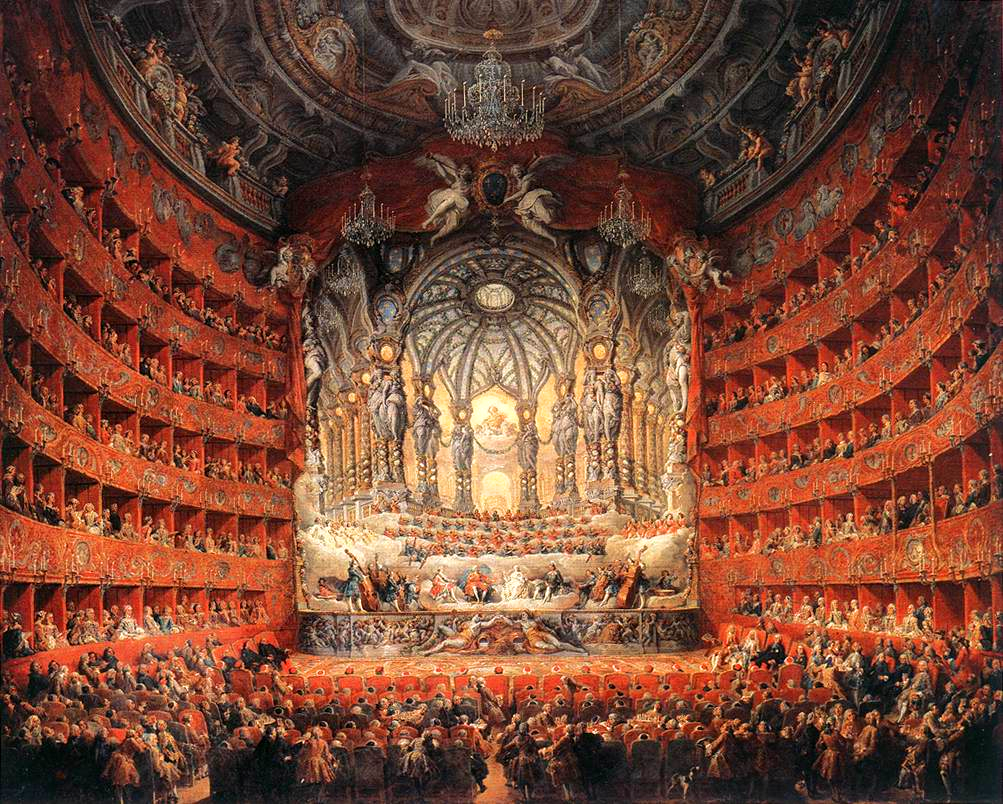
The Teatro Argentina is a grand rococo theater in Rome.  It was built in the 1730s and is where the opera, The Barber of Seville first premiered.  But when one looks at the impressive interior you get the sense that The Argentina is a true reflection of its time.  Sure, it has all the rococo grandeur in the form of cupids and pastels, but remember, going to the theater in the 18th century was less about going to see the play and more about seeing the attendees.  In order to accommodate this essential detail the Teatro Argentina was built with six stories of opera boxes, which makes viewing and gossiping all the easier.

Like Canaletto and his views of London, although times have changed we can still look upon the same structure.  The Argentina has gone through many alterations through the years, which has stripped it of its rococo look and replaced it with a more simple one.  But luckily for us Giovanni Paolo Panini painted the theater in 1747, leaving us with the grand spectacle that it once was when it was filled with all its gossiping guests.
Giovanni Paolo Panini, Feast at the Teatro Argentina in Rome in Honor of the Second Marriage of the French Dauphin, 1747

Tuesday, March 8, 2011

Masks of the Masquerade

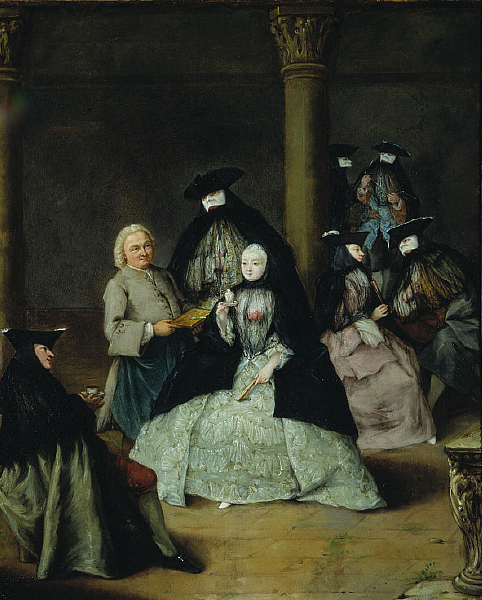
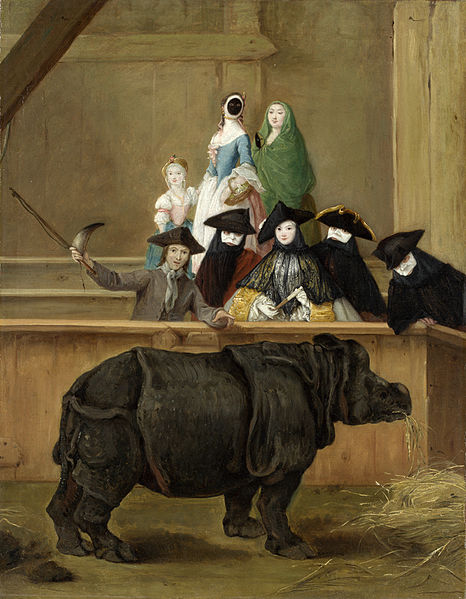
Happy Mardi Gras! If you are in Venice right now you are finishing up Carnival which is hopefully as debaucherous as it was in the 18th century.  When I think of the Venetian Carnival the artist Pietro Longhi comes to mind.  Longhi was known for painting everyday scenes of Venetian life in the early 18th century, many of his paintings depict Venetians in their carnival masks.


Now the fact that many of Longhi's paintings portray people in masks does not mean the artist had an unhealthy obsession with Mardi Gras. Visitors to Venice found masks to be commonplace accessories for native Venetians, which distinguished them from the harangue of tourists.Venetians wore them for the same reason you might make yourself "invisible" on instant messaging.  It was hard to get to point A to point B without running in to people you know so in order to politely avoid conversation for the sake of punctuality Venetians would wear masks.  That was their way of setting their little availability dot to "invisible."  Sometimes citizens were legally obligated to don their masks during critical political decision-making times.  That way street gossip could be curtailed and consequently wouldn't effect the political decision.

The standard-issue mask, promoted by the Ventian government was the bauta which disguised the wearer but still allowed them to speak and eat freely.  It is the white bautas that you commonly see in Longhi's paintings.  Another breed of mask you can see in the Longhi paintings is the morretta, an oval black velvet mask popular with the ladies.  Not pictured by Longhi is the volto, a mask commonly associated with the Venetian Carnival.  Voltos are white masks that cover the entire face.

So which mask will you be wearing today?