Showing posts with label John Fielding. Show all posts

Friday, March 25, 2011

Crimes of Fashion

When picturing the highly romanticized notions of highwaymen one tends to picture a man in black, under a heavy coat and tricorn hat. That may have been how John Rann, aka Sixteen-String Jack, looked while he was committing highway robbery but underneath the black was a wardrobe that Lady Gaga would have gone nuts for.

Jack was born just outside Bath in 1750 to humble yet innocent beginnings. He worked as a child and by the age of twelve was working as a postilion which paved the way for him to take various coachman jobs, eventually leading him to London. Jack felt alive in the busy metropolis. He was young, good looking and there was plenty in the city to keep him entertained...especially when it came to fashion. Jack soon earned himself the nickname of Sixteen-String Jack from his trademark pants which had eight strings hanging down each leg, each one a different color. When Jack couldn't keep up his fashion expenditures with his wages he turned to pickpocketing which evolved to highway robbery, which he found he was quite good at.

Fashionable Jack's new career allowed him the comforts of attending balls, picking up women, and of course buying all that wacky designer clothing. Jack was arrested several times but always seemed to get off due to lack of evidence. He once took the stand in front of Magistrate John Fielding wearing a bouquet of flowers blooming from the breast of his coat and accessorized his shackles with some comely blue ribbons. Next time he was in court for being caught breaking into a woman's window into her bedroom (was it the future Lady Lade, I wonder?) but was acquitted due to the fact that she was expecting him but had fallen asleep. A week later Jack had waltzed into an establishment, in a scarlet coat, silks stockings, and a lace hat and announced that he was a highwayman and proceeded to pick fights with everyone until a brawl broke out. I think it safe to say Jack was not just a highwayman but a macaroni.
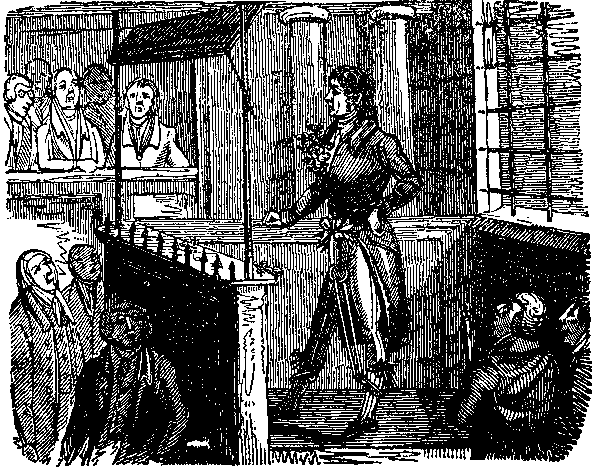
The twenty-four year old robbed his last victim in 1774 when he was tried for heisting Princess Amelia's Chaplain. Jack showed up to the trial in a pea-green suit, fully expecting to get off due to lack of evidence again. He was quite shocked when he received the guilty sentence. Still, what's a rake to do? Make the most of the situation is the answer. He held a farewell dinner in jail with seven lovely ladies and when he arrived at Tyburn he joked with his executioner and danced a jig before his last drop.

Friday, March 19, 2010

Quick Facts

What the heck is on Sir John Fielding's head? Just as many blind people have worn sunglasses to signal their handicap, Fielding did so with a black band around his forehead. Fielding was blinded at the age of 19 in a navy accident but that didn't stop him from being a successful magistrate. Rumor had it Fielding knew the voices of 3,000 criminals. I remain a little skeptical of the last fact though!

Thursday, March 18, 2010

The Watchmen

I hope everyone was good last night and there were no altercations with the authorities while you were out celebrating merrily! Now if this was the early 18th century, the banter of St Patrick's Day would be just another night on the streets of London which were polluted not only with garbage, but noise and shady characters. All this, and no police force! So how was justice upheld on the dangerous streets of London?

It may be hard to believe now with police officers' 20 years and then retirement incentive, but those who patrolled the streets of London were volunteers. You could compare them to a neighborhood watch today. At the head of this operation was a constable. This man or woman was assigned the year-long post, without pay and without usually knowing exactly what they were doing. No prior experience needed. The constables set up the night watch or The Watch which would patrol the streets and apprehend any wrong doers and put them before the Magistrate or Justice of the Peace. The Watch would act as our police do now, but did so without pay. By 1737 George II began paying some watchmen for their much needed services.

Believe it or not, this system was not without its imperfections. One of the people taking note of the shortcomings was author Henry Fielding, who had penned Tom Jones. When Fielding was elected London's Chief Magistrate in the late 1740s he took the position seriously and attempted to implement a better system of keeping London safe. Using Magistrate money supplied from the government, Fielding paid a small group of men to police London. They operated out of his Bow Street Magistrates office so they were given the name The Bow Street Runners. The monetary incentive seemed to make for a better night watch than The Watch. The Bow Street Runners are sometimes created with the title of the first professional police force. They even went on to undertake missions that would take them across the country to make arrests.

The Watch and Bow Street Runners remained up and running into the 19th century. It wasn't until 1829 that the a government funded official police force appeared, although I suspect both of the prior enforcement organization hadn't completely diminished everywhere. You could always use some veteran crime-fighters to show you the ropes!