Showing posts with label Royal Academy of Art. Show all posts

Tuesday, May 26, 2009

The Genesis of Rowdy Rowlandson

Thomas Rowlandson is often disregarded when we think of great artists of the eighteenth century. You may have noticed from this blog's banner that I am quite a fan of the sometimes raunchy satirical artist. So, for those who are not familiar with him, let me introduce Rowlandson to you.

Rowlandson's artistic talent was noticed from a young age. But the artist was not without his own initial setbacks. For one, he was not the son of an artist, his father was a simple city tradesman from Old Jewry, London. Still, education was a priority in the Rowlandson household and this city boy spent his youth in school. His big break came at the age of sixteen when he was given the opportunity to be a student at the illustrious Royal Academy and then later study in Paris. He first exhibited a painting in 1775 and was on a nice, productive roll. Then, disaster. You know those fictional aunts we all wish we had that die and leave you obscene amounts of money in their wills? Well, Rowlandson had a non-fiction one who left him £7,000 when she died. Rowlandson did what anyone else living in 18th century London would do with that money. He gambled it away until he was penniless.
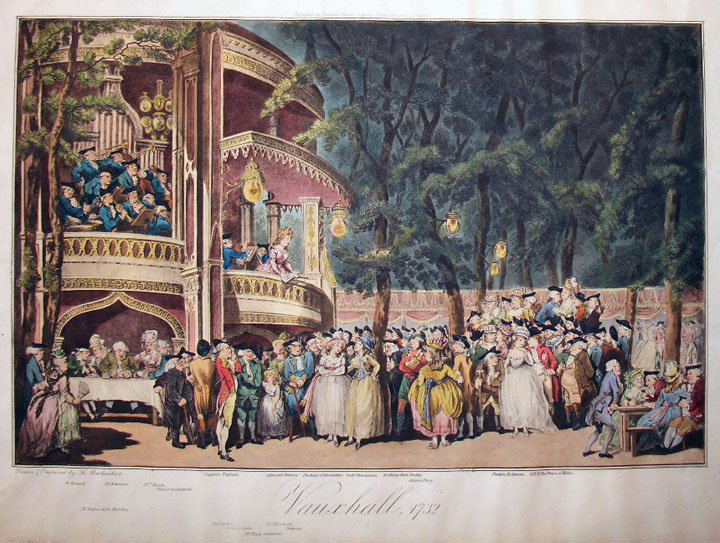
Rowlandson needed to get back on his feet, and fast. His friends Henry Bunbury and James Gillray, who just happened to be caricaturists, suggested he take upon their 'lower' form of art. That way he could produce work faster and generate money from selling prints. He began slowly, with his drawing of Vauxhall which bordered on satirical, by displaying the great celebrities of the time. While the drawing was exhibited, prints were selling left and right. Rowlandson decided this caricature gig might not be so bad after all. Soon enough he was pumping out satirical images which has given us some of the best political, social, and celebrity commentary of the time.

Friday, December 26, 2008

Tart of the Week: Angelica Kauffman


The gypsy painter that is Angelica Kauffman was born in Switzerland, raised in Austria, and is considered to be one of the great British artists of the 18th century. How peculiar. She was born in 1741, the daughter of a painter. She inherited her father's skills in the art, and when the family moved throughout Italy on his various commissions, Angelica was allowed to hone these skills by working with him. Because of relocating throughout the continent, Angelica became fluent in a variety of languages including English. Soon, British tourists were commissioning her to paint their portraits on their World Tour. All this networking among the gentry of Britain got Angelica a ticket to London with Lady Wentworth.

Angelica was an immediate success in London. Due to Lady Wentworth's influence Angelica was able to rub shoulders with the great leaders of the arts such as Garrick and Reynolds. It was here that the naive 25 year-old became in entwined with a dangerous man that almost ruined everything she had earned through her hard work. The Swedish Count de Horn has been described as a "rogue" and was known to live lavishly but never invite anyone over to dine with him. Somehow or another he convinced Angelica to a clandestine wedding. It was not long before Angelica realized the danger she was in; her husband was squandering all her money and had none of his own. In fact this Count Frederick de Horn was an impostor. He wasn't the count at all, merely some guy who used to work for him.

With the help of her new friend, Joshua Reynolds, Angelica managed to escape unscathed from the secret marriage. Hmm, still sounds fishy to me! She moved on to new endeavors, and was one of the signatures partitioning the king for a Royal Academy of Painting and Sculpture. Indeed, Angelica was one of the two female incumbents in the Royal Academy which later banned women. She exhibited many of her works at the academy, many of which reflected her love of the Renaissance. Angelica also continued painting portraits and made lots of moolah doing so.

She married fellow artist, Antonio Zucchi in 1781. The marriage was not one based on passionate love, but more out of convenience. In fact, it is a bit questionable why Angelica even bothered. After the marriage the couple moved to Rome where Angelica continued to submit her work to the Royal Academy. The city welcomed her with open arms and her studio became a gathering place for great minds. Her husband died in 1795 (he was old to begin with) and left her barely anything in his will but if this bothered Angelica, she never really showed it. Maybe it was because she was filthy rich because of her successful career. She died in 1807 and was honoured by being given the most lavish funeral procession for an artist since Raphael. Just think how many artists Rome has supplied us with, too! Under the direction of the sculptor, Antonio Canova Angelica's funeral procession laid her to rest.