Showing posts with label Thomas Rowlandson. Show all posts
Thursday, December 19, 2013
Exhibition Review: High Spirits: The Comic Art of Thomas Rowlandson
I recently had the pleasure of seeing High Spirits: The Comic Art of Thomas Rowlandson now on display at the Queen's Gallery, Holyroodhouse which explores the satirical prints of one of our favourite satirists. My review can be seen as the BSECS Criticks' page here. There is also an accompanying catalogue (which is quite big) for those who will miss the exhibition. In short, the exhibition is packed with some of Rowlandson's most well-known prints as well as some rarer pieces. There is a section dedicated to the Westminster Election of 1784 so there are quite a few prints depicting the Duchess of Devonshire and they're all in pristine condition. So if you can make it to this exhibition, be it in Edinburgh or London, I would recommend it!
Thursday, August 12, 2010
Georgian Holidays Through Satire
Sorry everyone, I have vacations on my mind, so that will be projected onto the blog. Today let us take a journey through the satirical Georgian holiday, there is still a thing or two we can learn.
Be prepared for bad traffic...
...in worst-case scenarios you will have to resort to ducking behind a bush or carriage when nature calls.
Or if you are in the position of trusting your luggage to others, pack accordingly, loosing luggage is never fun.
Remember, just because you're on vacation doesn't mean you should get too out of control, just a simple out of control should be enough.
Be sure to be conscious of any skin slip-ups when swimming, the beaches are usually crowded and you never know who is around.
Please dress appropriately on hikes and nature walks.
Try to add a little culture into your trip, visit a local museum.
Sample the local fair, don't be afraid to over-indulge.
Last but not least, have a great time but be safe doing it!
| James Gillray, Middlesex Election, 1804 |
![]() |
| Thomas Rowlandson, Family on a Journey Laying the Dust, 1800 |
![]() |
| Thomas Rowlandson, Portsmouth Point, 1811 |
| Carington Bowles, Two Bloods of Humour..., 1771 |
![]() |
| George Cruikshank, Royal Embarkment, 1819 |
![]() |
| Anon., Mlle des Faveurs a la Promenade a Londres, 1775 |
![]() |
| Thomas Rowlandson, Exhibition Room, Somerset House, 1808 |
![]() |
| James Gillray, Monster Crawls at a New Coalition Feast, 1787 |
![]() |
| James Gillray, The Pursuit of Knowledge, 1799 |
Tuesday, January 5, 2010
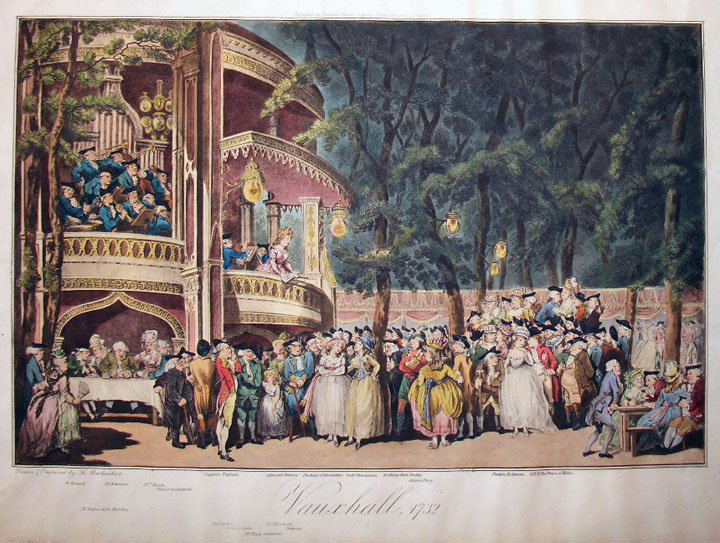
Vauxhall Gardens by Thomas Rowlandson

We can thank Thomas Rowlandson for such great insight into celebrity doings of the late 18th century. In one his more famous prints, Vauxhall Gardens, he congregates all the big social players of London at the time, doing what they do best. Although the two definitions can overlap, the difference between celebrities and historical figures is that celebrities fame is short-lived and they can be forgotten over time. One of the things I enjoy about Vauxhall Gardens is seeing which celebrities of the time are historical figures and who just faded into obscurity and is just a random name on a page.
Now let's see who I can point out for you!
On the left, in the dining box, is Samuel Johnson and his crowd. However, I will note that this is up for debate among historians as to whether this is true. Pigging out with him is Boswell, Goldsmith, and Mrs. Thrale.
Above them, singing to the crowd, is another figure historians haven't agreed on. Some say it is the celebrated singer, Mrs. Weichsel others say it is her daughter, Elizabeth Billington who surpassed her mother's fame. Leading the orchestra behind her is composer, François-Hippolyte Barthélémon.
Below her in the crowd, observing some fabulous ladies with his monocle is Topham Beauclerk. And who might those ladies be who are catching Topham's eye?
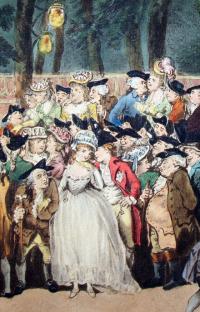
Dead center, is Georgiana (in white) and her sister Harriet, in a blue riding habit. Both ladies are gossiping away unaware of the fact they are being checked out. Fluttering around them are Admiral Paisley and the editor of the Morning Herald, Sir Henry Bate. Next to him in the kilt, is the editor of the rival publication, the Morning Chronicle, James Perry. What a gossipy grouping! Perhaps those journalists are following our favourite ladies around in order to find a good story to put in print.
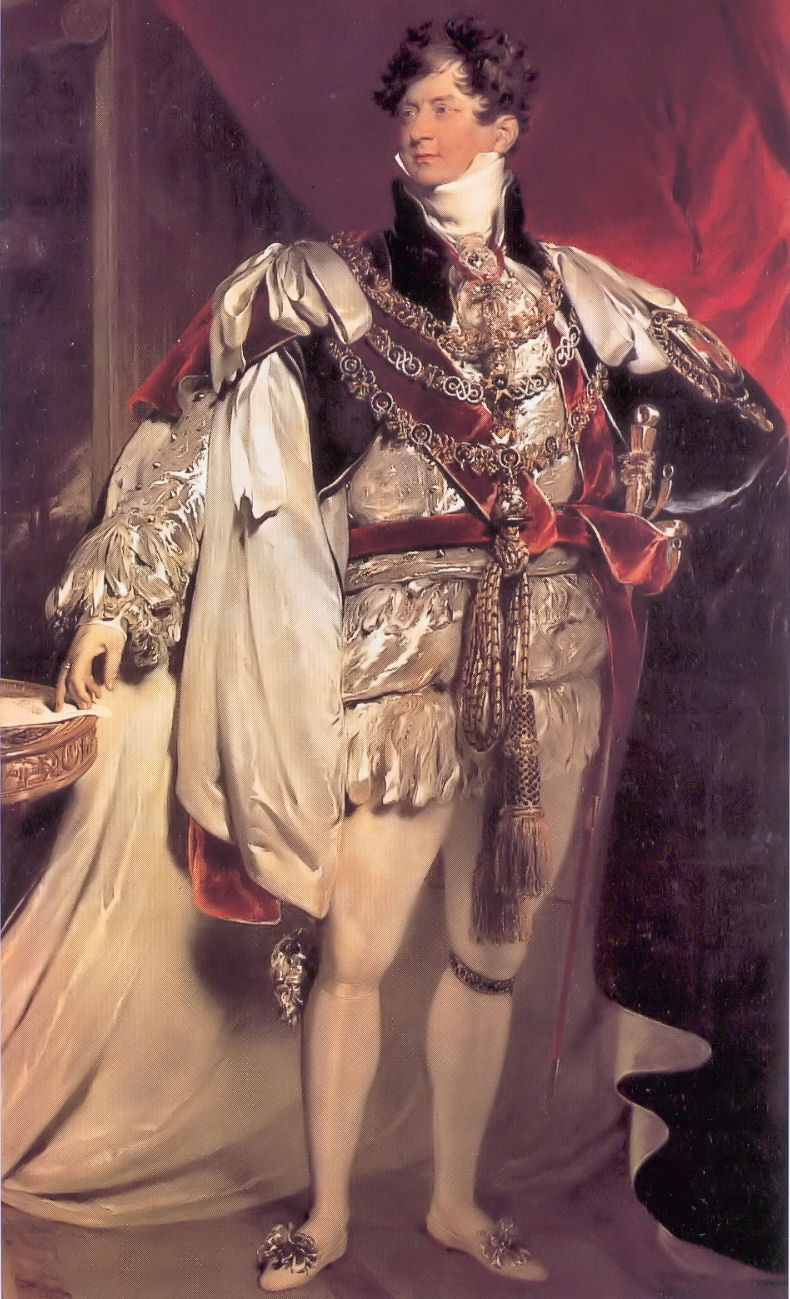
If they would only direct their attention the other way they would see the ravishing Mary Perdita Robinson, accompanied by her loser husband. On the other side of her is none other than the Prince of Wales, whispering sweet nothings into her ear, despite the fact that in reality the lovers had disbanded by then.
Tuesday, May 26, 2009
The Genesis of Rowdy Rowlandson
Thomas Rowlandson is often disregarded when we think of great artists of the eighteenth century. You may have noticed from this blog's banner that I am quite a fan of the sometimes raunchy satirical artist. So, for those who are not familiar with him, let me introduce Rowlandson to you.Rowlandson's artistic talent was noticed from a young age. But the artist was not without his own initial setbacks. For one, he was not the son of an artist, his father was a simple city tradesman from Old Jewry, London. Still, education was a priority in the Rowlandson household and this city boy spent his youth in school. His big break came at the age of sixteen when he was given the opportunity to be a student at the illustrious Royal Academy and then later study in Paris. He first exhibited a painting in 1775 and was on a nice, productive roll. Then, disaster. You know those fictional aunts we all wish we had that die and leave you obscene amounts of money in their wills? Well, Rowlandson had a non-fiction one who left him £7,000 when she died. Rowlandson did what anyone else living in 18th century
Rowlandson needed to get back on his feet, and fast. His friends Henry Bunbury and James Gillray, who just happened to be caricaturists, suggested he take upon their 'lower' form of art. That way he could produce work faster and generate money from selling prints. He began slowly, with his drawing of Vauxhall which bordered on satirical, by displaying the great celebrities of the time. While the drawing was exhibited, prints were selling left and right. Rowlandson decided this caricature gig might not be so bad after all. Soon enough he was pumping out satirical images which has given us some of the best political, social, and celebrity commentary of the time.
Monday, September 29, 2008
"Darling, Should We Call on the Pig Today?"
With the wind-down of the Westminster Elections of 1784 there was not enough supply for the gossip-demand. The quack doctor spectacle seemed to be simmering down, and you could only make fun of Perdita for so long. Luckily enough for the people of England, a pig came to their rescue. There was once again fun news to talk about!
A learned pig was put on display and wowed audiences with its ability to arrange cards with numbers or letters on them. The pig could probably count but it was also advertised in The Daily Universal Register (today, The Times) as being able to tell time, cast accounts, and read ladies minds. That's some pig! Well, this naturally drew much attention and the pig was the talk of the town.
Rev James Woodeforde recorded that he paid a shilling to see the pig and praised its sagacity, stating that it arranged its cards to spell and do arithmetic.
The poet, William Cowper joked in a letter that, "I have a competitor for fame...in the Learned Pig! Alas! what is an author's popularity worth, in a world that can suffer a prostitute on one side and a pig on the other, to eclipse his brightest glories?"Thomas Rowlandson illustrated the beau monde's interest in the pig with the above satirical print. Which, if he hadn't documented it, it would more easily have been forgotten. The truth be told, Rowlandson was just catering to the gossip and fads of the time as he usually did in order to make his money, I'm sure he thought the whole spectacle was ridiculous. The pampered pig is depicted with a ruffled collar to differentiate it from normie pigs. On the wall the poster reads, "The surprising PIG well versed in all Languages. Perfect Arethmatician Mathematician & Composer of Musick."
But I suspect not much has changed considering I was watching this show, Hog Genius, a few weeks ago. Johnson was right, pigs kind of rock.
Tuesday, September 9, 2008
Lessons in Physiognomy, How to Indentify a Georgiana in the Wild
A key aspect of 18th c gossip is total anonymity. When the great portraits were hung in the Royal Academy the titles would only be listed as "a man" or "a woman," etc. Crowds would gather and test each others' pop culture based on whether they could identify the sitter or not. The tabloids of the times, satirical prints, kept their subject anonymous many times too, despite the newly freed press. Sometimes, for gossip's sake, instead of listing the subjects name the satirical artist would just drop a subtle hint, "A certain dutchess..."Because Georgiana was a leader of the ton and a leading female celebrity most everyone knew who she was and what she did. Therefore, artists developed a means of identifying Georgiana in their work so viewers would know who the anonymous scandalous lady was.
The most popular identifier was Harriet. If a work contained two tall, poufy-haired, fashionable ladies next to each other it was Georgiana and her sister. Despite Bess being Georgiana's best friend, society found the two sisters to be inseparable (they were) and they would constantly be seen in public together. Just like in this print by Rowlandson:

The second article of identity was a dog. Yes, dogs were popular in the 18th century, but their biggest fan was Georgiana's husband, whom was called Canis by his friends. There is a family tradition of the Dukes and Duchesses of Devonshire being obsessed with their dogs and still remains true today -their furry family is usually part of their portraits. The association of Cavendish/Dog made for another identifier for Georgiana as can be seen in this print Robert Dighton did of the 1784 Westminster Election:

Feathers, feathers, feathers! Can you imagine if you popularized shoulderpads in the 1980's and you were still being depicted wearing those awful 80s blazers today? What a nightmare. Well, if you recall, Georgiana popularized the fad of huge ostrich feathers in the late 1770's. For ever afterwards she was depicted as wearing them in her hair.
Friday, August 1, 2008
Upgrade
I am not sure how worthy this is as a post, but The Gossip Guide is getting a little make-over to make it look slightly more presentable. As with fashion, I know there's a few kinks to work out which I will hopefully figure out. But if there is something that is just not showing up on your computer correctly, shoot me an email and I'll try my darnedest to fix it; GeorgianaGossip@gmail.com.
Subscribe to:
Posts (Atom)