Showing posts with label Bastard Children. Show all posts

Friday, July 31, 2009

Tart of the Week: Princess Sophia


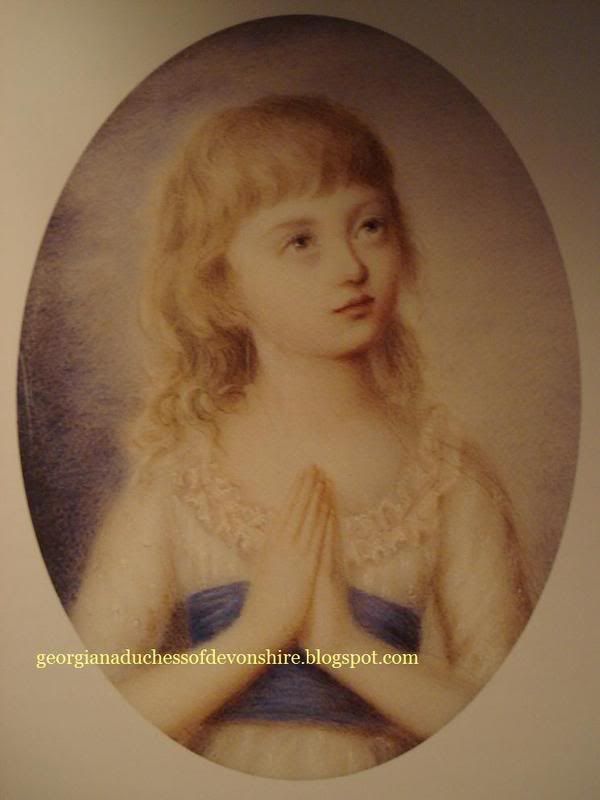
It may seem odd to you that a daughter of prudish King George III could be considered a tart. Aftera ll, the six princesses were isolated from the outside world and brought up to be duplicates of their regal parents' sensibilities. But somehow, Sophia managed to stray from the pack and enjoy a little naughty fun in her youth.

The twelfth child of King George and Queen Charlotte was born in 1777. She was christened Sophia Matilda; Sophia after her mother who was really "Sophie Charlotte" and Matilda after her aunt who just happened to be the tartly queen of Denmark. Sophia lived a life that is comparable to both of her namesakes. She grew up much like the other princesses, isolated from the outside world, only knowing the royal court and only being intimate with her sisters and governesses. This lifestyle wore on all the princesses at one point or another, causing a rebellious streak here or there. Their father was extremely over-protective and as the princesses grew older they noticed he refused almost every proposal of marriage for his daughters. Sophia saw this happen and knew her life too, was doomed to the mundane everyday existence that she went through daily.

The princess also suffered from a mysterious illness that would impair her from time to time. During a bad episode Sophia was sent away to the country in hopes that the different atmosphere would benefit her health. On top of this she had a hard time seeing, and required the use of spectacles which made her self-conscious. But Sophia had no problem seeing Colonel Thomas Garth when he bounded into her life. Thomas was the King's equerry, he was also a good thirty years older than her (maybe those glasses didn't work out so well, after all) and not that good looking either. Sophia was introduced to him through her niece's subgoverness, Miss Garth (his niece) who was happy to act as the secret go-between when the two began writing to each other. Soon enough, everyone was aware of Sophia's absolute infatuation with Colonel Garth, but her sisters seemed to just think it was adorable little fancy and didn't take it too seriously. But the sisters should have known, a woman has needs.

Princess Sophia gave birth to a child in 1800 which would be raised by Thomas Garth as his son. The whole affair was, of course, shrouded in mystery, and is even debated by historians today. It is likely that Sophia's sisters figured out their sister's time in the country in the summer of 1800 wasn't necessarily because of her illness. The queen may have even known but was too depressed at the time to really do anything about it. Rumors spread about the secret topic but luckily managed to stay under control. But then the rumors took a more devastating turn. Stories began to surface that not only did Sophia give birth to a child but the father was not Thomas Garth, it was her own brother, Prince Ernest. Sadly these rumors were never to fully go away. Even sadder, there were foundations to these rumors. Ernest was a reckless prince who knew no boundaries (he made George look saintly) and although he never succeeded there is evidence that he did attempt to rape Sophia on more than one occasion.

All this commotion during the turn of the century made Sophia withdraw from her "crazy" lifestyle. It brought some truth to all her parents' well-meant advice and over-protectiveness. The remainder of her life returned to being quiet and family-oriented and man-free. In the last ten years of her life Sophia succumbed to blindness and finally died at the ripe old age of seventy in the reign of Queen Victoria.

Friday, May 22, 2009

Tart of the Week: Maria Duchess of Gloucester


Many of our tarts are rule-breakers; rebels if you will. That is part of their appeal. So this week's tart should prove to be very appealing.

Maria Walpole (yes, Horace Walpole's niece) was the second daughter of Edward Walpole, an MP and son of the first Prime Minister, Robert Walpole. Normally, this would mean Maria and her sisters would grow up with good prospects but there was a problem. Maria's mother, Dorothy Clements was a milliner and not married to Edward. She wasn't, however, just some mistress; Edward loved her, he didn't marry her out of fear of it hurting his family's reputation. Well, her daughters, although Walpoles and loved by their family, did have a ruined reputation. They struggled to be accepted by society. Eventually a few brave members of the gentry opened up to them and they were introduced to court.

Maria stood out from her sisters in both beauty and personality. So when the twenty-two year old Maria was introduced to Lord Waldegrave, the forty-three year old was smitten. Not only was James almost twice Maria's age but he was known for poor personal hygiene. But a girl could use some extra pocket money, especially if you're considered to not have the best prospects to begin with. Hence, Maria became the Countess Waldegrave. Three beautiful daughters quickly followed the 1759 marriage but no heirs were to grace the Waldegraves for James died of smallpox in 1763.

After three years of marriage Maria was a widow with three young children. In those three years she had also made a name for herself as a delightful society lady. Maria had become close friends with Lady Coventry and Horace Walpole delighted himself to report that the beauties would be mobbed by onlookers when they took walks in the park. However, she was still not thoroughly protected financially. She needed another husband, and there was no shortage of eager candidates. She had already rejected the Duke of Portland (a duke!) when Prince William, Duke of Gloucester became acquainted with her. A romance blossomed, but it was a forbidden romance for Maria's illegitimacy prevented William from being able to marry Maria. His brother, King George would need him to form a proper attachment. Their chances of marriage approval diminished completely when the Duke of Cumberland enraged their brother by marrying a commoner.

King George saw the marriage as a betrayal and made William promise not to do the same with Maria. William gulped, and agreed in an attempt to calm his brother's anger. When Maria became pregnant though, in 1772 he had to finally admit that they has been secretly married in 1766. George threw a temper tantrum and tried to prove the marriage to be a farce but was defeated. The two were recognized but not welcomed at court, forcing them into exile onto the continent.

Maria did not go through all this trouble for the money (this time) she and William genuinely loved each other. Eventually George did forgive his brother and the two were welcomed back and their children provided for, after all, they were princes and princesses. Sadly, Maria and William's love cooled after a fight over their daughter's education and they eventually separated. Maria occupied herself by finding good husbands for her three eldest daughters and involving herself in politics. She was a fervent Whig, and would have made a mean politician if she were born a man. Maria continued to cause fusses and live fabulously until her death in 1807.

Friday, April 3, 2009

Tart of the Week: George Anne Bellamy


No, George Anne Bellamy isn't England's version of the Chevalier d'Eon. George Anne was very much a woman and was born in eastern Ireland in 1727. Her mother was the very unfortunate Miss Seal who was not only a Quaker but a mere schoolgirl when she discovered she was pregnant by Lord Trywaley. Miss Seal had already conducted an affair with the Irish aristocrat which resulted in a son. Trywaley went away looking for a rich wife before he returned to the old fling. However, Trywaley still needed a wife and he went to Lisbon in search of one, inviting Miss Seal to come with him. When she realized his true intentions in Portugal, Miss Seal quickly returned to England and married a sailor by the name of Bellamy. But when baby George Anne was born not long after the wedding Bellamy soon disappeared too.

The series of unlucky events continued at George Anne's christening. The hard of hearing priest didn't quite get the name of "Georgiana" when her mother said it. For whatever reason he heard "George Anne" and so became the girl named George.

Unlike many bastard daughters of aristocrats, George Anne had a a privileged upbringing. Her father sent her to France to receive her education like every other proper young English lady. Given this upbringing you would think George Anne would try to nab herself a rich husband and settle down to a wealthy lifestyle. But no, she took a path she was born into rather than the opportunity her father presented to her. She moved back in with her mother who convinced her to pursue acting, figuring George Anne's beauty could make some fast cash. After playing Monimia in The Orphan at Covent Garden George Anne met with the success her mother hoped for and many parts soon followed.

Success was sweet for "Mrs. Bellamy." She caught David Garrick's eye which, of course meant instant success and celebrity treatment. She also became his leading lady since the position was now open due to his recent breakup with Mrs Cibber. George Anne would be seen around town partying it up with her male-friends. Naughty! Not only did she make many friends but enemies as well. There was a notorious rivalry between her and fellow Irish actress, Peg Woffington that supposedly began when they were both in the (appropriately named) Rival Queens. The rumour mills cited jealousy and gowns as to the cause of the rift, but who could know for sure. The rivalry ended when Peg was on her deathbed and she called George Anne so they could kiss and makeup.

Of course, the good life couldn't last forever. George Anne's dapples with men led to pregnancies without marriages. She also was cursed with faded beauty. George Anne's wilted beauty meant no one was interested in seeing her on stage anymore. Meanwhile, debts from her frivilous celebrity days were piling up and debtor's prison loomed in the distance.

In an act of desperation George Anne wrote her revealing memoirs, An Apology for the Life of George Anne Bellamy. As the title implies, the book was an autobiography of degregation at the author's social expense. Although the books sold, it was a little too late to save her from monetary ruin. George Anne died not too long afterwards, a fallen woman, her last moments spent hidden in shame.

Thursday, January 1, 2009

Devonshire Progeny: Eliza Courtney


Perhaps you are wondering whatever happened to Georgiana and Charles Grey's child, Eliza? As you may know, after the Duke of Devonshire discovered Georgiana's pregnancy he forced her into France to have the child, leaving her to wonder whether he would also divorce her. Luckily for Georgiana she had the benefit of being very loved and was accompanied by a rather large party consisting of Harriet and her husband and daughter Caroline, Lady Spencer, Bess and her daughter Caroline St Jules. However, Harriet's bad health caused all but Bess and Caro St Jules to remain with Georgiana at the time of her child's birth. Since Georgiana had such a bad history with pregnancies she was sure she would not survive this one. As she waited in anticipation of what was to come she wrote her will and goodbye letters to each of her children. Georgiana's letter to Hart was written in her own blood. It was made no secret to her children why their mother was away but the rest of England was told that their favourite celeb was going on vacay. On 20 February 1791 Charles Grey's first child was born and named Eliza (a name Bess liked) Courtney. She was then quickly taken away from her mother and placed in foster care until Grey's parents were ready to take her.

Eliza grew up as a little Cinderella in the Grey household. She was raised to believe that her father was actually her older brother and was ignored by her "parents." It seems as though the Greys resented little Eliza for her parents' error. Grey himself also seemed unattached to his child while Georgiana was heartbroken. She would act as Eliza's kind godmother who would occassionaly visit (when allowed) and give Eliza toys since no one else would. Georgiana would write to Eliza, once telling her a story about a little orphan girl who was restored to her loving mother (who was really alive) eventually. Humble little Eliza never got the hint.

I'm not sure when Eliza found out the truth of her parentage. But luckily her sad story has a happy ending. Eliza grew into a very likeable young lady. She was also very beautiful, moreso than her half-sisters. Her inner and outer beauty grabbed the attention of a Colonel Robert Ellice who fell in love and married Eliza, saving her from her miserable life with the Greys. Robert adored his wife and the remainder of Eliza's life was happy. Georgiana's (legitimate) children kept in contact with Eliza who seemed to always be welcoming of their half-sister. As for Eliza's feelings for her birth mother, there was no bitterness. She only had the fondest memories and sympathy for her mother. Her first daughter was named Georgiana in memory of the mother Eliza loved so much.

Monday, December 1, 2008

Devonshire Progeny: Caroline St Jules


It was 1785 and Bess was in Paris, romping around with the Duke of Dorset, whom she knew very well was the object of Georgiana's affection. She was also a bit stressed: Bess was three months pregnant with the Duke of Devonshire's child. A letter had just arrived from her best friend. The Duchess of Devonshire wrote that she was happily expecting her child; she was also three months pregnant. Bess did the math, the children had been conceived within days of each other, possibly even hours.

On 16 August 1785 in a brothel/hostel in Italy the Duke and Bess' first child was born and named Caroline Rosalie. Not long afterward, Georgiana gave birth to her second daughter, Harriet, in a much more suitable setting. Caroline spent her first weeks with poor people her mother didn't even know before getting shipped off to a more middle-class family. Bess promptly went back to partying (guiltily). Somehow, she convinced the elderly Comte St Jules to adopt Caroline. It is unknown how the two knew each other but by convincing the comte to do this that meant that Caroline was being raised as the comte's illegitimate daughter, Bess always did have a way with convincing others to do things they normally wouldn't. It also meant that Caroline St Jules would be brought up with foster parents not the old comte.

As time went on Bess also schemed sneaking the girl into England to be raised with Georgiana's two daughters but that was not to be. Instead, she was sent away to Paris to be educated with Charlotte, the Duke's other illegitimate daughter. This didn't deter Bess from making many attempts to bring her daughter back to England to be with her. Her relief came in the form of a very unexpected person, the formidable Lady Spencer, who never made it a secret that she despised Bess. When Georgiana and her family were in Paris during the birth of Hart, Lady Spencer was eager to get out of revolutionary France ASAP, this meant taking her grandchildren with her. She was in such a rush she allowed for Charlotte and Caroline to be included in her escape party. Caroline, the little french girl, had made it into her parent's home-country and soon, their home.

Personality-wise Caroline took after her mother. Perhaps this is why she was her father's favourite child. Fanny Burney found her to be "fat and full of mincing little affections and airs." Hmmm, sounds familiar doesn't it? Burney was no fool, and also very suspicious. She found Georgiana's daughters much more agreeable (despite being biased against Georgiana). Strangely enough, Caroline still managed to win Lady Spencer's approval. Lady Spencer was torn by her hate for Bess but seemed to like that Caroline was obedient, especially in comparison to her grand-daughter, Caroline (later Lamb) who she found to be "very naughty."

Despite the setback of being an illegitimate child Caroline managed to nab herself a very good husband. George Lamb was the son of Lady Melbourne and the younger brother of William Lamb, later Lord Melbourne (Caroline Lamb's husband). Because the two Carolines married the Lamb brothers they were often referred to as Caro William and Caro George. At the time of her marriage, the Duke's favourtism shined through when he blessed Caroline with a whopping £30,000 for her dowery, more than he gave to his other daughters. Despite their dislike of Bess, the Cavendish children accepted Caroline and were very close to her. When writing her memoirs years later, Caroline gives a very poignant account of her childhood as Devonshire progeny that would probably have broken Bess' heart,
"I became reserved myself; the strangeness of my situation in that house, the not knowing who I was, the not having a human being to whom I could speak, made me so. Everything seemed full of secrets. I did not know the natural ties that bound me to my M[other], but I loved her as my protectress, my adopted mother, yet with a mixture of fear."

Thursday, November 13, 2008

Devonshire Progeny: Charlotte


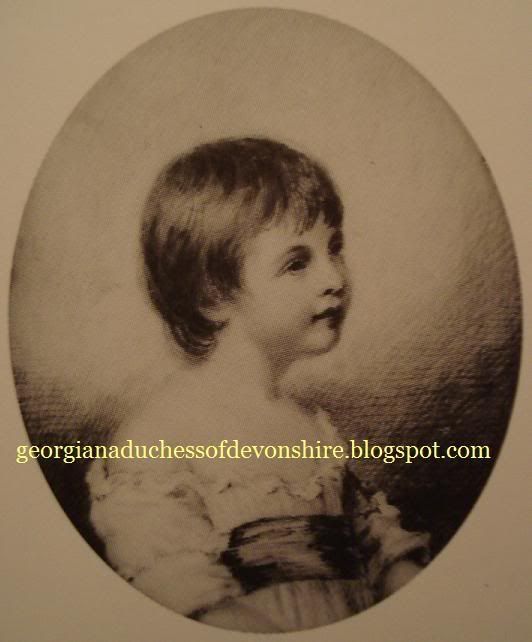
Charlotte was not the daughter of the Duke and Duchess of Devonshire but she was raised by both of them. She was actually the Duke's first (known) child and was born of the commoner Charlotte Spencer (no relation of Georgiana or her Spencer family). Charlotte was born in 1774, the same year that Georgiana married William so he technically hadn't committed adultery in Charlotte's conception. However, he did keep Charlotte's mother as his mistress after her birth, so we can't totally clear him of those early adultery charges.

Charlotte's early life was likely comfortably lived with her mother by the grace (and wallet) of the Duke. He likely provided them with a decent home and even paid for Charlotte to have a nurse. By 1778 he had tired of his mistress, and unfortunately for the the tot, Charlotte Spencer died not too long after the breakup. Now Charlotte was both motherless and a bastard-child. Most children in this situation were doomed a horrible and short existence unless they were charitably recognized by their father. Despite his coldness, and awkwardness with human affection, William was no monster and took his illegitimate daughter, and her nurse, into his home.

By the time the four or five-year-old came into the Devonshires' home, Georgiana and the Duke had been married at least four years and still had no children of their own. You may think that having the illegitimate daughter of her husband in her home would send Georgiana into a rage, but it did not. She immediately doted on the child and gushed about her as if she were her own, much to her mother's horror. Georgiana seemed impertinently ignorant of the whispers about welcoming the little girl into her family. At the time little Charlotte had no surname so the last name of Williams was created for her to distinct her as her father's child-though not legetimate child.

Charlotte grew up dearly loved by both Georgiana and William but with the arrival of Bess she became a neccessary tool in order to keep Bess close to the Devonshires without causing too much scandal. Lady Bess Foster was given the position of Charlotte's governess when the girl was about nine years old. As soon as this arrangement was settled the two set off for France to further Charlotte's education and refine her as a proper little lady (with Bess!? Dear lord, they should recheck her papers...). When Bess got bored with her task at hand and went partying in Europe poor, introverted Charlotte was dragged with her. Georgiana was horrified when word got to her that Bess and Charlotte were living in Naples with two of Bess' lovers. Eventually it was decided that Bess might not be the best fit for Charlotte, who seemed traumatised by her experiances abroad with Bess rather than "much improved." She was left in Paris to continue her education, even through the Revolution.

In 1794 the Devonshires were happy (and relieved) when their agent's nephew asked for Charlotte's hand in marriage. He was no aristocrat, but it was a good and secure marriage, especially considering Charlotte's unfortunate background. Nothing else can really be known of her after that, but Charlotte was likely relieved to settle down to the quiet life of a wife after her circus-like life as a Devonshire.