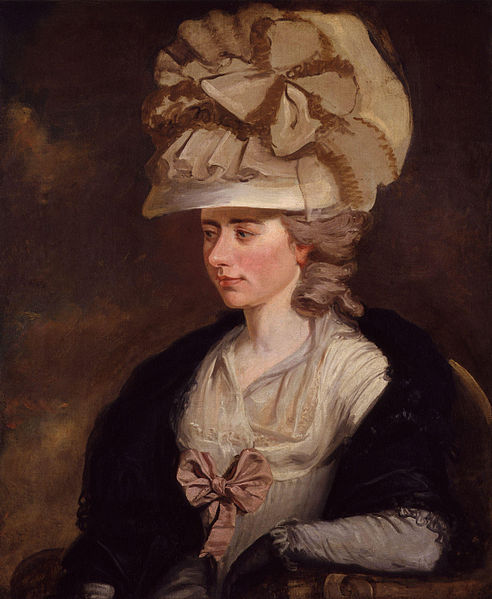
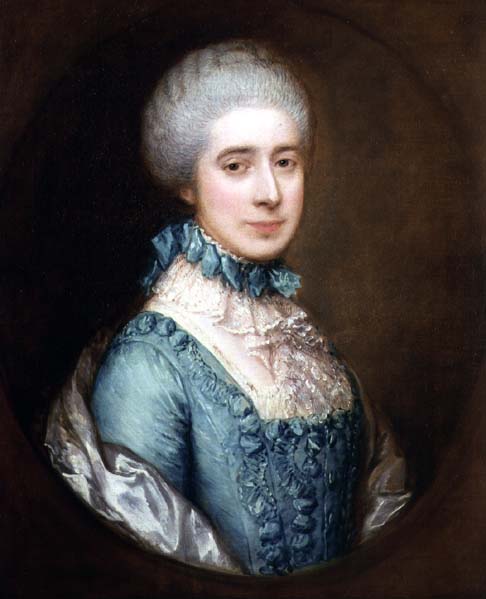
Mr. Burney, Hetty and I took a walk in the Park on Sunday morning, where, among others, we saw the young and handsome Duchess of Devonshire, walking in such an undressed and slaternly manner as in former times Mrs. Rishton might have done in Chesington Garden. Two of her curls came quite unpinned, and fell lank on one of her shoulders; one shoe was down at heel, the trimming of her jacket and coat was in some places unsown; her cap was awry; and her cloak, which was rusty and powdered, was flung half on and half off. Had she not had a servant in a superb livery behind her, she would certainly have been affronted. Every creature turned back to stare at her. Indeed I think her very handsome, and she has a look of innocence and artlessness that made me quite sorry she should be so foolishly negligent of her person. She had hold of the Duke's arm, who is the very reverse of herself, for he is ugly, tidy, and grave.
Omai, who was in the Park, called here this morning, and says that he went to her Grace, and asked her why she let her hair go in that manner! Ha, ha, ha ! Don't you laugh at her having a lesson of attention from an Otaheitan?
Showing posts with label Frances 'Fanny' Burney. Show all posts
Sunday, February 17, 2013
A Walk in the Park Reveals a Startling Revelation
A walk in the pleasure gardens was a perfect opportunity for celebrity-spotting in eighteenth-century London. Fanny Burney wrote in April 1776 to a friend to tell of one particularly interesting glimpse of celebrity: none other than the Duchess of Devonshire. However, her account of the young debutant may come as quite a surprise...although if we think of all the paparazzi photos of celebrities returning from a night out or ungracefully exiting a car perhaps Fanny's account isn't so difficult to believe:
Thursday, July 28, 2011
Bess: More of a Hervey than a Foster
It was two hundred and twenty years ago that Fanny Burney met Georgiana and her family for the first time, despite the two women being in the celebrity spotlight for over a decade.
The truth of the matter is that Fanny had no interest in Georgiana and her group. To her, it would be like the modern equivalent of having the opportunity to meet a tabloid celebrity who was famous for no good reason (ie: Paris Hilton, Kim Kardashian), Fanny was disgusted and just not interested. However, no one was as surprised as herself when, with little effort, Georgiana won Fanny over, "it is impossible to view...this celebrated woman without feeling the strongest disposition to admire and like her." Fanny found that Georgiana's sister, Harriet, whom her pre-conceived notions were even harsher on, was surprisingly equally likable. However, she found Lady Spencer to be a bore, the Devonshire nanny (Selina Trimmer) to be full of herself, and Bess and the Duke's daughter, Caroline to be a brat. As for Bess herself, Fanny reserved her harshest criticisms. "To the tales told about her, scandal is nothing - INFAMY enwraps them." Fanny found herself smothered by the sycophantic Bess, whose efforts made it almost impossible to socialize with anyone else.
In the end Fanny decided that after talking to Bess, "Lady Elizabeth has the general character of inheriting all the wit, all the subtlety, all les agréments [charms], and all the wickedness of the Herveys. While I can't imagine Bess would be too pleased with this assessment, I have a feeling her relative John Hervey, would have found it quite flattering.
Monday, June 13, 2011
Frances Burney
The exceptional life of Frances Burney is a bit of Cinderella tale with the exception of Fanny's intelligence and talent saving her from a stepmother and life of drudgery rather than a handsome prince.
Fanny was born June 13, 1752 to Dr Charles Burney and his wife, Esther. Dr Burney was an esteemed musical historian and Mrs Burney was the daughter of a French emigrant with the familiar name of DuBois. The Burneys had six children, Fanny the third-born and subjugated to middle-child injustices. Her sisters, Susanna and Esther were sent to be educated in Paris while at the age of eight, Fanny still didn't know the alphabet. However, two years later Fanny had learned to read and couldn't stop writing stories which she secretly did on scraps of papers; for to be caught would surely earn her a punishment for not contributing to helping out around the house. It was at this age that Fanny suffered the loss of her mother, a loss she would never fully heal from.
Fanny continued her writing in secret, even beginning a draft of a novel, The History of Carolyn Evelyn, what would become a prequel to Evelina. Although scholarly, Dr Burney only had one novel in his home, and frowned upon writing. At the same time Fanny was plagued with guilt for her dirty habit of writing which was "unladylike" and only acceptable in society if a woman was in desperate financial need for money based on her writing. On her fifteenth birthday she attempted to forever extinguish her dirty habit by burning all her writing in a bonfire, including the ill-fated The History of Carolyn Evelyn. But we all know that didn't work. Fanny already had the story of Evelina in her head, she just hadn't written in down yet.
The Burney brood soon grew larger. The same year Fanny made her resolution not to write, her father remarried a woman with three children from her previous marriage and who wasn't kind to her new stepchildren. The situation, however unfortunate, did serve to make the Burney children closer to one-another. Fanny spent her teenage years acting as her father's secretary. Her urge to write could no longer be suppressed and she began writing Evelina in secret.
Evelina was published in secret too. To preserve her decency it was published anonymously. Fanny's younger brother, Charles even dropped off the manuscript to publishers disguised as an older gentleman. By 1778 the novel was on bookshelves in three volumes and many were singing the unknown twenty-five year old's praises. One of those who sung the book's praises was Dr Burney who read it after stumbling upon the truth of the author and proudly proclaimed it, "...the best Novel I know except Fielding's..."*
When the author's true identity was revealed, she was quickly swept up in the creme de la creme of London. She became very close with Hester Thrale and was introduced to other great minds of the time. In 1782 she published Cecilia which also received praises. Four years later Fanny found herself in employment to the queen (a huge fan of Evelina) as a Keeper of the Robes. Fanny was hesitant to accept the position, worried that it would interfere with her time to write but felt obligated to accept. After four years in the position Fanny decided it was time for her to move on and resigned, yet continued her friendship with the queen and princesses.
It was now 1791, the French Revolution was in full-swing and Fanny was nearly forty. In Fanny's many circles she became acquainted with a number of French exiles but one in particular caught her attention. General Alexandre D'Arblay was an artillery officer who fought alongside Lafayette. Fanny was smitten with him and in 1793 the two were married. The following year the D'Arblays welcomed a son, Alexander.
In 1801 Alexandre was offered a position with Napoleon's government. The family moved to Paris, expecting to live there for a year, but instead remained there for ten years. While still in France Fanny underwent a mastectomy to remove a cancerous breast. She documented the ordeal and it remains one of the most compelling accounts of a successful early mastectomy, although many who read it find themselves surprised she survived the ordeal at all!
Fanny continued to live and to write for many years after her surgery. She outlived both her husband and son, whom she was buried with when she eventually died at the age of 87 in Bath, 1840. The posthumous publishing of her journals and letters only served to earn her a greater appreciation, almost downplaying her novels. Today she is considered one of the great writers of the 18th century who continues to delight many with her real and fictional accounts of English life in the Age of Reason.
*Probably Amelia since that was the only novel in the house!
Wednesday, June 8, 2011
A Collection of Insults, Care of Captain Mirvan
Our favorite century was, by no means, well behaved. Yet the language and culture of the time put a certain panache on describing things of a bawdy or crass nature. Take for example this small except from Rambler's Magazine, 1823 about discovering two people in compromising positions: "What he did behind the lady, we do not pretend to know; but this we know, that he had not any business there with his friend's wife." Dare I proclaim that curses and insults were more works of art than they are now? Perhaps that is simply due to their exotic nature.
Those who are reading or have read Fanny Burney's Evelina know that the character of Captain Mirvan is not short of insults for the high-strung Frenchwoman Madame Duval. Being a member of the British Navy one might expect the Captain to have a mouth on him, although the saying back then was He/She "swears like Lady Lade" rather than a sailor. I've been quite enjoying his insults and name-calling so I thought I would arrange a collection here for everyone's enjoyment and use.
Frog- French. A term derived from impoverished people's habit of eating frogs. Letter 14
Spark- a boyfriend or suitor. Letter 16
Beldame- When used in condensation, an old witch. Letter 16
Trumpery- "Showy but unsubstantial apparel; worthless finery." (OED) Letter 16
Draggle-tailed- "A woman whose skirts are wet, and draggled, or whose dress hangs about her untidily and dirty; a slut." (OED) Letter 19
Mrs. Turkey-Cock Letter 21
Canaille- The mob, commoners. Letter 23
Dish-clout- dish cloth. Vol 2 Letter 2
Dangler- "One who hangs or hovers about a woman,; a dallying follower." (OED) Vol 3, Letter 15
Bantling- "A young or small child, a brat." (OED) Vol 3, Letter 18
Old Tabby- Old lady. Vol 3, Letter 21
Friday, May 20, 2011
Tart of the Week: Fanny Crewe
In the late 18th century there were three main Whig society hostesses, Georgiana, Lady Melbourne, and Mrs. Crewe. All were good friends and all were considered the ton and members of the Devonshire House set. All also qualify as tarts!
Frances Anne Greville was born in 1748 to two published authors, into a family with strong political connections, strong ties to the great minds of the time, and kickass girl power. Who could complain? Just sit back and absorb all of these connections. Fanny's mother, Frances Macartney, was besties with Lady Spencer so Fanny and Georgiana most likely knew each other since childhood. Fanny's Dad, Fulke Greville was besties with Dr Charles Burney, father of Fanny Burney so the two Fannys grew up together and were friends as well. Talk about friends in all the right places!
With this social upbringing it is no wonder Fanny grew up talking and talking and talking. All her life she was known as quite the chatterbox. Georgiana once complained that Fanny had lately been a bit of a sycophant with her and needed to stop cooing over her. Lady Douglas once stated that Fanny's "ideas came so quickly that [she] could not follow them" and assumed that neither could Fanny!
Fanny was also privileged enough to be considered a great beauty of the time. Which no doubt helped to attract her husband to her. She was married to John Crewe in 1766, joining two powerful Whig families together which worked out just perfectly for Mrs. Crewe who quite enjoyed playing hostess. Her beauty and wit also got Fanny in trouble as well. She succumbed to an affair with a frequent house guest and cohort of her husband's, Richard Sheridan. Fox was right when he said "she loved high play and dissipation."
Of course Fanny's well-known beauty was up for debate depending on who you asked. Fanny Burney said she was so beautiful that she "uglified everything near her." However, if you asked the critical Lady Douglas she would tell you Fanny was "very fat with a considerable quantity of visible down about her mouth..." Lady Sour Grapes seemed to not be be impressed with Mrs. Crewe.
Regardless of whether she was pretty or not or whether she was a big mouth or not, Mrs. Crewe's political influence cannot be denied. She like Georgiana and other society hostesses was the backbone of political causes. Organizing events to bring together the minds of political factions, participating in elections, and being prominent in public (and also risking reputation) in order to further the cause; Fanny did it all tirelessly. She died as Lady Crewe (due to her husband's elevation to Baron in 1806) in 1818.
Thursday, May 12, 2011
Quotables
For my part, I confess I seldom listen to the players: one has so much to do, in looking about and finding out one's acquaintance, that, really, one has no time to mind the stage. One merely comes to meet one's friends, and show that one's alive.-Fanny Burney on attending plays
Tuesday, May 10, 2011
Announcing the Evelina Group Read
Gentle Readers,
I am very excited to make the long-await announcement for a group read of Fanny Burney's first novel which she published anonymously, Evelina, or a History of a Young Lady's Entrance into the World. The book was a big success and even an inspiration to Jane Austen. Queen Charlotte liked the book so much she hired Fanny as a Keeper of the Robes, much to Fanny's chagrin. But who can say "no" to the queen; especially when she is your fan! Now it's our turn to find out if we enjoy Fanny's wit as much as Queen Charlotte (my money is on "yes") with the Evelina Group Read.
Book Editions
Our salons will meet once a week (every Thursday) here to discuss designated chapters but that doesn't mean you can't get a head-start now! Many local libraries may just have this classic in their stacks. Amazon also has many affordable editions of the book from Penguin Classic, Oxford World Classics, Norton, and Broadview (which I personally enjoyed). GirleBooks has an ebook version for free. Lauren even found an audiobook from SilkSoundBooks in which Judi Dench is one of the readers; doesn't that sound awesome? Our group read will also offer participants and opportunity to win a copy of the soon-to-be treasured book!
Calendar
Mark your calendar, the tentative salon schedule is as follows:
2 June: Volume 1 Letters 1-20
9 June: Volume 1 Letter 21- Volume 2 Letter 6
16 June: Volume 2 Letter 7- 22
23 June: Volume 2 Letter 23- Volume 3 Letter 9
30 June: Volume 3 Letter 10-23
So who is with me? The more the merrier I say! Please don't let anyone miss out on your wit! Sign up below via the Mr. Linky widgit (hit refresh if you don't see it below). Stay tuned to the blog for more details. I can't wait!
Tuesday, April 19, 2011
Miss Monckton Entertains
The Honourable Miss Monckton was the daughter of Lord and Lady Galway and a famous society hostess. She had a trademark of receiving guests while sitting down. Fanny Burney found that a bit alarming but went on to describe her as "between thirty and forty, very short, very fat, but handsome, splendidly and fantastically dressed, rouged not unbecomingly, yet evidently and palpably desirous of gaining notice and admiration."
Once when Fanny and her friend Mrs Thrale were invited to a Monckton party they made the careless mistake of showing up on time. Never show up on time to a ton event! The events that follow sound like they could have been a retelling of a Lauren and Heather situation! How many times has this awkward situation happened to you?
![]() |
| Mrs and Miss Thrale |
I had begged Mrs. Thrale to call for me, that I might have her countenance and assistance upon my entrance. Miss Thrale came also. Every thing was in a new style. We got out of the coach into a hall full of servants, not one of which inquired our names, or took any notice of us. We proceeded, and went upstairs, and, when we arrived at a door, stopped and looked behind us. No servant had followed or preceded us. We deliberated what was to be done. To announce ourselves was rather awkward, neither could we be sure we were going into the right apartment. I proposed going up higher, till we met with somebody; Miss Thrale thought we should go down and call some of the servants; but Mrs. Thrale, after a ridiculous consultation, determined to try her fortune by opening the door. This being done, we entered a room full of tea-things, and one maid-servant."Well," cried Mrs. Thrale, laughing, "what is to be done now? I suppose we are come so early that nothing is ready."
Fanny Burney The maid stared, but said,—"There's company in the next room."Then we considered again how to make ourselves known; and then Mrs. Thrale again resolved to take courage and enter. She therefore opened another door, and went into another apartment. I held back, but looked after, and observing that she made no curtsey, concluded she was gone into some wrong place. Miss Thrale followed, and after her went little I, wondering who was to receive, or what was to become of us.Miss Monckton lives with her mother, the old Dowager Lady Galway, in a noble house in Charles-street, Berkeleysquare, The room was large and magnificent. There was not much company, for we were very early. Lady Galway sat at the side of the fire, and received nobody. She seems very old, and was dressed with a little round white cap, and not a single hair, no cushlori, roll, nor any thing else but the little round cap, which was flat upon her forehead. Such part of the company as already knew her made their compliments to her where she sat, and the rest were never taken up to her, but belonged wholly to Miss Monckton.Miss Monckton's own manner of receiving her guests was scarce more laborious ; for she kept her seat when they entered, and only turned round her head to nod it, and say "How do you do?" after which they found what accommodation they could for themselves.
Wednesday, January 26, 2011
Quotables
"Whoever she is, I wish she would mind her own affairs: I don't know what the devil a woman lives for after thirty: she is only in other folks way."
-Lord Merton, in Fanny Burney's Evelina
Tuesday, October 19, 2010
Book Review: Evelina
For those familiar with my book reviews, you could be aware I seldom stray away from my beloved non-fiction. But variety is the spice of life and fiction can't always be ignored especially in terms of classical fiction. I am ashamed to say one of the classical fictions that had been a stranger to me was Fanny Burney's Evelina, or, the History of a Young Lady's Entrance into the World
. I was familiar with the spunky author but not her actual work so I was long, long overdue to give a Burney book a try. The further and further I got into the book the more ashamed I was with myself for not reading Evelina sooner, where has this book been all my life! I laughed, rolled my eyes, gasped with scandalized shock, and whined to a bewildered Lauren about how things were just not going in the happy ending direction that I so wanted. It was fantastic.
Evelina is the epistolary tale about a teenage orphan who has been kindly raised by a charitable vicar due to her mother's premature death and father's estrangement. Living happily in the country all her life she is invited to leave her beloved foster father for the first time to be a guest of the Mirvan family. An unexpected arrival of Captain Mirvan, the bulsterous patron of the family sends the Mirvans and Evelina with them to London where a Pandora's box of experiences now lay before the naive, but beautiful country girl who is now the attention to many of the men of London. First there is Mr. Lovel, the macaroni whom Evelina instantly offends, then the dashing Lord Orville, and of course the tedious Sir Clement Willoughby who can't seem to leave Evelina alone, much to her chagrin. But it is when Evelina's long lost French grandmother arrives looking for her, that Evelina finds her life has gotten more complicated than it ever was. What's a girl to do?
Fans of Jan Austen will immediately see why Fanny Burney was an influence of the famous author. Both lady-writers capture their scenery and immerse the reader into the story; you feel the main character's pain and rejoice with her victory. The characters are varied from the stoic Evelina to the hilarious and mischievous Captain Mirvan or sarcastic Mrs Selwyn, who were both favourites of mine. Any and every Austenite should pick up this book although its appeal crosses many genre's. It was my guy-friend, Joel who lent me his copy of Evelina; so I can honestly say I would recommend this book to anyone, which I've already been doing with great enthusiasm.
There are a variety of editions Evelina which was originally published in 1778. I read Broadview's edition (which is now sold with an unfortunate cover rather than the appropriate Canaletto which graced mine) edited by Susan Kubica whose delightful footnotes added to my pleasure of the book. There is also a free e-book edition offered by Girlebooks.
Subscribe to:
Posts (Atom)