Showing posts with label Satirical Prints. Show all posts

Friday, July 13, 2018

British and French Print Media's and the Death of Marat

On this day in 1793 a young French woman named Charlotte Corday sought a meeting with the prominent French revolutionary, Jean-Paul Marat, promising information on an future uprising.  After being turned away in the morning, Corday was admitted in the evening to Marat's bathroom, where he conducted business now due to a debilitating skin disease that kept him submerged in his bathtub.  Corday recited the names of dissidents while Marat wrote them down, proclaiming that they would soon be guillotined.  This was Corday's cue; she drew out a kitchen knife hidden in her clothing and stabbed Marat in his chest, killing him almost instantly.  She then calmly waited for the police to apprehend her and was guillotined four days later.

Corday hoped that this act of violence would put an end to the violence of the French Revolution which she felt was now out of hand.  She blamed Marat for the excessive and repulsive bloodshed and she was not alone in this sentiment.  A search in the British Museum's collection of prints reveals a stark contrast in how France and Britain interpreted the assassination. 

Anonymous, 1793

Paul André Basset, 1793

Corday is often portrayed in French prints as a savage (though well-dressed) beast of a woman.
Isaac Cruikshank, 1793

William Holland, 1793

Whereas in British prints she is often depicted as a pretty young woman stabbing a buffoon.  One example is my favourite image of Corday, by James Gillray which portrays her with the dignity and grace of an eighteenth-century heroine. 

There are many depictions of the event by French and British printmakers that survive and of course, not all of them can fit within these two categories.  Notably this French print which is thought to have been printed a few years after the dust had settled and seems to give an accurate representation of Corday's arrest.  She sits patiently, next to victim while men rush in to apprehend her.

Jacques Swebach-Desfontaines, c. 1793-8

Thursday, July 2, 2015

'The Fashionable Bosom'


I'm not sure which I like more: the title of this print (A Nest for Puppies or the Fashionable Bosom) or its content.   Either way it's in my favourite file along with The breeches in the Fiera Maschereta.

The 1786 print critiques women's frivolous love of cute little lap dogs and expanding bustlines.  Why not combine the two?

Why not indeed.

Thursday, December 19, 2013

Exhibition Review: High Spirits: The Comic Art of Thomas Rowlandson


I recently had the pleasure of seeing High Spirits: The Comic Art of Thomas Rowlandson now on display at the Queen's Gallery, Holyroodhouse which explores the satirical prints of one of our favourite satirists.  My review can be seen as the BSECS Criticks' page here.  There is also an accompanying catalogue (which is quite big) for those who will miss the exhibition.  In short, the exhibition is packed with some of Rowlandson's most well-known prints as well as some rarer pieces.  There is a section dedicated to the Westminster Election of 1784 so there are quite a few prints depicting the Duchess of Devonshire and they're all in pristine condition.  So if you can make it to this exhibition, be it in Edinburgh or London, I would recommend it!

Tuesday, July 2, 2013

Charlie Billingham

Another contemporary artist who has come to my attention lately is Charlie Billingham whose paintings are just plain glorious.  Billingham appropriates British satirical prints from our favourite century into his paintings.  Cropping the famous prints, sometimes stretching them, and using bright, exciting colours and loose lines, Billingham takes out the old social and political message (and context all together), adding mystery to these images which, if you've never seen them, could be quite indecipherable to begin with.  Let's take a look.


Billingham has recently had shows at Saatchi Gallery, and I am sure there will be more to come so keep your eyes peeled!

Wednesday, March 13, 2013

The New Phaeton


As women's hair grew bigger and bigger in the the 1770s, many satires honed in on the comedy of these women actually getting to their fashionable events that required such sartorial extravagance.  The New Fashioned Phaeton (1776) was one print which had a suggestion for how society could accommodate such fabulosity.

Thursday, April 12, 2012

Favorites

Anon. The breeches in the Fiera Maschereta, 1775

Friday, March 30, 2012

Favorites

Anonymous, An Emblem of a Modern Marriage, 1775

Saturday, July 30, 2011

Trouble with Travel: Hats

While scouring for pictures of the royal wedding in Edinburgh today I cam across this gem, which I found rather adorable.


 Get in the back, Kate! 

Then I looked at it again and realized poor Katie Cambridge is hunched over due to her rather large hat (been there, Honey)! 

That instantly brought to mind a satirical print from Matthew Darly in 1776 when hair heights were at their largest.  Elegant females were constantly forced to sit on the floor due to their hair; there was no other way to get around it aside from sticking your head out the window.  Here's hoping that someday we will have vehicles to accommodate fashion!

Monday, October 25, 2010

The Ladies Room


Have you ever walked into a public restroom with where the lavatories were exposed with no privacy barriers?  Yes, yes, men we know you use the urinals without a thought many times.  Well, the experience nowadays may send some ladies running for the hills but in bustling 18th century London, these were the types of public restrooms you got if you went somewhere posh.  While public restrooms weren't as common as they are today you could find them in popular watering holes for the rich such as Henry Kingsbury portrayed in his satire of the Vauxhall Garden Ladies Room.  His satire was an excuse to portray well-to-do, fashionable ladies doing something everyone does behind closed doors (just as many satires of women did) but it serves the great purpose now of giving us an idea, however exaggerated, of how ladies did their business in order to avoid lifting various layers of their robe a l'anglaise skirts while hiding behind a bush.

Thursday, August 26, 2010

Young Men Be Warned

Carrington Bowles, The Man-Trap, 1780
Don't be deceived, she has a trick up her sleeve!  Carrington Bowles' 1780 satirical print could have its own theme song, for it serves as a warning to young men out there to be wary of one of the most feared things to an 18th century gentleman: women.  You may chuckle, but "man-traps" were a genuine concern, especially because women were considered to be vamps whose voracious sexual appetite couldn't be satisfied.  Many satirical prints show an amorous woman asking their exhausted lover for more sex. Oh the horror!

Here we have the culprit, not in the act, but in her natural form: sitting in high fashion on her couch.  She looks quite virginal in white, and her fair skin further serves to induce you to believe in her innocence.  But if you are only to look behind her and see her daily income of love letters you could just save yourself from a dangerous maneatertrap!

Thursday, August 12, 2010

Georgian Holidays Through Satire

Sorry everyone, I have vacations on my mind, so that will be projected onto the blog.  Today let us take a journey through the satirical Georgian holiday, there is still a thing or two we can learn.

James Gillray, Middlesex Election, 1804
 Be prepared for bad traffic...

Thomas Rowlandson, Family on a Journey Laying the Dust, 1800
 ...in worst-case scenarios you will have to resort to ducking behind a bush or carriage when nature calls.

Thomas Rowlandson, Portsmouth Point, 1811
Or if you are in the position of trusting your luggage to others, pack accordingly, loosing luggage is never fun.

Carington Bowles, Two Bloods of Humour..., 1771
 Remember, just because you're on vacation doesn't mean you should get too out of control, just a simple out of control should be enough.

George Cruikshank, Royal Embarkment, 1819
 Be sure to be conscious of any skin slip-ups when swimming, the beaches are usually crowded and you never know who is around.

Anon., Mlle des Faveurs a la Promenade a Londres, 1775
Please dress appropriately on hikes and nature walks.

Thomas Rowlandson, Exhibition Room, Somerset House, 1808
Try to add a little culture into your trip, visit a local museum.

James Gillray, Monster Crawls at a New Coalition Feast, 1787
Sample the local fair, don't be afraid to over-indulge.

James Gillray, The Pursuit of Knowledge,  1799
Last but not least, have a great time but be safe doing it!

Monday, July 5, 2010

Fashionable Contrasts

Gillray's print, Fashionable Contrasts may be familiar to many of you. But whose feet are those?

This was the satirical artist's marriage gift/big English welcome to Princess Frederica when she married Prince Frederick (Duke of York). Yup, as if it weren't cruel enough to be named Fred, the couple now each had a spouse also named Fred. Frederica had notably dainty feet, which was apparently easy fuel for Gillray's satirical fire. But were her feet really that tiny? Sources say they were a mere 5.5 inches long. That would be the equivalent to about a children's shoe size 7 (US). Given, Frederica was reportedly pretty short even for the 18th century but she became quite famous for her tiny toes.

Friday, June 4, 2010

Happy Friday!


Robert Dighton, Return from a Masquerade- A Morning Scene, 1784

Wednesday, March 17, 2010

Happy St Patrick's Day!

Robert Dighton, Geography Bewitched or, a Droll Caricature Map of Ireland, 1793

I hope you have your green on! Last year we celebrated with some Irish tarts. This year I thought we'd take a quick look into the 18th century view of Ireland via satirical prints. That way, you can be the judge.


James Gillray, Portrait of an Irish chief; drawn from Life at Wexford, 1798

James Gillray, Irish Gratitude, 1782

James Gillray, United Irishmen in Training, 1798

James Gillray, Horrors of an Irish Union, 1798


Friday, June 26, 2009

Tart of the Week: Hannah Humphrey


Hannah Humphrey is one of those women who is amazing in the sense that she was a self-sufficient female who managed to be one for most of her life, and come out unscathed. I can't tell you much about dear Hannah's beginnings (possibly born around 1745) but I can tell you her brother, William was a publisher and print seller on Gerrard Street in London. Hannah likely learned the tricks of the trade from her brother and decided to begin her own print shop where she would publish as well. This was quite a risk for a woman in London, on many accounts. In order to protect her reputation, Hannah did as many actresses tended to, and went by Mrs. Humphrey, for a married or widowed woman with a business was much more acceptable than a single one.

Hannah established her print shop on Old Bond Street. The storefront was black with gold lettering which read, Humphrey's Print Shop. A large Bay window was covered from head to toe in all the prints Hannah published. The inside of the shop was just as posh, with mahogany counters. People would stop, gawk, and giggle over the storefront and be enticed into spend a few shillings on a satirical print. The shop was one of the most successful print shop in London and it even attracted customers like the Prince of Wales, who was usually on more than one of the prints in the window. One of the decisions Hannah made as a print seller was to exclusively sell (usually bawdy) satirical prints and to exclude prints made after paintings. This was another risk, but Hannah was looking for a certain clientele.

Hannah's shop not only attracted a particular clientele but a particular artist. James Gillray knew Hannah through her brother, who published some of his prints. In 1791 Gillray exclusively published with Hannah, so if you wanted to buy one of his prints there was only one place to get them. Above the Humphrey's Print Shop was apartments where Hannah took residence. Gillray also conveniently moved into a room above the shop. Now I would be the last to start rumours here, but isn't it a little suspicious to have a single man and woman living in such close proximity? There were many rumours going around about Hannah's and Gillray's "professional" relationship, especially when he followed her when she moved her shop to New Bond Street and then again to fashionable St James Street. It is said that Gillray thought of proposing to Hannah numerous time, and even did one day on their way to church. But that could just be the talk of romantic gossipers.

Hannah was with Gillray up until his death. Poor Gillray went insane after a bout of depression and failing to commit suicide and was looked after by Hannah for the remainder of his life (six years after producing his last print). Hannah, herself died a few years later in 1818. She died a respected and extremely successful businesswoman.

Wednesday, October 29, 2008

For Sale


I just recently added a fun widget to my sidebar of some of my favorite book recommendations. After I refreshed my blog and was playing with the widget, I noticed that one of the books I added, City of Laughter by Vic Gatrell is currently on sale for only $7.99!! Now I don't know Vic, but I was lucky enough to have gone to his lecture on the book in question, and I just have to promote buying this book from Amazon right now because it is an absolute steal! I paid a lot more for it (£35 I think!) and was happy to do so because this book is chuck-full of great information on all the scandals in England in the late 18th and early 19th centuries. Gatrell studies the various scathing satirical prints that circulated London during this time. Over 600 pages, most with colour illustrations, talk of some of our favorite subjects including Lady Worsley, The Learned Pig, and Mary Bowes all while examing the aesthetic and comedic technique of the satirical artists of the time. Gatrell's book is like an 18th century tabloid encyclopedia. It's a fun read, and a good reference to have in your library.

Monday, September 29, 2008

"Darling, Should We Call on the Pig Today?"


With the wind-down of the Westminster Elections of 1784 there was not enough supply for the gossip-demand. The quack doctor spectacle seemed to be simmering down, and you could only make fun of Perdita for so long. Luckily enough for the people of England, a pig came to their rescue. There was once again fun news to talk about!

A learned pig was put on display and wowed audiences with its ability to arrange cards with numbers or letters on them. The pig could probably count but it was also advertised in The Daily Universal Register (today, The Times) as being able to tell time, cast accounts, and read ladies minds. That's some pig! Well, this naturally drew much attention and the pig was the talk of the town.

Rev James Woodeforde recorded that he paid a shilling to see the pig and praised its sagacity, stating that it arranged its cards to spell and do arithmetic.


The poet, William Cowper joked in a letter that, "I have a competitor for fame...in the Learned Pig! Alas! what is an author's popularity worth, in a world that can suffer a prostitute on one side and a pig on the other, to eclipse his brightest glories?"


Even Samuel Johnson was mesmerized by the pig, "The pigs are a race unjustly calumniated," rather than killing a piglet, we should "allow time for his education."

Thomas Rowlandson illustrated the beau monde's interest in the pig with the above satirical print. Which, if he hadn't documented it, it would more easily have been forgotten. The truth be told, Rowlandson was just catering to the gossip and fads of the time as he usually did in order to make his money, I'm sure he thought the whole spectacle was ridiculous. The pampered pig is depicted with a ruffled collar to differentiate it from normie pigs. On the wall the poster reads, "The surprising PIG well versed in all Languages. Perfect Arethmatician Mathematician & Composer of Musick."

But I suspect not much has changed considering I was watching this show, Hog Genius, a few weeks ago. Johnson was right, pigs kind of rock.

Tuesday, September 9, 2008

Lessons in Physiognomy, How to Indentify a Georgiana in the Wild

A key aspect of 18th c gossip is total anonymity. When the great portraits were hung in the Royal Academy the titles would only be listed as "a man" or "a woman," etc. Crowds would gather and test each others' pop culture based on whether they could identify the sitter or not. The tabloids of the times, satirical prints, kept their subject anonymous many times too, despite the newly freed press. Sometimes, for gossip's sake, instead of listing the subjects name the satirical artist would just drop a subtle hint, "A certain dutchess..."

Because Georgiana was a leader of the ton and a leading female celebrity most everyone knew who she was and what she did. Therefore, artists developed a means of identifying Georgiana in their work so viewers would know who the anonymous scandalous lady was.

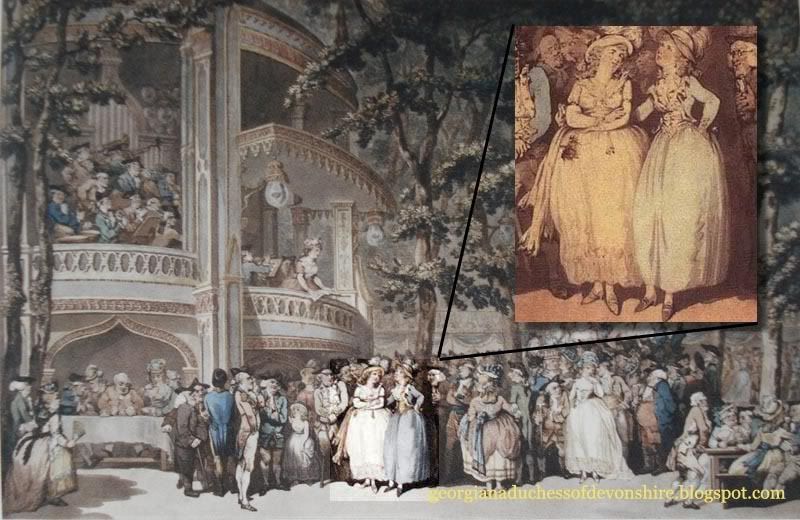
The most popular identifier was Harriet. If a work contained two tall, poufy-haired, fashionable ladies next to each other it was Georgiana and her sister. Despite Bess being Georgiana's best friend, society found the two sisters to be inseparable (they were) and they would constantly be seen in public together. Just like in this print by Rowlandson:


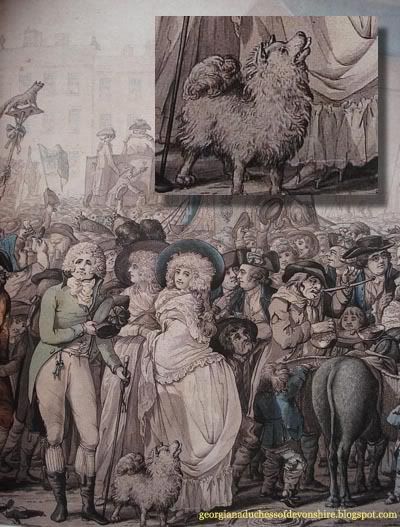
The second article of identity was a dog. Yes, dogs were popular in the 18th century, but their biggest fan was Georgiana's husband, whom was called Canis by his friends. There is a family tradition of the Dukes and Duchesses of Devonshire being obsessed with their dogs and still remains true today -their furry family is usually part of their portraits. The association of Cavendish/Dog made for another identifier for Georgiana as can be seen in this print Robert Dighton did of the 1784 Westminster Election:


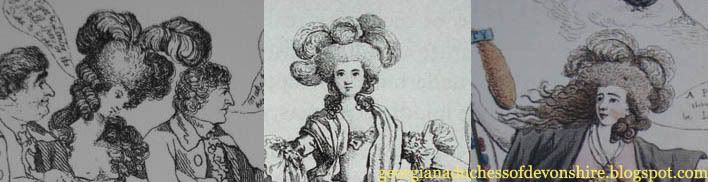
Feathers, feathers, feathers! Can you imagine if you popularized shoulderpads in the 1980's and you were still being depicted wearing those awful 80s blazers today? What a nightmare. Well, if you recall, Georgiana popularized the fad of huge ostrich feathers in the late 1770's. For ever afterwards she was depicted as wearing them in her hair.

Wednesday, June 4, 2008

Size Matters

What better to make an entrance into society than with a 3 foot hairdo. Georgiana blasted into the London scene in full couture splendor upon her marriage at the age of 17. She immediately got to work on establishing herself as a fashion icon. Whether this was her intention or not, one can only guess, but her celebrity began with her fashion trends.

The first notable trend she began was the three-foot hair tower. Hair was already large at the time, especially due to French influences, Georgiana simply took it one step further. The hair towers required scented pomade, pads of horse hair, and at least two hairdressers in order to be constructed. To this, Georgiana would add scenes such as the classic ship in sail or stuffed birds. As with every trend in London, woman immediately took to the look and tried to make it more outrageous by making their hair even taller or more ornate.

Georgiana never seemed to acknowledge when people took to her fashions; while London society attempted to imitate her by making her vogues more outlandish, she would simplify and create an even bigger buzz. Her next hair fad was the infamous ostrich feather which she would drape in a large arch across the front of her hair. When Lord Stormont presented her with one over four feet long every lady of refinement went on a wild goose chase to find the rare length of feather. Of course scandal developed. Only the very wealthy could afford the feathers, which they snobbily flaunted to the point where Queen Charlotte banned them from court. This couldn't have come at a worse time for the fashion elite. The Duchess of Kingston's trial for bigamy was approaching and everyone who was anyone would be showing up in their best in order to outdo each other at the embarrassment of their fellow Peeress. Feathers were forbidden from the trial. This was a devastating blow; like banning Gucci from fashion week. The only lady who seemed unaffected by the ban was the one who started the fashion trend; Georgiana brought snacks to munch on with Lady Derby at the trial instead of her signature feathers.

Although (probably due to the ban) large ostrich feathers was only a short-lived fad it lived on through the decades. In satirical prints, Georgiana would forever be identified as herself by being portrayed with ostrich feathers in her hair.

Check out this collage I made of the hair tower. I only used Reynold portraits because I'm lazy, but it serves a purpose; if you were being painted by one of the most fashionable artists in society you would be portrayed in only the hottest trends. The portraits were painting from 1775-1779.Satirical Prints related to the D of D and her hair:

Lady All-Top May 1776

The Preposterous Head Dress, or Feathered Lady March 1776


Matthew Darly, Vis a Vis May 1776