Showing posts with label London Amusements. Show all posts

Wednesday, November 16, 2011

18 Folgate Street Daniel Severs House

18 Folgate street was brought to my attention by Melanie of Madame Guillotine who posted about the museum in July.  Perhaps "museum" isn't the right word.  "Art Instillation" would be much more appropriate. 

Dennis Severs bought the dilapidated Georgian house in 1979 and proceeded to transform it into a time capsule by collecting antiques to tell a story in each room.  But they aren't just placed neatly in a room like a historic home.  Instead they are placed in a way which tells a story.  Take for example the drawing room.  Tea is set up in the center of the room, one of the cups is still half full with tea.  Pearl earrings sit beside the cup as if a woman just took them off after a long night of socializing.  Fans sit on chairs and some careless person actually dropped their teacup in the course of the night and the shattered remains are left on the floor.  The effect really makes you feel as though you have traveled back in time. 

There are a few ground rules you should be aware of before visiting.  When you arrive to what looks like any old home you will see a note telling you to ring a bell.  I still am not sure where the bell is but using the door knocker works just as well.  You also have to arrive during the specified hours, so make sure you plan ahead!  After knocking, someone will come out and explain what you're about to do and then tell you to fork over 10 pounds, so be sure to have cash on hand!  Another thing you should know is that there is no talking allowed, not even whispering.  My art historian friend and I got in trouble for this...but honestly two art historians in this house...there is no way we could just point and make faces to each other!  Getting chastised by the workers is also a bit confusing because they don't have uniforms or name tags.  So the girl in the hallway with a messenger bag telling you to shut up; yeah that's an employee.

There are notes and images around the house to give you a feel for what you're walking into.  A reminder note for George IV's coronation is pinned to the door of a regency bedroom.  So you must always be taking in your surroundings.   I found a black cat on a chair and broke another rule by petting it.  That was the first time an exhibition literally ran away from me!

Next time any of you lovers of the 18th and 19th centuries are in London, this house should definitely be on your to do list!

Tuesday, June 14, 2011

The London Tourist

While visiting with the Branghtons in London, Evelina is introduced to a variety of sites that tourists of the time enjoyed seeing.  Some like the Tower of London are an attraction that is still a must-see for London tourists centuries years later.  Others have been lost to the ages.  So let's use the Braghntons' suggestions to guide us through the amusements that amused 18th century London.

One of the first suggestions was Don Saltero's coffee shop which was more a curiosity cabinet than a coffeeshop.

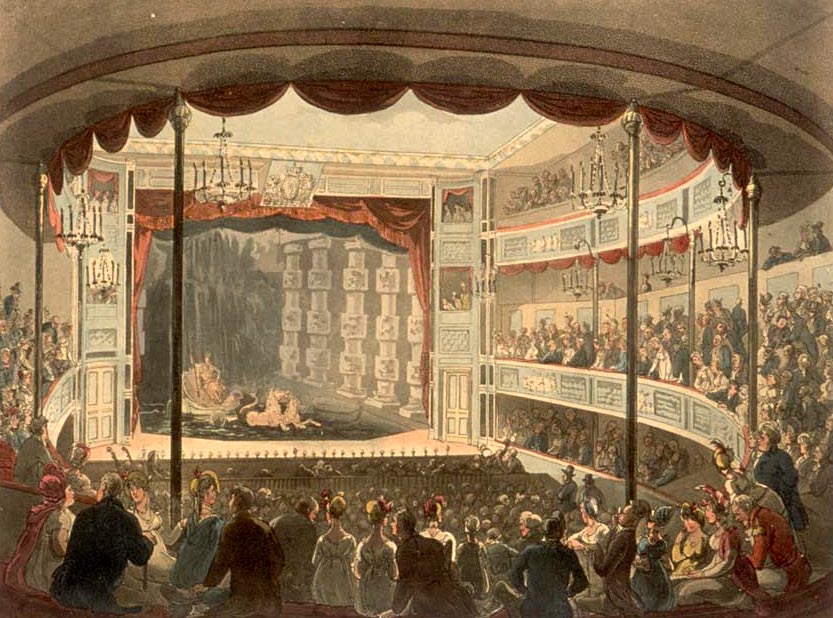
Sadler's Wells was founded in 1683 when a surveyor discovered a mineral spring there.  It became a fashionable resort for high society but declined in popularity.  It also served as a music hall before becoming a theater and today is a dance house of which there is no mention of any mineral springs on the site. For shame!

"The Monument" is another tourist attraction tourists flock to today.  Erected in 1677 by Christopher Wren, it marks where the Great Fire of London is said to have started.  Visitors could climb to the top to gain an impressive view of the city.  Visitors now can do the same, with the help of a fence around the platform, which was added in the 19th century due to multiple suicides.  Goodness, I wouldn't want to be on that platform without that fence, especially in panniers!

Of course there were the famous pleasure gardens which had both residents and tourists alike flocking to.  Evelina is fortune (or perhaps unfortunate) enough to visit the most famous ones.  Vauxhall, Ranelagh, Marylebone, and Kensington Gardens drew both the upper echelons of society and the prostitutes that fed off them.  Every garden had endless amusements, both in the gardens and in watching the people in attendance at them.

Remember when there were no new television shows during the summer and you had to wait until fall for all the premieres?  So was the case for theater-goers in London.  The theater season began in September and ended in June.  That is, if your theater wasn't "Foote's."  Samuel Foote's theater took advantage of the off season to stage plays for those who remained in London for the summer.

At King's Cross Road one could visit Bagnigge Wells, another fashionable spa which brought the country to London.  One could roam in a honeysuckle covered tea arbour, visit the gardens and fish ponds, skittle alley, bowling green, or bun house.  Just as with any fashionable pump room you could rub shoulders with the elite as well as attend concerts. 

Thursday, January 27, 2011

The Tower

An essential tourist attraction to first-time visitors to London is the Tower of London.  Hoards of people visit to see the city's castle which has a long list of famous prisoners.  The same was true of tourists in the eighteenth century.  The Tower was rarely used to house prisoners and, like today, it housed the crown jewels which were on display for the public.  For a small fee you could view the royal jewels, which seems quite daring in the days before CCTV and bullet-proof glass.  A renewed interest in the medieval period and the Gothic also brought visitors into the Tower.

Something that eighteenth-century visitors did get to enjoy that we no longer do in the present age was the Tower's menagerie.  The Royal Menagerie at the Tower had been there for centuries and had an array of amazing animals through its many monarchs such as elephants, leopards, lions, and even a polar bear.  For the small price of 3 half-pence you could gain admission but if you didn't have that kind of money, a cat or dog would suffice.  Why a cat or dog? Well, what else were the lions going to eat? Yikes; I surely wouldn't be there during feeding time, how traumatizing!

Thursday, December 9, 2010

Coffee and Spectacle

One of the popular sights for those visiting London was Don Saltero's coffeehouse in Chelsea.  Coffeehouses themselves weren't uncommon, they were popular local hangout where you got the local news and gossip.  Much like today's local pubs or internet social networks, coffeehouses tended to be part of the daily routine.  What set Don Saltero's apart from others was it was both a coffeehouse and museum of curiosities.


Wunderkammer or cabinets of curiosity were popular spectacles for people in the renaissance onward.  For those with enough money to house these collections, wunderkammers could be a time consuming and expensive hobby.  Beside cabinets, whole rooms were dedicated to the marvelous.  What sort of things would you find in these cabinets?  Well it wasn't Ripley's Believe it or Not Museum, curiosity cabinets contained many natural objects of beauty.  Shells, rocks, taxidermy, and if you were especially lucky, unicorn narwhal horns.  Many beautiful depictions of these collections can be found in museums.

These were the sort of objects you would find at Don Saltero's although the uniqueness of these being at a coffee house made the place a bit of a tourist trap albeit a good one.  While many 18th century wunderkammers now served as places of study Don Saltero, or James Salter, brought articles of curiosity to the masses for the price of a cup of coffee. 

Salter began as a humble barber in the late 17th century.  He had amassed a decent collection of articles from his old employer, Sir Hans Sloane, the founder of the British Museum.  Whatever Sloane didn't care for he would hand off to the grateful Salter.  When Salter founded the coffeehouse in 1695 customers were wowed by the rejected articles.  Salter even published catalogs of his collection.  Don Saltero's became such a famous attraction of London that when Salter died in 1768 his daughter took over running the coffeehouse museum.  However, at her death there was no one to continue the care of the business so in 1799 the marvelous collection had to be sold.

Tuesday, October 5, 2010

Ranelagh Gardens

Ranelagh Gardens (pronounced Rawn-a-lah or Ran-a-ley in some cases) was one of the 18th century watering holes of the social elite of London.  Like a classic newest big thing, Ranelagh was instantly popular which instantly gave it a reputation for being a prime place of celebrity spotting and showing off your newest fashionable wear.  Those finely dressed and with enough shillings to be admitted to the public gardens were entertained by the scenery in the form of tree-lined roads, a man-made lake, and even a Chinese pavilion which was built later in 1750 when their was a fad for all things oriental.  Ranelagh was also an ideal setting for a masquerade.

The gardens' main attraction (which rivaled the attraction of people-watching) wasn't lovely flowers, no, it was the architectural wonder known as the Rotunda.  The Rotunda housed musical performances such as the composer, Mozart who performed there as a child.  Those entering the Rotunda would be awed by the centerpiece, a large, ornate support containing the heat sources so you could walk about even in the cold of winter while other pleasure gardens were still closed.

Despite its extreme popularity, Ranelagh's 18th century heart, that is the Rotunda, was destroyed in 1805 after a drop in visitors.  The gardens remained but lacked the atmosphere they once boasted in the previous century.  The soul of Ranelagh was now gone.  However the atmosphere is still captures in the immortalized prints and paintings of the romping ground.


Monday, September 29, 2008

"Darling, Should We Call on the Pig Today?"


With the wind-down of the Westminster Elections of 1784 there was not enough supply for the gossip-demand. The quack doctor spectacle seemed to be simmering down, and you could only make fun of Perdita for so long. Luckily enough for the people of England, a pig came to their rescue. There was once again fun news to talk about!

A learned pig was put on display and wowed audiences with its ability to arrange cards with numbers or letters on them. The pig could probably count but it was also advertised in The Daily Universal Register (today, The Times) as being able to tell time, cast accounts, and read ladies minds. That's some pig! Well, this naturally drew much attention and the pig was the talk of the town.

Rev James Woodeforde recorded that he paid a shilling to see the pig and praised its sagacity, stating that it arranged its cards to spell and do arithmetic.


The poet, William Cowper joked in a letter that, "I have a competitor for fame...in the Learned Pig! Alas! what is an author's popularity worth, in a world that can suffer a prostitute on one side and a pig on the other, to eclipse his brightest glories?"


Even Samuel Johnson was mesmerized by the pig, "The pigs are a race unjustly calumniated," rather than killing a piglet, we should "allow time for his education."

Thomas Rowlandson illustrated the beau monde's interest in the pig with the above satirical print. Which, if he hadn't documented it, it would more easily have been forgotten. The truth be told, Rowlandson was just catering to the gossip and fads of the time as he usually did in order to make his money, I'm sure he thought the whole spectacle was ridiculous. The pampered pig is depicted with a ruffled collar to differentiate it from normie pigs. On the wall the poster reads, "The surprising PIG well versed in all Languages. Perfect Arethmatician Mathematician & Composer of Musick."

But I suspect not much has changed considering I was watching this show, Hog Genius, a few weeks ago. Johnson was right, pigs kind of rock.