Showing posts with label Thomas Gainsborough. Show all posts

Tuesday, July 31, 2012

Quotables

We are all going to Heaven, and Vandyke is of the company.
-Thomas Gainsborough

Monday, August 8, 2011

New Gainsborough Self-Portrait?

This weekend I was alerted to this article thanks to M from Alberti's Window.  To summarize: art historian, Stephen Conrad bought a miniature at an auction, struck by the familiar face.  He now believes that he is in possession of Thomas Gainsborough's first self-portrait.  Conrad's evidence is the uncanny likeness and the fact that the miniature is painted in Sudbury around 1736/7 when Gainsborough would have been about ten years old.  Conrad's suspicions seemed founded when on the back in a "childish script" was written, "Gainsboro."  

Now could this sitter be a young Gainsborough? Absolutely.  The facial features are congruent with Gainsborough's self-portraits.  Is this a self-portrait? I highly doubt it.

When I first read the article Gainsborough's 1754 self-portrait immediately popped into my head.  Painted when Gainsborough was in his late teens, this unfinished work shows how Gainsborough's proficiency was still developing.  The skill demonstrated in the miniature seems much more honed than that of the 1754 portrait which was done by a young man who had studied art in London for about five years.

The other peculiar thing about this newly revealed painting is the sitter's eyes.  From what I can tell, they are brown.  If we look at Gainsborough's self-portrait from 1787 two blue eyes are looking at us.  Supposed portraits of Marie Antoinette have been disproved merely by incorrect eye color. 

I am curious to see where this discovery will go.  What do you think?

Wednesday, March 23, 2011

The Depression-Inducing Portrait

Thomas Gainsborough, The Honourable Mrs. Graham, 1775-7
Georgiana and her best friend Mary Graham had many things in common.  One of their commonalities is they were lucky enough to sit for Thomas Gainsborough more than once.  Their portraits by Gainsborough were highly praised during their lifetime yet both portraits were hidden away from eyes for many years after the sitter's death, to only be narrowly saved and revealed in the following century. 

Like many great paintings, elements of mystery surround Mary's portrait.  She sat for the portrait when she returned from her honeymoon.  Many accounts do not refer to Mary showing the symptoms of tuberculosis, the disease which would plague and kill her and her family, yet she was reportedly too weak to sit long for Gainsborough.  Mary is shown wearing an ornate masquerade dress of pink and silver in the Van Dyck style. A jaunty plumed hat is perched on Mary's high tower of hair.  The fantastic outfit dazzled viewers and was made even more impressive by the fact that it was purely a figment of Gainsborough's imagination.  Mary never owned the dress and supposedly her family was upset with her being portrayed in such a harlot-y sort of outfit.  Strangely I have never personally found any thoughts Mary or her husband, Thomas had on the painting which was raved about when it was exhibited at the Royal Academy.

Mary succumbed to consumption in 1792 leaving a devastated husband wrought with grief.  Thomas could not even bring himself to return to the homes he once shared with his wife.  You might imagine the effect that seeing the celebrated portrait would have on him.  Some accounts say that bricks were laid over the hanging portrait where it remained until it was found during renovations.  Most accounts tell of Thomas hiding it in storage in London.  Storage is where it remained until after Thomas' death.

In 1843 Thomas' cousin, Robert Graham received a message about his deceased cousin's paintings still being in the warehouse. He accepting the paintings not even knowing if they were worth the storage fee he had to pay for them.  Robert had the enthusiasm of a child on Christmas morning and intercepted the delivery cart on Dalcrue bridge and immediately began opening the crates of paintings.  Robert felt as if he was seeing a ghost when he drew out Mary's portrait which had been hidden away for fifty years.

In 1859 Robert bequeathed Mary's portrait to the National Gallery of Scotland on the condition that it never leaves the walls of the museum.  He felt that the portrait should never again be housed in darkness and should be regarded as one of Scotland's national treasures.  Visitors to the National Gallery may just feel that way upon being welcomed to museum by the elegant Mary Graham.
Side-Note: There will be a lecture on Thomas Graham at the National Gallery of Scotland on May 17. Details here.

Wednesday, December 29, 2010

Book Review: Thomas Gainsborough and the Modern Woman

It is always unfortunate to hear of a fantastic museum exhibition that is sadly too far away.  Luckily there is always some comfort in exhibition catalogs that allow the geographically challenged to vicariously attend the exhibition.  Such was the case with The Cincinnati Art Museum's exhibition, Thomas Gainsborough and the Modern Woman and I.  Luckily for me, Benedict Leca was very kind in supplying me with a copy of the corresponding book so I could get a literary perspective on the exhibition.

Immediately upon opening the catalog you will find that it is quite different from others that may be sitting on your shelf.  Of course it has the glorious colored plates of the paintings exhibited and essays by notable art historians but the book makes an impact on you before you even read a word, proving that there's something quite special about this culmination of paintings.  The title, Thomas Gainsborough and the Modern Woman automatically gives you the sense of something old (Gainsborough) and something forthcoming ("Modern") which the overall design of the book mimics, having a unique and modern layout, daringly mixing serif and sans serif fonts, putting footnotes in the center, and breaking other such rules to produce a catalog that challenges what we know to be the norm.  That is how Gainsborough was with his style of painting or, as he referred to it, "touch of the pencil" as Leca reminds us in his essay.  Gainsborough brought a unique style that elevated him to one of the most sought-after painters of his time and still brings him renown today.

Included in the catalog are three accompanying essays; one by the curator, Benedict Leca, one by clothing art historian, Aileen Ribeiro, and the last by Amber Ludwig who is completing her PhD in the portrayals of Emma Hamilton.  The three contributors all bring a different perspective to the general topic of female portraiture in eighteenth century England so you may find yourself disagreeing with one perspective and agreeing with another.

This was a fantastic read, for what is undoubtedly a great exhibition.  I found all the essays both different and engaging and loved that book not only contain plates at the beginning but large details of the paintings blown up throughout the book in order to give the reader a more intimate look at the portraits being discussed.  Many of the topics will interest readers of this blog; there is much discussion on portraying the fallen woman (most of whom have been featured on this blog), clothing, and how women could exert themselves through the painted image. 

Thomas Gainsborough and the Modern Woman will be leaving The Cincinnati Art Museum on 2 January and will soon be unveiled at the San Diego Museum of Art on 29 January.  The catalog is available to purchase from Amazon.com and the museum.

Thursday, December 2, 2010

Thank Heaven for Little Girls

Thomas Gainsborough had two children, Mary (1750-1826) and Margaret (1752-1820).

Artist's Daughters Chasing a Butterfly, 1756

The Painter's Daughters, ca. 1758

Artist's Daughters with a Cat, 1759
Portrait of the Artist's Daughters, ca.1763-64
The Artist's Daughters. 1770
The Artist's Daughter, Margaret, 1772
The Artist's Daughter, Mary, 1777
Gainsborough was a proud and affectionate father which his numerous paintings of his daughters can attest to.  His portraits also show how close his daughters were to one another.  The girls had an interesting childhood, granting them access to high society and some of the biggest celebrities of the time.  However it did nothing for their dating life.  Only Mary married and it was an extremely unhappy relationship ending in separation.  She began showing signs of mental illness and was taken care of by her parents until their death.  The Gainsborough girls lived out the remainder of their life together with Margaret acting as caretaker to Mary.

Thursday, October 28, 2010

The Obsession-Causing Portrait


What was it about painting the Duchess of Devonshire?

Her son, Hart, said none of her numerous portraits captured her true likeness.  She was the lady who made Thomas Gainsborough, an expert portraitist, throw down his paintbrush in frustration and claim the image defeated his talents.  Despite this setback, we can credit Gainsborough for perhaps the most famous depiction of Georgiana.  We also have Gainsborough to thank for creating a painting which became an obsession for many.

With a knowing look and a raised eyebrow she studies the viewer from under her powdered hair and cocked picture hat, a hat named after this very painting due to women rushing to their milliners asking for a hat just like as they saw in the picture.  The hat design was one of Georgiana's own, and had a resurgence in the Victorian era where it was known as Gainsborough hat.  The painting experienced a resurgence as well in the Victorian era when it vanished.  The famous painting we see today is only a portion of the original work that so frustrated Gainsborough in 1783.


A print showing the original layout
When Georgiana sat for Gainsborough in it was at the height of her popularity.  She was a fashion leader, active in politics, and a familiar face in the tabloids.  When she died prematurely in 1806 the nation mourned her death.  By 1830 she was all but forgotten.  So is the course of celebrity.  Somehow the painting once exhibited at the Royal Academy ended up in the possession of a simple schoolteacher who was vexed by the full-length portrait not fitting over her fireplace so she cut it down to just above the sitter's knee.  The painting then spent the next 40 or so years passing through various owners before the value was realized and it was auctioned at Christies in 1875.  The Morgan Family had every intention of buying the painting and if they had been successful the Duchess might be safe in the Morgan Library today.  Unfortunately Adam Worth, an American career criminal had already decided he must have the painting, no matter what the cost.  Once again the masterpiece was tragically cut down, this time from Worth stealing it while it hung on display. The weeping garden background that so typified Gainsborough's style was now lost forever from the painting.

1871 print showing where it was originally cut
Georgiana's portrait is now Worth's captive while he continues his crime sprees.  He creepily refers to it as "The Noble Lady" as if it isn't a inanimate object, and stores it in a false bottom trunk where it remains for about twenty-five years.  Five of those years Worth spent in jail and it was only when he was released he agree to let "The Lady...go home" in exchanged for some leniency.  Despite being hidden from the world, the portrait was well taken care of and in pristine condition  As soon as Pierpoint Morgan heard of the retrieval of the painting his father intended to buy he immediately forked over $150,000 for it, an unheard of amount for artwork at the time.  Morgan displays the Duchess to the public for a short period before doing the same thing Worth did when the painting was in his possession, keeping it all to himself.  Morgan selfishly refused to even let prints be made of the acclaimed, and now especially famous, painting.

Like Tolkien's Gollum and the ring, these men wanted to keep Gainsborough's portrait of Georgiana all to themselves, and like Tolkien's tale, the painting eventually made it to its rightful place and balance was restored.  In 1993 the portrait was once again up for auction and this time the then Duke of Devonshire knew where it needed to be.  As its former captor wished, the Duchess was finally going home.  The Duke and the Chatsworth trust bought the portrait so Georgiana could once again preside over her former home, Chatsworth, and be in the public eye rather than hidden away. After all, art is rarely meant to be hidden.

Wednesday, October 20, 2010

Saturday, September 18, 2010

Opening Day: Gainsborough and the Modern Woman

Just a kindly reminder for those in the area Thomas Gainsborough and the Modern Woman opens today at the Cincinnati Art Museum.  The exhibit is not one to be missed and what could be more fabulous than attending on opening day!

Monday, August 23, 2010

Upcoming Exhibition: Thomas Gainsborough and the Modern Woman

Art, fashion, and scandalous ladies; does it get any better than that? 

On 18 September The Cincinnati Art Museum will be unveiling its new exhibition, Thomas Gainsborough and the Modern Woman, a fun romp through the beautifully painted women who sat for Gainsborough as put together by curator Benedict Luca.  Presiding as hostess would be the Cincinnati Art Museum's own Ann Ford (Mrs. Thickness) whom has just undergone a thorough cleaning.  Joining her will be the iconic Grace Dalyrymple Elliott, Viscountess Ligonier, Maria Fitzherbert, and Elizabeth Sheridan, among others.  Together these fabulous women rendered by Gainsborough  not only represent feisty females of the time but also an era of women taking possession of their own image.  The exhibition will "ask us to look anew at the formal specifics that made his portraits so important to ambitious women and their self-definition in the celebrity culture of the period."

It is only appropriate that period gowns will also be featured alongside the paintings; Gainsborough had a love of portraying couture unlike his rival, Joshua Reynolds, who preferred his female sitters in classical drapery.  Not only will the exhibition bring together an amazing collection of portraits but also some fabulous examples of fashion from the same period.  Visitors will be plunged headfirst into a the glamor of 18th century aristocratic life.

Thomas Gainsborough and the Modern Woman will run at the Cincinnati Museum of Art from 18 September to 2 January and will then move to San Diego Museum of Art from 29 January to 1 May.  It promises to be a show not to be missed! Will you be attending?

Press:
Read more about the curator's journey through piecing together the exhibition together here
ArtDaily.org announces Thomas Gainsborough and the Modern Woman

Friday, June 11, 2010

Thomas Gainsborough's Portraits of George III's Family

In 1782 King George and Queen Charlotte decided they couldn't get enough of their large family and commissioned their favorite artist, Thomas Gainsborough, to paint individual portraits of everyone. It is kind of like those old school portraits your mother still has on display, right down to the bland background. Awkward smiles are absent and I think the outfits are quite fashionable unlike my school portraits.


Queen Charlotte
George Prince of Wales
William IV
Princess Royal (Charlotte)
Prince Edward, Duke of Kent
Princess Augusta
Princess Elizabeth
Prince Ernest, Duke of Cumberland late King of Hanover
Prince Augustus, Duke of Sussex

Prince Adolphus, Duke of Cambridge

Princess Mary

Princess Sophia

Prince Octavius

Prince Alfred


Some of you may have noticed two family members are missing. First of all, I'm impressed if that is the case. Princess Amelia was not portrayed for she was still a twinkle in her father's eye. The second-born Prince Frederick is also missing from portrayals. This is not due to his parents' dislike of him but because the prince was vacationing on the continent. However, some art historians can't believe that Gainsborough would go without completing the family and think there is a long lost Frederick portrait.

Sunday, May 23, 2010

Yay or Nay? Mrs. Anne Pleydell

Despite the many watermelon comments (is anyone else hungry now?) Princess Frederika Sophia Wilhelmina was met with an overall Yay from the panel. This week let us examine an outfit that isn't so fruity-tootie. Perhaps the gown will be a little sweeter or maybe it will just leave you with a rotten taste in your mouth.


Thomas Gainsborough paints Mrs. Edmund Morton Pleydell (1765) in her puffy ivory and blue ensemble. Yay or Nay?

[Boston Museum of Fine Arts]

Thursday, April 29, 2010

Name that Gainsborough

You heard me! Can anyone identify this snippet of a famous painting?

Wednesday, April 7, 2010

Quotables

"We are all going to Heaven, and Vandyke is of the company."

-Thomas Gainsborough

Sunday, March 28, 2010

Yay or Nay? Giovanna Baccelli

Once again kindness was bestowed upon our subject, in this case, Mrs. Boardman. She was greeted with a Yay, but still got many slaps on the wrist for clashing with her drapery. Bad play Mrs. B! Will you be just as kind this week with something more whimsical? We shall see.

Thomas Gainsborough paints Giovanna Baccelli in her pastoral costumes for the ballet, Les Amants Surpris (The Surprised Lovers).

[Tate]

Friday, March 27, 2009

Tart of the Week: Elizabeth Linley Sheridan


One of the most beautiful and musically-gifted women of the late 18th century was Elizabeth Linley. Elizabeth, or Betsy (and even Eliza on occasion) as she was commonly known, was born in 1754 to the composer Thomas Linley and his wife Mary. Together, Thomas and Mary raised their twelve children to be just as musically talented as themselves. Think: Von Trapp family of Bath. Adorable little Betsy would stand outside the Pump Room selling tickets to her father's concerts. Betsy grew gracefully into a stunning Soprano and soon drew her own crowds in with her beautiful voice. By the time Betsey was barely fourteen she had all the guys drooling over her. She had a tall, slim figure, dark hair, and gorgeous porcelain skin. Thomas Gainsborough took notice of her right away. The artist had painted more than one portrait of the musical Linleys but he especially took notice of Betsy. His many portraits of her, flaunt her natural beauty.

Among the many admirers and young men begging for Betsey's hand was twenty year-old Richard Brinsley Sheridan. Sheridan was perhaps more interested in the chase, and the prize at the end was something he could rub in everyone's face. However, a certain Walter Long stood in his way. Long was really wealthy and about four times the age of Betsy. Thomas Linley pressured his daughter into the match for both the money and for the assurance than she would retire from the stage. God forbid she become an actress! The two were about to marry when Long randomly cut off the engagement, causing Thomas to fly into a rage. Rumors surfaced that Betsy had begged him to break it off. The whole drama resulted in a comedy to premiere at the Haymarket Theater called The Maid of Bath.

Another drama quickly followed Betsy's broken engagement with Thomas Long. Sheridan saw his chance and swept Betsy off her feet. She agreed to marry him and the two eloped to France in 1772. Since both were underage, the marriage was invalid, and neither father approved. To save his daughter's reputation Thomas gave his blessing a month later and the two were accepted into polite society as a very talented and good-looking young couple.

While absconding away to France Betsy became very sick and almost died. Sheridan began to realize just how much Betsy meant to him and how he truly did love her, she wasn't just a prize anymore. Although Betsy survived, her illness was to be a precursor to the many that would follow throughout her life. Miscarriages soon burdened the new couple and it wasn't long before Sheridan began wandering into other women's beds. Betsy was devastated; the man she had chosen above others and at a huge risk, couldn't even be faithful to her. Still, they attended the political events and masquerades and men still marveled at her.

It was only a matter of time before Betsy finally had the courage to have her own affair. Her choice: the hunky Lord Edward Fitzgerald. Unfortunately the affair resulted in a pregnancy. Not only would her infidelity be discovered, it would put her life at serious risk. When Sheridan found out he had an usual reaction for a Georgian male with a big ego: he blamed himself. Instead of casting her out, he spent more time with her and helped her through the pregnancy which proved to be difficult. In fact after Eliza managed to deliver a baby girl her health depleted further and she succumbed to tuberculosis.
Betsy was dying and both she and Sheridan knew it. They went to Bristol in hopes that the hot wells would improve her health. Sheridan tried to support his wife but seeing her dying in front of him torn him up from the inside. One night he found her playing piano, "with tears dripping on her thin arms," a shadow of her former self. Not long afterward Elizabeth died. Sheridan, in tears, held her hand, while she told him to stop crying or to leave the room, for she could not bear the sight when she needed fortitude. The guilt after her death sent Sheridan into the realms of madness. He wasn't the only one to morn her. The crowds at her funeral were so large that the carriage could barely get through the street to Wells Cathedral. Everyone crowded one last time to pay tribute to the maid of Bath whose voice was now silenced forever.

Wednesday, January 21, 2009

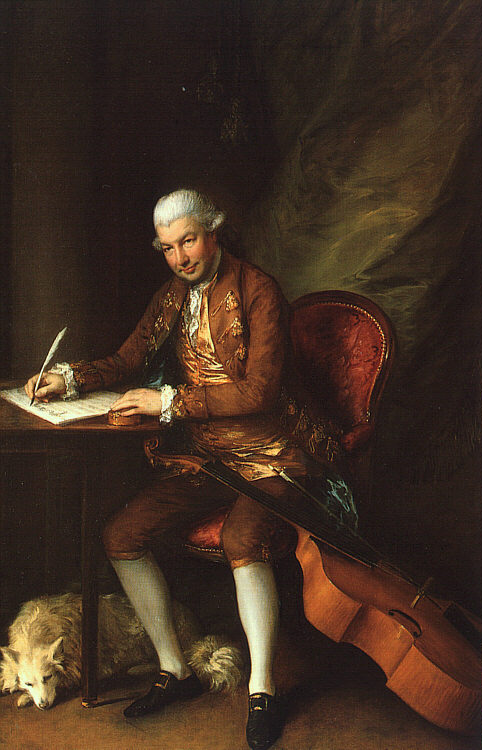
Immortal Companion: Carl Friedrich Abel


To begin a series on pooches in paintings, I wanted to open with one of my favourite human-dog portraits. Thomas Gainsborough's portrait of the composer Carl Friedrich Abel depicts the music man as if we have just interrupted him in his study. The busy musician looks up from his work that he has been pouring onto paper before the notes leave his head. His cello (musicians, feel free to correct me if I'm wrong!) casually leans against his leg, so he can quickly play the tunes he hears and then go back to recording them on paper. Abel is obviously successful in his musical career. The grandness of his fine chair, the drapery, and even his copper coloured silk vest excrete wealth and success. He is enlightened man because of his connection to music...and nature.

Sleeping calmly at his master's feet is Abel's dog. The faithful companion is the only one allowed in Abel's private study while he works. We can see why, he is a quiet audience. The dog's presence evokes a sense of calm and gives the viewer a sense of comfort about the sitter and his personality. In fact, the dog completes the portrait; it would be unbalanced without him. Gainsborough, a big dog fan, puts a lights source on both Abel's face and the dog's. The rest of his fluffy white body is shadowed under the desk. If you think only a crazy dog-lover would zone in on the pooch in the painting, let me reiterate how much the people of the 18th century loved their dogs. When the painting was exhibited, the St James Chronical reported on "the correctness" of Gainsborough's execution of the dog. Ya know, just in case you were worried that the dog didn't come out right!

If you were wondering about that music Carl was composing in the painting, I put together a sampling of it below. It gave me an excuse to play with the amazon mp3 player! So now you can make like Abel's puppy and relax to the sounds of his strings.