Showing posts with label William Hogarth. Show all posts

Tuesday, January 11, 2011

Lambert's Views of Chiswick in the 1740s


William Hogarth and George Lambert, View from the Cascade Terrace, Chiswick House, 1741


George Lambert, Chiswick, View Towards the Inigo Jones Gate, 1742

 George Lambert, View of Chiswick Villa from a Balcony above the Cascade with the Lake, 1742

Monday, January 3, 2011

Hogarth's The Graham Children


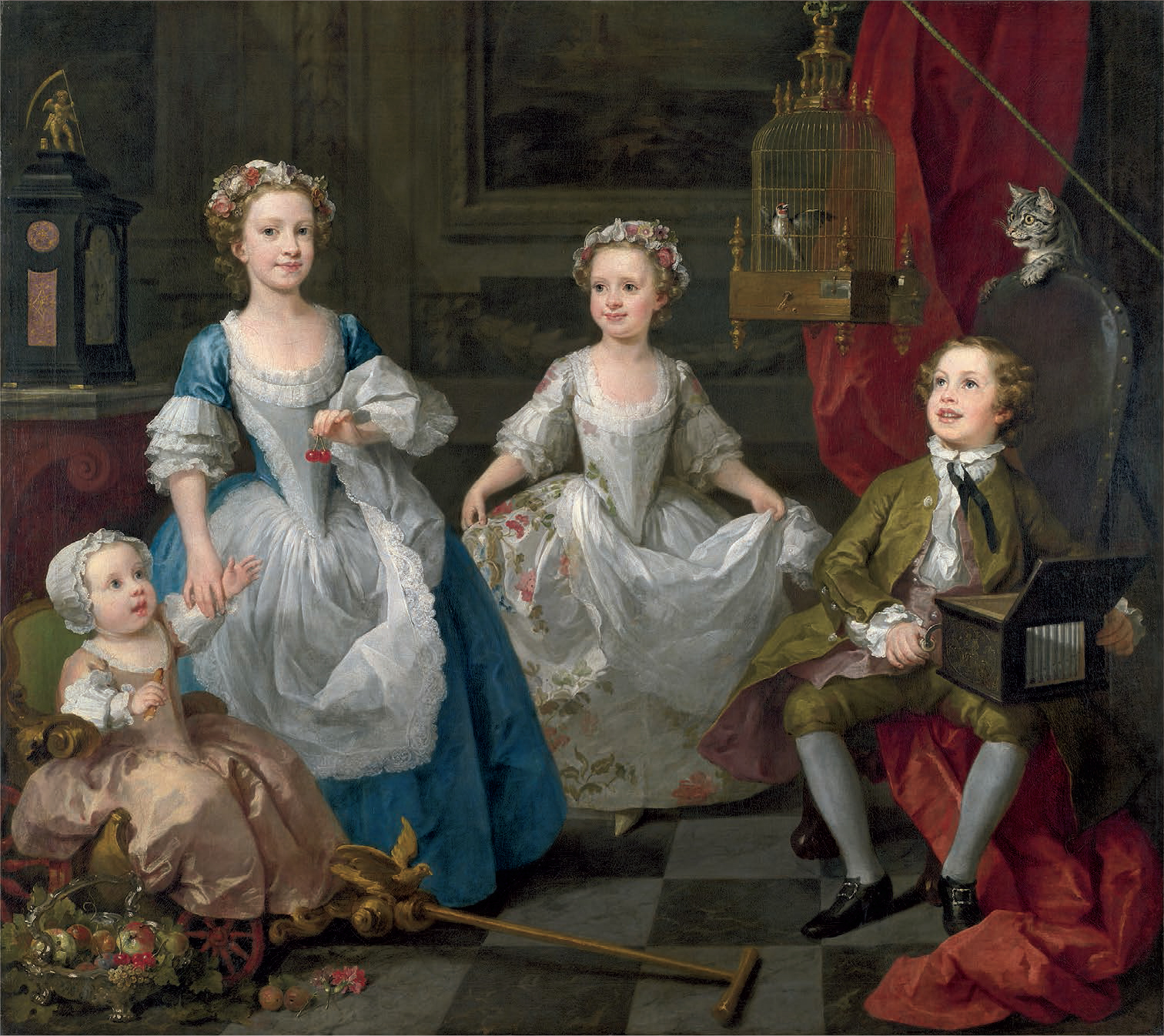
Perhaps William Hogarth's finest portrait would be his 1742 painting, The Graham Children.  The Graham whose children was portrayed was Daniel Graham, the king's personal pharmacist.  As you can probably tell by the children's fine clothing and the fine background, the king's apothecary made a good wage.  Something that also stands out is how beautifully rendered and happy the children are.  Hogarth had a great fondness for children (he was a founder of the Foundling Hospital) and his affections for them shine through in his painting. 

Like Hogarth's satirical pieces, the artist can not help himself and includes symbolism into the work.  Behind the children stands a clock with the bronze figure of Cupid wielding a scythe next to an hourglass which symbolizes death's triumph over love, hinting to viewers that this is a posthumous portrait.  My favorite aspect of the painting is the cat crawling up the chair to get closer to the the pet goldfinch who is quite unsettled by its new visitor.  From far away the feline has the "aww" factor but an up close examination delivers a more frightening perspective.  The cat's expression actually reminds me of of Sir John Tenniel's illustrations of the Cheshire Cat.  The direction of the boy and cat's eyes reflects the opposite plane of the composition in which the baby reaches upward for the cherries in his sister's hand.  The cherries which have somewhat of a scandalous symbolism today were a childhood symbol in Hogarth's time, the "fruit of paradise."

If you have been trying to figure out which of the child sitters had sadly passed at the time of the portrait it would be Baby Thomas which explained why the cherries were just out of his reach.  Hogarth created a fitting sentimental portrait of the Graham children which many would admired. Gone were the stiff child portraits, Hogarth brought a new standard for the sentimental family portrait.

Tuesday, December 7, 2010

Quotables


"We know the very minds of People by their Dress."
 -William Hogarth

Friday, July 23, 2010

Naughtiness Immortalized...Repeatedly

Oh Sir Francis, you rogue!

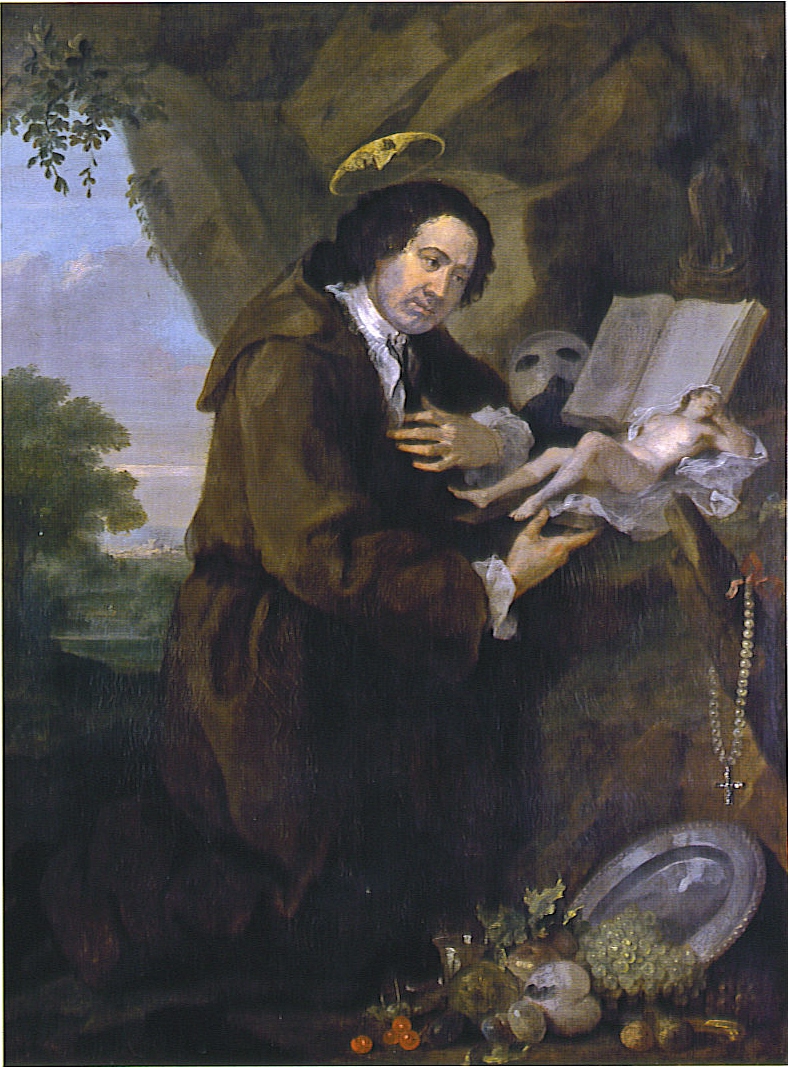
Sir Francis Dashwood has quite the reputation for his debaucheries.  Being somewhat of a king of the Hell-fire clubs and a outspoken scorner of everything sacred, Sir Francis liked to see how much mischief he could get away with.  Most of his mischief was carried out in the privacy of his own home or among a secret society so how could Sir Francis spread the word around of his dubious reputation?  Why immortalizing it in a portrait of course!

Portraits were a rarity to everyday folks and normally to have an artist immortalize you in oils you wanted to look your best so that past generations would remember you as such.  This is how Sir Francis wanted us to remember him as:


I'll let your form your own impressions.

As if the 1750s portrayal wasn't outlandish enough, Sir Francis not one but twice had himself portrayed as Saint Francis which was one step away from blasphemous, given Sir Francis' reputation for renouncing God every chance he got.  One of the portrayals can be found on a sign in the caves of his West Wycombe estate.  The other portrayal was done by his good friend, William Hogarth, and shows Dashwood kneeling before a vision of a sprawled out naked woman with a pile of questionable looking fruit at his knees.

Thursday, December 17, 2009

The Foundling Hospital


Establishing a large metropolitan orphanage seems to have marked a city and its society's arrival at their own Renaissance. They came to symbolize a time of wealth and an new found interest in the welfare of its people. During the Italian Renaissance foundling hospitals (remember, hospital-hospitality) sprung up, one even had a large wheel that you could place your baby on and rotate into the building so as not to show your shamed face when your dropped your child off. Amsterdam's beautiful History Museum is housed in the former old Civil Orphanage, established during the Dutch Golden Age. The English were very stuffy about the topic of illegitimate children. They saw orphanages in the same way many people now see giving condoms to teenagers: if we provide a place for whores to put their unwanted children it's condoning bad behavior. It wasn't until the Enlightenment that there was a call to finally do something about the orphan problem.

If a family or individual couldn't afford to take care of their child, it tended to end up in a workhouse; think: Oliver Twist. Only 10% of the children sent here would survive. Those that were too young to work would be on the streets. Dead babies in the street were a common, early-morning sight. This was a sight that Captain Thomas Coram couldn't bear to see. For years he petitioned the king for a foundling hospital with no success. Luckily, King George II ascended to the throne in 1727 and his wife, Queen Caroline had the same concerns as Coram about the children. Coram's petition for a hospital that would turn forgotten children into useful citizens seemed like a good idea to this king and he approved it. The nobility and the wealthy also thought it sounded good and many became subscribers, that is, donated their money to build the hospital.

Those who couldn't spare money were able to help in other ways. The idea of the Foundling Hospital appealed to William Hogarth, who often critiqued society in his artwork. He became one of the hospital's founding Governors and would go on to foster some of the children with his wife since they had none of their own. Hogarth brought artwork to the hospital, donated by himself and other artists such as Gainsborough and Reynolds, and even designed the uniforms and the Coat of Arms. Another artistic supporter was George Frideric Handel. The musician was in the height of his career and used his popularity to his advantage by holding charitable performances in order to raise money for the hospital.
The Foundling Hospital wouldn't take all babies at first, but by 1756 a basket was hung outside its door to symbolize the law passed in the House of Commons deeming that the hospital would turn away any child under twelve months old. Many times, the babies would be dropped off with some sort of token by their mother, perhaps symbols of sacrifice or remembrance. A key, a more pricey and meaningful token of ownership, were often left to symbolize that the mother meant to reclaim the child if fortune ever was to smile on her. Babies' lives began at the hospital with wet nurses, who lived outside the actual hospital. One of Hogarth's duties was to supervise the wet nurses. When old enough, children were tended to inside the hospital, girls and boys on opposite wings as was traditional in orphanages. Here the children were tended to when they were ill, given food and amenities, and an education. There was an apprenticing program, so that when the children became teenagers they became apprentices and began their journey into the outside world.

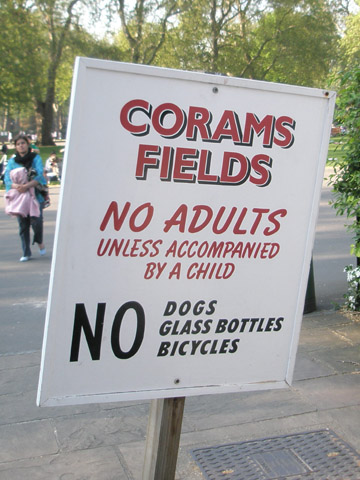
Today the hospital doesn't exist. The 20th century saw the end of orphanages in England and the demolishing of the actual building which was once described as being, "the most imposing single monument erected by eighteenth century benevolence." Traces of this symbol of humanity can still be seen on the former site. A playground sits on seven acres of the site, which is commonly used by children from the modern hospital nearby, Great Ormond Street Hospital. The Foundling Museum stands to tell the Foundling Hospital's story and houses the art collection William Hogarth put together to bring the joy of art into forgotten children's everyday lives.

Thursday, December 3, 2009

The Rake's Progress, Part 5: Married to an Old Maid


When we last saw Tom Rakewell he was teetering over the gates of Debtor's Prison but at the last moment was saved by the most unlikely of sources, the woman he had forsaken, Sarah Young. Perhaps this act of charity will renew Tom's love for his old flame and turn his life around?

Well Tom is getting married but his bride does not look like Sarah. In fact, his bride looks slightly older than Sarah. Instead of Sarah's selfless act causing Tom to see the error of his ways, it made Tom realize how short of cash he was! In a desperate act he finds the richest old spinster he can find in order to renew his funds. In a cramped church on the outskirts of London they are wed. The church itself is covered in cobwebs and literally has cracks in the foundation. The new Mrs. Rakewell is conveniently short enough for Tom to be able to look over her in order to ogle the attendant. Those in the ceremony seem blissfully unaware of all the commotion by the church door. Sarah has shown up with her son and her mother who is so angry that she is being apprehended by a church attendant. The ever amusing Hogarthian symbols are not to be neglected. In the foreground a pug pants over a maidenly-pup. The interaction mirrors Tom and the oblivious attendant whom his eyes have landed on.

Will Tom grow to love his blushing bride or leave her for faithful Sarah? Or is something more villainous afoot? We can only hope Tom is finally ready to settle down now that he has walked down the aisle.

The Rake's Progress Part 1
The Rake's Progress Part 2
The Rake's Progress Part 3
The Rake's Progress Part 4
Next >>

Friday, September 25, 2009

Tart of the Week: Elizabeth Needham


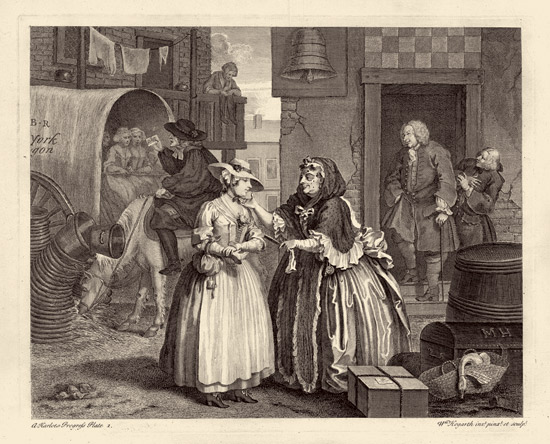
You might recognize this tart. The only image we have of her is a satirized one by William Hogarth from the first image from A Harlot's Progress. But what many may not know is that Mother Needham was a very real person; a pimp, a cunning businesswoman, and tart by all means.

Who knows why or how Elizabeth got involved in the brothel business but she opened up one of the nicest brothels in London, and did so on the nicer side of the city. Elizabeth's face may have been scared by her various venereal diseases but she dressed in fine silks and wanted no less for her fancy brothel which demanded the best. Her whores had only the best clothes, but that was because they were ones that they were forced to rent from Elizabeth. The woman was a shrewd businesswoman, which perhaps explains why she was such a successful procuress. Elizabeth was known to pick up her pretty prostitutes from the streets. She invited the homeless girls to live with her under false pretenses. Soon the girls found themselves having to pay a heavy rent in order to live and work in the elegant brothel. If they couldn't pay up they were forced to take on more customers or face debtor's prison.

Elizabeth wasn't unfamiliar with prison herself. On 21 July 1724 The Daily Journal reported,
Yesterday morning the celebrated Mother Needham and Mother Bird, two eminent conservators of the Game of the Kingdom, were committed to Newgate; their houses being disturb’d the night before by the Constables, who disengaged the Gentlemen and Ladies to a great number, and carried them to the Round-House. This being the first time Mrs Needham ever received publick correction, since her being at the head of venal affairs in this town, ’tis thought will be the ruin of her houshold.
Yes, Elizabeth was quite the drama queen. When she wasn't herding young innocents into servitude, her house was burning down with Frenchmen in it. She also had the pleasure to house the infamous prossie, Sally Salisbury in her confines. The newspapers and gossipers always seemed to have something to talk about with Mother Needham around.

However, tongues can only wag for so long when a woman is condemned. A raid on brothels sent Elizabeth to court to pay for her crimes. She was fined a shilling and sentenced to two days in the pillory. As with many of our tarts' judgment days, the whole town showed up to witness. Elizabeth was feeling ill so was allowed to lay face down in front of the pillory. Someone (maybe Elizabeth herself) paid guards to stand in front of Elizabeth as some sort of protection from the onslaught of what she was about to be pelted with. The crowd was large and very rowdy. A little boy died when he fell on a iron fence, trying to get a better look. By the time Elizabeth was brought to the pillory the crowd was out for blood, her blood. They were so violent in pelting Elizabeth that she was dragged off the pillory half-dead, despite her face-down position and guards. Her wounds would prove to be fatal and Elizabeth soon died from the ordeal before she could even make it to the second day of her sentence. While Elizabeth was not the nicest person in the world, her violent martyrdom begs the question: why so bitter?
May he who is without guilt cast the first stone.

Wednesday, September 2, 2009

The Rake's Progress, Part 4: Arrested for Debt


It may strike you as surprising to catch our favourite rake out and about in the light of day, but that is where we find Tom is this next edition. My guess is he is finally returning home after a night out. He exits his sedan chair to find out who has the audacity to prevent him from passing only to find it is two Welsh Bailiffs. Uh oh, this can't be good. It would appear that Tom's debts have finally caught up with him and now he must pay. To the debtor's prison with thee! But just as things are about to get messy, aid comes to Tom in a surprising form. Lowly milliner, Sarah Young, the very same pregnant, former-fiancee of Tom's happened to be walking by with her wares when she heard the commotion. Not being able to bare the thought of Tom rotting away in prison, she scraps together what little wagers of a single, working mother can, and pays the bailiffs for Tom's freedom. For some reason I feel this act of charity and compassion was wasted...but what do I know!

In the hustle and bustle of the London street it is easy to miss a few great Hogarthian details. A little dog calmly sits and watches the whole folly. Hogarth commonly added dogs to his paintings to symbolize the calm outside observer. During the commotion, a pickpocket snatches Tom's fancy cane. The lantern-lighter is refilling the oil in the street lamp and oops spills oil on Tom's nice white wig. Not only is this for comic relief but also is a reference to religious blessings (oil on the forehead) and how Sarah's act of charity was a blessing. A blessing soon to be forgotten, no doubt!

The Rake's Progress Part 1
The Rake's Progress Part 2
The Rake's Progress Part 3
Next >>

Tuesday, June 23, 2009

The Rake's Progress, Part 3: The Tavern Scene


It's been a while since we last saw our rambunctious rake, but he is back and up to some antics. Much of this painting is self-explanatory. The other title for it is The Orgy. Good ol' Tom is seen here canoodling with some lovely ladies of the night. These prostitutes are quite the entertainers, as you can see they have gotten Tom quite intoxicated. While Tom is in the aftermath of ecstasy, the syphilis-covered ladies take advantage. One of the prostitutes slips her hand down Tom's shirt and swipes his pocket-watch. Well, hopefully his father's will-money can cover that loss just as it has covered the bill for the evening.

But once we get past Tom's debauchery, we can start to disect the bad behaviour of the ladies with whom he keeps company. They are a bad set. First of all, we have no idea if the foremost whore is dressing or undressing; either option is not appropriate, even in a Roman-style tavern. One lady feels she has been miffed for attention and is therefore lighting fire to a map on the wall in order to gain some. Two of the ladies are having a spat and one (quite literally) spits her drink into the other's face. Perhaps she is not the whore to insult because she is holding a knife. These ladies do not keep a clean house either. Look at what a mess they made! I hope that when Tom finally decides to settle down, it with someone better behaved than this brand of woman!

The Rake's Progress Part 1
The Rake's Progress Part 2
Next >>

Wednesday, April 22, 2009

The Rake's Progress, Part 2: Surrounded by Artists and Professors


When we last saw our young man about town he was in mourning for the recent passing of his father. Now we rejoin him at his morning levee. And what a crowded levee it is! In fact, while Tom is being groomed for the day ahead he also conducts important business. He must be very busy now that he is the head of the household. You may notice that the somber surrounding of his father's home have now been transformed into the luxurious ones they should have been. Now that's the home of an heir!

The many faces crowding around Tom are the various artists and instructors that are now on his payroll or vying to get on that payroll. A beautifully rendered musical instructor sits at the harpsichord. Amoung the other masters there is a fencing master, quarterstaff instructor, a landscaper, a fox hunt bugler, and even an old drunken soldier offering to be a bodyguard; although I couldn't imagine who would want to kill Tom. Taking center stage, and even upstaging our subject himself is the very french dance instructor in exaggerated dress-a real pet peeve of Hogarth's. Tom's tutor does not look amused at all by the crowded levee. He crosses his arms and grumbles at the zealous fencing instructor.

Oh how will Tom decide between all these neccessary services? He will simply just have to take them all. It is the only means of improving oneself...in the most fashionable way of course!


The Rake's Progress Part 1

Next >>

Sunday, April 5, 2009

The Rake's Progress, Part 1: The Heir


While most of our Hogarthian series tend to end with a death A Rake's Progress begins with one. We are introduced to our hero while he is in mourning for his poor father, whom has just passed away. Tom Rakewell is fresh out of university, having the finest education money can buy. So perhaps his collegiate experience has prepared him for being the head of the household. Look, he is using both his debate and business class skills already! Our rake's pregnant fiancee has just arrived with her mother. As you can tell by the look on Tom's face, he's is giving some lame excuse as to why he changed his mind about marrying her. She cries while her scary mother looks like she's about to beat an heir.

But Tom really does not have any time to deal with these triffles. He is very busy. While his father devoted his life to humility Tom thinks both he and his new pad are overdue for some pampering. The mourning servants, with tears in their eyes for their deceased master set to work putting up the black mourning clothes over the walls of the house. But the first order Tom puts into action is shopping for new clothes. He was being measured for a new outfit when he was so rudely interupted by the pregnant Miss Young. His lawyer takes advantage of the situation to dip his hand in an open pocket of gold coins. He has also instructed the servants to open up all the dusty chests and wardrobes to know the true possessions of his father that had been hidden from him throughout his childhood. Apparently his father was quite the miser, as one servant has found treasures in the chimney. Oh dear, it is beginning to appear to me that young Mr Rakewell is entirely self-centred.

It becomes more and more apparent just how much of a miser Rakewell Senior was. There is even a portrait of him counting money above the fireplace. It appears that this hindering lifestyle has caused the young Rakewell to go on a path in the opposite direction. After so many years of saving money he is ready to be a one man economic stimulus!

Next>>

Wednesday, January 7, 2009

A Harlot's Progress: Plate 6


I wish I could say that our journey with Moll ends happily, but unfortunately I can't. This is a Hogarth series after all! We now find Moll at her own wake which anyone would be proud to call their own. Look, there's a nice crowd, a parson, a decent casket...which is being used as a bar. At second glace, the parson's hand seems to have disappeared under the skirt of the prostitute next to him. This is an awful wake! It appears as if no one even cares about our heroine's passing. All the other mourners/prostitutes are distracted at their co-worker's wake. One bar-tends, two gossip, another is checking her hair in the mirror while one more steals the undertaker's handkerchief. One prostitute is oblivious to Moll's dead body in front of her as she shows another mourner her injured pinky.

Even Moll's little son seems to not care about his own mother's passing. Whether this is because of her mothering skills or childhood ignorance, we can only guess. He sits under Moll's coffin and plays in front of the rosemary that is traditionally brought to funerals.

There does seem to be one person generally sad about Moll's passing and that is her madam who weeps by a bottle of booze. Maybe it's the booze talking? Or maybe, just maybe, someone does feel the loss of this gentle soul. Considering that this is a procuress we are speaking of, she is likely just mourning one less income to go into her pocket. If so, that means no one actually misses poor Moll who died at the age of 23 in 1731.

This may seem like a harsh satire that Hogarth presents us with but there is some truth in his assertion. Although the path to prostitution may have been a quick fix to poverty, the profession contained many dangers and sadness. Successful and celebrated prostitutes such Kitty Fisher existed, but were still rare. Today still, many young women are faced with the same options as Moll Hackabout and choose the same lifestyle. Like the fictional Moll they fall victim to substance abuse, sexually-transmitted disease, imprisonment, and poverty; not to mention many other awful things. Therefore, Hogarth's humourous satire also contains a frightening warning that should still be heeded to this day, as poor young girls are still forced into this dangerous way of life.


A Harlot's Progress Plate 1
A Harlot's Progress Plate 2
A Harlot's Progress Plate 3
A Harlot's Progress Plate 4
A Harlot's Progress Plate 5

Monday, December 15, 2008

A Harlot's Progress: Plate 5


Can't you just hear the commotion through the thin tenement walls? In Hogarth's next print in the series we find out heroine, Moll is out of prison but in a setting that is not much improved. Moll barely has a breath left in her, she is deathly ill. She slumps in her chair, half unconscious, wrapped in white linen like a specter. While she breathes her last, two notable doctors fight over her cure, too distracted by their own egos to notice their patient. The rotund, German doctor, Richard Rock argues that they should bleed her while the skinny French doctor, Jean Misaubin shouts that cupping is the way to go. Amongst the French and German accents is Moll's maid's vulgar tongue, screaming for them to pay attention to her mistress who lays limp in her arms.

Among the dissaray are two figure who seem to not be bothered by the commotion. One is the nurse or landlady who scours through what is left of Moll's possessions, looking for something worth stealing. Judging by the hovel Moll now calls home, it is unlikely that she will find anything worthwhile. A little boy is roasting a piece of meat on a string while he itches the lice in his hair. This is Moll's son. The result of a night's work.

Once again we are reminded of the former splendor of Moll's life. The fine apartment once procured to her by her Jewish lover is now a distant memory. Instead, her former lover has now given her enough money for this one, as indicated by the passover bread. Many old flames took pity on their former mistresses, like Grace Elliot, when they reached the end of their rope. But obviously, Moll is not being taken care of enough; whether it is by past lovers or current doctors. Will she be able to survive this mishap as she has the others we have seen her survive?

A Harlot's Progress Plate 1
A Harlot's Progress Plate 2
A Harlot's Progress Plate 3
A Harlot's Progress Plate 4
Next >>

Tuesday, November 25, 2008

A Harlot's Progress: Plate 4


This does not look good.

Oh how the mighty have fallen. Just think, Moll once was comfortably situated in a rich home that she didn't even have to pay for and now she has found herself in Bridewell Prison. Bridewell was once a palace of Henry VIII but was converted into a prison. By the 18th century it was chiefly used to house women, mostly prostitutes, who spent their days being whipped and beating hemp in public-view. This just happens to be exactly what we have come find Moll doing, beating hemp to make nooses. She isn't the only one. Moll is at the head of a line of inmates which also is a heirarchy of wealth. Next to her is a gamester who couldn't leave home without his dog. Beside him is a girl who is so young that she may not even be a teenager-she'll grow up to be a worthy tart. At the very end of the line is a pregnant African or West Indies woman who likely pled her belly in lieu of a death penalty.

Moll, meanwhile, is getting yelled at by the jailer who menicingly holds a switch. Next to him stands his wife who winks as she steals the clothes of Moll's back. Who the heck is she even winking at? Why, it's Moll's servant who we saw in the last plate. Just as Moll's fellow inmate brought his cherished pet to prison with him, Moll brought her cherished servant, who winks back at the jailer's wife as she puts Moll's shoes on. Behind Moll is a man in hanging from gallows which state "Better to work than stand thus." I'm sure Moll would argue that she was working until the magistrate took her to this godawful place. Her answer to that would be on the post behind all the prisoners which reads, "The Wage of Idleness." Sure, Moll "worked" at night but but it was that line of work that got her to Bridewell. Will Moll ever get out Prison? Or is this the end of the line for her?

A Harlot's Progress Plate 1

A Harlot's Progress Plate 2
A Harlot's Progress Plate 3
Next >>

Tuesday, November 11, 2008

A Harlot's Progress: Plate 3


It would appear that things have gone quite array for our naughty heroine, Moll since we last saw her. Her fabulous pad as been reduced to a barely-tolerable hovel. No longer do fine paintings grace the walls, now all Moll can afford is prints of Macheath and William Sacheverell that any average person could buy off the streets. Moll no longer has the security of being a kept woman, she is a common street prostitute; not the most glamourous of jobs but it puts gin on the table. She has a cat for company who does a very good impression of the compromising position Moll commonly finds herself in by nightfall. Look, she can still afford a maid...a maid with syphilis but a maid just the same! Actually, come to think of it, Moll doesn't look so good either. She has sores festering on her once-virginal face. Judging by the two medicine bottles on her sill; Moll shares the same venereal disease as her grumpy maid. But luckily, alcohol keeps one merry. Moll happily shows the maid the watch she nicked from last night. Oh but Moll, it appears your time has run out!

The magistrat Sir John Gonson has entered her chambers in order to arrest our Covent Garden beauty but is quickly distracted by the witches' hat and broom on the wall. Is our fair one tempering with the occault? Or even more disgusting for the magistrate to envision: perhaps she does a bit of role-playing with her clients? *Shudders* Either way, this doesn't look too good for Moll. Will her sharp wit be able to get her out of this scrap?


A Harlot's Progress: Plate 1

A Harlot's Progress: Plate 2
Next>>

Wednesday, October 29, 2008

A Harlot's Progress: Plate 2


Oh Moll! What are you up to now? It seems as though our docile seamstress from the last plate has done quite well for herself in the new career path that Mother Needham picked out for her. Moll is a high-class tart; a kept woman. This has secured her a comfortable living arrangement, a pet monkey, a fashionable West Indian servant boy, and considerable pocket money. She seems to be enjoying her hedonistic life as mistress to a Jewish merchant (Hogarth obviously came from a time predating political correctness).

After spending a rambunctious night at the masquerade (as indicated from the mask on the vanity) Moll seems to have brought home a man who isn't paying her rent. When the man who is paying it shows up unexpectantly for an early breakfast with his mistress Moll is put in a tight spot. In order to get her boytoy out undiscovered Moll picks a fight with her merchant which ends with her knocking down the tea table. Not the classiest move, but it gets her lover out undetectected.

Evidence of Moll's downfall to debauchery are all around. The broken china of the tea set symbolizes Moll's broken honor. Her pet monkey runs away with her headdress, showing the chaos and drama of her life. It should also be noted that traditionally, in northern art, monkeys have been used as a symbol of evil or Satan.

It would appear by Moll's casual expression (or drugged?) that she is way too comfortable in the deceit of her merchant. The expression on his face clearly mark's astonishment over her behaviour. I would be a little more careful if I were you Moll. You may have gotten out of this scrap, but I wouldn't be so optimistic with any others.


A Harlot's Progress: Plate 1
Next >>

Monday, October 20, 2008

A Harlot's Progress: Plate 1


Since Hogarth has already educated us on the dangers of a fashionable marriage, it is time for us to, once again, seek his insight on other issues of the age. I had a hard time deciding which series to do next: A Rake's Progress, or A Harlot's Progress. Then, my dear friend Carolyn told me, "Ladies first!" and I realized she was absolutely right! So take heed, my impressionable young lady-gossips, here is a story to think of when trouble may lead you astray.

Here we have the mild-mannered Moll Hackabout, who is beginning the first day of the rest of her life. She has moved out of her parents' home and is looking to make her start in the big city; in this case: Cheapside. She is dropped off by the wagon full of other young ladies trying to make an honest pound in London. First impressions tell us that Moll is young, pretty, neatly dressed, and looking for a job as a seamstress (as judged by the scissors and pincushion on her arm). But is this overdressed woman in this backstreet really a seamstress? And if she is a seamstress, why is she poking a proding young Moll as if she were a piece of meat? Indeed, this woman is actually a procuress, "Mother" Needham who was such a legandary "abbess" that when she was later sentenced to stand in a pillory, the crowds were so large that a boy was crushed to death. Rumour has it, Mother Needham was too. Another famous deviant stands behind the two women. This is the rake and rapist, Francis Charteris. Hogarth had no sympathy for characters like him. He comes out of, what we can assume to be, a brothel; either a satisfied customer or a partner in Mother Needham's dark business deal. Charteris also appears to be, ahem, excited about the prospective new employee.

While poor Moll's downfall seems to be unfolding before everyone's eyes in these dank streets, a priest passes on his horse. He is too interested in finding his way than saving the girl's innocence. To further insist on his blatant disregard for Moll, his horse is shown to knock down a teetering stack of pots. This is a reference that the French artist, Greuze would commonly use to show loss of innocence or virginity among young girls. There is no doubt that is Hogarth's intention too. Another important Hogarthian symbol (that we should always be keeping an eye out for) is the dead goose in the corner. This hints to Moll's gullibility. Poor Moll, she has no idea what she is about to get into.

Next>>

Tuesday, August 19, 2008

Marriage a la Mode, Part 6: The Lady's Death


Alas! All good things must come to an end, and so it is here that Hogarth concludes his painted tale of a fashionable marriage.

When we last saw the couple, the Earl was dying by the hands of his wife's lover, the lawyer, Silvertongue. Now it appears that the lover has been found guilty of his crime and was hanged. His dying speech lies at our mistress' feet. Speaking of dying, she doesn't look too good either! In her despair over her lost love, the lovely wife had ordered her daft servant to fetch her laudanum so that she may do away with herself. Her lost love being Silvertongue, not her Doherty-looking husband, the earl. Her suicide is here discovered, in the moments before her death. While the poor mentally-challenged servant is punished for his fatal error, the nursemaid brings the couples' only child, a daughter, to bid farewell to her mother. The child itself is rather sickly. It seems to have caught syphilis from one of its parents, as indicated by the black spot on her neck. She also has the misfortune of being crippled; probably due to rickets: the children's version of gout. While she kisses her mother one last time her grandfather slips his daughter's wedding ring off her finger before she goes all stiff. Suicides' possessions were forfeited to the state, so he has to make sure he gets what is left of her wealth. The deeper symbolism here ultimately describes the father's lack of compassion and guilt in his daughter's untimely death. While her soul slowly drifts into the hands of the devil, her own father is still only thinking of the money which she can bring him. But what money? The splendor of her atmosphere seems to have gone by the time of this last edition. It appears that the finery that once surrounded the countess has been replaced with a quaint little house on the Thames. Cobwebs decorate the space instead of gilded edges and curtains.

Some reoccurring themes once again appear in this painting. The art on the wall, as always, leaves clues as to what else is happening in the scene. Instead of the rich Italian masters, the walls are now graced with Dutch genre scenes. These were popular market paintings in the 17th century, but not suitable for a wife of a peerage. They depict the poorer classes being amused by simple things; which also references the dim-witted servant. Another reoccurring theme seen here is that of the dog. This dog, is unlike the others, it is a skin and bones street dog who is taking advantage of the the commotion to steal food (a pig's head) off the table. The symbolism isn't that deep here. The family is now poverty-stricken and has resorted to less-than-stellar food.

To finish this circle of sad events Hogarth reminds us of the first scene in which the marriage was formed. A family tree was displayed by the earl's father to indicate his intentions for the marriage. Now, the only legitimate child of the couple is a daughter, severing the growth of the family and marking it's untimely end. Even the Countess' greedy father did not gain wealth from the match because his daughter's suicide forfeits all of her possessions to the state. The loveless match created with no respect to the peoples involved has sown exactly what was planted in it: greed, stupidity, and misfortune. Nothing good was produced from the foul seed. As always Hogarth makes his point in his very decided and opinionated manner. Fashionable marriages were common and usually had disastrous results. Two easy examples of this is both Marie Antoinette and Georgiana's marriages. Hogarth's opinion is delivered alongside his great humor but the message, however exaggerated, is not to be made light of. It is from his satires in paint and print that we have discovered much about 18th century culture. Marriage a la Mode is one of the more historically significant of Hogarth's works because it criticizes the age-old tradition of arranged marriages and perhaps aided in it becoming unfashionable.


Marriage a la Mode, Part 1
Marriage a la Mode, Part 2
Marriage a la Mode, Part 3
Marriage a la Mode, Part 4
Marriage a la Mode, Part 5

Tuesday, August 5, 2008

Marriage a la Mode, Part 5: The Bagnio


When we last left off, our Lady was in her toilette among "friends," contemplating the idea of going to a masked soirée. We now happen upon the couple together again...but in much darker circumstances. It appears that the Countess did take the lawyer, Silvertongue up on his offer of going to the masquerade, judging by the mask on the floor by the window. It also appears that she didn't return home after the party. The Countess and Silvertongue have checked into The Turk's Head, a bagnio that actually existed in Hogath's time. Bagnios were no-questions-asked hotels; similar to roadside motels today. Apparently our favorite Pete Doherty-like Earl somehow discovered his wife's infidelities and followed her to the bagnio where he discovered her in bed with Silvertongue. Her panniers and masks are strew about near the bed; the adulterous couple were obviously in a rush to consummate their lust. When the Earl discovered them, a fight broke out and swords were drawn. But unfortunately for our hero, he spent more of his spoiled life gambling and womanizing than fencing and has lost with a fatal wound to the heart. Seeing what he has done, Silvertongue immediately drops his bloody sword and escapes out the window in his nightdress. It is at this fatal moment that the Countess falls on her knees and cries out for forgiveness for her wicked ways. The master of the house bursts in after hearing the commotion and sees the scene before us.

The background does not contain as many hints as with the previous paintings in the series. Instead, it implies more hindsight than foresight. The tapestry covering the wall depicts the Judgment of Solomon in which Solomon decrees a baby should be split in two to appease two mothers claiming the baby was theirs. This story is reference to the couple's destruction of each other for their own selfish pleasures. Hogarth adds his own style of humor by placing a 3/4th length portrait of a prostitute over a figure in the tapestry so only the legs show. The masks on the floor take on the appearance of skulls to simulate doom and death. The mirror behind the Earl refers to the first painting in the series where the madness begins, and the Earl can only be occupied looking at himself in a mirror. Will the couple learn from the culmination of their errors and find happiness in one another? Or is the Countess' plea for forgiveness too late?

Next, Part 6 >>

Marriage a la Mode Part 1
Marriage a la Mode Part 2
Marriage a la Mode Part 3
Marriage a la Mode Part 4