Showing posts with label Sex. Show all posts

Monday, July 25, 2011

A Stanky Subject

Fashion and wit may have been more of a priority than hygiene in the age of Enlightenment, with the subjects of Britain having a reputation for being...well, rather gross.  Casanova's sensibilities were shaken as he toured St James's Park and saw, "hinder parts of persons relieving nature in the bushes..." Casanova was rather shocked at the Bosh-like qualities of the metropolis and went on to say that people were even relieving themselves in the middles of the street rather than hiding themselves to do their business.  Visitors to the royal court would find much of the same behavior.  The French ambassador's wife was known to use the court chamber pots in view of everyone, "...at least ten times a day amongst a cloud of witnesses."  Yup, England had no shame.  The little shame that they did have could easily be covered up with powder and perhaps a few patches.

To add insult to injury, defecating in public was the least of England's hygiene problems.  Bathing tended to only include the washing of hands and the face.  Most everything else was neglected, resulting in course commentary about the sort of odors emitted from body parts.  As much as sex was enjoyed as a recreational activity, the appendages needed for the act didn't get much love from the bath tub.  Due to this transgression 18th-century lovers tended to avoid putting their mouth on anything they didn't have to, and clothing tended to stay on in the bedroom.  If that doesn't leave horrible enough images in your imagination, just ask John Wilkes who was especially harsh on poor Scottish girls,
"it is shocking how much of [the vagina] is neglected, especially in the Northern part of this Island.  The Face, the neck, the Hands, I owe are clean, but of a Whiteness which would rival Leda's lover.  All the rest, alas! is hid in mysterious Sluttishness."  
Wilkes was also known to famously say, "the nobler parts are never in this island washed by women; they are left to be lathered by men." This naturally leaves one to wonder how clean Mr. Wilkes' gentlemen-bits were.

In the last quarter of the century bath basins became slightly more widespread, at least in the homes of the more well-to-do.  Dr James Graham who would be dismissed as a quack (and was Scottish) for his work in the sexual field was a strong advocate of frequent bathing.  When childless couples came to him for help in the bedroom, a relaxing bath was usually part of the procedure.  Graham's novel advice seemed to catch on, for one of the prostitutes in Harris' List of Covent Garden Ladies's trademark was her hygiene which, "from a practical knowledge of its increase of pleasure, from motives of cleanliness, or as a certain preventative we will not pretend to say; but we know it makes her the more desirable bed-fellow."  Based on this evidence it is safe to say that there were prostitutes that were cleaner than heads of state, yikes!

Tuesday, April 26, 2011

Naughty Prenuptials

"If you are at Goodwin...I hope you will take a walk up to the Carne Seat, sit down in the little room and think of that you took with Lady Emily Lennox..."  
 -Emily Duchess of Leinster to her husband

Many aristocratic teen girls got married off quickly and some of those girls got their teenage kicks.  Lady Emily Lennox was barely a teen when she caught the interest of James, Marquess of Kildare.  Like most high school relationships, her parents weren't thrilled with their daughter's crush on a guy in his twenties, despite the fact that he was a rich peer.  James was Irish, and unlike many aristos of the Emerald Isle, actually enjoyed living there.  The Lennoxes saw him as a guy from the wrong side of the tracks.  Did this bad boy bring out the saucy side of Emily? Who knows; but what we do know is that after James proposed to fifteen-year-old Emily she gave in to her, shall we say, carnal desires.  After church, on Christmas day, Emily and James took advantage of his empty summerhouse to give in to their feelings for each other. 

Now some mothers will scare their daughters about giving it up so easily because then there is no lure for the husband.  This certainly wasn't the case for James.  Whatever Emily did to him in that "little room" that she fondly remembered sixteen years later, James liked, and wanted more of.  Lord Kildare was especially anxious to wed now!  Two months later at a magnificent ceremony the two were formally joined.  Emily also made a great impression on her husband on their wedding night: 
"I don't believe, if I was to lie at Whitehall, I could ever sleep, for thinking that in that house it was that I first took possession of that which for about fifteen years I have enjoyed."
The two were madly in love and many children followed.  Perhaps Emily wouldn't be the teenage role model your mother would pick out for you but then again it would seem as if her actions didn't mislead her.

Wednesday, August 25, 2010

Quotables

"The joy would be so great, I mean to keep you in bed for a week at least when we marry."
-Princess Amelia to her lover Sir Charles FitzRoy, 21 years her senior

Tuesday, August 10, 2010

A Fertility Expert of the Georgian Age

Does thought of a Georgian gynecologist make you shudder a little and instinctively cover your nether-regions?  There is good reason for that.  But rather than telling horror stories, I have a triumphal tale today.

The year 1776 saw the first successful attempt at artificial insemination.  A humble draper, born with a deformed urethra and penis, and his wife was having difficulty in conceiving a child.  The couple brought the issue to the esteemed Dr. John Hunter whose advice was to use a warm syringe to inject the husband's semen into his wife's uterus.  Success!  Modern science helped the happy couple become parents.

But like so many scientific topics that tend to be controversial due to moral and religious feelings, Dr Hunter didn't reveal the success of the procedure; in fact he hid it.  It wasn't until after Dr Hunter's death that the successful artificial insemination was revealed.

Thursday, June 10, 2010

Book Review: Fanny Hill

Disclaimer: The following review speaks openly on issues of a sexual nature in relationship to an 18th century erotica book. Those sensitive to this sort of discussion may choose to skip over this review.

P
erhaps you recall a short while ago when I was deliberating over which edition of Fanny Hill to read. I ended up buying this edition with illustrations by Talia Felix and was not disappointed.
Fanny Hill or Memoirs of a Woman of Pleasure by John Cleland, is the story of a young woman (teenager, really) who moves to the bustle of London and quickly is scooped up by a madame to become a prostitute. Her virginity is sold and Fanny is very near being raped if it weren't for the client's impotence. Fanny is safe for the time being until a new danger appears in the form of falling in love with one of the young men visiting the brothel. They run away together where she does indeed loose her virginity and becomes head over heels in love with him. Unfortunately the two young lovers are separated and Fanny is forced into a life of a kept mistress and later, prostitute. Although she seems to enjoy her profession, her mind always wanders back to her lost love.

Let me first be clear about this book. It is smut. It was written with the intention to titillate and therefore has very little plot yet a large amount of detail when it comes to talking about sex. If you are looking for great literature of the 18th century, you won't find it in Fanny Hill, you will find, however, what tickles a 18th century gentleman's fancy. That in itself is interesting.

What one part of me (the sarcastic, bitter, feminist side) was thinking was, Well, not much has evolved in men's tastes. Penises had to be described in great detail, and size was a big topic. But that is just a detail I have come to expect when it comes to males and topics of sex. One of the first sexual scenes was girl-on-girl, so once again I was thinking about how men are creatures of routine and their tastes haven't evolved much in 200 years, and so on and so forth. But then there was something that I did notice which I found interesting: there was no oral sex. Oral sex was considered to be something the French favored throughout the centuries, and in page after page of the sexual scenes in Fanny Hill, its absence was obvious. It seemed as though this article of foreplay wasn't even a thought, or perhaps it just wasn't attractive to bedroom frolickers in 18th century England, or perhaps that was just Cleland's taste. Another noticeable difference was in the attention to pubic hair Cleland included in his details. The same things we, in the modern age, take great care to hide away, was a real turn-on for both men and women, if we are to believe what Cleland has to say!

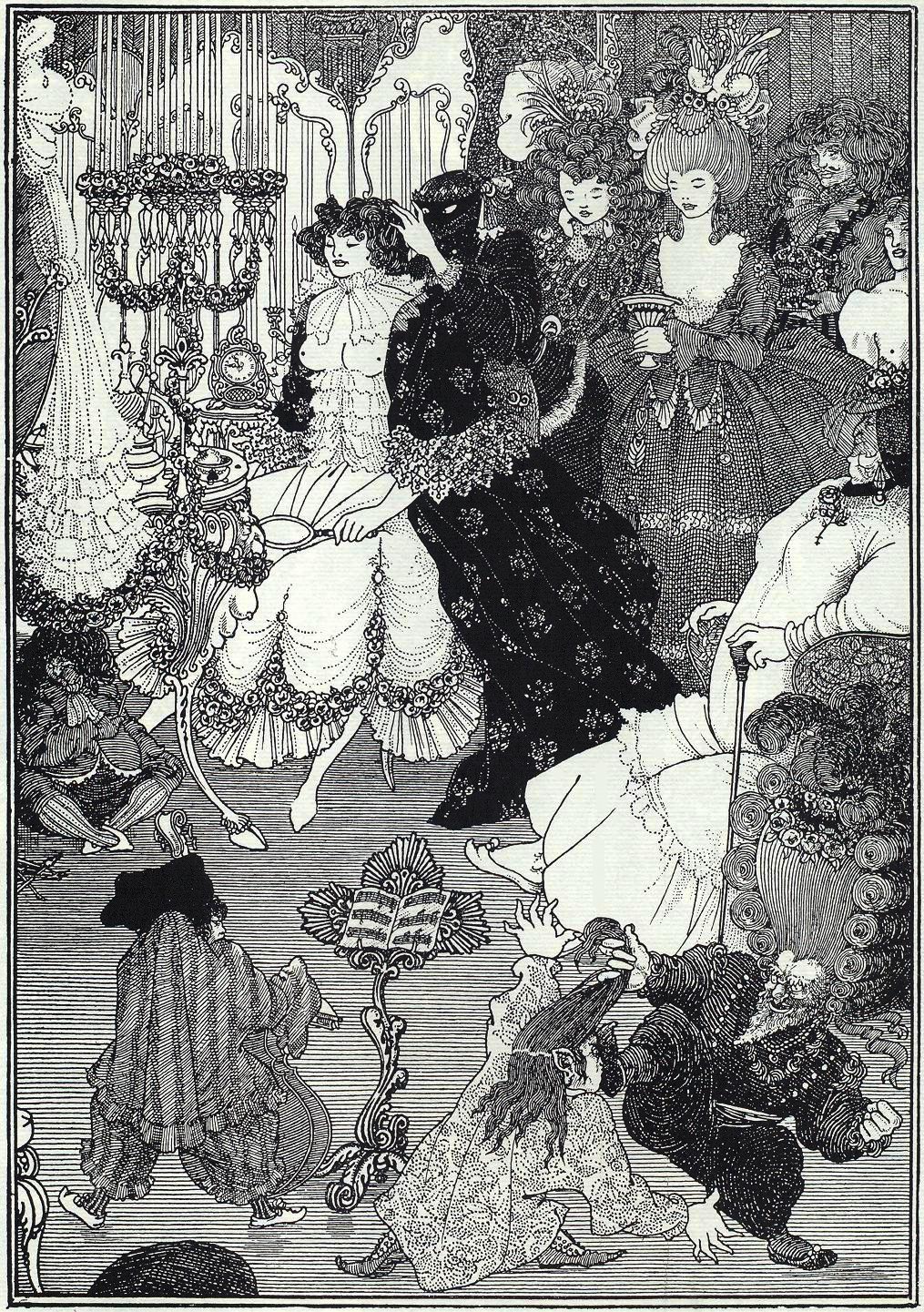
As for the edition itself, I was pleased with my selection. I knew I wanted an illustrated version since I'm a visual person [feel free to begin snickering and making comments in context to the book]. I enjoyed Felix's illustrations which were reminiscent of Aubrey Beardsley's style and added some fun to a text which can get redundant. Yes, redundant; you might find yourself skipping through the sex scenes once you get halfway through the book. But despite the little plot and large amount of redundant sex scenes I still found myself enjoying Fanny Hill.

That's what she said.

Thursday, April 1, 2010

Memoirs of a Woman of Pleasure

While perusing Amazon for a copy of Fanny Hill, I was overwhelmed by the many editions of this book. I am not sure why I should be so shocked, the brazen novel was published in 1749, allowing for many versions to be released over the centuries. But what is it about this book where we are still interesting in reading it here in the 21st century? Was it great literature? Nope, not really. It was smut, written by John Cleland in an attempt to escape debtor's prison.

Originally published as Memoirs of a Woman of Pleasure, the novel would come to be known by the name of its main character which sounds strangely enough like a naughty lady-bit. Fanny is an orphan teenager who moves to London and takes lodgings with a madam who wastes no time transforming the young girl into a prostitute. But instead of this being the same moralistic story as Hogarth's Harlot's Progress, Fanny enjoy her various sexual exploits which, like our modern pornos, are more plentiful than the plot line is complicated. Yes, Cleland was not out to open the eyes of the public to the plights of poor women; he was in the entertainment business.

John Cleland was an educated individual who worked for the Bombay company. It was in India that he allegedly began penning the manuscripts which would become, Memoirs of a Woman of Pleasure. The tale was an erotic novel and Cleland probably wrote it only because he knew: sex sells, and he needed some cash. The book was published in two volumes and it wasn't until a year after its publication that word got around to the wrong ears about the intimate details it divulged. Censorship laws may have been repelled, but for whatever reason Cleland's book didn't fit into this category and he was put on trial for obscenity. He saved himself by laying no claim to the book, stating he just happened upon the manuscript and embellished it. That didn't stop it from being published under the title Fanny Hill with some edits to the most scandalous parts. Rumor has it, the book was contained even more scandalous scenes that are now lost to us. For the next couple of centuries the book would be sold on the black market and banned from just about everywhere. The book wasn't even published in the United States until the 1970s!

Now, the problem is quite opposite. There are so many editions of the book, I can't even decide which to choose! I'm torn between these two (below), since they're both from indie publishers. I'm leaning toward the second one but worried it's from too late an edition. Oh dilemmas.


Check out some of the covers from some of the many editions. I was surprised by the amount with 19th century paintings and there are a plethora of different and creative covers which I found quite interesting.


Tuesday, February 9, 2010

Adam Buck and his Sideline Art

The print market was a hugely successful market in England in the the 18th century. It supplied rich and poor alike with artwork for their residences and places of business. Mezzotint prints would be made of the most popular portraits of the time. Satirical Images by the likes of Gillray and Rowlandson would be sold alongside them in the print shop windows, and were also eagerly scooped up by consumers. Satirical images tended to have a raunchier side, and frequently displayed titillating imagery to mix with humor.

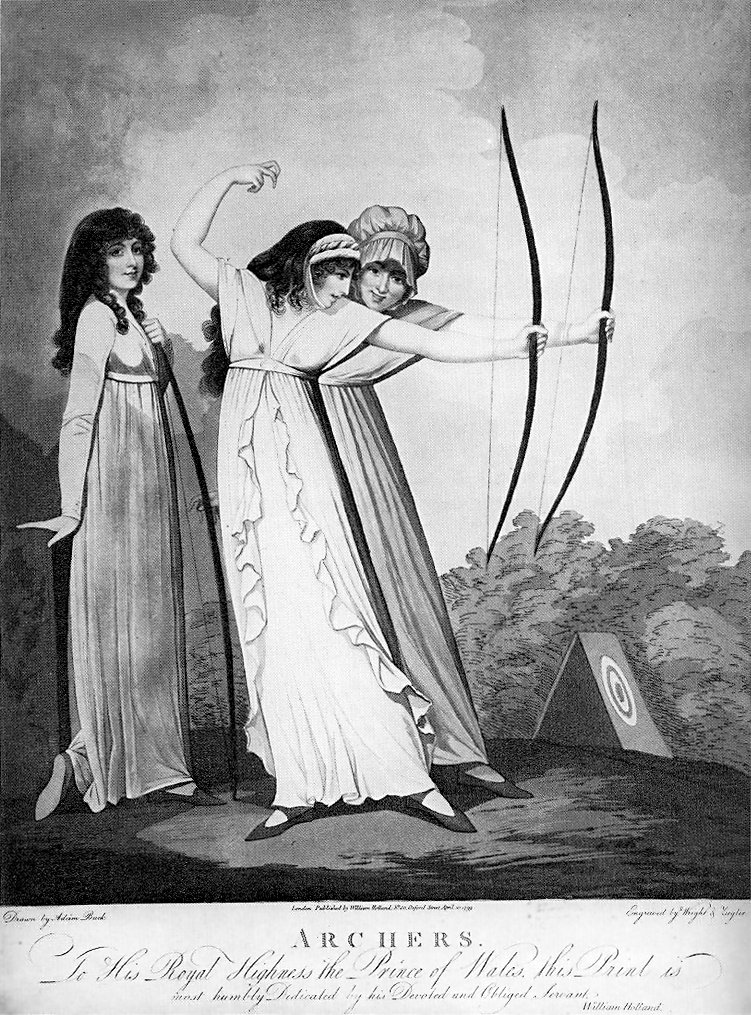
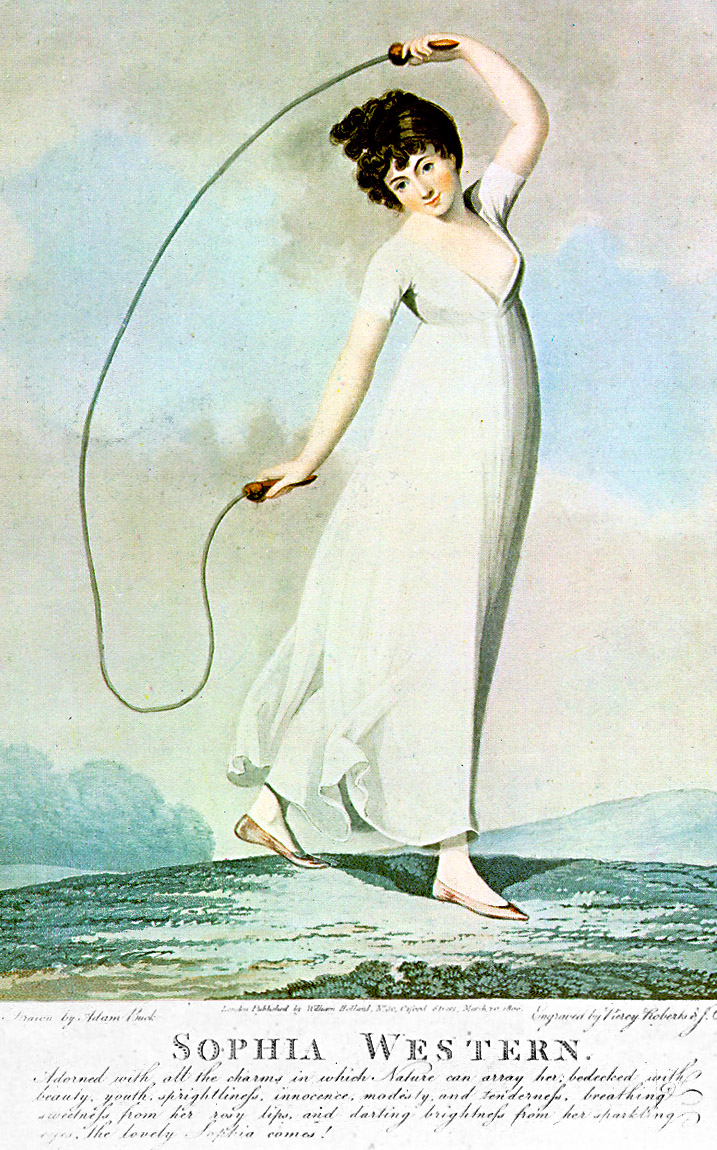
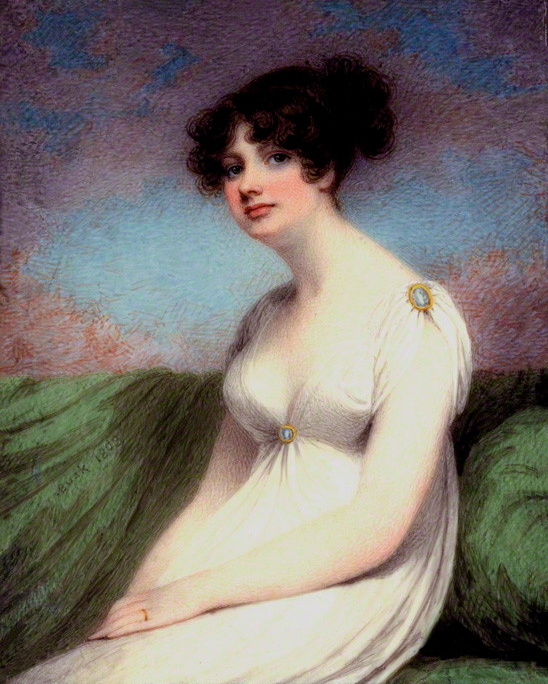
Adam Buck was a miniaturist who felt especially home when the Classical came in style during the last few years of the 1700s. We can thank him for this portrait of the tart, Mary Anne Clarke. We can also thank Mr. Buck for what some now consider to be "pin-ups." Buck published some prints which border between the formal reproductions of fine art portraits and satirical images. Take the lovely print, Archers for example. Upon initial analysis we see ladies in the latest fashion practicing a sport en vogue for women of the time. However this print would be considered somewhat inappropriate to display in a formal setting among ladies of respect. Ladies of the time would have their hair pulled back or hidden under some form of bonnet, therefore the display of these ladies' free-flowing hair was rendered with the purpose of titillation. Also, the archer's positioning, being so liberal, could be considered quite exciting, as well as the closeness of the two women; lesbian pornography was not foreign to the 18th century. If you are still not convinced of Buck's intentions with the Archers, there is always his print, Sophia Western which is a little more forward with its intentions. Psst, Sophia your umm is uh... you need to adjust your top.

Wednesday, October 22, 2008

Safe Sex?

As you may have gathered from this blog or other texts of the 18th century, sex was a common amusement of the 18th century. The new freedoms of speech and ideas of the Enlightenment allowed for sex to not be talked of only behind closed doors but also commonly read about and seen in the art of the time. Yes, sex was everywhere and everyone was having it. That is why there were so many illegitimate children being born of aristocratic ladies and then quickly shipped off to be raised by foster mothers, preferably in France. But for as long as humans have been having sex for recreation, there has been means of contraception. The 18th century was no exception to this. Although, it may not seem so if you've been keeping up with your weekly tarts.

The most common and ineffective use of contraception in the 18th century is one still commonly practiced today, "pulling out." Coitus Interruptus was popular based on the fact that it was cheap and handy. That is, until its participants realized how ineffective it really was.
For those more willing to spend some money and more worried about getting a venereal disease there were condoms (image at right circa 1900). These were commonly called, "machines" and made from the intestines of various animals, usually sheep. They were produced in Covent Garden (or course) and distributed at the various sleazy shops in the same area. When you bought one of these "machines" you bought it with the intention of using it more than once. The condom usually came in packaging for safekeeping and the very end was folded over and stitched with a silk ribbon (usually pink) at the end to tie and secure. Washing was recommended but was probably not commonly done. Although these sheaths may have helped protect against STDs they weren't that successful as contraceptives; they were semi-permeable. Water could go right through them. Not to mention they were prone to tears. So that's where all those illegitimate kids came from.

Wednesday, October 8, 2008

Princess Seraphina and the Transvestite Escapades

The Age of Enlightenment brought with it a huge fad for the masquerade. Where else could you, for one night, be something you were not? And get totally trashed in the process. Harlequins, dominos, and shepherdesses were some of the most popular costumes to grace the party halls. Another popular costume? The queen. Not the kind with a crown.

Masquerades also allowed those who never felt comfortable in their own bodies to try out the clothes of the opposite sex for a night. In fact, every masquerade could be a chance to enter public in drag and not be ostracized. The masked balls had a reputation for lasciviousness to begin with; some only went to get laid, and this went for those seeking the same sex as well. In fact, to be blunt, they tended to be parties full of horny people. So what was a little cross-dressing?

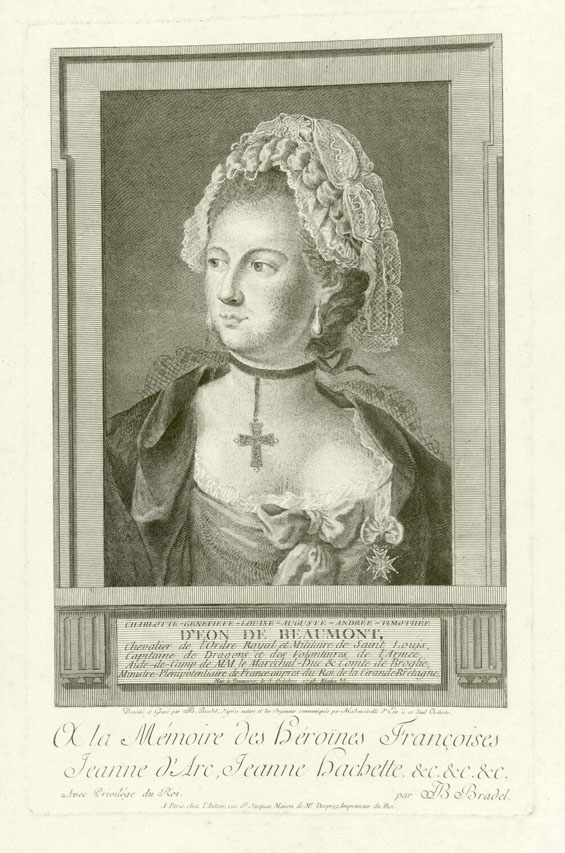
In France, the Chevalier d'Eon became a famous transgender person who was also a spy. She sported both elegant gowns and her dragoon uniform. You could put money into a betting pool at the London Stock Exchange whether you thought she was a woman or man. She fenced like a man but walked like a woman.

That brings us to Princess Seraphina. Back in these dark ages, gay men were yet to be referred to as "queens," they were merely "princesses." They have apparently moved up in rank. Princess Seraphina is the first recognized English drag queen in history. That means that like the drag queens of today, Seraphina was out and about in public regularly as a female. Even when she wasn't in drag people called her Seraphina. It was her identity. She was a servant for a "molly" (another term for a gay male) and hustled on the side a bit. But drama erupted in 1732 when a Tom Gordon stole Girlfriend's clothes and then threatened that if she charged him he would accuse her of sodomy. Well, that didn't scare Seraphina she sued him (yay!) but lost (boo!). Interesting enough, the clothing was her male garb.

But I do not bring this up because drag queens are funny or "hot tranny messes". Crossdressers, homosexual and gender dysmorphic people have been around forever. But here we see a time and a place in western civilization where it is beginning to be okay for them to be themselves in public. We also see a gay culture developing with "Molly Houses" (gay clubs) being established and sexual relations more easily found. Of course, as with most developments in the 18th century, these advancements in Enlightened thought were dashed in the Victorian age and had to be re-established in the 20th century.

To end this expose, I would like to close with a excerpt from a witness at the trial. Elizabeth Jones' account gives you a little glimpse into how others reacted to Seraphina as a transsexual in the 18th century:

"I saw the Princess Seraphina standing at Mr. Poplet's Door. "What, have you been robb'd, Princess?" says I, "Has Tom Gordon stripp'd your Highness stark naked? An impudent Rogue! And yet, Ma'm, I think, your Highness had better make it up with him, than expose yourself, for some say it was only an Exchange." "Why," says he, "at first I would have made it up, and taken my Cloaths again, but now it's too late, and I must prosecute, for those that were concerned in taking him up, expect their Share in the Reward, and won't let me drop the Prosecution."


[Rictor Norton]

Tuesday, August 12, 2008

Dr Graham and The Sex Machine

There have been many quack doctors in the past but the most notorious of the 18th century is arguably Dr James Graham. It’s hard to even know where to start with this character so I will just introduce him as a typical celebrity. Like our contemporary celebrity doctor, Dr Phil, Graham didn’t entirely know what he was talking about, and people didn’t necessarily believe him yet he still had flocks of people flooding to his practice, mostly the rich and celebrities.

The Scottish doctor had a rather nomadic start. After going to medical school (notice I didn’t say ‘graduating’) he moved to the American colonies where he learned some electricity basics from Ben Franklin’s friend. He turned his tail and ran at the first hint of revolution and ended up in a variety of European cities, gaining a name for himself along the way. His specialty: sex therapy.

TEMPLE OF HEALTH
By 1779 Graham had acquired enough press and money and in 1780 he was able to open his infamous Temple of Health. It cost a crown for admittance and modest ladies were given masks at the door so their privacy was preserved and gossip could not be spread about infertility. Among gaudy gilded decorations and soft playing music, guests would listen to Graham’s pretentious lectures in his auditorium. This usually ended with a sharp electric jolt from their seat which was supposed to cure impotence and infertility. Graham employed lovely assistants as his ‘Goddesses of Health’ and they dressed scantily in Classical drapery. It has been rumoured that Emma Hamilton was one of these Goddesses but her biographer Flora Fraser argues against this gossip.

THE CELESTIAL BED
The Temple was a success and allowed him to build the Temple of Hyman in Pall Mall which in 1781 housed his invention, the Celestial Bed. The electro-magnetic bed was available to desperate couples attempting to conceive who could afford the £50 charge; about £3,000 today. Gilt dragons adorned the bed along with the saying (in Latin) “It is a sad thing if a rich man has no heir to his property.” To the sounds of music, a couple would make love on the bed while “magnetic fire” was pumped into the room. While the couple watched themselves copulate from the mirror on the bed’s canopy a tilting inner-frame helped position them in the best stance for conceiving.
Of course on top of using this bed, customers were urged to buy Graham’s special products to further aid in conceiving an heir.

CELEBRITIES
Celebrities were drawn to the temples like moths to the flame. Even ones like the Prince of Wales, who obviously didn’t need any help conceiving, were known to frequent Graham’s creations. It was just the “in” thing to do. After years of miscarriages Georgiana and the Duke went to the temple in hopes of producing an heir, to no avail. Other celebrities who were associated with the temples were Charles James Fox, Elizabeth Armistead, the Duke of Richmond, and John Wilkes. Mary Robinson’s reputation began to disintegrate after it became public knowledge that she was a patron of the quack. Not because he was a quack but because he was a sex-quack!

Like with most celebrities, what comes up must come down and this was the case with Graham as well. He went bankrupt in 1782 with the help of The Morning Herald and James Gillray’s campaigns against his quack-practice. Plus it probably didn’t help that his methods didn’t actually work either. He was imprisoned for debt and then went insane and died in 1794.


In this satirical print, Graham is flanked by his famous customers including Fox (center), Mary Robinson and Grace Ellitot (top)