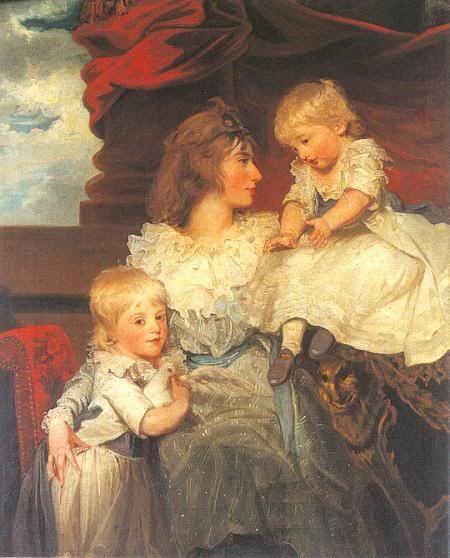
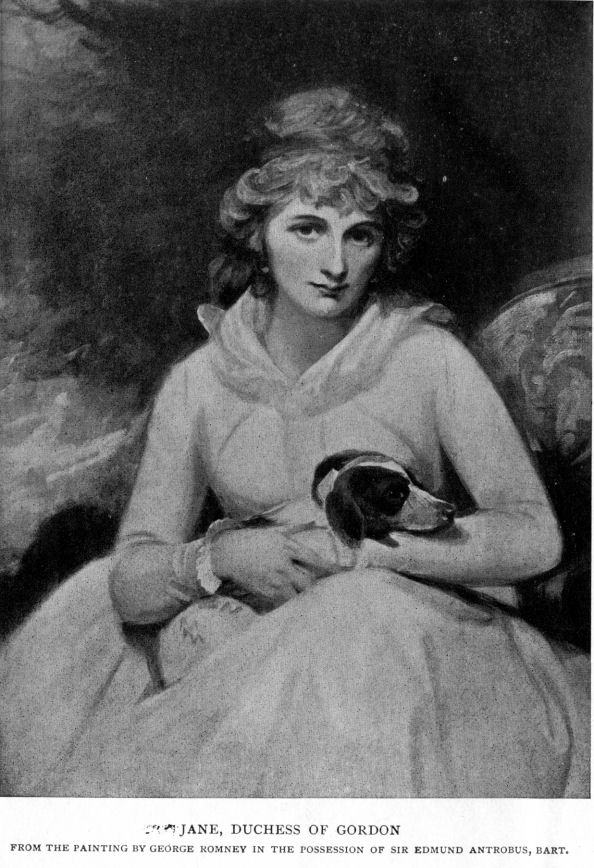
Gordon Castle, the seat of the Duke and Duchess of Gordon in northern (and rather remote Scotland) was considered to be the largest building of Scotland in the eighteenth century. Dating back to the 14th century, the castle grew, and grew, and grew. The home-loving Alexander, 4th Duke of Gordon, husband to Jane, Duchess of Gordon, added to the baronial home considerably until Gordon Castle was more of a Scottish Versailles. However, after his son died without an heir, transferring the Dukedom to the Duke of Richmond (who was quite happily settled in his own massive mansion, Goodwood) the castle gradually fell into disrepair. Leaky roofs forced much of these eighteenth-century additions to be demolished after which the once-grand Castle was all but forgotten. Luckily, after the second World War Lieutenant General Sir George Gordon Lennox, grandson of the 7th Duke of Richmond, took an interest in his ancestral home and began the restoration process which has continued into today. Gordon Castle, as it exists now, is only 1/8th of what existed in Jane, Duchess of Gordon's day. A wing, is now the central house, and the castle's formidable tower remains standing. The castle has been transformed into a hotel (and one that makes gin!) so it is once again open to visitors from afar.
Showing posts with label Jane Duchess of Gordon. Show all posts
Thursday, March 2, 2017
The Decay of Gordon Castle
Gordon Castle, the seat of the Duke and Duchess of Gordon in northern (and rather remote Scotland) was considered to be the largest building of Scotland in the eighteenth century. Dating back to the 14th century, the castle grew, and grew, and grew. The home-loving Alexander, 4th Duke of Gordon, husband to Jane, Duchess of Gordon, added to the baronial home considerably until Gordon Castle was more of a Scottish Versailles. However, after his son died without an heir, transferring the Dukedom to the Duke of Richmond (who was quite happily settled in his own massive mansion, Goodwood) the castle gradually fell into disrepair. Leaky roofs forced much of these eighteenth-century additions to be demolished after which the once-grand Castle was all but forgotten. Luckily, after the second World War Lieutenant General Sir George Gordon Lennox, grandson of the 7th Duke of Richmond, took an interest in his ancestral home and began the restoration process which has continued into today. Gordon Castle, as it exists now, is only 1/8th of what existed in Jane, Duchess of Gordon's day. A wing, is now the central house, and the castle's formidable tower remains standing. The castle has been transformed into a hotel (and one that makes gin!) so it is once again open to visitors from afar.
Friday, July 25, 2014
Tart of the Week: Eglantine, Lady Wallace
Like many little sisters of celebrated big sisters, Lady Wallace was stuck in the shadow of her elder sister, Jane, Duchess of Gordon. However, just like the Harriet to Jane's Georgiana, Eglantine, or Betty as she was known, proved to be just as interesting of a character.
Betty and her sisters were brought up by their mother, Lady Maxwell in a tenement in Edinburgh. The girls were known to be a bit wild (especially for daughters of a baronet) and rode pigs down the street with all the local children (hence the term 'piggy-back rides'). While Jane seemed to have curtailed the majority of her wild personality as she successful moved up the social ranks, Betty never seemed to lose her fire. She married Thomas Dunlop in 1770 who was made the 5th Baronet of Wallace shortly afterward. The marriage only lasted eight years; the couple legally separated on the grounds of Thomas's cruelty. However, I wouldn't be too surprised if Betty didn't give back as good as she got. Around this time she was summoned before a magistrate to answer for assaulting a female companion. She had to answer the same charges in 1793 when she assaulted a servant. Lady Wallace was a honey badger.
In 1793 she snuck into the House of Commons to watch a debate. Since women were forbidden from the public gallery Betty disguised herself in mens' clothing and managed to see much of the debate before she was discovered and consequentially kicked out. After her separation, she moved to London and took up the playwrights' pen. Three of her plays seemed fairly well-received in the late 1780s, with Sarah Siddons even taking up one of the roles. Her 1795 play, The Whim: A Comedy, however was banned by the licenser for an unknown reason. One can only hope it was because it was too racy.
Betty had a few close calls in her adventurous life. In 1789 she decided to travel to France to take the spa waters for her health, not thinking, perhaps this wasn't the best time to do so. After speaking her mind about the current political situation to, erm, the wrong people, she was arrested and accused of espionage - a crazy accusation considering Betty would have been the worst spy ever. She luckily managed to escape the situation with her head intact.
Not deterred by the continent after that experience, Lady Wallace seems to have spent the remainder of her life traveling in London through Europe. She died in Munich in 1803.
Betty and her sisters were brought up by their mother, Lady Maxwell in a tenement in Edinburgh. The girls were known to be a bit wild (especially for daughters of a baronet) and rode pigs down the street with all the local children (hence the term 'piggy-back rides'). While Jane seemed to have curtailed the majority of her wild personality as she successful moved up the social ranks, Betty never seemed to lose her fire. She married Thomas Dunlop in 1770 who was made the 5th Baronet of Wallace shortly afterward. The marriage only lasted eight years; the couple legally separated on the grounds of Thomas's cruelty. However, I wouldn't be too surprised if Betty didn't give back as good as she got. Around this time she was summoned before a magistrate to answer for assaulting a female companion. She had to answer the same charges in 1793 when she assaulted a servant. Lady Wallace was a honey badger.
In 1793 she snuck into the House of Commons to watch a debate. Since women were forbidden from the public gallery Betty disguised herself in mens' clothing and managed to see much of the debate before she was discovered and consequentially kicked out. After her separation, she moved to London and took up the playwrights' pen. Three of her plays seemed fairly well-received in the late 1780s, with Sarah Siddons even taking up one of the roles. Her 1795 play, The Whim: A Comedy, however was banned by the licenser for an unknown reason. One can only hope it was because it was too racy.
Betty had a few close calls in her adventurous life. In 1789 she decided to travel to France to take the spa waters for her health, not thinking, perhaps this wasn't the best time to do so. After speaking her mind about the current political situation to, erm, the wrong people, she was arrested and accused of espionage - a crazy accusation considering Betty would have been the worst spy ever. She luckily managed to escape the situation with her head intact.
Not deterred by the continent after that experience, Lady Wallace seems to have spent the remainder of her life traveling in London through Europe. She died in Munich in 1803.
Wednesday, March 12, 2014
Quotables (Insults Edition)
'You little, insignificant, good-for-nothing, upstart, pert, chattering puppy!'
-The Duchess of Gordon to Jack Payne
Tuesday, February 19, 2013
On the Duchess of Gordon
'She looks as fierce as a dragon and contents herself with spending her breath upon politics, and ringing a daily peal in the ears of her poor husband, with whom, Lord William says, she squabbles more than ever.'-Lady Louisa Stuart
Thursday, January 24, 2013
Lady Hester Stanhope on...Political Hostesses' Hospitality
Lady Hester Stanhope was not a woman to hold her tongue, which was only more apparent when her doctor (and close friend) released her memoirs in 1845 - which was more like his memoirs of her. In it, William Pitt's niece remembered the various environments created by the great political hostesses of the time:
"'I
remember too what a heavy, dull business the Duchess of R[utland]'s parties were - the
rooms so stuffed with people that one could not move, and all so heavy - a deal
of high breeding and bon ton; but there
was, somehow nothing to enliven you. Now
and then some incident would turn up to break the spell.
Now,
at the Duchess of Gordon's there were people of the same fashion, and the crowd
was just as great; but then she was so lovely, and everybody was animated, and
seemed to know so well what they were about - quite another thing.
As for
the Duchess of D[evonshire]'s, there they were - all that set - all yawning, and wanting
the evening to be spent, that they might be getting to the business they were
after.'
It may be
mentioned that Lady Hester was always very
severe on the Duchess of D. and her friends, whenever her name or theirs
was mentioned."'
Monday, July 9, 2012
The Butcher Kissing Duchess of...Gordon?
The Tory Queen, Jane Gordon was known for doing as she damn-well pleased as a little girl and marrying into the aristocracy and becoming a duchess didn't change that at all. One of the things Jane would never compromise on was her love of Scotland. She spoke in a brogue, encouraged social events in the Highlands, and encouraged her children to share her love for their country as well. When her son, the Marquess of Huntly raised a company for the Black Watch, a regiment of Highland soldiers, Jane could have died of pride.
Like a soccer mom on a mission, Jane wanted to help her wee one with his big project. She appeared at public events and offered to men willing to join the regiment a King's Shilling from between her teeth for enlisting. That way they got paid and got to say they kissed a duchess. Funnily, eight years prior, her rival, Georgiana was accused of both bribing and kissing butchers in exchange for votes for Charles James Fox. The Tories created the rumors in order to curtail Georgiana's success and force her to hide in shame and yet here was Jane obstinately doing exactly what her rival was only rumored to do. Ballsy! But Jane wasn't quite done with her parade yet.

At a London Ball in 1792 Jane barged in dressed head to foot in Black Watch tartan taffeta, which I can only imagine looking absolutely amazing. Well, it must have looked amazing, because Jane started a trend for tartan with her bold look. Soon it was reported that 'scarce a respectable female but wore a tartan waist to her gown at least, and there was hardly a waiter at any inn in London but appeared in his tartan waistcoat.' Hmm, perhaps that was an exaggeration, but as a life-long fan of plaid, I can't blame the fad! Not bad to be a trend-setter in your 40s!
Like a soccer mom on a mission, Jane wanted to help her wee one with his big project. She appeared at public events and offered to men willing to join the regiment a King's Shilling from between her teeth for enlisting. That way they got paid and got to say they kissed a duchess. Funnily, eight years prior, her rival, Georgiana was accused of both bribing and kissing butchers in exchange for votes for Charles James Fox. The Tories created the rumors in order to curtail Georgiana's success and force her to hide in shame and yet here was Jane obstinately doing exactly what her rival was only rumored to do. Ballsy! But Jane wasn't quite done with her parade yet.
At a London Ball in 1792 Jane barged in dressed head to foot in Black Watch tartan taffeta, which I can only imagine looking absolutely amazing. Well, it must have looked amazing, because Jane started a trend for tartan with her bold look. Soon it was reported that 'scarce a respectable female but wore a tartan waist to her gown at least, and there was hardly a waiter at any inn in London but appeared in his tartan waistcoat.' Hmm, perhaps that was an exaggeration, but as a life-long fan of plaid, I can't blame the fad! Not bad to be a trend-setter in your 40s!
Thursday, June 21, 2012
The Duke of Bedford Causes a Stir
"Indeed we are all undone,"
These were Georgiana's distressed words to Lady Melbourne in 1802. Political catastrophe was first thing on the two ladies minds; she continued, "no possible event could have so thoroughly overtuned the habit of our society as this.'
The Duke of Bedford was considering, do I dare say it? 'tis truly horrible...a Tory for a wife.
Yes, the prominent Whig was not just crossing over to the dark side, he was crossing over to the deep-dark side; he was considering the Duchess of Gordon's daughter as a wife. That would mean having Tories for in-laws. Georgiana saw him as good as turned just from mere proximity to that Tory temptress!
She also blamed herself for this whole debacle. Bedford had once been after her eldest daughter, Little G but she instead ended up marrying Lord Morpeth. He had also been canoodling with the widely available Lady Melbourne for fun. Although Little G marrying some other dude didn't hurt Bedford's feelings, Georgiana not paying him back money she owed him when he was short on cash did. He refused to speak to her, and not long after was courting Georgina Gordon.
Georgiana and Lady Melbourne expected the worst but they certainly didn't expect the duke to suddenly drop dead while playing tennis three weeks later. Neither did the notorious husband-hunter Duchess of Gordon; she and her daughter were severely lampooned by satirical artists for their fruitless labour of love.
These were Georgiana's distressed words to Lady Melbourne in 1802. Political catastrophe was first thing on the two ladies minds; she continued, "no possible event could have so thoroughly overtuned the habit of our society as this.'
The Duke of Bedford was considering, do I dare say it? 'tis truly horrible...a Tory for a wife.
Yes, the prominent Whig was not just crossing over to the dark side, he was crossing over to the deep-dark side; he was considering the Duchess of Gordon's daughter as a wife. That would mean having Tories for in-laws. Georgiana saw him as good as turned just from mere proximity to that Tory temptress!
She also blamed herself for this whole debacle. Bedford had once been after her eldest daughter, Little G but she instead ended up marrying Lord Morpeth. He had also been canoodling with the widely available Lady Melbourne for fun. Although Little G marrying some other dude didn't hurt Bedford's feelings, Georgiana not paying him back money she owed him when he was short on cash did. He refused to speak to her, and not long after was courting Georgina Gordon.
Georgiana and Lady Melbourne expected the worst but they certainly didn't expect the duke to suddenly drop dead while playing tennis three weeks later. Neither did the notorious husband-hunter Duchess of Gordon; she and her daughter were severely lampooned by satirical artists for their fruitless labour of love.
Thursday, April 12, 2012
Friday, February 3, 2012
Quotables
"As her Grace, when requisite, expressed sentiments very frankly that she knew to be right, although not perfectly agreeable to some hearers, she was at that time not sparing in her animadversions. She accosted, with very great and just severity, a well-known peripatetic (we do not mean a peripatetic philospher,) and exposed his conduct in so humourous and strong satire, that is said she almost recalled to his recollection that there is such a feeling as shame in the human mind."-Public characters of 1799-1800. To be continued annually.
Saturday, January 28, 2012
The Duchess of Gordon's Sim City
The Duchess of Gordon was known as being the quintessential Tory political hostess in fashionable London society. However, like many politicians today, she had a soft spot that didn't get exposed in the public area as much. The duchess was an economic stimulator!
The little highland estates of Badenoch and Strathspey didn't have much going on in terms of economy but when Jane Gordon looked across those rolling fields she saw an opportunity to roll in the pounds. Either that or this was how eighteenth century aristocrats played Sim City. She hired instructors to teach the locals how to raise crops of flaxen and linen (to make all those fashionable gualle gowns Marie Antoinette had popularized!). The duchess then pulled some threads to get supplies to the area.
There was only one problem, Badenoch and Strathspey weren't actual towns and therefore couldn't sustain this new influx of economy. So what did Jane do? She damn-well built a village. Because she was a duchess and duchesses have money to build their own villages if it suits their fancy.
Jane seems to have been very good at establishing and tending to villages for Kingussie (look you can have a pretty wedding there and eat haggis in the pubs and other fun things!) is still alive and well today thanks to the Duchess of Gordon.
The little highland estates of Badenoch and Strathspey didn't have much going on in terms of economy but when Jane Gordon looked across those rolling fields she saw an opportunity to roll in the pounds. Either that or this was how eighteenth century aristocrats played Sim City. She hired instructors to teach the locals how to raise crops of flaxen and linen (to make all those fashionable gualle gowns Marie Antoinette had popularized!). The duchess then pulled some threads to get supplies to the area.
There was only one problem, Badenoch and Strathspey weren't actual towns and therefore couldn't sustain this new influx of economy. So what did Jane do? She damn-well built a village. Because she was a duchess and duchesses have money to build their own villages if it suits their fancy.
Jane seems to have been very good at establishing and tending to villages for Kingussie (look you can have a pretty wedding there and eat haggis in the pubs and other fun things!) is still alive and well today thanks to the Duchess of Gordon.
Monday, November 15, 2010
A Fitting Employment
The noble Gordon family was tight-knit and therefore tended to be had no problem in speaking candidly with each other. Dirty jokes were not just for the chop house as many a fine lady would prove.
During one dinner conversation with friends, young George Gordon was asked the question many brooding teenagers get at their parents' dinner parties: what trade would he like to go into? Although it is unlikely the question was meant to be taken seriously as George was next in line to be Duke of Gordon, he answered "making garters for ladies' stockings." While the group chuckled at young Gordon's jocular perversions, his mother piped up with her own jibe, "Ah George! You would soon be above your trade."
No wonder the ladies of fashion were reported to complain, "How dull the town is! Would to Heaven the Duchess of Gordon were arrived! We shall have no life, no spirit, till she come!"
During one dinner conversation with friends, young George Gordon was asked the question many brooding teenagers get at their parents' dinner parties: what trade would he like to go into? Although it is unlikely the question was meant to be taken seriously as George was next in line to be Duke of Gordon, he answered "making garters for ladies' stockings." While the group chuckled at young Gordon's jocular perversions, his mother piped up with her own jibe, "Ah George! You would soon be above your trade."
No wonder the ladies of fashion were reported to complain, "How dull the town is! Would to Heaven the Duchess of Gordon were arrived! We shall have no life, no spirit, till she come!"
Wednesday, September 22, 2010
Lady Mary Coke on Two Women of the Aristocracy
"The Duchess of Gordon resembles my Lady Bristol, is like her in person, manner, contrivances, and like her, scruples nothing to gain her end, such a person must always be dangerous."-Lady Mary Coke
Tuesday, January 19, 2010
When Plaid Wasn't 'In'
"shall, on any pretext whatsoever, wear or put on the clothes commonly called Highland clothes the Plaid, Philabeg, or little Kilt, Trowse, Shoulder-belts, or any part whatsoever of what peculiarly belongs to the Highland Garb; and that no tartan or party-coloured plaid or stuff shall be used for the Great Coats or upper Coats..."No plaid? I wouldn't survive. The ban on plaid didn't apply to soldiers uniforms. The reason for this: the sight of plaid struck fear into enemies. But Scottish peasant and noble alike were forbidden from donning the fabric of their heritage. Those who dared challenge this decree faced a prison sentence. Well, I happen to know one such daring individual, Jane Duchess of Gordon. The Duchess didn't fear the law and was known to wear plaid; and she got away with it too! No doubt she escaped persecution due to her constant sucking up to the king! It didn't matter too much anyway because by 1782 George III lifted the silly fashion ban.
Wednesday, May 6, 2009
A Toiling Schedule
No one ever said it was easy being a fashionable duchess! Take for example the week of 14 February, 1785. Georgiana was just swamped with social events!
Monday
"There is a ball tonight at Ly Beauchamp's, Tuesday Ly Lucan's, (I GO upon PARTICULAR invitation), Wednesday Princes, Thursday D'Adhemar's, Friday Mrs. Poole (who was Miss Forbes), Saturday, the Prince, and Monday the survivors dance Scotch reels at the Dss of Gordon's..."The Duchess of Gordon's? Georgiana's foil? I predict some major dramz!
Tuesday Night
Georgiana wrote that the Duchess of Gordon "made a great riot at the Opera." She was tricked into thinking that in France it was a proper mark of respect to kiss a blood royal upon introduction. So when introduced to Louis, the Duke of Chartes (future Duke of Orleans and Louis Egalite) Jane laid a big one on him! Oh the laughs that must have followed... Georgiana also reported that
"Ly Lucan's was a very pretty ball...Nannette's dancing is vastly pretty, but my sister is without question the best. I sup'd and was home about 3."What happened to 'before midnight' Cinderella?
Wednesday
The Pri
"Our gowns were night gowns of my invention. The body and sleeves black velvet bound with pink and fasten'd with silver buttons. The pettycoat light pink, and the skirt, apron and handkerchief crape bound with light pink, large chip hats with feathers and pinks."If that doesn't sound absolutely fabulous, I don't know what is! She added, "My shape look'd very decent." After describing the rooms, Georgiana went back to talking some smack on the Duchess of Gordon,
"[She] was drest in the Prince's uniform [what a suck-up!], blue and buff, and his buttons. They persecuted her by pinning foxes' tails to her back..."The moral of that story, Mrs. Gordan: stick to your roots because no one likes a sycophant!
Saturday, December 20, 2008
On the Second Day of Christmas Jane Gordan Gave to Me...

Two rival parties...
Thanks a lot, Jane. The Duchess of Gordan was Georgiana's rival political party hostess. While Georgiana threw huge bashes for the Whigs Jane was throwing ones for the Tories. Although the two ladies were competitive, Jane was more brash in flaunting her triumphs and was a sore looser. While Georgiana turned heads canvassing for a candidate, Jane actually kidnapped a man once in order to secure a vote. She was also notoriously ruthless when it came time for her children to secure good marriages. The satirical artists lampooned Jane, who was very obvious in her want of wealthy sons and daughters in law. Jane played dirty, and didn't care who that offended one bit!
Sunday, September 7, 2008
The Enlightened Family Portrait, Part 1 Women and Children
There were many means of expressing a sitter's sense of Enlightenment in portraits. One of the most popular accessories a sitter used was their family. Family portraits in the 18th century weren't necessarily commissioned because the sitter wanted to immortalize their children or save money with a group portrait, it was a means of immortalizing yourself as a creature of Enlightenment. Of course, not everyone had selfish motives by getting a family portrait, but the rise in their popularity can be attributed to this trend. The painters who thought outside the box with the composition and the sitters' interactions with each other produced some of the greatest paintings in this genre. After all, anyone could snap a family portrait at Sears but is that who celebrities go to when they want theirs? No, they tend to want something creative that shows a hint of candour and love. The same concept went for artists in 18th century and it is what made painters, such as Joshua Reynolds. See why these painters made the big bucks:

Joshua Reynolds, Georgiana, Duchess of Devonshire and Her Daughter, 1784
John Hoppner, Harriet, Viscountess Duncannon and her Two Sons, 1787

George Romney, Jane, Duchess of Gordon and her Son, the Marquis of Huntly, 1778
Joshua Reynolds, Lady Cockburn and Her Three Eldest Sons, 1777
Joshua Reynolds, Lady Smith and Children, 1787

George Romney, The Gower Family, 1776-7
Joshua Reynolds, Miss Cocks and Her Niece, 1789

Joshua Reynolds, Georgiana, Duchess of Devonshire and Her Daughter, 1784

George Romney, Jane, Duchess of Gordon and her Son, the Marquis of Huntly, 1778
Joshua Reynolds, Lady Cockburn and Her Three Eldest Sons, 1777
Joshua Reynolds, Lady Smith and Children, 1787George Romney, The Gower Family, 1776-7
Joshua Reynolds, Miss Cocks and Her Niece, 1789
Friday, August 29, 2008
Tart of the Week: Jane, Duchess of Gordon

Jane was the Tory version of Georgiana and her fiercest rival. Indeed the two women were foils, Jane being an outspoken Scot with a competitive nature loved being a Tory hostess just as much as Georgiana enjoyed being a
Jane Maxwell was the daughter of a typical poor, drunken baronet. While her father sold off his lands to pay his debt her mother educated her and her sisters in Edinburgh. When she was 14 Jane accidentally jammed a finger from her right hand in a carriage wheel and when it moved away it took her finger with it. From then on she usually wore gloves with a false wooden finger. By the time she was 16 she was so beautiful songs were being written in her honor. She had fallen in love with a young soldier but he went off to fight and was presumed dead so when the dashing 24 year old Duke of Gordon asked for her hand she said yes. It was on her honeymoon with the Duke that Jane received a letter from her lost love asking for her hand in marriage. She fainted upon reading it.
As for politics, well, Jane fought dirty. During the 1780 election she even kidnapped a man and locked him in her cellar to secure the seat for a friend of hers. She hated the success and popularity of the parties Georgiana threw in celebration of the Whigs and attempted to create the Tory versions. Pitt, seeing the influence Georgiana had on the popularity of candidates, happily allowed Jane to throw parties in his honour in hopes of the same success. During the regency crisis she came close to usurping Georgiana as the prime social hostess and even looked like she would replace her as queen of the ton. Jane smugly invited Georgiana and Harriet to the House of Commons to listen to speeches after a Whig defeat and relished in their curt refusal. She had won this round. But unfortunately for her, no one can outdo the Duchess of Devonshire.
Despite the unhappiness of her marriage, Jane loved her status as a duchess and became
After being separated from her husband for years the couple finally divorced in 1805. She spent the remainder of her lonely years fighting with him over receiving the full annuities he promised her. She died in London in 1812 and her body was laid to rest in her beloved Scotland.
Subscribe to:
Posts (Atom)