Showing posts with label King George III. Show all posts

Wednesday, May 25, 2011

Liotard's Portraits of the Royal Family

In his long life the pastel-ist, Jean-Étienne Liotard had the privilege of rendering the portraits of not one but two royal families.  You can find his portraits of Maria Theresa's brood on Lauren's blog today.  Here are Liotard's portraits of Frederick, Prince of Wales' family from 1754.

Frederick Prince of Wales

Princess Augusta Charlotte of Wales
George III
Henry Frederick, Duke of Cumberland
Princess Caroline Matilda
Princess Louisa

Friday, June 11, 2010

Thomas Gainsborough's Portraits of George III's Family

In 1782 King George and Queen Charlotte decided they couldn't get enough of their large family and commissioned their favorite artist, Thomas Gainsborough, to paint individual portraits of everyone. It is kind of like those old school portraits your mother still has on display, right down to the bland background. Awkward smiles are absent and I think the outfits are quite fashionable unlike my school portraits.


Queen Charlotte
George Prince of Wales
William IV
Princess Royal (Charlotte)
Prince Edward, Duke of Kent
Princess Augusta
Princess Elizabeth
Prince Ernest, Duke of Cumberland late King of Hanover
Prince Augustus, Duke of Sussex

Prince Adolphus, Duke of Cambridge

Princess Mary

Princess Sophia

Prince Octavius

Prince Alfred


Some of you may have noticed two family members are missing. First of all, I'm impressed if that is the case. Princess Amelia was not portrayed for she was still a twinkle in her father's eye. The second-born Prince Frederick is also missing from portrayals. This is not due to his parents' dislike of him but because the prince was vacationing on the continent. However, some art historians can't believe that Gainsborough would go without completing the family and think there is a long lost Frederick portrait.

Friday, March 5, 2010

Tart of the Week: Hannah Lightfoot


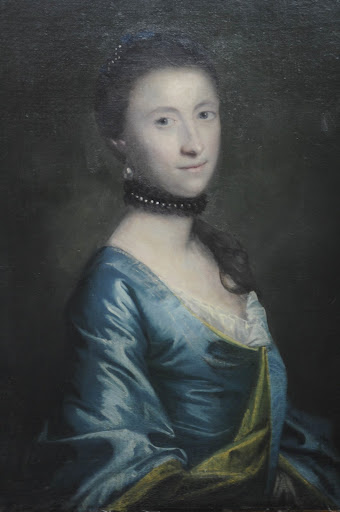
Many mysteries surround our tart this week. So many so, that some even question her existence. Her portrait, for example, by Joshua Reynolds, has been attributed as Hannah Lightfoot but she is described in life as being a blond bombshell and the clothing is a little too luxurious. So her tartly tale is about 10% fact and 90% gossip; most of the gossip springing from the following century. But I know gossip shouldn't be an issue for this crowd.

Hannah Lightfoot was born into the middle class in 1730. Her family was Quaker and she was raised as such, growing up in extreme simplicity in an age of extreme outrageousness. Her father died when she was young which relocated the girl to live with her uncle, a linen-draper in Westminster. It was here than Hannah not only grew up but would work to earn her keep, much like a Cinderella story. Perhaps some day her prince would come?

At the age of twenty Hannah had had enough of the linen-draping business and secretly married a grocer, Isaac Axford. The young Quaker soon tired of her rebellious marriage and around this same point in her life we loose track of what is fact and what is fiction of the fair Quaker "maid."

Allegedly it was in this time frame that Hannah met up with none other than the Prince of Wales, the future George III, who was thirteen by many accounts. Of course, this doesn't add up since by the time Hannah married her husband, George would have been 15. Either way George was young, naive, and not yet the prudish person we now come to think of. Some tales chatter of him first seeing her in her uncle's shop window as he was leaving the Royal Opera, other, more daring tales speak of them meeting at a masquerade. Either way, the prince and the Quaker met, and despite the age gap, began an affair. Allegedly.

It is interesting to envision the young George having this affair. It is even more perplexing to think that the affair is alleged to have resulted in a marriage between the already married Hannah and the teenage George III. This is the same man who passed the Royal Marriage Act making it impossible for members of the royal family to marry without the king's permission. It is also the same man who flew into a rage when he found out his son married the Catholic widow, Mrs. Fitzherbert. A bit hypocritical if true, huh?

Supposedly the affair produced two, maybe even three illegitimate children. Oh whom descendants graves were found in 2000. Hannah herself conveniently disappeared into obscurity. Her own mother stated that she didn't know if her daughter was living or dead since she had not seen her for two years when she made her will in 1760. Isaac Axford remarried in 1759 with his certificate stating he was a widower. Yet there is no trace of where Hannah could have disappeared to. With the few sources citing she married George in 1759, had three kids with him, and then wasn't heard from again a year later, there are obviously many missing pieces in the mystery.

Thursday, April 30, 2009

School Portraits


Do you suppose that when King George III or his brother Edward Duke of York looked back on this painting of themselves with their tutor by Richard Wilson they were like, "Ugh I hate my 6th grade school picture, I looked like such a dork!"

I also doubt, based on this portrayal, that Tutor Ayscough was generous with recesses.

Friday, January 30, 2009

Tart of the Week: Lady Henrietta Grosvenor


Henrietta Vernon was born in the most fortunate of circumstances. Not only was she an aristocrat (grand-daughter of the famous politician Thomas Wentworth) but she was a noted beauty. Therefore, it may come as no surprise that she was married very early in life. She met her future husband in one of the most cinematically romantic of ways, during a rainstorm. Richard Grosvenor, the 1st Baron Grovesnor captured the young girl's fancy despite the 14 year age gap between them. They married within a month of their initial meeting, in 1764.

Henrietta soon realized that her hast in marrying Richard had been a huge mistake. He was a huge gambler, even by 18th century standards. We're talking £250,000 in one night (more than a million today)! When he wasn't gaming away the couple's money he was out whoring in every brothel in London. Yuck! Imagine the diseases he brought back to his young bride. It was not long before Henrietta admitted to feeling "ill used." Do you blame her eye for wandering?

Henrietta's attention fell on the King's brother, Henry Duke of Cumberland who just happened to be the same age as her. Henry himself, already had a rebellious history, it was rumoured that he had married a commoner, Olivia Wilmot and there was to be more commoner marriages in his future as well. Henry was young and royalty; there was a dangerous appeal to having an affair with him. The couple would meet in secret in inns around the country. One time, while they were out at a friend's house in Cavendish Square Henrietta asked for a private meeting with the Duke to talk about her brother in the dining room. They were excused but after a half hour, the friend decided there had been enough talking and went in to interrupt. She found Henry on top of Lady Grosvenor, "with her petticoats up" on her couch. There is nothing I hate more than rude house guests! A crim con trial was soon underway.

As with just about every other crim con trial, this was the talk of the town, especially since it involved royalty. Henrietta, was outraged at her husband's hypocracy. She slept with one man and was to be damned for all time while her husband constantly frequented brothels. She went to bawdy houses in search of witnesses to testify upon Richard's many infidelities. But this was not to aid her defense. Henrietta and Henry's dirty letters to each other was enough to award Richard damages of £10,000. After a mere seven years of marriage, Henrietta and Richard were seperated in 1771.

Now Henrietta was an outcast with a mean £1,200 allowance. But rather than wallow in the sorrow of her situation she made the best of it, and became friends with other social outcasts. Soon she was seen at the Pantheon arm in arm with Lady Worsley. The papers would follow her, in hopes of catching her in a scandalous act with a rake. Once they reported that she showed up to the opera with a different man every night. Well, can you blame her? With such a small allowance, Henrietta needed rich men to support her elegant lifestyle.

In 1802 Richard finally kicked the bucket. Relieving Henrietta of her marriage limbo. A month later Henrietta was no longer Lady Grosvenor. She married Lt.-Gen. George de Hochepied, 6th Baron de Hochepied and retired to a quiet life with him until her death in 1828. Her second husband followed, two months later.

Wednesday, January 7, 2009

State Portraits of England and France

When a monarch (and his consort) rose to power, one of the best things to do to assert their awesome ability to rule a country was to paint them in all their glory. These fantastic paintings, known as state portraits, differ from other 18th century portraits because they expressed a political ideal of an all-powerful being. Decked out on in coronation robes, the full-length monarch holds their royal regalia in a timeless setting that displays their wealth. The portraits were meant to generate awe, and when you see them in person, your mouth does kind of hang open.


Of course I love comparing the English aesthetic to the French. King George and Queen Charlotte had no choice but to allow Joshua Reynolds to do their portraits since he was the head of the Royal Academy. They much preferred Gainsborough (who painted many portraits of them and their family) because of his personal views and style of painting; but decorum deemed they had to have Reynolds paint them. The result is a rather dark portrait duo. In Reynold's brown hues the two monarchs are seated at their thrones, looking as if they are being crushed by their heavy uniforms of state.

Now here comes those young kids who are ruling France! Judging by Louis' portrait you would never know the deathly shy, naive, scared little boy that is contained under the gold fleur de lys. He stands in his finery, a true descendant of the Sun King. His crown does not lay on his head but is on a pillow in the background as a reminder that yes, this is your king. Marie's portrait is quite interesting. While it compliments her husband's, it also is a testament to her purpose as France's consort: a union with Austria. While she is also decked out in France colours, flowers, and symbols she still shows a bit of her Austrian roots which she had to give up upon her marriage. On the table beside her sits a pillow with both a Hapsburg rose and the French lily, showing the uniting of countries. It is the only small hint at her true orgins. Meanwhile, those French lilies are popping out everywhere! Fresh lilies are placed in the folds of her grand corps gown, asserting her devotion to France, as well as making her smell really good while she was sweating during the painting of the portrait!

Friday, December 12, 2008

Tart of the Week: Queen Caroline Matilda


Naughty Queen alert! If you are aware of what a prude King George III was, it might shock you to find that his baby sister was, well...not. Caroline grew up as you would a expect a young princess to. She was born in 1751, a few months after her father's premature death. She learned the way to walk, talk, and be the perfect little princess, so it was only a matter of time before she was married off to secure a political alliance.

The lucky fellow was the King of Denmark and Norway, Christian VII. Unbeknownst to sixteen year-old Caroline or the royal family, Christian had a few quirks. Actually, he was full out crazy. He was obsessive about his looks and was known too look at his ripped muscles in public. Christian was also into devious forms of sex and would wear disguises in public in order to pick fights. His peculiarities may have stemmed from sexual abuse as a child but also could have been attributed to schizophrenia.

Chistian's peculiarities only grew worse after his marriage with Caroline. He and the Duke of Devonshire seemed to share the same point of view that wives were for heirs and nothing else. Caroline was both scared and depressed by her husband's treatment of her, yet, she still managed to give birth to an heir. Since she performed her duty in the eyes of Christian, he left Caroline to do as she pleased while he did his (crazy) thing. In fact, she ended up being the one who ran the country. It was not long before she fell in love and had an affair with Johann Struensee, the royal physian and minister. It is likely that her other child, Princess Louise Auguste was likely Struensee's and not the king's. Just look at her features compared with her brother's.

Of course, things could not stay sunny for poor Caroline. Struensee decided to take advanatge of his cohorting with the queen (and ultimately ruler) and the king's trust to input some of his own decrees upon the country. Typical! This may have been okay for the lovestruck Caroline but not for the people of Denmark. The couple was invited to a masquerade which also just happened to be a trap. The two were arrested; Caroline was divorced and Struensee was drawn and quartered. Caroline was released from prison and put into exile, never to see her children again. Her own brother was afraid to let her into England for fear it could cause a disagreement with Denmark so Caroline had was forced to live in Germany. She died not long afterward of Scarlet Fever in 1775.

Wednesday, June 25, 2008

Righty and Lefty

Now artists and politics are notorious for not mixing well. Two great examples of that would be David and Hitler. While artists should never give up their day job for politics, they historically can be successful involving themselves minimally in politics. Of course I am specifically thinking of Gainsborough and Reynolds when I say this.

The two artists were notorious rivals and actually quite opposite of each other. Gainsborough was rather reserved and tended to side with King George on political issues, therefore he was associated with the Tories. On the opposite spectrum was Reynolds, who was more outspoken and bold. He was the head of the Royal Academy and therefore left King George no choice to name him as the royal painter. Reynolds' political views tended to be more liberal and his friends tended to be Whigs, creating a further polarity between him and the quiet Gainsborough. The royal family actually always preferred Gainsborough, and continued to commission works from him even after naming Reynolds the royal painter.

I find that comparing both artists' depictions of their politician counterparts produces some interesting results. Charles James Fox and William Pitt the Younger were political rivals just as Gainsborough and Reynolds were artistic ones. Judging from their portraits, the individual artists' aesthetic styles aren't the only things separating the sitters. Fox's girth strongly contrasts with Pitt's narrow frame. Fox sloppily wears blue while Pitt favors a neat black. Reynold's cakey application of paint accurately displays the psychological boldness of Fox. The wispy strands that distinguish Gainsborough's strokes meet in a cohesive and neat form to display Pitt, who devoted himself to peacing together a neat infrastructure of government out of the surrounding chaos. The amazing contemporary artist, Julie Heffernan theorizes that every painting an artist creates is a self-portrait because it shows the artist; these examples make truth of her statement.

Despite being rivals, both artists remained successful. Aristocrats such as Georgiana were rich enough to be painted multiple times by both artists. I think Reynolds' esteem and general fondness for her shines through in his images of her in comparison to Gainsborough's, which seem seem to falter usually for him. However I should note that Gainsborough did throw down his brush in frustration upon his dissatisfaction of being able to portray her likeness. Ah, the price of perfection!

Left: Gainsborough, 1783 Right: Reynolds, 1776