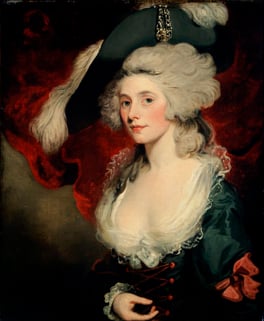
'The King, Queen, and the Three Princesses with two of the younger childred occupied two Boxes fronting the Orchestra. The Duchess of Devonshire and all the women of Fashion in a gallery near them...With regard to the company the Women appeared to disadvantage as being forbid Hats and Feathers they had almost uniformly put on the most disfiguring head-dress I ever saw — A Mob of a most immense size, simply illustrated with blue or yellow ribbons — this over friz'd Heads and sallow complexions had a very bad effect — a few with fair skins and clear brown hair bore the disguise tollerably.'
Showing posts with label Elizabeth Linley Sheridan. Show all posts
Wednesday, October 2, 2013
Forbidden feathers
On June 1, 1785 Eliza Sheridan wrote of a visit to the theatre where, as usual, eyes were mostly on those off the stage:
Monday, January 30, 2012
Gossip at Chatsworth
Eliza Sheridan was certainly aware of her husband's tendencies to be, oh how do we say this delicately, a slut. When she first found out about his affair with Fanny Crewe, Eliza threw a fit, but sadly Sheridan was not a man to be controlled and Eliza ended up admitting defeat (although she had her own vengeful affairs). Her letter to her friend Mary Anne Canning in 1785 is very revealing of for genteel women had to constantly deal with their husband's infidelities:
"S is in Town—and so is Mrs Crewe. I am in the Country and so is Mr Crewe—a very convenient Arrangement, is it not? Oh the Tiddlings and Fiddlings that have been going on at Chatsworth. 'Twas quite a Comedy to see it."
Saturday, June 11, 2011
Coming Exhibitions: The First Actresses
I nearly jumped out of my seat in excitement when I read this announcement from the Nation Portrait Gallery today:
The First Actresses: Nell Gwyn to Sarah Siddons
20 October 2011 - 8 January 2012
Wolfson Gallery
Tickets £11/£10/£9
This sounds like an exhibition not to be missed since no museum has ever housed so many tarts at once! I have never had the pleasure of seeing my favorite portrait of Perdita Robinson (by Hoppner) and it appears it will be one of the highlights of the collection. Time to begin counting down the days until October.
The First Actresses: Nell Gwyn to Sarah Siddons
20 October 2011 - 8 January 2012
Wolfson Gallery
Tickets £11/£10/£9
The First Actresses will explore the vibrant and sometimes controversial relationship between art, gender and the theatre in eighteenth-century England. Combining much-loved masterpieces with newly-discovered works, the exhibition will look at the ways in which actresses used portraiture to enhance their reputations, deflect scandal and increase their popularity and professional status.
The exhibition features portraits by artists such as Joshua Reynolds, Thomas Gainsborough, John Hoppner and James Gillray, with highlights including Reynolds’s famous portrait of Sarah Siddons as the Tragic Muse, Hogarth’s The Beggar’s Opera and Gainsborough’s portrait of Elizabeth Linley. Visitors will discover the fascinating stories of actresses including Nell Gwyn, Kitty Clive, Hester Booth, Lavinia Fenton, Sarah Siddons and Dorothy Jordan.
Starting with the emergence of the actress’s profession in the late seventeenth century, The First Actresses will show how women performers were key figures in celebrity culture. Fuelled by gossipy theatre and art reviews, satirical prints and the growing taste for biography, eighteenth-century society engaged in heated debate about the moral and sexual decorum of women on stage and revelled in the traditional association between actress and prostitute. The exhibition will also look at the resonances with modern celebrity culture and the enduring notion of the actress as fashion icon.
Friday, June 25, 2010
Dueling Rakes
How dare you, sir!
Well S or Sheridan knew exactly what those strong letters meant and he wasn't going to let Mathews get away with calling him an l and an s! (Liar, scoundrel, by the way)
What brought Mathews to this alarming language? Mathews has recently discovered Sheridan's marriage to his crush, Elizabeth Linley, whom he had pursued to no avail. Miss Eliza was not interested in being a teenage mistress to a married man and had rejected his advances
Sheridan demanded satisfaction for Mathews insulting his lady-love (wait, I didn't see any strong letters defaming her?), and a duel with swords was settled upon. First they were to meet in Hyde Park but it was too crowded. They settled for a tavern in Covent Garden and slapped each other around in what sounded like a true macaroni fight; no blood despite the use of swords.
Apparently the enraged Irishman had disarmed the military man and made him promise to retract his statements via an additional newspaper advertisement. Mathews agreed but was none too pleased when the new talk of the town was his impotence in the dueling field.
Mathews counter-challenged Sheridan, and this time he meant business. The second duel was more gruesome and left both significantly bloody and bruised. Sheridan was left hanging on for survival but recovered a little over a week later. Mathews apparently escaped in shame in his carriage. Lucky for us too! Who else would we have to write scandalous plays, womanize intelligent ladies, and mingle in politics?
Tuesday, June 15, 2010
Modern Muses- Samuel's Painted Collection of Lady Greats
As, perhaps, a tribute to England's respect toward their learned women, little-known artist Richard Samuel painted the now-famous, Portraits in the Characters of the Muses in the Temple of Apollo, better known as The Nine Living Muses of Great Britain. Keeping with the tradition of the group portraits of the Dutch golden age, Samuel painted his sitters naturally in their environment...well, naturally might not be the best word for it since I doubt there was a temple of Apollo for the girls to hop in and play dress up (how else are we supposed to get the illusion to the nine muses?). The ladies interact with each other while still serving the painting's chief goals: portray these notable women and do it in a means which tells the viewers that these women deserve your respect. Isn't the eighteenth century great?
When looking at this painting, I find not enough time is dedicated to pointing out the whose who. I almost want to brush my mouse arrow over it to see if the facebook tags will come up. Wouldn't that be nice? While I am not techie enough to put something like that on a blogger platform, I can still give you the whose who report.
Elizabeth Carter is shown (far left in painting) in conversation with Anna Laetitia Barbauld. Described as a "fine old slut" by Lord nappier, Carter was, of course, more than that. She was a bluestocking and linguist, who translated the works of Epictetus in English for the first time in history. Being a friend of Samuel Johnson, she would help him edit some of his works. Barbauld has a long resume of achievements which make her difficult to categorize; a poet, political commentator, teacher, and in her later life, a children's book author.
The woman at the easel is none other than one of the founders of the Royal Academy, Angelica Kauffman.
Regaling everyone with a song on the lyre is the songbird, Elizabeth Linley Sheridan.
Surrounded by ladies, and visibly entranced by the music is Elizabeth Griffith. Griffith was born in theater royalty in Dublin and became and actress. Her husband wanted to take her as a mistress but she refused, resulting in the marriage. Not surprisingly, he had a roaming eye, and when he wouldn't return to home for extended periods it was Griffith who supported the family with her writing.
To Elizabeth's right is Catherine Macauly, whom I will be so cruel as to say Samuel was quite generous in her portrayal; it looks nothing like her!
Staring to the heavens is the queen of the bluestockings herself, Elizabeth Montagu. Once again, I have to wonder if Samuel had even laid eyes on her, Montagu being 59 when this portrait was painted. She was one of the wealthiest women of England and she used her wealth to foster British and Scottish literature.
The other lady musician, is Charlotte Lennox, taking up the cithara. This prop is misleading for Charlotte was not known for any musical skills but was a celebrated author, playwright, and poet as well as failed actress. Among her circle were Joshua Reynolds, Samuel Johnson, ans Samuel Richardson.
The figure who can't be bothered to look up from her reading to enjoy the music is Hannah Moore who was a playwright, religious writer, social reformer and philanthropist. Moore lived a long, fulfilling life, dying at age 88.
There are a few faults with the painting. The first being, the sitters are not accurately rendered. Perhaps in the quest to becoming an allegorical figure, your very image itself becomes, well, allegorical. Or, as I am inclined to believe: the painter just wanted pretty ladies. Samuel did not paint from live models. The other fault is that each of the ladies is supposedly representing one of the muses, however many have pointed out, it can't be determined which muses they are representing. Who is supposed to be Melpomene? Urania?
One side of me thinks this is a desperate attempt of an artist to feed into the celebrity craze of 18th century England. Making a tributary painting of famous women is bound to make a guinea or two, right? If that is the case the plan worked, for the painting made it into the Royal Academy exhibition of 1779. But the other side of me knows that I could be looking at the painting the wrong way. I should see these women as they are presented: as muses, inspirations. And that is, without a doubt what these women are, people to be inspired by and to look up to in one's own personal goals. For that, they were most deserved of being named the nine living muses.
The woman at the easel is none other than one of the founders of the Royal Academy, Angelica Kauffman.
Regaling everyone with a song on the lyre is the songbird, Elizabeth Linley Sheridan.
Surrounded by ladies, and visibly entranced by the music is Elizabeth Griffith. Griffith was born in theater royalty in Dublin and became and actress. Her husband wanted to take her as a mistress but she refused, resulting in the marriage. Not surprisingly, he had a roaming eye, and when he wouldn't return to home for extended periods it was Griffith who supported the family with her writing.
Staring to the heavens is the queen of the bluestockings herself, Elizabeth Montagu. Once again, I have to wonder if Samuel had even laid eyes on her, Montagu being 59 when this portrait was painted. She was one of the wealthiest women of England and she used her wealth to foster British and Scottish literature.
There are a few faults with the painting. The first being, the sitters are not accurately rendered. Perhaps in the quest to becoming an allegorical figure, your very image itself becomes, well, allegorical. Or, as I am inclined to believe: the painter just wanted pretty ladies. Samuel did not paint from live models. The other fault is that each of the ladies is supposedly representing one of the muses, however many have pointed out, it can't be determined which muses they are representing. Who is supposed to be Melpomene? Urania?
One side of me thinks this is a desperate attempt of an artist to feed into the celebrity craze of 18th century England. Making a tributary painting of famous women is bound to make a guinea or two, right? If that is the case the plan worked, for the painting made it into the Royal Academy exhibition of 1779. But the other side of me knows that I could be looking at the painting the wrong way. I should see these women as they are presented: as muses, inspirations. And that is, without a doubt what these women are, people to be inspired by and to look up to in one's own personal goals. For that, they were most deserved of being named the nine living muses.
Friday, April 23, 2010
A Very Special Announcement
I am extremely excited to announce the Librifiles edition of The Sylph is now available to order. This is the same edition as the Girlebooks ebook now available to download for free, but in print form for those who enjoy a good old fashioned book. I had a wonderful experience working together with the fabulous Laura of Girlebooks to put this out and was overwhelmingly flattered when she suggested distributing a print version with a introduction by myself. You can immediately begin to order The Sylph on Createspace.com now and for those Amazon.com addicts like myself, the book will soon be available to purchase there as well.For those who are interested, especially participants in The Sylph Group Read next month this is great opportunity to get your hands on a print copy of the book that also supports humble bloggers, and more importantly, independent publishers.
Don't forget to use discount code 95Y8NF33 at checkout with CreatesSpace to get 20% off!
A Note About the Cover
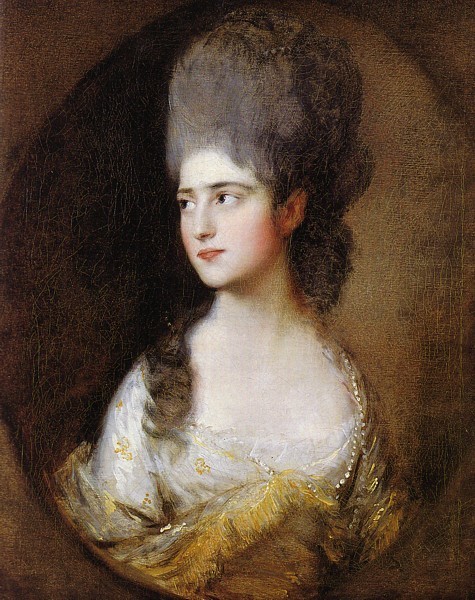
Thomas Gainsborough, Elizabeth Linley (later Sheridan), ca. 1775
The portrait of Elizabeth Linley was not only selected for the beauty of both the sitter and the painting but for Elizabeth's many similarities with the main character of The Sylph, Julia. In the many images Gainsborough painted of Elizabeth, she is portrayed with her curly locks loose and a natural glow. In this portrayal of the singer, she is made up with the high hair and makeup of the latest fashions and therefore, looks slightly out of her element, and almost uncomfortable. The process of this primping process is described in detail in the book from the perspective of a girl who had lived her life in the country, unused to the extreme fashions and unable to cope with them. Julia's similar discomforts with a rake husband, a malicious high society, and leaving a loving family match those of Elizabeth Linley Sheridan's, making her portrait an appropriate selection for the book's cover.
Friday, March 27, 2009
Tart of the Week: Elizabeth Linley Sheridan

One of the most beautiful and musically-gifted women of the late 18th century was Elizabeth Linley. Elizabeth, or Betsy (and even Eliza on occasion) as she was commonly known, was born in 1754 to the composer Thomas Linley and his wife Mary. Together, Thomas and Mary raised their twelve
Among the many admirers and young men begging for Betsey's hand was twenty year-old Richard Brinsley Sheridan. Sheridan was perhaps more interested in the chase, and the prize at the end was something he could rub in everyone's face. However, a certain Walter Long stood in his way. Long was really wealthy and about four times the age of Betsy. Thomas Linley pressured his daughter into the match for both the money and for the assurance than she would retire from the stage. God forbid she become an actress! The two were
Another drama quickly followed Betsy's broken engagement with Thomas Long. Sheridan saw his chance and swept Betsy off her feet. She agreed to marry him and the two eloped to France in 1772. Since both were underage, the marriage was invalid, and neither father approved. To save his daughter's reputation Thomas gave his blessing a month later and the two were accepted into polite society as a very talented and good-looking young couple.
While absconding away to France Betsy became very sick and almost died. Sheridan began to realize just how much Betsy meant to him and how he truly did love her, she wasn't just a prize anymore. Although Betsy survived, her illness was to be a precursor to the many that would follow throughout her life. Miscarriages soon burdened the new couple and it wasn't long before Sheridan began wandering into other women's beds. Betsy was devastated; the man she had chosen above others and at a huge risk, couldn't even be faithful to her. Still, they attended the political events and masquerades and men still marveled at her.
It was only a matter of time before Betsy finally had the courage to have her
Betsy was dying and both she and Sheridan knew it. They went to Bristol in hopes that the hot wells would improve her health. Sheridan tried to support his wife but seeing her dying in front of him torn him up from the inside. One night he found her playing piano, "with tears dripping on her thin arms," a shadow of her former self. Not long afterward Elizabeth died. Sheridan, in tears, held her hand, while she told him to stop crying or to leave the room, for she could not bear the sight when she needed fortitude. The guilt after her death sent Sheridan into the realms of madness. He wasn't the only one to morn her. The crowds at her funeral were so large that the carriage could barely get through the street to Wells Cathedral. Everyone crowded one last time to pay tribute to the maid of Bath whose voice was now silenced forever.
Friday, February 20, 2009
Tart of the Week: Hecca Sheridan
You could say that Hecca Ogle was Richard Brinsley Sheridan's retribution for being such a bastard to his first, and much sweeter wife, Elizabeth. Esther Jane Ogle, nicknamed Hecca, was born in 1776, the daughter of the Dean of Winchester. Her family tended to be involved in politics and move in the subsequent circles so it is likely there that the 43 year old playwright/politician first met the green-eyed eighteen year old.
Legend has it that upon their first meeting Hecca was all, "Ew go away!" and said that Sheridan was a "fright" and a "terrible creature" which of course just encouraged him all the more. At the time he was manic and depressed over rejection from Harriet Countess of Bessborough, so what better a time then to pursue a high-spirited teen. Eventually, his persistence paid off and Hecca began to say that he was "quite clever" despite being a "monster." Then Sheridan's star-quality began to dawn on her, perhaps this wouldn't be such a bad match after all. In 1794 she was in love and by 1795 they were married.
Hecca was not drop dead gorgeous but she was pretty. She also was young and had a wild side that appealed to a lot of men. Her dark features and green eyes along with her tall figure presented her as an exotic and mysterious creature that needed to be tamed. But taming was not in the works for this tart. The press began to take notice of how Sheridan's young wife's refusal to conform to the standards of a great man's wife. Yet, Sheridan was smitten and their son was soon born, with Charles Fox and Charles Grey as his godfathers. God forbid, anything happened to the Sheridans!
But things weren't to stay happy for long. Soon the arguments began. Hecca had no problem raising her voice against her Irish politician husband. She was disenchanted by her gloomy old husband who was fast becoming an alcoholic. She threatened to leave him and he begged her not to, all while thinking of Harriet. Hecca didn't leave him but she did move on to another; a man who just happened to be married to her own cousin, Charles Earl Grey.
At the time Georgiana and Grey had either reignited their affair or were good friends. Either way, Georgiana had put the past behind her and was ready to maturely move on. Grey himself, was not in love with her, yet couldn't stay away. But suddenly Grey began avoiding her altogether. This was due to Grey and Hecca hooking up. Hecca took no discretion, and once the affair reached the press, she flaunted it in Georgiana's face. I believe, after that, Georgiana finally realized Grey was just not worth it; but she still took the blow hard. Hecca relished in her victory. She would get hers later.
One night, Sheridan had drank himself into a stupor and Hecca feared for the worst. She sent for none other than Harriet who Sheridan was crying out for. Nervously, Harriet raced over at midnight. When Sheridan saw her he began apologizing for his awful treatment of her throughout the years and told her that he never loved anyone as much as her. Hecca was shocked and upset and interjected. Sheridan responded with, "My dear Hecca, you know I love you more than anyone else. Except her." When Hecca flew into a rage he merely responded, "Don't talk nonsense."
Hecca's remaining years were plagued by cancer. She perished prematurely at the age of 41, a year after her husband's death.
Subscribe to:
Posts (Atom)