Happy Mardi Gras! If you are in Venice right now you are finishing up Carnival which is hopefully as debaucherous as it was in the 18th century. When I think of the Venetian Carnival the artist Pietro Longhi comes to mind. Longhi was known for painting everyday scenes of Venetian life in the early 18th century, many of his paintings depict Venetians in their carnival masks.

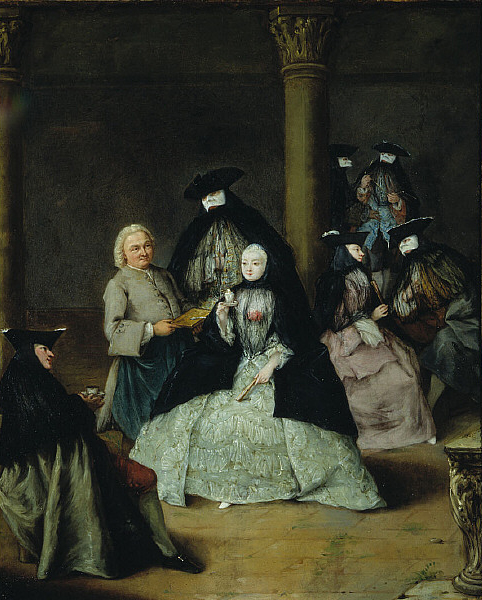


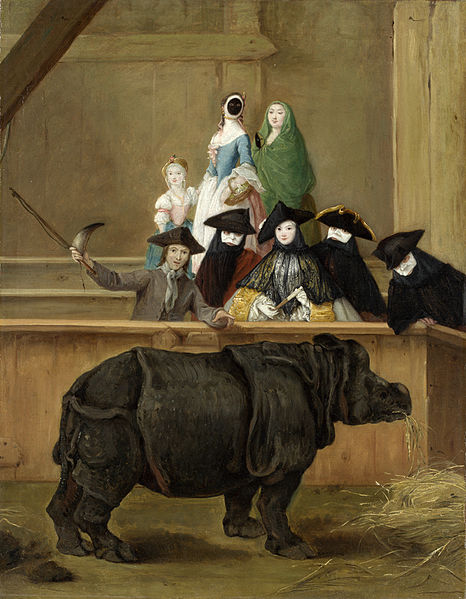


Now the fact that many of Longhi's paintings portray people in masks does not mean the artist had an unhealthy obsession with Mardi Gras. Visitors to Venice found masks to be commonplace accessories for native Venetians, which distinguished them from the harangue of tourists.Venetians wore them for the same reason you might make yourself "invisible" on instant messaging. It was hard to get to point A to point B without running in to people you know so in order to politely avoid conversation for the sake of punctuality Venetians would wear masks. That was their way of setting their little availability dot to "invisible." Sometimes citizens were legally obligated to don their masks during critical political decision-making times. That way street gossip could be curtailed and consequently wouldn't effect the political decision.

The standard-issue mask, promoted by the Ventian government was the
bauta which disguised the wearer but still allowed them to speak and eat freely. It is the white
bautas that you commonly see in Longhi's paintings. Another breed of mask you can see in the Longhi paintings is the
morretta, an oval black velvet mask popular with the ladies. Not pictured by Longhi is the
volto, a mask commonly associated with the Venetian Carnival.
Voltos are white masks that cover the entire face.
So which mask will you be wearing today?

 Now the fact that many of Longhi's paintings portray people in masks does not mean the artist had an unhealthy obsession with Mardi Gras. Visitors to Venice found masks to be commonplace accessories for native Venetians, which distinguished them from the harangue of tourists.Venetians wore them for the same reason you might make yourself "invisible" on instant messaging. It was hard to get to point A to point B without running in to people you know so in order to politely avoid conversation for the sake of punctuality Venetians would wear masks. That was their way of setting their little availability dot to "invisible." Sometimes citizens were legally obligated to don their masks during critical political decision-making times. That way street gossip could be curtailed and consequently wouldn't effect the political decision.
