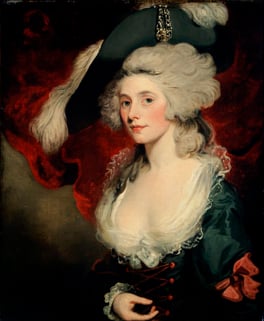
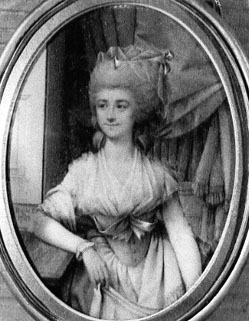
Like many little sisters of celebrated big sisters, Lady Wallace was stuck in the shadow of her elder sister, Jane, Duchess of Gordon. However, just like the Harriet to Jane's Georgiana, Eglantine, or Betty as she was known, proved to be just as interesting of a character.
Betty and her sisters were brought up by their mother, Lady Maxwell in a tenement in Edinburgh. The girls were known to be a bit wild (especially for daughters of a baronet) and rode pigs down the street with all the local children (hence the term 'piggy-back rides'). While Jane seemed to have curtailed the majority of her wild personality as she successful moved up the social ranks, Betty never seemed to lose her fire. She married Thomas Dunlop in 1770 who was made the 5th Baronet of Wallace shortly afterward. The marriage only lasted eight years; the couple legally separated on the grounds of Thomas's cruelty. However, I wouldn't be too surprised if Betty didn't give back as good as she got. Around this time she was summoned before a magistrate to answer for assaulting a female companion. She had to answer the same charges in 1793 when she assaulted a servant. Lady Wallace was a honey badger.
In 1793 she snuck into the House of Commons to watch a debate. Since women were forbidden from the public gallery Betty disguised herself in mens' clothing and managed to see much of the debate before she was discovered and consequentially kicked out. After her separation, she moved to London and took up the playwrights' pen. Three of her plays seemed fairly well-received in the late 1780s, with Sarah Siddons even taking up one of the roles. Her 1795 play, The Whim: A Comedy, however was banned by the licenser for an unknown reason. One can only hope it was because it was too racy.
Betty had a few close calls in her adventurous life. In 1789 she decided to travel to France to take the spa waters for her health, not thinking, perhaps this wasn't the best time to do so. After speaking her mind about the current political situation to, erm, the wrong people, she was arrested and accused of espionage - a crazy accusation considering Betty would have been the worst spy ever. She luckily managed to escape the situation with her head intact.
Not deterred by the continent after that experience, Lady Wallace seems to have spent the remainder of her life traveling in London through Europe. She died in Munich in 1803.
Showing posts with label The Theatre. Show all posts
Friday, July 25, 2014
Wednesday, October 2, 2013
Forbidden feathers
On June 1, 1785 Eliza Sheridan wrote of a visit to the theatre where, as usual, eyes were mostly on those off the stage:
'The King, Queen, and the Three Princesses with two of the younger childred occupied two Boxes fronting the Orchestra. The Duchess of Devonshire and all the women of Fashion in a gallery near them...With regard to the company the Women appeared to disadvantage as being forbid Hats and Feathers they had almost uniformly put on the most disfiguring head-dress I ever saw — A Mob of a most immense size, simply illustrated with blue or yellow ribbons — this over friz'd Heads and sallow complexions had a very bad effect — a few with fair skins and clear brown hair bore the disguise tollerably.'
Monday, May 14, 2012
A Cheat-Sheet for the Theatre
One of the best places for celebrity spotting in eighteenth-century London was the theatre, where one could see royalty, peers, and famous actors all together in one room. But how did one know which box a scandalous duchess or naughty count that were frequently talked about in the press would be sitting in? The papers would publish diagrams of the box subscribers so you could pick out who was sitting where.
One amazing article from the V&A's collection shows that people took this plan one step further. On one side of this fan is your usual fan decoration. But on the other side is a theatre layout with a list of subscribers. That way the owner of the fan could attend the theatre and do their usual people-watching with a cheat sheet of just who they were spying on- in case they forgot. What a handy tool for gossiping!
Monday, November 14, 2011
The First Actresses at NPG London
Every once in a while you hear of an exhibition that is so incredibly geared toward your tastes that you question whether you curated it in your sleep. Sometimes you even happen to be in the right place at the right time in order to actually see these once-in-a-lifetime shows. I am counting my blessings that I manged to be around for The First Actresses at the National Portrait Gallery which opened last month.
The exhibition is small but packs a great punch. Upon entering you are greeted by Nell Gwyn's portraits by Verelst. The first is one of the more recognizable images of the King's mistress but the second, showing Nell in state of undress, has been loaned from a private collection and shows just how stunning the comedic actress was. Upon seeing this boudoir portrait you have already made your visit worthwhile. The rest of the exhibition featured so many portraits that I have included in blog posts I felt like I was actually walking into the Gossip Guide! The rooms were separated into categories having to do with themes such as Covent Garden and the actresses as a muse. Who was there? Well, anyone who is anybody, my pet! Hester Santlow tipping her harlequin cap welcomed guests into the menagerie of eighteenth-century actresses. Mary 'Perdita' Robinson, Fanny Abington, Dorothy Jordan, Kitty Clive, Elizabeth Linley Sheridan, Sarah Siddons, Lavinia Fenton, Giovanna Baccelli, and Hester Booth are just a sampling of the wide range of ladies seen through the paint and pencil of artists such as Reynolds, Gainsborough, Hogarth, Hoppner, Gardner, and Russell. Even the beautiful Duchess was there in Gardner's depiction of her, Lady Melbourne and Anne Damer as the three witches- it is the first time in ages that the work has been on public display and now it will hopefully stay that way as a new acquisition for the museum.
While limited, the collection the curators accrued is quiet profound in terms of selection. My only criticism is the lack of gossip in the exhibition. I would have liked to see more satirical images; sadly, only a couple of Gillrays were included in the exhibition. I believe having more satirical images would have captured the actresses' celebrity and the fanfare surrounding them.
The First Actresses will be at the National Portrait Gallery until 8 January so do not hesitate to see the exhibition. For those who cannot possibly manage to get to the show, the exhibition catalog is currently on sale for £19.50 and has fun essays on things like dancing and celebrity (hopefully I will have a review up in a timely manner).
The exhibition is small but packs a great punch. Upon entering you are greeted by Nell Gwyn's portraits by Verelst. The first is one of the more recognizable images of the King's mistress but the second, showing Nell in state of undress, has been loaned from a private collection and shows just how stunning the comedic actress was. Upon seeing this boudoir portrait you have already made your visit worthwhile. The rest of the exhibition featured so many portraits that I have included in blog posts I felt like I was actually walking into the Gossip Guide! The rooms were separated into categories having to do with themes such as Covent Garden and the actresses as a muse. Who was there? Well, anyone who is anybody, my pet! Hester Santlow tipping her harlequin cap welcomed guests into the menagerie of eighteenth-century actresses. Mary 'Perdita' Robinson, Fanny Abington, Dorothy Jordan, Kitty Clive, Elizabeth Linley Sheridan, Sarah Siddons, Lavinia Fenton, Giovanna Baccelli, and Hester Booth are just a sampling of the wide range of ladies seen through the paint and pencil of artists such as Reynolds, Gainsborough, Hogarth, Hoppner, Gardner, and Russell. Even the beautiful Duchess was there in Gardner's depiction of her, Lady Melbourne and Anne Damer as the three witches- it is the first time in ages that the work has been on public display and now it will hopefully stay that way as a new acquisition for the museum.
While limited, the collection the curators accrued is quiet profound in terms of selection. My only criticism is the lack of gossip in the exhibition. I would have liked to see more satirical images; sadly, only a couple of Gillrays were included in the exhibition. I believe having more satirical images would have captured the actresses' celebrity and the fanfare surrounding them.
The First Actresses will be at the National Portrait Gallery until 8 January so do not hesitate to see the exhibition. For those who cannot possibly manage to get to the show, the exhibition catalog is currently on sale for £19.50 and has fun essays on things like dancing and celebrity (hopefully I will have a review up in a timely manner).
Thursday, October 20, 2011
Show Stoppers
Sometimes a night at the opera theatre was not as relaxing as one would have hoped. Just ask Joseph Addison. He was trying to get some culture one night at a showing of Macbeth when the worst thing that could happen, happened. He discovered he had chosen a seat near an annoying audience member.
Some Years ago, I was at the Tragedy of Mackbeth, and unfortunately placed my self under a Woman of Quality that is since Dead; who, as I found by the Noise she made, was newly returned from France. A little before the rising of the Curtain, she broke out into a loud Soliloquy. When will the dear Witches enter? and immediately upon their first Appearance. asked a Lady that sate three Boxes from her, on her Right hand, if those Witches were not charming Creatures. A little after, as Betteron was in one of the finest Speeches of the Play, she shook her Fan at another Lady, who sate as far on her Left Hand, and told her with a Whisper, that might be heard all over the Pit, We must not expect to see a Balloon to night. Not long after, calling out to a young Baronet by his Name, who sate thtree Seats before me, she asked him whether Mackbeth's Wife was still alive; and before he could give an Answer, fell a talking of the Ghost of Banquo. She had by this time formed a little Audience to her self, and fixed the Attention of all about her. But as I had a mind to hear the Play, I got out of the Sphere of her Impertinence, and planted my self in one of the remotest Corners of the Pit."
Thursday, July 14, 2011
Teatro Argentina
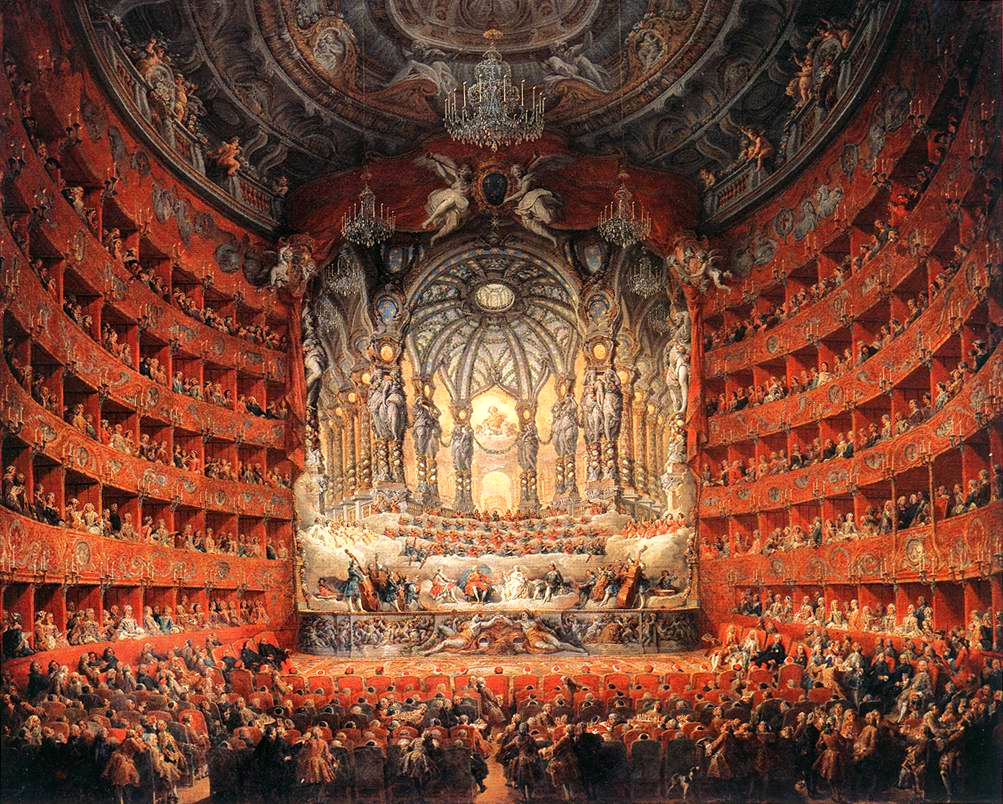
The Teatro Argentina is a grand rococo theater in Rome. It was built in the 1730s and is where the opera, The Barber of Seville first premiered. But when one looks at the impressive interior you get the sense that The Argentina is a true reflection of its time. Sure, it has all the rococo grandeur in the form of cupids and pastels, but remember, going to the theater in the 18th century was less about going to see the play and more about seeing the attendees. In order to accommodate this essential detail the Teatro Argentina was built with six stories of opera boxes, which makes viewing and gossiping all the easier.
Like Canaletto and his views of London, although times have changed we can still look upon the same structure. The Argentina has gone through many alterations through the years, which has stripped it of its rococo look and replaced it with a more simple one. But luckily for us Giovanni Paolo Panini painted the theater in 1747, leaving us with the grand spectacle that it once was when it was filled with all its gossiping guests.
![]() |
| Giovanni Paolo Panini, Feast at the Teatro Argentina in Rome in Honor of the Second Marriage of the French Dauphin, 1747 |
Saturday, June 11, 2011
Coming Exhibitions: The First Actresses
I nearly jumped out of my seat in excitement when I read this announcement from the Nation Portrait Gallery today:
The First Actresses: Nell Gwyn to Sarah Siddons
20 October 2011 - 8 January 2012
Wolfson Gallery
Tickets £11/£10/£9
This sounds like an exhibition not to be missed since no museum has ever housed so many tarts at once! I have never had the pleasure of seeing my favorite portrait of Perdita Robinson (by Hoppner) and it appears it will be one of the highlights of the collection. Time to begin counting down the days until October.
The First Actresses: Nell Gwyn to Sarah Siddons
20 October 2011 - 8 January 2012
Wolfson Gallery
Tickets £11/£10/£9
The First Actresses will explore the vibrant and sometimes controversial relationship between art, gender and the theatre in eighteenth-century England. Combining much-loved masterpieces with newly-discovered works, the exhibition will look at the ways in which actresses used portraiture to enhance their reputations, deflect scandal and increase their popularity and professional status.
The exhibition features portraits by artists such as Joshua Reynolds, Thomas Gainsborough, John Hoppner and James Gillray, with highlights including Reynolds’s famous portrait of Sarah Siddons as the Tragic Muse, Hogarth’s The Beggar’s Opera and Gainsborough’s portrait of Elizabeth Linley. Visitors will discover the fascinating stories of actresses including Nell Gwyn, Kitty Clive, Hester Booth, Lavinia Fenton, Sarah Siddons and Dorothy Jordan.
Starting with the emergence of the actress’s profession in the late seventeenth century, The First Actresses will show how women performers were key figures in celebrity culture. Fuelled by gossipy theatre and art reviews, satirical prints and the growing taste for biography, eighteenth-century society engaged in heated debate about the moral and sexual decorum of women on stage and revelled in the traditional association between actress and prostitute. The exhibition will also look at the resonances with modern celebrity culture and the enduring notion of the actress as fashion icon.
This sounds like an exhibition not to be missed since no museum has ever housed so many tarts at once! I have never had the pleasure of seeing my favorite portrait of Perdita Robinson (by Hoppner) and it appears it will be one of the highlights of the collection. Time to begin counting down the days until October.
Thursday, May 12, 2011
Quotables
For my part, I confess I seldom listen to the players: one has so much to do, in looking about and finding out one's acquaintance, that, really, one has no time to mind the stage. One merely comes to meet one's friends, and show that one's alive.-Fanny Burney on attending plays
Tuesday, May 3, 2011
Eugenie, or Men Suck
Before Pierre Beaumarchais wrote his most famous play, The Barber of Seville, centering around the famous character of Figaro and his antics, he had created a play of almost equal popularity with a female lead. The play, Eugenie and centered on the popular 18th century theme of a moralistic woman battling against an immoral world.
Wales must have been considered the country of naive country girls in the Georgian age. Georgiana's heroine from The Sylph, Julia, and Eugenie both share a commonality of being from Wales and getting mixed up with rakes. In the play, Eugenie has secretly married the Earl of Claredon and is pregnant with his child. She leaves Wales to visit him in London and is perplexed when he is a difficult man to get in contact with, despite her husband's knowledge of her visit. What Eugenie doesn't know is that her wedding to the Earl was staged and that he is in the midst of planning his upcoming nuptials to the daughter of the Duke of Winchester (doesn't that sound like a grand family). The result of this mess is webs of lies, duels, and risks of estrangement from fathers culminating in Eungenie's near death from the Earl's betrayal.
When the play first premiered it was a bit long-winded, creating a few yawns in the audience. Baumarchais and the cast noted this and then quickly made alterations so the play wouldn't be as long which did the trick. Instant success! Although the play took place in England it took a while to adapt to English due to Baumarchais messing up many facts about British culture that certainly would set English audiences talking during the play. It was Elizabeth Griffith who managed to create an adaption for the play in 1769, renaming it The School for Rakes.
If you would like to read Eugenie, a new translation has just hit the shelves of Amazon. Talia Felix, whose amazingly illustrated version of Fanny Hill I enjoyed, put together this new edition of Eugenie. If there aren't enough rakes or rakish antics in your life you might just have to check this play out!
Wales must have been considered the country of naive country girls in the Georgian age. Georgiana's heroine from The Sylph, Julia, and Eugenie both share a commonality of being from Wales and getting mixed up with rakes. In the play, Eugenie has secretly married the Earl of Claredon and is pregnant with his child. She leaves Wales to visit him in London and is perplexed when he is a difficult man to get in contact with, despite her husband's knowledge of her visit. What Eugenie doesn't know is that her wedding to the Earl was staged and that he is in the midst of planning his upcoming nuptials to the daughter of the Duke of Winchester (doesn't that sound like a grand family). The result of this mess is webs of lies, duels, and risks of estrangement from fathers culminating in Eungenie's near death from the Earl's betrayal.
When the play first premiered it was a bit long-winded, creating a few yawns in the audience. Baumarchais and the cast noted this and then quickly made alterations so the play wouldn't be as long which did the trick. Instant success! Although the play took place in England it took a while to adapt to English due to Baumarchais messing up many facts about British culture that certainly would set English audiences talking during the play. It was Elizabeth Griffith who managed to create an adaption for the play in 1769, renaming it The School for Rakes.
If you would like to read Eugenie, a new translation has just hit the shelves of Amazon. Talia Felix, whose amazingly illustrated version of Fanny Hill I enjoyed, put together this new edition of Eugenie. If there aren't enough rakes or rakish antics in your life you might just have to check this play out!
Friday, January 7, 2011
Tart of the Week: Nancy Dawson
The ongoing trend for celebrities in all ages is to have their great moment of fame and then to be cruelly forgotten, only leaving traces of their celebrity through time. Such is the case of Nancy Dawson. Googling the name today will deliver songs, and dances and nursery rhymes such as this one:
- Nancy Dawson was so fine
- She wouldn't get up to serve the swine;
- She lies in bed till eight or nine,
- So it's Oh, poor Nancy Dawson.
- And do ye ken* Nancy Dawson, honey?
- The wife who sells the barley, honey?
- She won't get up to feed her swine,
- And do ye ken Nancy Dawson, honey?
Nancy was born around 1728 into a poor situation in life but had aspirations for the stage. She turned to prostitution for survival and then took up with a traveling puppet company where she learned to dance. Her natural ability for dance opened up the opportunity to play Columbine, the ballerina in Commedia Dell'Arte and brought Nancy some recognition. Nancy continued to take different dancing jobs, performing at various coffee houses in Covent Garden. She was quite the go-go girl of her time. Her dancing caught the attention of Ned Shuter, a renown comedian and became his mistress. The relationship opened up more theater opportunities for Nancy.
Nancy was now comfortably situated in Covent Garden taking small acting parts here and there but her big break came in 1759. In the wildly successful The Beggar's Opera the dancer who would dance to horn pipes in the play was ill and an understudy was needed immediately. Nancy was given the role and when she pranced onto the stage she brought the house down. She became such a sensation that she was hired to perform her horn-pipe dances in between the acts of the play.
Songs and poems showered Nancy with praise. Of course this was 18th century London, so other songs and poems mocked her as well. The signature song she danced to had the tune of what we know as Pop Goes the Weasel and words were added to immortalize the lady who made the song famous.
- All the girls in our town,
- black the fair the red the brown,
- Who dance and prance it up and down,
- There's none like Nancy Dawson!
- Her easy mien her step so neat,
- She foots she trips she looks so sweet,
- Her every motion is complete,
- I die for Nancy Dawson
Capitalizing on Nancy's fame were two books which may or may not have been published by her or with her permission; Genuine Memoirs and the appropriately titled, Nancy Dawson's Jests. Although far from a pure woman, Nancy seemed to have a good sense of humor, a tenacity, and a very fine talent which is what truly made her famous. After taking a few more rolls as Columbine Nancy retired to a comfortable house in Hampstead where she died in 1767.
*"Ken" is Scottish slang, still used today, meaning "know"
Monday, August 2, 2010
Felicity Nussbaum talks Rival Queens in UPenn Podcast
Check it out hereFelicity Nussbaum, author of Rival Queen dishes about those 18th century actresses we all love to gossip about on a new podcast put out by the UPenn Press. Topics include actresses' rivalries, memoirs, promotion, fashion, class infiltration, and even products. Once again, it would appear our celebrity-crazed century isn't too different from the 18th century. Or perhaps we could still learn a trick or two from these dramatic dames!
Friday, May 28, 2010
Book Review: Rival Queens
One of the many enchanting things that draws people to the eighteenth century is the theater. The venues, the actors, the audience; there is just so many captivating aspects to this period in theater history. But perhaps the aspect that drew the most people into the theaters at the time and what still catches our modern-day interest is the actresses. It is the British actress that caught Felicity Nussbaum's interest which culminated in her newly released book, Rival Queens: Actresses, Performance, and the Eighteenth-Century British Theater.Rival Queens is an analysis of the celebrated English actress in the long eighteenth century. As Nussbaum makes clear in her introduction, her mission is not to give a historical account of her subject but to "focus on the exceptional actresses who changed theater history and afforded unprecedented models of public display as they confronted the social and theatrical strictures that traditional femininity imposed." Nussbaum does just that, with finesse. She does this all while drawing a comparison of the world these actresses encompassed with Nathaniel Lee's popular play, The Rival Queens, the story of Alexander the Great's wives, Roxana and Statira's jealousy for each other. Among the many topics Nussbaum covers is the actress' relationship with the audience, how the eighteenth century actress infiltrated the caste system, and how the actress would play up their personal life (which was of interest to the public) in her work.
Rival Queens is an exceptionally researched and thought-out book. I really enjoyed the information and research Naussbaum presented and especially appreciated her creative comparisons throughout the book. She consistently proves her expertise on gender-roles in the eighteenth century while drawing various arguments from other researchers to support her theories. Great actresses, many of whom have been discussed here, are examined in great detail. Like Naussbaum warns in the beginning of the book, this is not a history lesson text. Even though I learned much from this book, readers are expected to have somewhat of a background knowledge before reading it. This is an academic book, abundant with theories so it is not a book for every eighteenth century enthusiast. This doesn't mean it's a bad read; far from it, in fact! Rival Queens is an excellent book and I can see it soon gracing many a library and bibliography.
Friday, February 5, 2010
Tart of the Week: Anna Maria Crouch

For many years there was a thin line between actress and whore, which was entirely unfair considering there were some fabulous actresses out there who worked hard on stage for their living. But then again, this was the eighteenth century, actresses tended to come from the lower classes where it was dog-eat-dog, and stereotypes don't just appear out of thin air. While the fabulous Mrs. Crouch never took to the streets (as far as we know) she was no stranger to scandal, or rich men's bedrooms.
Not long after Anna Maria began at Drury Lane, she was already flouncing off with rakes. In 1783 it was reported that she eloped with a certain Irish peer, but we cannot confirm who.
Michael Kelly was a Dublin-born musician and singer who had been giving performances all over Europe and had also dabbled in acting. He arrived in London from Vienna with Nancy Storace, looking to making it big in England's capital city. A mere three years after her marriage, Anna Maria began an affair with Kelly. The two were not only sleeping together but also acting together, which as we all know, made great whisperings around London. To further delve into infidelity, Mrs. Crouch caught the eye of the Prince of Wales (he always did have a thing for actresses) and she had a brief affair with him. Let us examine how very tartly this was: Anna Maria was married and having an affair, and possibly hadn't cut things off with Kelly yet. The Prince, was also married at this time albeit, illegally to Maria Fitzherbert. Although the affair was brief, Anna Maria still managed to make off with a £10,000 bond from the silly prince, which probably ticked Perdita Robinson off royally because of all trouble she went through to get some of the prince's money!
After jumbling all these men around in 1791, Anna Maria reorganized herself. She separated from her husband and moved in with Kelly. The two divided their time between their home in London and their other home in Brighton. Sadly, Anna Maria's life was cut short in 1805 when she suddenly died. The 42 year old's cause of death is unknown and it sounds as if it wasn't a pretty situation, for rumors suggest she died from either drinking or a tragic carriage accident. Kelly was heartbroken and the monument he errected in her memory still stands today.
Monday, November 9, 2009
Monday, October 5, 2009
A Night at the Theatre
The Afternoon-
Around 5:00-6:00-
Arrive at the theatre of your choice. Mill about while the opening music plays. Check out who is the best dressed, make faces at those who are better dressed than yourself. See if your rival (political or otherwise) is there and make sure you act appropriately since all the papers will be talking about it tomorrow. Catch the eye of the woman or man you would like to become more intimate with. Is the royal family there tonight? Finally, when all those necessities are out of the way you can make your way to your box. Remember, this could be the most important part of your trip!

Bring on the Show!-
Of course, while you're in your box you should still be keeping your eye out for anything gossip-worthy. The play will begin, hopefully with the best and most fashionable actors of the time. In between acts there could be a comedy routine, singing, dancing, miming, juggling or acrobatics, and even a bit of a sideshow.
After the Play-You aren't going home just yet! That is, unless you are a gent who has just caught the eye of one of the women working the playhouse! After the play, there is another event to stay in your seat for. Perhaps a little opera is on the menu or even a ballet. Your eyes should still be gracing over the crowd because some people show up just for the Afterpiece since it is half-priced.
The Exit-
By now you've been at the theatre for hours. It could be midnight or later. Perhaps it is time to go home or perhaps it's time for a card game or dinner with friends. After all, going to the theatre might just be the start to your night!
Thursday, July 23, 2009
Commedia Dell'arte
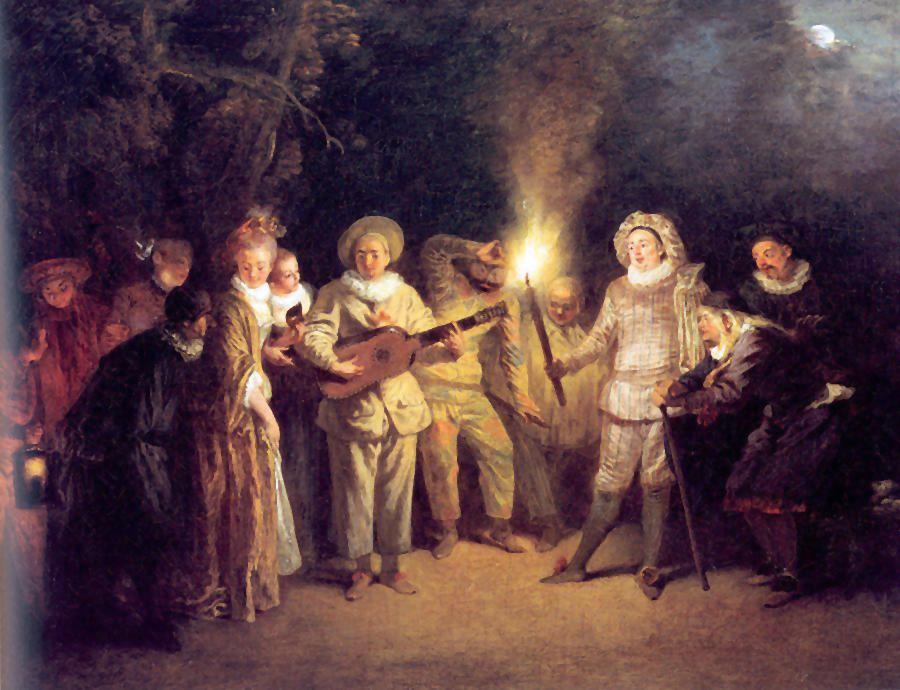
Arlecchino aka the Harlequin- The mischievous clown/acrobat who is hopelessly in love with the ballerina, Colombina. He can usually be identified by his diamond outfit, a wooden bat, and a cat-like mask with a wart on it.
Brighella- A rogue whose always scheming to make some cash
The Captain- The stereotypical soldier
The Doctor- The stereotyped doctor very pompous and very plump.Pantalone- The old miserly Venetian merchant. Pantalone usually has a long pointed beard and red pants. For extra commedic effect he is sometimes accompanied by a young and pretty wife.
Colombina- The saucy ballerina who is crafty, clever, and untamed. She would usually introduce or initiate the plot. Usually her white ballerina gown would have diamond patches to show her connection to Arlecchino. She was one of the few characters who tended to remain unmasked.
Innamorati (Innamorato and Innamorata)- The lovers who
can't keep their hands off each other are usually decked out in the most fashionable dress of the time.La Ruffiana- The gossipy old woman who maliciously attempts to keep the lovers apart.
Pedrolino- The faithful servant and target for physical jokes at his own expense. Pedrolino dresses in a white, puffy outfit with a ruff.
La Signora- Sometimes Pantalone is married to this matriarch who also happens to be the mistress of Pedrolino. She is over the top (think: Lady Gaga) and wears heavy makeup and wide skirts which cause her to walk with her arms out.
Pulcinella- As Lucy has added, "The tricky and always up for schemes- long-nosed hunchback."
Friday, July 10, 2009
Tart of the Week: Charlotte Charke

Charlotte Cibber, daughter of the famous poet laureate Colley Cibber, was a curious creature of many talents. She was an actress, author, transvestite, puppeteer, playwright, and even a sausage maker at one point. Charlotte was born in 1713 and received her education at a girl's school. When she later moved away to live with her mother she continued her education independently by teaching herself skills a women's education usually neglected such as shooting and horse racing. At thirteen she developed an interest in medicine and began studying to be a doctor. As soon as her father began receiving the supply bills, he immediately put a stop to her independent studies.
Time for a new career goal.
Charlotte married musician, Richard Charke and used her new marital status in order to secure a job. This time she tried her hand at acting; her father was the purveyor of Drury Lane, after all. She took to the art and soon was taking on my roles, including breeches roles, where she would have to dress as a boy. Usually young, attractive actresses like Mary Robinson were given these roles as an excuse to show off their legs. After five years on stage, Charlotte had had enough of theatre bureaucracy and went off to start HER OWN theater company. Soon afterward, Parliment passed a censorship law, making it illegal to perform any play that hadn't been approved by them. Charlotte venomously opposed the bill and was left without a job soon afterward. By this time her husband had run off to Jamaica and died shortly thereafter. Charlotte was now
a single mother who was unemployed.The next chapter of Charlotte's life was quite different. She took up puppeteering, eventually owning her own Punch and Judy theatre. She also wasn't just playing the breeches role on stage; now she was dressing as a man in public and would even go by the name of Charles Brown. Whether this was because she identified as a man more than a tart or just a means of escaping debt we do not know. At one point a young heiress fell in love with "Charles" and "he" proposed. Sadly, the engagment fell through. Once she was taken to debtor's prison, but the prostitutes of Covent Garden banded together to spring "Master Charles'" bail Girl power!
After many years of ups and downs with the theatre business, Charlotte decided she was too old for the business and settled down to be an author. After two successful novels, Charlotte wrote her memoirs, which, as that genre tended to be, were eagarly snatched up by the gossip-loving public. Charlotte died at age 47 in 1760, a mere two years after her famous father died.
Thursday, July 2, 2009
Ballerinas
There's some beautiful images of dancers (and dances) of the eighteenth century. I couldn't possibly remember them all, but here is a selection of some of the famous ballerinas of the age who enchanted audiences with their grace and beauty.
Wednesday, June 17, 2009
Ladies and Gentlemen, Mrs. Clive
A lovely reader, Kate, found this epilogue of the glorious Kitty Clive, the feisty Irish actress. Kitty closed her play at the Exeter Mercury Theatre with this little piece in 1763, six years before she officially retired. I think you will find the personalized epilogue witty and representative of the times and their values.LADIES! methinks I hear you all complain,
Lord! Here's the talking creature come again.
The men seem frighted -- for ‘tis on record,
A prattling female will have the last word.
But you're all out; for sure as you’re alive,
Not Mrs. Friendly now, but Mrs. Clive.
No character from fiction will I borrow;
But, if you please, I'll talk again tomorrow.
Then you conclude, from custom long in vogue,
That I come here to speak an epilogue,
With satire, humour, spirit, quite refined,
Double entendre, too, with wit combined;
Not for the ladies, but to please the men:
All this you guess -- and now you're out again.
For to be brief -- our author had me say,
She try’d -- but cou’dn't get one to her play.
No epilogue! Why ma'am you'll spoil your treat;
An Epilogue is the Cordial after Meat;
For when the feast is done, without all Question,
They’ll want liqueors [sic], to help them to Digestion:
And Critics, when they find the banquet light,
Will come next time with better appetite;
So, make your friends to write, for faith ‘tis hard,
If, ‘mongst them all, you cannot find one bard,
She took the hint -- Will you, good sir? Or you, sir?
A sister Scribbler – sure you can’t refuse her!
Some Lawyers try’d – not one cou’d make an end on’t,
They’d now such Work with Plaintiff & Defendant.
A Poet try’d; but he alledg’d for Reason,
The Muses were so busy at this Season
In penning Libels, Politics, and Satires,
They had’nt [sic] Leisure for such trifling Matters.
What’s to be done, she cry’d? Can’t you endeavour
To say some pretty Thing? – I know you’re clever,
I promis’d, - but, unable to succeed,
Beg you’ll accept the Purpose for the Deed.
Tho’ after three long hours in playhouse coop’d,
I fear you’ll say – you’ve all been finely dup’d.
Friday, April 17, 2009
Tart of the Week: Kitty Clive

Catherine Raftor was born in 1711 to a family neither well-off, nor poor. Her Irish father actually served Louis XIV in the french army. However, a soldier's salary was not great means of income so by the age of seventeen Kitty was pursuing acting since she seemed to
have a knack for it. It also didn't hurt that she was pretty as well. Kitty was blessed with a light complexion, dark hair, and light eyes. But underneath the pretty facade Kitty had a bad temper that would become slightly notorious.Kitty, being a Londonite, quickly secured a job at Drury Lane. Her story is similar to many other tartly actresses. Being young and full of life, she quickly grew in popularity and had an affinity for comedic acting. So of course, Kitty decided to put a deterrent on her fame by getting married to a George Clive. What is interesting about Kitty is how she was able to keep most of her private life under wraps. Her marriage quickly disintegrated but instead of George abusing or abandoning her, the two agreed to a mutual separation. They
probably just grew sick of each other!Luckily for Kitty, her dappling with marriage didn't seen to hurt her career. She continued on stage as Mrs. Clive. Of course, Kitty had her dalliances with men, and the press was always suspicious; but Kitty was always clever enough to manage to keep her affairs under wraps. Soon she was beginning to get noticed for a singing talent as well. One of the people who noticed her was Handel who she became close friends with. Another person whose friendship couldn't be avoided on Drury Lane was David Garrick. He also noticed Kitty's talent. She became one of his original company members in 1747. Kitty's temper tried Garrick's patience many a time, but she stayed with the company for twenty-two years.
After over forty healthy years on stage Kitty decided it was time for her to let the new pretty little actresses try their hand in the business. She retired to a cozy house in Twickenham that her friend Horace Walpole had secured for her. He called it Clive's Den but she dubbed it "Little Strawberry Hill" after his estate. Kitty died in 1785, after 75 happy years of life.
Subscribe to:
Posts (Atom)