Showing posts with label Paintings. Show all posts

Tuesday, April 10, 2012

Depicting the Duke of Devonshire

When it comes to images of Canis, otherwise known as William Duke of Devonshire, there is generally one that floats around on the web by Batoni showing the Duke on his grand tour adventure. And let's all be honest, most of you probably looked at it and went, "How did he get all that eighteenth-century tail?!"  Which is a totally legitimate question being that the Duke lacked social skills to be smooth with the ladies.  He just looks a bit plain and awkward.  When Anton von Maron painted him at the age of 20 the result was also pretty bad.
Hart would write almost 80 years later that the painting of his father was "so very bad" that Bess "had it altered by (I believe) Mr Rising, the cleaner of pictures..."  I'm sure it surprises none of you that Bess took charge on that!

But my favorite images of the Duke are the lesser-known ones which, ironically, are by one of the two most famous artists of the time, Joshua Reynolds.  One shows how handsome the Duke was around the time that he married Georgiana.  I believe the painting is in bad condition now, but you get a good idea from the print (love that coat!):
However my favorite of the two is rarely seen due to it being hidden away in a private collection.  It shows the Duke at age 19 or 20 although he looks much older and more sophisticated

Friday, September 23, 2011

Reynolds and Regalia

Who says you can't look good in the family uniform?  It may be a lot of red and gold but Joshua Reynolds helped some peers pull it off.  Which begs the question: Who wore it best?

Lord and Lady Pollington and their son, John, 1761-4
Anne Fitzroy, Duchess of Grafton, 1757-9
Elizabeth Percy, Duchess of Northumberland, 1757-9
The Harcourt Family, 1780
James Maitland, 7th Earl of Lauderdale, 1759
William Pulteney, 1st Earl of Bath, 1761
Isabella Countess of Erroll, 1763
Jane, Duchess of Gordon, 1778
Thomas Lawrence, Philadelphia Hannah, 1st Viscountess Cremorne, 1789
*Not a Reynolds, I know, but I couldn't resist this portrait's inclusion

Friday, September 9, 2011

Interior Scenes

Arthur Devis, Mr and Mrs Atherton,  c.1743
Arthur Davis, The John Bacon Family, c.1742-43
Johann Zoffany, Sir Lawrence Dundas and his Son, c. 1775
Johan Zoffany, Colonel Blair with his Family and an Indian Ayah, 1786
William Hogarth, The Cholmondely Family, 1732
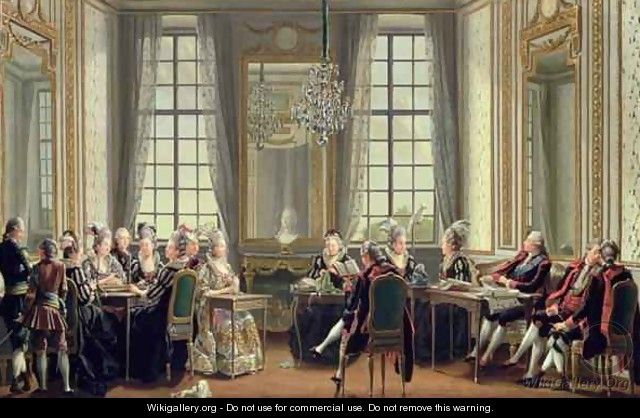
Pehr Hillestrom, Gustavian Style Interior with Cardplayers, c. 1779
Pehr Hillestrom, Conversations at Drottningholms Palace, 1779
Niclas Lafrensen, Count Alexander Stroganov with his wife and Children , c. 1778
Arthur Devis, Sir Roger Newdigate in the Library at Arbury
William Hogarth, The Strode Family, 1738

Monday, August 1, 2011

Cornelia Presenting her Children

Angelica Kauffman was one of the handful of women in the eighteenth century to be an esteemed and respected artist whose talents were sought after.  Kauffman also took a great role in the Neoclassical movement, preferring to place her subjects in a Greco-Roman atmosphere.


Kauffman also had a fondness for painting subjects with a moralistic message, especially when she could use stories from her beloved antiquity, such as her 1785 painting, Cornelia Presenting Her Children, the Gracchi, as Her Treasures. Now before I tell you the story behind this painting I want to selfish show why I enjoy this particular piece so much.  Kauffman not only proves that she can take the wheel in the male-driven world of history painting, but that she could bring in her knowledge of human emotion.  Here we have Cornelia presenting her two sons, with a causal gesture that has a strong impact.  The two sons look both humble and serene as they enter, one holds a book to show that he going places with his knowledge.

As this moralistic tale goes, Cornelia was a Roman matron and the example of virtue.  Romans were great lovers of virtue (in their women, at least) but that didn't necessarily mean that it was filled with the virtuous.  Here, Cornelia's guest, shows off her new treasures, no doubt gifts from a conquering Roman husband.  She then asks Cornelia to show her jewels to which Cornelia calls in her children and tells her that they are her, "treasures."

This is where Kauffman's skill in depicting human emotion, or perhaps females in general, comes into play.  Just look at the matron's face.  The history painting ends here and a more realistic depiction is revealed.  We have all seen that gobsmacked expression before.  I just can't decide if the proper caption would be, "Are you kidding me?" or "What the heck." since those are usually the two things that run through my head at a moment such as this.  I'm sure that's one less superficial Roman matron who will be visiting Cornelia from now on.

Thursday, July 14, 2011

Teatro Argentina

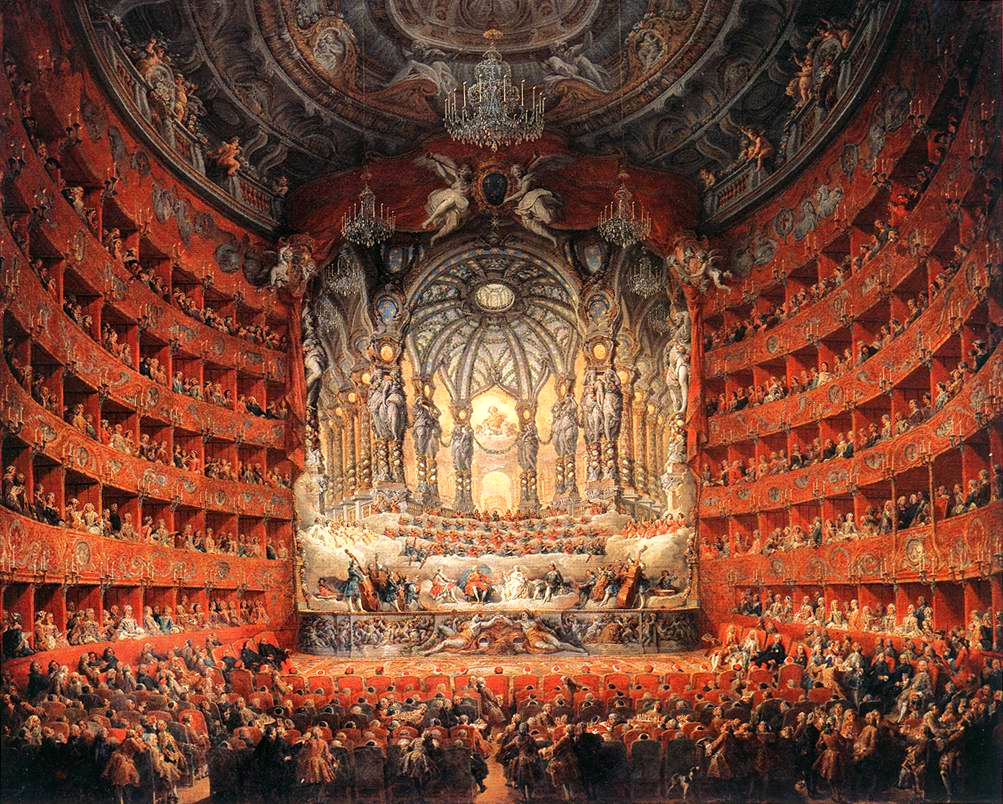
The Teatro Argentina is a grand rococo theater in Rome.  It was built in the 1730s and is where the opera, The Barber of Seville first premiered.  But when one looks at the impressive interior you get the sense that The Argentina is a true reflection of its time.  Sure, it has all the rococo grandeur in the form of cupids and pastels, but remember, going to the theater in the 18th century was less about going to see the play and more about seeing the attendees.  In order to accommodate this essential detail the Teatro Argentina was built with six stories of opera boxes, which makes viewing and gossiping all the easier.

Like Canaletto and his views of London, although times have changed we can still look upon the same structure.  The Argentina has gone through many alterations through the years, which has stripped it of its rococo look and replaced it with a more simple one.  But luckily for us Giovanni Paolo Panini painted the theater in 1747, leaving us with the grand spectacle that it once was when it was filled with all its gossiping guests.
Giovanni Paolo Panini, Feast at the Teatro Argentina in Rome in Honor of the Second Marriage of the French Dauphin, 1747

Monday, July 11, 2011

Favorites

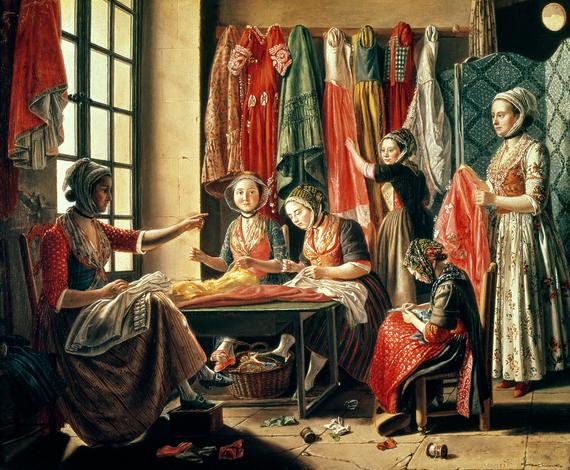
Antoine Raspal, The Couturier's Workshop, Arles, 1760

Tuesday, May 24, 2011

Favorites

Henry Robert Morland, The Fair Nun Unmasked, 1769

Monday, May 23, 2011

Plaid

Major James Fraser of Castle Leathers, 1720

detail Lord George Murray, first quarter of 18th Century
Domenico Duprà, John Drummond, 1739
Charles Campbell of Lochlane, ca 1745
Richard Wilson, Flora MacDonald, 1747
William Mosman, Sir James Sir Alexander Macdonald, 1749

Cosmo Alexander, A Jacobite Lady (Jenny Cameron), ca 1745
William Mosman, Prince Charles Edward Stuart, ca 1750
George Chalmers, Sir Alexander Macdonald
Joshua Reynolds, John Murray 4th Earl of Dunmore, 1765

Henry Raeburn, Niel Gow, 1787
Henry Raeburn, Colonel Alastair Ranaldson Macdonell of Glengarry, ca 1812

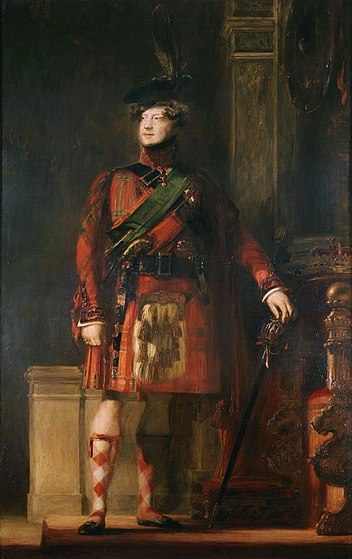
David Wilkie, George IV, 1829
In eighteenth-century England tartans were outlawed, but that didn't prevent sitters from being portrayed in them in their portraits.  Noble rebels such as the Duchess of Gordon and Frederick Prince of Wales (who much like a goth kid, wore it just to annoy his parents) were known for sporting plaid and getting away with it.  For more on these portraits of Scottish pride check out Portrait of the Nation now at the National Gallery of Scotland.

Thursday, May 5, 2011

Happy Cinqo de Mayo

Happy Cinqo de Mayo to all Mexican gossipers! What better way to celebrate than with an 18th century Mexican artist, Miguel Cabrera.

Miguel Cabrera, Spaniard and Indian Woman, 1763
Miguel Cabrera, Mexican Family, 1763
Miguel Cabrera, Spaniard and Octoroon Woman, 1763
Miguel Cabrera, Spaniard and Mulatto Morisca, 1763
Miguel Cabrera, Spaniard and Black, Mulatto, 1763

Monday, April 11, 2011

Favorites

Nicolas de Largillière, Study of Hands, 1715

Wednesday, March 23, 2011

The Depression-Inducing Portrait

Thomas Gainsborough, The Honourable Mrs. Graham, 1775-7
Georgiana and her best friend Mary Graham had many things in common.  One of their commonalities is they were lucky enough to sit for Thomas Gainsborough more than once.  Their portraits by Gainsborough were highly praised during their lifetime yet both portraits were hidden away from eyes for many years after the sitter's death, to only be narrowly saved and revealed in the following century. 

Like many great paintings, elements of mystery surround Mary's portrait.  She sat for the portrait when she returned from her honeymoon.  Many accounts do not refer to Mary showing the symptoms of tuberculosis, the disease which would plague and kill her and her family, yet she was reportedly too weak to sit long for Gainsborough.  Mary is shown wearing an ornate masquerade dress of pink and silver in the Van Dyck style. A jaunty plumed hat is perched on Mary's high tower of hair.  The fantastic outfit dazzled viewers and was made even more impressive by the fact that it was purely a figment of Gainsborough's imagination.  Mary never owned the dress and supposedly her family was upset with her being portrayed in such a harlot-y sort of outfit.  Strangely I have never personally found any thoughts Mary or her husband, Thomas had on the painting which was raved about when it was exhibited at the Royal Academy.

Mary succumbed to consumption in 1792 leaving a devastated husband wrought with grief.  Thomas could not even bring himself to return to the homes he once shared with his wife.  You might imagine the effect that seeing the celebrated portrait would have on him.  Some accounts say that bricks were laid over the hanging portrait where it remained until it was found during renovations.  Most accounts tell of Thomas hiding it in storage in London.  Storage is where it remained until after Thomas' death.

In 1843 Thomas' cousin, Robert Graham received a message about his deceased cousin's paintings still being in the warehouse. He accepting the paintings not even knowing if they were worth the storage fee he had to pay for them.  Robert had the enthusiasm of a child on Christmas morning and intercepted the delivery cart on Dalcrue bridge and immediately began opening the crates of paintings.  Robert felt as if he was seeing a ghost when he drew out Mary's portrait which had been hidden away for fifty years.

In 1859 Robert bequeathed Mary's portrait to the National Gallery of Scotland on the condition that it never leaves the walls of the museum.  He felt that the portrait should never again be housed in darkness and should be regarded as one of Scotland's national treasures.  Visitors to the National Gallery may just feel that way upon being welcomed to museum by the elegant Mary Graham.
Side-Note: There will be a lecture on Thomas Graham at the National Gallery of Scotland on May 17. Details here.

Tuesday, March 22, 2011

Skeleton Suits

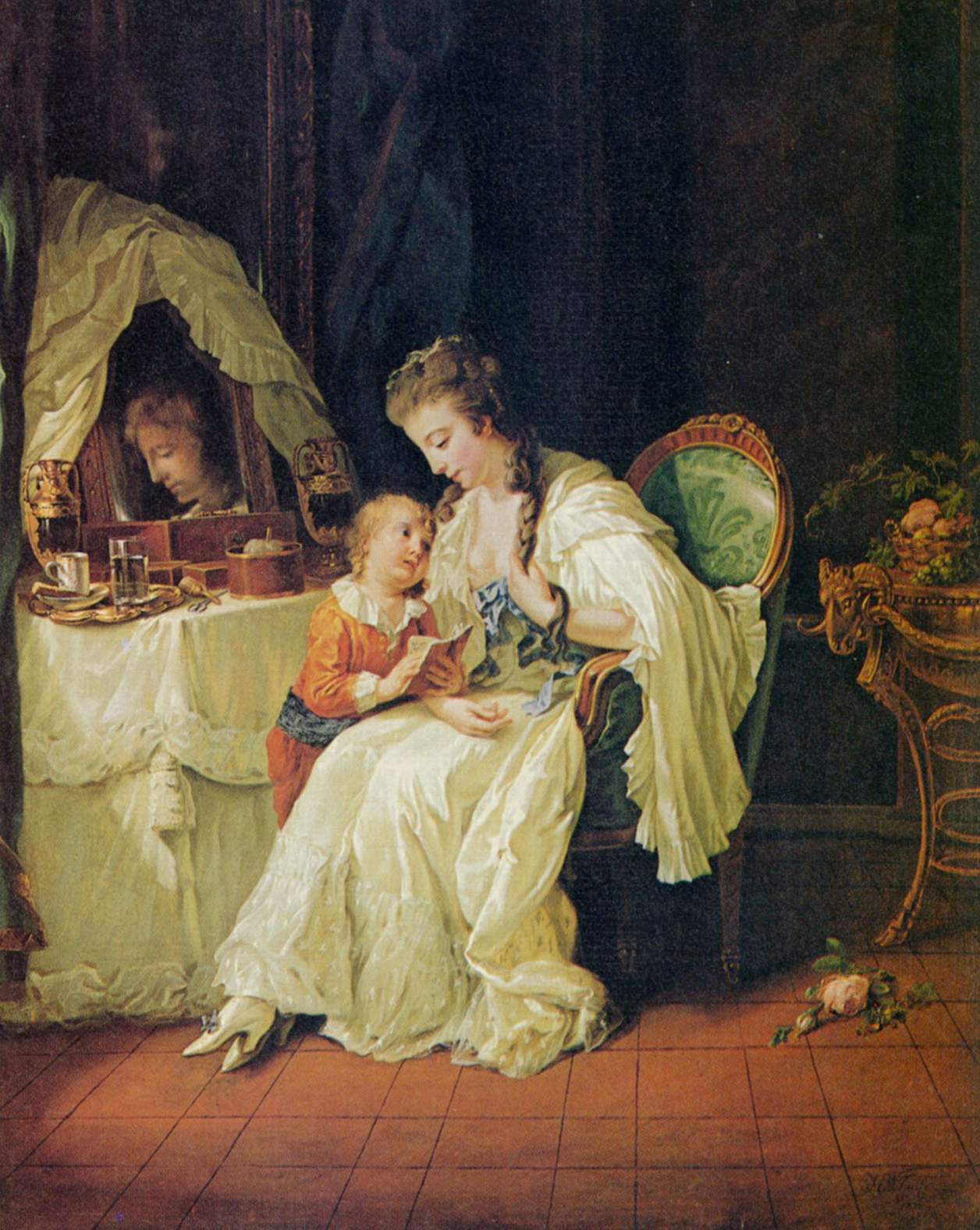
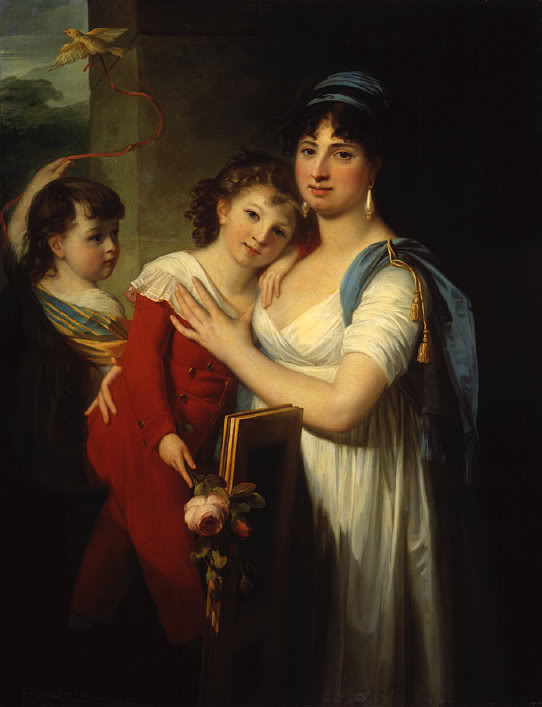
Remember those silly articles of children's clothing that weren't very cute but since they were synonymous with childhood you were put in them constantly and ooed and ahhed over?  I spent my first years in many rompers (just like last summer!) and onesies would look ridiculous on anything other than an infant.  The long eighteenth century equivalent were skeleton suits, which well-to-do little boys were forced into.  These jumpsuits look similar to clown suits and I am sure more than one little boy gave his nurse a hard time about wearing them.  However, they present a sentimental portrait into the lifestyle of the time.  Take a look at the wide range of skeleton suits worn all over Europe.

French School, Count Strogonov and Family, ca. 1778
Johann Tischbein, Family Scene, 1778
Anne Rosalie Filleul, The Children of the Comte d'Artois, 1781
Thomas Gainsborough, The Baillie Family, 1784
Adolf Ulrik Wertmüller, Marie Antoinette and her Children, 1785
Francisco Goya, Portrait of Don Manuel Osorio Manrique de Zuniga, 1787
Jean-Laurent Mosnier, Anna Muravyova-Apostol and her Children, 1799
Gerard von Kugelgen, The Family of Paul I of Russia, 1800
William Berczy, The Woolsey Family, 1809
Francisco Goya, Porträt des Pepito Costa y Bonelis, 1813
Giuseppe Cammarano, The Family of Francis I of the Two Sicilies, 1820