Showing posts with label Joshua Reynolds. Show all posts

Tuesday, May 22, 2012

Nursery Rhymes for Little G

The many visitors to Chatsworth every year will be lucky to see an amazing art collection, which includes esteemed portrait by Reynolds celebrating the birth of Georgiana's first child, Little G.  At first glance both eighteenth-century viewers and modern have had one of two reactions; the first being that the beautiful duchess is about to happily smack her long-awaited child (this was actually included in a contemporary review!) or the intended one, that a mother and child are in the throes of a fun game.  The game that the two Georgianas are supposed to be playing is, Ride a cock horse to Banbury Cross, which is now sung as follows:
Ride a cock-horse to Banbury Cross,
To see a fine lady upon a white horse;
Rings on her fingers and bells on her toes,
And she shall have music wherever she goes
Perhaps more familiar to British readers than Americans, this nursery rhyme is still sung to little tykes today.  In fact there is a gorgeous statue commemorating it in, you guessed it, Bunbury Cross. The rhyme has gone through some changes throughout the years and it may have been sung a little differently to Little G.  The recorded 1744 version had a different ending:
Ride a cock-horse
To Banbury Cross,
To see what Tommy can buy;
A penny white loaf,
A penny white cake,
And a two-penny apple-pie
In 1884 when Randolph Caldecott illustrated the rhyme, he picked the perfect setting to illustrate his "fine lady." the 1780-90s.  The lovely result has the essence of familiar ladies (and their awesome fashion); methinks the sailor-mouthed, Lady Lade is on the cover!  Thanks to Project Gutenburg you can read the book here.

Tuesday, April 10, 2012

Depicting the Duke of Devonshire

When it comes to images of Canis, otherwise known as William Duke of Devonshire, there is generally one that floats around on the web by Batoni showing the Duke on his grand tour adventure. And let's all be honest, most of you probably looked at it and went, "How did he get all that eighteenth-century tail?!"  Which is a totally legitimate question being that the Duke lacked social skills to be smooth with the ladies.  He just looks a bit plain and awkward.  When Anton von Maron painted him at the age of 20 the result was also pretty bad.
Hart would write almost 80 years later that the painting of his father was "so very bad" that Bess "had it altered by (I believe) Mr Rising, the cleaner of pictures..."  I'm sure it surprises none of you that Bess took charge on that!

But my favorite images of the Duke are the lesser-known ones which, ironically, are by one of the two most famous artists of the time, Joshua Reynolds.  One shows how handsome the Duke was around the time that he married Georgiana.  I believe the painting is in bad condition now, but you get a good idea from the print (love that coat!):
However my favorite of the two is rarely seen due to it being hidden away in a private collection.  It shows the Duke at age 19 or 20 although he looks much older and more sophisticated

Friday, September 23, 2011

Reynolds and Regalia

Who says you can't look good in the family uniform?  It may be a lot of red and gold but Joshua Reynolds helped some peers pull it off.  Which begs the question: Who wore it best?

Lord and Lady Pollington and their son, John, 1761-4
Anne Fitzroy, Duchess of Grafton, 1757-9
Elizabeth Percy, Duchess of Northumberland, 1757-9
The Harcourt Family, 1780
James Maitland, 7th Earl of Lauderdale, 1759
William Pulteney, 1st Earl of Bath, 1761
Isabella Countess of Erroll, 1763
Jane, Duchess of Gordon, 1778
Thomas Lawrence, Philadelphia Hannah, 1st Viscountess Cremorne, 1789
*Not a Reynolds, I know, but I couldn't resist this portrait's inclusion

Monday, May 23, 2011

Plaid

Major James Fraser of Castle Leathers, 1720

detail Lord George Murray, first quarter of 18th Century
Domenico Duprà, John Drummond, 1739
Charles Campbell of Lochlane, ca 1745
Richard Wilson, Flora MacDonald, 1747
William Mosman, Sir James Sir Alexander Macdonald, 1749

Cosmo Alexander, A Jacobite Lady (Jenny Cameron), ca 1745
William Mosman, Prince Charles Edward Stuart, ca 1750
George Chalmers, Sir Alexander Macdonald
Joshua Reynolds, John Murray 4th Earl of Dunmore, 1765

Henry Raeburn, Niel Gow, 1787
Henry Raeburn, Colonel Alastair Ranaldson Macdonell of Glengarry, ca 1812

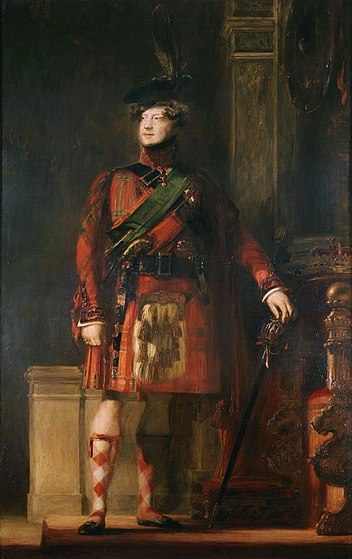
David Wilkie, George IV, 1829
In eighteenth-century England tartans were outlawed, but that didn't prevent sitters from being portrayed in them in their portraits.  Noble rebels such as the Duchess of Gordon and Frederick Prince of Wales (who much like a goth kid, wore it just to annoy his parents) were known for sporting plaid and getting away with it.  For more on these portraits of Scottish pride check out Portrait of the Nation now at the National Gallery of Scotland.

Tuesday, May 18, 2010

Portraits in the Grand Manner

The dominating style in late eighteenth century British portraiture is known as "Grand Manner." Some credit the invention of the style with Joshua Reynolds refined and defined the style in his Discourses on Art and would discuss it in his lectures at the Royal Academy. Reynolds actually would refer to it as "great style" or "great style" but names were not important, it was the concept of the style.

So how we do we know what is Grand Manner? Well, most of the portraits that have graced this blog over the years are done in this style, for the blog's author has a preference to this style which shows her Enlightenment. That is the intention of Grand Manner: to show the sitter's Enlightenment. The sitter is made to look noble, smart, and with purpose. "That isn't as easy as you may think." you might say. Luckily, I have a a quick reference guide to how to piece together a portrait in the grand manner style:

1. Paint a full length life size or larger.

2. Put the sitter in a Classical pose (extra points for a gesture)

3. Paint an Arcadian landscape, more fantasy than reality.

4. Include a Classical prop: urn, fragment of architecture, or even Laocoon statue (if you are in Rome)

5. Dog is a charming touch but optional

Tuesday, April 27, 2010

Festooning the Bust of Hymen

It would seem pretty sacrilegious if young virgins of English nobility really decorated the bust of the god of marriage before their marriages. The depiction of them doing so, however, was a popular theme in portraiture. Not only was it a Romantic notion but also a nod toward the Classical.

Hymen or Hymenaios was usually depicted as wearing flower garlands, which may of had something to do with the ritual of decorating his term to gain his favors. Eighteenth century ladies would be depicted in such form to commemorate their marriage. When a term of Hymen was not to be had women, such as Lady Harrington, would pay tribute in their marriage commemorations by being portrayed with a garland. Lady Keppel's portrayal is probably the most well-known of these depictions. She was a lady of Queen Charlotte's and is portrayed in the gown she wore at the coronation, or perhaps wedding (I can't remember specifically!). The results are always a stunning result of motion and color displaying the sitters at their best, to show the triumph of the future bridegroom in snagging such a great catch!


Joshua Reynolds, Lady Elizabeth Keppel, 1761

Joshua Reynolds, Ladies Adorning a Term of Hymen, 1773

Benjamin West, Lady Beauchamp-Proctor, 1778

Wednesday, February 24, 2010

The Death of Reynolds

Yesterday was the anniversary of the death of one of England's greatest artists who graces this site regularly, Joshua Reynolds. To commemorate the anniversary of Reynolds' 1792 death The Times ran an interesting article about his funeral. Would you believe it created some controversy? Well, that's how it goes when you are famous I suppose!

Death of Sir Joshua Reynolds

Friday, December 18, 2009

Festive Family Portrait

Joshua Reynolds, Portrait of the Harcourt Family, 1780

From Left to Right: William Harcourt 3rd Earl Harcourt, Elizabeth Countess of Harcourt, George Simon Harcourt 2nd Earl Harcourt

This is the family portrait on the front of my Christmas cards this year; I like it a lot more than the ones I get in the mail! In truth, it's a quirky little family portrait, one that is quite unique to the time. Lord and Lady Harcourt are portrayed in their peers' robes and were nice enough to invite Lord Harcourt's little brother to stand in the background looking awkward. I'm sure Reynolds was driven mad by the formality of the portrait. Another unusual aspect of the painting is how the coronets are included in the depiction; usually peers didn't bother visually bragging during the Enlightenment. I thoroughly enjoy how Lady Harcourt stylishly perches her coronet on the side of her coiffure as well.

For some strange, sad reason this three-person portrait hasn't been seen by the public since the mid 19th century according to Culture 24. The Ashmolean Museum needs to stop holding out and let the masses gaze upon its noble glory.

Friday, October 9, 2009

Favorites


Joshua Reynolds, Mrs. George Huddesford, 1776

Monday, August 3, 2009

The Ladies Waldegrave


Joshua Reynold's iconic painting is probably familiar to many of you. Three heavily-powdered ladies in white sit around a table humming and hawing over their crafts. But before you get up to put the kettle on I'd like to share a bit about this painting.

The Ladies Waldegrave are specifically Elizabeth, Charlotte and Anna Horatia who were each 20, 19, and 18, respectively, when Reynolds painted them. Their mother was the vivacious and enterprising, Maria Duchess of Gloucester. It was she who commissioned this portrait, with a plan in mind. You see, Maria knew marketing and was a good PR rep, especially when it came to making sure her daughters married well, despite their mother's past sins. That's how The Ladies Waldegrave came to be.

The painting contains everything that would lead potential suitors to believe that these are the perfect little wifeys. First of all, they are all dolled up and pretty TO THE MAX. Take it easy on that powder Waldegrave sisters, you don't quite need that much! They are also in white for a reason, they're all virgins. To show that all sisters can employ themselves in a useful manner they are portrayed embroidering. If you saw them all gossiping and playing faro, I doubt that would make you want to jump up and marry them. Men date those girls they don't marry them!

Now exposure was no problem, that was the whole reason for getting Reynolds to create the depiction. Anything that came out of his paintbrush was considered gold and therefore, exposing the single man market to this billboard would not be a problem. It almost garenteed itself a spot at the Royal Academy exhibition where all the fashionable set would be.

Maria's plan worked. Elizabeth married the Earl Waldegrave (marrying your cousins allows you to keep your last name), Charlotte became a duchess when she married the Duke of Grafton (can you say: dark and mysterious hunk?), and Anna married Admiral Lord Hugh Seymour. Not bad catches to reel in with a painting! Art does speak volumes.

Monday, June 1, 2009

Quotables

"If a man were known to have a connection with [Margaret Caroline Rudd], it would sink him."


-Sir Joshua Reynolds

Sunday, March 15, 2009

The Intimate Portrait at The British Museum


Set in the intimate Gallery 90 in the British Museum, The Intimate Portrait takes some of the nicest drawings and miniatures out of the British Museum's collection and puts them on display for the masses...free of charge!

After hiking up the many flights of worn marble stairs you enter the dimly lit print gallery. It looks like any other print gallery with the exception of an ingenious little simplicity: rest boards. These banisters follow the glass cases allowing you to rest your arms (and handbag) as you lean down to read the detailed description of the drawings. Lauren and both remarked on what a convenient feature this was. It was needed to because there was a lot of reading in the descriptions and each was was so interesting, you didn't want to skip over any.

I loved this exhibition. Although small in size you could easily spend an hour or more there. There weren't as many miniatures as I was hoping, but the amazing drawings made up for the lack of miniatures. There were many highlights I particularly enjoyed. Two sketches of Angelica Kauffman show the artist in candid moments, sketched when she was sketching or in the company of friends. The drawing of Mary Hamilton by Lawrence is so beautiful it was chosen as the icon for the exhibition itself. A chalk self-portrait of Joshua Reynolds at 27, shows not only how handsome the young artist was but also depicts his young ambition and confident air. There is also a sketch Thomas Lawrence did of Emma when he was visiting the Hamiltons which is interesting in that Emma herself signed it. Her signature is surprisingly neat; I always pictured it in my head as sloppy since her grammar was horrible (although it wasn't her fault she was illiterate for years).

All in all, this is not an exhibition to be missed if you are in London. Give yourself an hour or so to dedicate to it and then leave through the opposite exit so that you come out in the citradel right by the restaurant. Order some afternoon tea for two and you are in heaven. Fabulous exhibitions should always be discussed over tea.

Friday, January 16, 2009

Oh Clotworthy!

Can't get enough Clot? Mythosidhe was so besotted with the charms of Mary Worsley Montagu's lost fiance that she did us all the favor of researching the face to go with that notorious name. Everyone should check out her post.

Joshua Reynolds painted this hunk and despite the humourous subject matter, you have to admit, it's a very nice portrait. To think, Mary actually rejected him; she must have been crazy! She could have led the exciting life of Mary Skeffington and never had to bother exploring Turkey or bringing the Smallpox inoculation to Europe. But no, she made her rash decision and had to pay for that mistake with her many amazing adventures and celebrity lifestyle.
Thanks for the find Mythosidhe!

Wednesday, January 7, 2009

State Portraits of England and France

When a monarch (and his consort) rose to power, one of the best things to do to assert their awesome ability to rule a country was to paint them in all their glory. These fantastic paintings, known as state portraits, differ from other 18th century portraits because they expressed a political ideal of an all-powerful being. Decked out on in coronation robes, the full-length monarch holds their royal regalia in a timeless setting that displays their wealth. The portraits were meant to generate awe, and when you see them in person, your mouth does kind of hang open.


Of course I love comparing the English aesthetic to the French. King George and Queen Charlotte had no choice but to allow Joshua Reynolds to do their portraits since he was the head of the Royal Academy. They much preferred Gainsborough (who painted many portraits of them and their family) because of his personal views and style of painting; but decorum deemed they had to have Reynolds paint them. The result is a rather dark portrait duo. In Reynold's brown hues the two monarchs are seated at their thrones, looking as if they are being crushed by their heavy uniforms of state.

Now here comes those young kids who are ruling France! Judging by Louis' portrait you would never know the deathly shy, naive, scared little boy that is contained under the gold fleur de lys. He stands in his finery, a true descendant of the Sun King. His crown does not lay on his head but is on a pillow in the background as a reminder that yes, this is your king. Marie's portrait is quite interesting. While it compliments her husband's, it also is a testament to her purpose as France's consort: a union with Austria. While she is also decked out in France colours, flowers, and symbols she still shows a bit of her Austrian roots which she had to give up upon her marriage. On the table beside her sits a pillow with both a Hapsburg rose and the French lily, showing the uniting of countries. It is the only small hint at her true orgins. Meanwhile, those French lilies are popping out everywhere! Fresh lilies are placed in the folds of her grand corps gown, asserting her devotion to France, as well as making her smell really good while she was sweating during the painting of the portrait!

Friday, December 26, 2008

Tart of the Week: Angelica Kauffman


The gypsy painter that is Angelica Kauffman was born in Switzerland, raised in Austria, and is considered to be one of the great British artists of the 18th century. How peculiar. She was born in 1741, the daughter of a painter. She inherited her father's skills in the art, and when the family moved throughout Italy on his various commissions, Angelica was allowed to hone these skills by working with him. Because of relocating throughout the continent, Angelica became fluent in a variety of languages including English. Soon, British tourists were commissioning her to paint their portraits on their World Tour. All this networking among the gentry of Britain got Angelica a ticket to London with Lady Wentworth.

Angelica was an immediate success in London. Due to Lady Wentworth's influence Angelica was able to rub shoulders with the great leaders of the arts such as Garrick and Reynolds. It was here that the naive 25 year-old became in entwined with a dangerous man that almost ruined everything she had earned through her hard work. The Swedish Count de Horn has been described as a "rogue" and was known to live lavishly but never invite anyone over to dine with him. Somehow or another he convinced Angelica to a clandestine wedding. It was not long before Angelica realized the danger she was in; her husband was squandering all her money and had none of his own. In fact this Count Frederick de Horn was an impostor. He wasn't the count at all, merely some guy who used to work for him.

With the help of her new friend, Joshua Reynolds, Angelica managed to escape unscathed from the secret marriage. Hmm, still sounds fishy to me! She moved on to new endeavors, and was one of the signatures partitioning the king for a Royal Academy of Painting and Sculpture. Indeed, Angelica was one of the two female incumbents in the Royal Academy which later banned women. She exhibited many of her works at the academy, many of which reflected her love of the Renaissance. Angelica also continued painting portraits and made lots of moolah doing so.

She married fellow artist, Antonio Zucchi in 1781. The marriage was not one based on passionate love, but more out of convenience. In fact, it is a bit questionable why Angelica even bothered. After the marriage the couple moved to Rome where Angelica continued to submit her work to the Royal Academy. The city welcomed her with open arms and her studio became a gathering place for great minds. Her husband died in 1795 (he was old to begin with) and left her barely anything in his will but if this bothered Angelica, she never really showed it. Maybe it was because she was filthy rich because of her successful career. She died in 1807 and was honoured by being given the most lavish funeral procession for an artist since Raphael. Just think how many artists Rome has supplied us with, too! Under the direction of the sculptor, Antonio Canova Angelica's funeral procession laid her to rest.