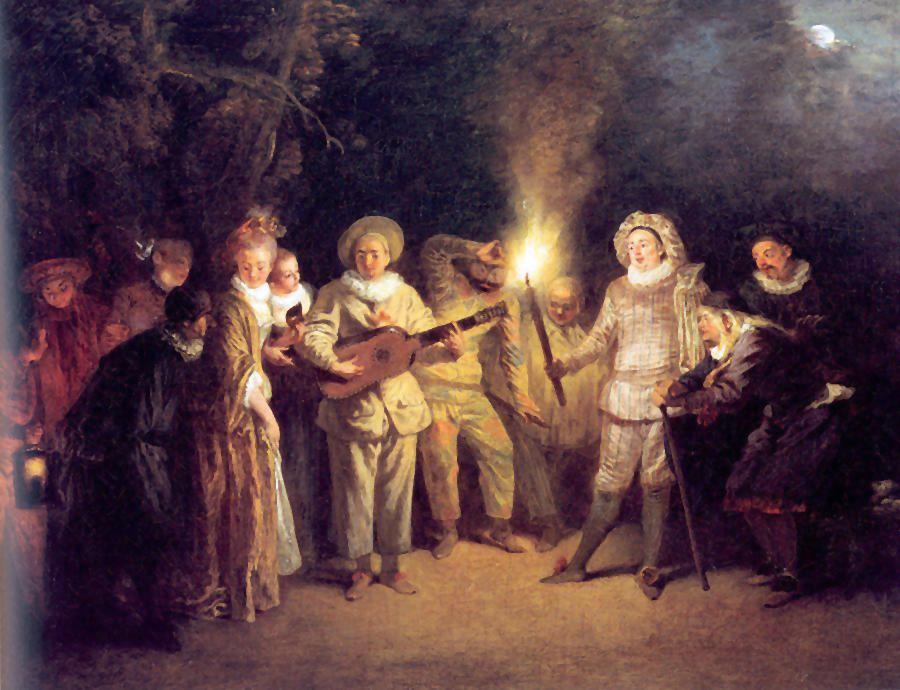
A certain Rococo artists seems to have taken New York City by storm. Everywhere I went last weekend it was Watteau, Watteau, Watteau! Three different museums had three different exhibits where Jean-Antoine Watteau was a key player.
Watteau to Degas: French Drawings from the Frits Lugt Collection, The Frick Collection
Our first stop on our Watteau walk was to The Frick. I enjoy the Frick; it has a fabulous collection housed in an amazing turn of the century house. This leaves little room for exhibition space. Exhibitions are held in the two rooms of the collection's basement. The first room contains various drawings and sketches from Watteau and his contemporaries. Then you walk in the second room and suddenly it's works from the following century. Whoa, wait, huh? Oh yeah, it's called Watteau to Degas. Strangely enough there is only one Degas and it was in the style of the Italian Renaissance. It was almost as if they couldn't fill their exhibition space completely with Watteau's contemporaries so they spanned into the 19th century. I love the Frick Collection but this exhibit was not a show-stopper.
Watteau, Music, and Theatre, The Metropolitan Museum of Art
This exhibition is nearing its close which is too bad because it was quite amazing. Why the Met decided to only host it for two months, is beyond me. Anyone who is familiar with Watteau is aware that music an theatre were the man's muse. This exhibition helps to explain his inspiration with not just Watteau's paintings (from collections all over the world) but with other works such as prints of ball scenes and operas and instruments from the era. If you have to opportunity to see this exhibition before it ends on 29 November, I highly suggest racing over to the Met. Lauren wrote a rave review of it and the show was my favourite of the three Watteau exhibitions we attended.
Rococo and Revolution: Eighteenth-Century French Drawings, The Morgan Library
Yes, it doesn't have Watteau in the title but the Morgan's exhibition of 18th century French drawings has no shortage of the artist's work. Also containing works from Fragonard, Lancret, Boucher, David, and many others, this exhibition takes up a large, open gallery in the Morgan Library. There is a lovely variety in the subject matter of the drawings ranging from still-lifes to interiors, to human form studies, all done with the delicate lines we tend to think of in Rococo art. The best part of the exhibition is it housed in the same venue as A Women's Wit, the Jane Austen exhibition, so you will be able to check out there two amazing shows at once!