Friday, July 27, 2018

Female Academics in the Eighteenth Century

I was alerted on Twitter that yesterday was the anniversary of the death of Elena Cornaro Piscopia - which is as fun a name to spell as it it is to pronounce, but alas, many are still unfamiliar with Elena.

Elena was a Venetian who, in 1678, was the first woman to receive her PhD.  Her doctorate was in Philosophy as her true love, Theology was deemed inappropriate for woman - baby steps toward progress, I suppose.  She was awarded it at the age of 32 which I personally think an excellent age to gain a PhD *wink*.  Elena's successes has made me wonder about female academics in the age of Enlightenment, though.  Sadly, sexism and gender division was still rampant during the so-called Age of Enlightenment and that unfortunately didn't produce many female academics.  However, that did mean the few to come out of the eighteenth century, were exceptional women indeed.

Dr Laura Bassi, was another Italian woman who earned her PhD in 1732.  Unlike Elena, Laura was interested in the Sciences, more specifically, Physics.  She defended her thesis at the age of 20 (!), becoming the second woman to hold a doctorate, 54 years after Elena.  She devoted much of her academic career to spreading the study of Newtonian mechanics to Italy.  In 1776, at the age of 65, she applied and was appointed to the chair in experimental physics by the Bologna Institute of Sciences, making her the first woman to earn a professorship.  Perhaps the best part: her supportive husband, who also had his doctorate, became her teaching assistant.

The mathematician, Maria Gaetana Agnesi, like Laura Bassi, would also be elected to a chair.  In 1750 she became a professor of mathematics,natural philosophy, and  physics at the University of Bologna which was apparently a very forward-thinking university in the eighteenth century.  Maria was an amazing mathematician, the likes of which I could never convey as someone who struggles with basic arithmetics.

If you're not Italian and starting to feel ashamed for your country of origins' historic lack of female empowerment in academia, have no fear, there is one more female academic.  Oh wait...she's Italian too.

Dr Maria Pellegrina Amoretti was awarded her Doctor of Law at the University of Pavia at the age of 20 (!) in 1777.  She initially applied to the University of Turin but was turned away because of her sex - get with the times, Turin!  Sadly, she only lived for a decade more after receiving her degree but in that time she worked on dowry laws, meaning she used her privileged position to help make other women's lives better.

Friday, July 13, 2018

British and French Print Media's and the Death of Marat

On this day in 1793 a young French woman named Charlotte Corday sought a meeting with the prominent French revolutionary, Jean-Paul Marat, promising information on an future uprising.  After being turned away in the morning, Corday was admitted in the evening to Marat's bathroom, where he conducted business now due to a debilitating skin disease that kept him submerged in his bathtub.  Corday recited the names of dissidents while Marat wrote them down, proclaiming that they would soon be guillotined.  This was Corday's cue; she drew out a kitchen knife hidden in her clothing and stabbed Marat in his chest, killing him almost instantly.  She then calmly waited for the police to apprehend her and was guillotined four days later.

Corday hoped that this act of violence would put an end to the violence of the French Revolution which she felt was now out of hand.  She blamed Marat for the excessive and repulsive bloodshed and she was not alone in this sentiment.  A search in the British Museum's collection of prints reveals a stark contrast in how France and Britain interpreted the assassination. 

Anonymous, 1793

Paul André Basset, 1793

Corday is often portrayed in French prints as a savage (though well-dressed) beast of a woman.
Isaac Cruikshank, 1793

William Holland, 1793

Whereas in British prints she is often depicted as a pretty young woman stabbing a buffoon.  One example is my favourite image of Corday, by James Gillray which portrays her with the dignity and grace of an eighteenth-century heroine. 

There are many depictions of the event by French and British printmakers that survive and of course, not all of them can fit within these two categories.  Notably this French print which is thought to have been printed a few years after the dust had settled and seems to give an accurate representation of Corday's arrest.  She sits patiently, next to victim while men rush in to apprehend her.

Jacques Swebach-Desfontaines, c. 1793-8

Monday, September 11, 2017

The Devonshire Children's Portraits

Henry Howard, Harriet Cavendish, 1798
Henry Howard was a well-known portraitist and history painter in the late- eighteenth and early- nineteenth centuries, who unfortunately doesn't get as much notice nowadays.  Luckily, his visit to the Devonshire family around 1798 resulted in three portraits of Georgiana's three [legitimate] children, Little G, Harryo, and Hart.  Though, I must apologise for the not-so-great quality of the photos of these portraits which now hang in the King William bedroom at Althorp, you can still decipher a certain je ne sais quoi quality to these portraits.  What is it...what is it...oh I know!

Awkward adolescence.


Henry Howard, Georgiana Dorothy Cavendish, 1798
These three portraits were painted when the painfully shy Little G was about 15, the painfully awkward Harryo was about 13, and Hart (who, perhaps, doesn't look totally uncomfortable) was about 9 or 10.  The ages of the daughters, specifically, is of interest because, outside of the rare family group portrait, adolescence is rarely commemorated in portraiture.  Baby and childhood portraits were common enough, and young women were often painted before they were married, or at least when they were in the marriage market.  However, this strange and, somewhat brief, period of youth was rarely portrayed in individual portraits.

 You can almost imagine adult Little G and Harryo cringing every time they passed these portraits; cursing their hair do and choice of headband.  While Little G's posture hints at a discomfort in sitting for her portrait, Harryo's somewhat more confident pose is mismatched with her still childish appearance.  ...and yeah, um, Hart just looks like any elite little boy-heir of the time in his portrait, so I'm just gonna leave that here as a contrast to his poor sisters.  In conclusion, rich eighteenth-century teenagers, they're just like us.  That would make the Devonshires similar to our camera-weilding parents and grandparents, snapping photos of their teenagers out of love, blind to any awkwardness.   When Howard was commissioned with these portraits, by either the Devonshires, or Lady Spencer, the children had already endured a two-year absence of their mother, after she was exiled to the continent by their father upon discovering her pregnant with Earl Grey's child.  It may be safe to say the separation of family members influenced commissioning such portraits.
Henry Howard, William Cavendish, Marquis of Hartington, 1799

If you would like to see these portraits, they are on display in Althorp House, amongst other lovely family pictures of Georgiana and her Spencer siblings as children.  However, if you can't make it to the glorious home, Althorp's website now has an amazing virtual tour.


Monday, August 28, 2017

New Video Detailing the Ritual of Dressing

The Lady Lever Gallery in Liverpool has commissioned a video detailing how well-to-do women dressed in the eighteenth century.  The seven-minute long video produced by Pauline Loven and made by Crow's Eye Productions leaves no one pondering why getting dressed (or undressed) required the help of another person.  To think, it only shows dressing, and not even other daily rituals such as styling hair or cosmetics; it makes me feel much better about how long it takes me to get ready in the morning!


I love this video for its portrayal of a rather mundane activity that is often forgotten about when we look at portraits, such as the Lady Lever Gallery's own Mrs Peter Beckford by Joshua Reynolds. My one critique is that as the narrator begins talking about pockets, the model is handed what looks like a giant popsicle stick and slips it down her stays between her breasts.  Quite a loud omission in my humble opinion!  The item in question is a busk, which added additional structure to the stays.  According to dress historian extraordinaire, Elisabeth Gernerd, they were often decorated with love poems due to being 'worn next to the heart' (I may or may not have questioned her anatomical accuracy was when she told me that).  Busks aside, this is a fantastic video to provide you with a better idea of just how intensive and time-consuming it was for privileged women to dress every day.


Friday, July 28, 2017

Sue Williams A’Court

This blog is guilty of regularly featuring glorious artwork from long-dead artists, but sometimes, just sometimes, it ventures into the land of the living [artist].

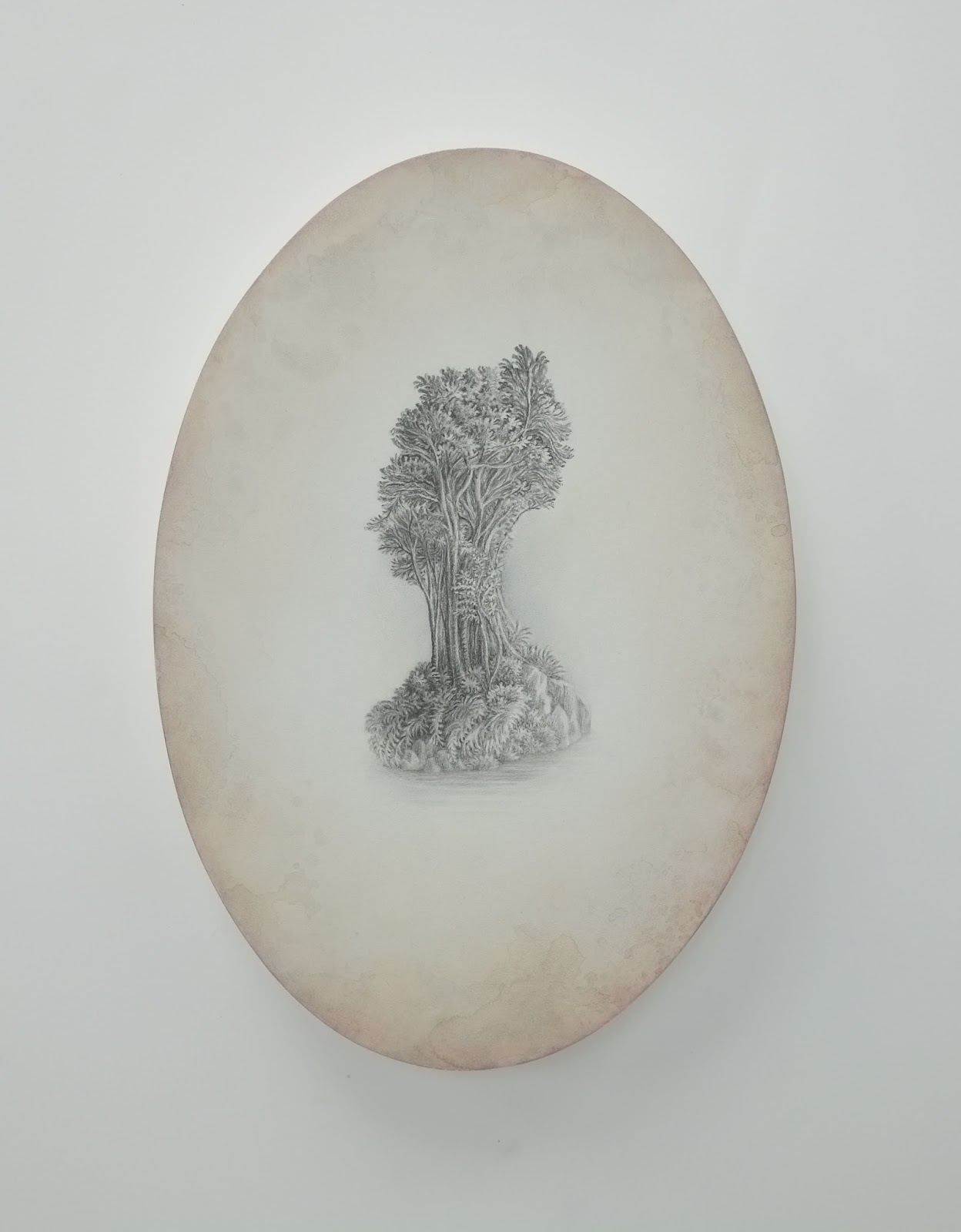
Sue Williams A'Court for example, is an artist whose work is very much inspired by those from the eighteenth century.  Her paintings are reminiscent of Gainsborough landscape prints and I am particularly reminded of them when I look at A'Court's pastoral trees.  Her most recent series blends famous portraits with natural formations.  In the spirit of Giuseppe Arcimboldo, the sixteenth-century painter who formed heads out of vegetables, A'Court transforms tufts of Arcadian landscape into imagery reminiscent of famous portraits.  See if you can pick out the portraits from these works.

After the Duchess of Devonshire

After the Hon Mrs Graham

After Marie Antoinette


The Escape fro Eden series will be exhibited at START Saatchi Gallery, London, 14-17th of September. Her work is currently on view at 'Only Connect' Curated by Prof. David Remfry RA Royal Academy The Keepers House.

Thursday, March 2, 2017

The Decay of Gordon Castle


http://www.scotlandsplaces.gov.uk/record/rcahms/16884/gordon-castle-tower/rcahms?item=1003299#carousel

http://www.scotlandsplaces.gov.uk/record/rcahms/16884/gordon-castle-tower/rcahms?item=1003299#carousel

Gordon Castle, the seat of the Duke and Duchess of Gordon in northern (and rather remote Scotland) was considered to be the largest building of Scotland in the eighteenth century. Dating back to the 14th century, the castle grew, and grew, and grew.  The home-loving Alexander, 4th Duke of Gordon, husband to Jane, Duchess of Gordon, added to the baronial home considerably until Gordon Castle was more of a Scottish Versailles. However, after his son died without an heir, transferring the Dukedom to the Duke of Richmond (who was quite happily settled in his own massive mansion, Goodwood) the castle gradually fell into disrepair. Leaky roofs forced much of these eighteenth-century additions to be demolished after which the once-grand Castle was all but forgotten. Luckily, after the second World War Lieutenant General Sir George Gordon Lennox, grandson of the 7th Duke of Richmond, took an interest in his ancestral home and began the restoration process which has continued into today. Gordon Castle, as it exists now, is only 1/8th of what existed in Jane, Duchess of Gordon's day. A wing, is now the central house, and the castle's formidable tower remains standing. The castle has been transformed into a hotel (and one that makes gin!) so it is once again open to visitors from afar.

Friday, September 9, 2016

Queens of Drag

http://previously.tv/rupauls-drag-race-all-stars/which-queens-want-it-on-rupauls-drag-race-all-stars/

It's no secret that I'm a fan of RuPaul's Drag race ever since it graced my television...however many seasons ago. The current season, for those who don't religiously watch, is their second All-Star Season, which means there's some quality queens competing to snatch that crown. The last episode may as well have said 'To Heather, Love, Ru' because the queens were all assigned to be 'queens from herstory', with the legend, Detox, impersonating Marie Antoinette and Southern belle extraordinaire, Ginger Minj, getting assigned with Catherine the Great.

I had to collect myself after that announcement.

Both queens turned it out. Minj's Catherine gown was surprisingly accurate - I love how she included the order star.

Detox went for what judge, Jeremy Scott termed, 'Neontoinette' which was kitschy fun (just like Marie Antoinette in pop culture, so why not?). I also appreciated the fact that she powdered her whole upper half in preparation and had a nearly perfect diamond necklace affair around her neck.

Ironically, both queens performed to songs concerning the great myths that are attached to them: Marie Antoinette saying 'Let them eat cake' and Catherine the Great's erm...great love for horses. But it's all in good fun, and that's exactly what this episode was FUN. 

You can watch the latest episode on Logo.

Friday, August 19, 2016

The Wonderful Everyday?


IKEA's latest commercial is an absolute delight! I won't say anything further; check it out for yourself.

Friday, March 4, 2016

Movie Review: Pride and Prejudice and Zombies

Ooo this looks cool
Those of you who read this blog when Jane Austen and Seth Grahame-Smith's Pride and Prejudice and Zombies first arrived in books stores, spawning a series of 'mash-ups' such as Sense and Sensibility and Seamonsters, may recall my delight in the book.  After numerous casting rumours and mishaps the film version finally arrived nearly 7 years (goodness!) later and I was eagerly looking forward to seeing it.  Pride and Prejudice and Zombies the book was clever, witty, and funny.  Pride and Prejudice and Zombies the film was not. 

I suppose what I liked the most about the book was that it took a genteel saga of mistaken first impressions and sprinkled zombies into it.  The plot line remained the same, there was just, let's say, some further hurtles to get in the way of Lizzie bennet and Mr Darcy's love.  Those hurtles happened to be a zombie infestation which forced Regency Britons to be very skilled in martial arts whilst still following the rhetoric of etiquette.  The film, decided this plot line was too familiar and perhaps wasn't enough, and like the horrible, Sense and Sensibility and Seamonsters tried to overcompensate by adding new plot lines that failed miserably.  But there's a reason that we still read Austen's books 200 years later: that plot works!  You can jazz it up with some zombies lusting for brains, but don't confuse it with extra plot lines.  Sometimes this came off as downright sloppy: for example, Wickham shows up to the Netherfield Ball just to tell Lizzie he isn't afraid of Darcy, and then he doesn't feature again in that scene, leaving me going 'why? what?'
Hollywood loves anachronistic pantaloons, doesn't it?

Perhaps the greatest offense was in Sam Riley's role as Darcy - admittedly, big boots to fill; even Colin Firth said that when he got the part for the 1995 miniseries his brother questioned his ability to be sexy enough for the role.  Riley tackles the challenge by speaking in a husky Christen Bale Batman voice which was hilarious at first and then sad for the remaining hour and 45 minutes.  There also seemed to be more of a focus on Mr Darcy - excuse me - COLONEL Darcy, as he kept insisting in the film, as a terminator of zombies than the protagonist, the plucky (and rather angry) Lizzie Bennet (Lily James).  My feminist alarm bells really went off though during the confrontation between Lizzie and Lady Catherine de Bourgh (Lena Headley).  Grahame-Smith extended this verbal garden confrontation in the book to an all-out battle royale, with the two gift sword-women fighting each other for honour.  Although the film tells you Lady C is the most formidable foe, you never actually see her in action.  She has a male crony fight Lizzie instead - so disappointing.

The only redeeming quality I felt the film had was Matt Smith as Mr Parson Collins.  He provided some much needed comic relief but alas, it wasn't enough to save this flaming zombie limb of a movie.

Thursday, December 10, 2015

Design your own Coiffure

Have a good chunk of time on your hands?  No?  Well you may find yourself going to this link anyway.  The V&A have developed a new distraction game in which you can design your own eighteenth-century wig.  You've been warned.

You can go for somewhat accurate


Slightly OTT


Or just go nuts.


Enjoy! Design a Wig

Tuesday, July 14, 2015

A Walk through 18th Century Paris


Musicologist Mylène Pardoen has brought us back in time with what she thinks the Grand Châtelet district of Paris sounded like.  We forget how much of our environment and memories consists of sounds and that is perhaps why few letters from the period document them.  The video above (start around the 2 minute mark) seeks to transport the viewer into Paris, with a 3D reconstruction of what it would have looked  and sounded like. Sigh, c'est merveilleux.

Thursday, July 2, 2015

'The Fashionable Bosom'


I'm not sure which I like more: the title of this print (A Nest for Puppies or the Fashionable Bosom) or its content.   Either way it's in my favourite file along with The breeches in the Fiera Maschereta.

The 1786 print critiques women's frivolous love of cute little lap dogs and expanding bustlines.  Why not combine the two?

Why not indeed.

Tuesday, December 23, 2014

A Royal Joke

Poor Mrs Fitzherbert.  Aside from the pain of being attached to the Prince of Wales, the unfortunate woman also seemed to suffer from a deficiency in brains by most accounts...which is likely how she got stuck with the prince to begin with.

Even though the Prince refused to socialise with people who refused to invite his illegal wife to their events, he and his family weren't entirely kind to Maria Fitzherbert Hanover.  Court gossip, Lady Mary Coke's letter tellsof one such occasion that left Maria publicly mortified.  While taking a walk with some of her friends and her husband in Windsor, enjoying the fresh air by the water's edge.  The Duke of Cumberland (the prince's uncle) approached Maria, and making polite conversation, asked her if she could swim.  When she responded that she 'thought she could,' he swiftly pushed her into the water.  Being that this was 1789, you can only imagine the layers upon layers of soaking wet muslin and delicate little shoes that were ruined in this display of 'humour.'  While poor Maria cried, the Duchess of Cumberland (and presumably, her hilarious husband) burst into laughter.  Mrs Fitzherbert wasn't injured, but I am sure her ego surely was.  Lady Mary Coke seemed to have little sympathy for her story's subject either, stating the whole thing was brought about 'by the company she is so desirous of keeping.'

Sunday, November 30, 2014

Bookspotting: Jane Austen's First Love, Blog Tour and Giveaway

I just want to direct the novel-consuming readers out there to the attention of a new Jane Austen inspired novel that may be of interest: Syrie James’ latest book, Jane Austen’s First Love.  Little is known about Austen's  love-interest, Edward Taylor, who may have inspired some of her admired male protagonists, however James has unearthed some new information about him in the process of writing her book.  From the publishers:


In the summer of 1791, fifteen-year-old Miss Jane Austen is determined to accomplish three things: to do something useful, write something worthy, and fall madly in love. While visiting at Goodnestone Park in Kent for a month of festivities in honor of her brother's engagement to Miss Elizabeth Bridges, Jane meets the boy-next-door—the wealthy, worldly, and devilishly handsome Edward Taylor, heir to Bifrons Park, and hopefully her heart! Like many of Jane’s future heroes and heroines, she soon realizes that there are obstacles—social, financial, and otherwise—blocking her path to love and marriage, one of them personified by her beautiful and sweet tempered rival, Charlotte Payler.

Unsure of her own budding romance, but confident in her powers of observation, Jane distracts herself by attempting to maneuver the affections of three other young couples. But when her well-intentioned matchmaking efforts turn into blundering misalliance, Jane must choose between following her own happily-ever-after, or repairing those relationships which, based on erroneous first impressions, she has misaligned.

The book has been receiving great reviews and is currently making the rounds on its blog tour.  There is also an amazing giveaway where you can get all sorts of Austen prizes just by leaving a comment here or on other stops along the tour.  


In the meantime we are lucky enough to have an excerpt from the book on a subject close to my heart: hair powdering:


It is June 1791, and Jane Austen is at Goodnestone Park in Kent visiting the Bridges family. Jane, age fifteen, is not yet “out,” but her mother has allowed her to attend her first ball that evening to celebrate her brother’s engagement to Elizabeth Bridges. Jane is all dressed in her best gown and filled with excitement, her only regret that her mother will not allow her to powder her hair, as her older sister Cassandra and the preponderance of the company is expected to do.

As I emerged into the passage, Louisa and Harriot appeared, attired in their new gowns, their hair elegantly styled with supplementary hair pieces, and fully powdered in bluish gray—the very image of all the fashionable ladies of the age whom I had so long admired.
I had never seen girls so young attired in such a manner except in old paintings, and the picture they presented was very striking. The young girls skipped up to me.
“Do not we look magnificent?” cried Harriot, beaming, as she paused to twirl in all her finery.
“You both look fit to be presented to the queen,” replied I sincerely, to which the girls broke out into giggles and ran off.
I stood still for half a minute, steeped in misery, listening to the laughter from behind the closed doors along the passage, wherein the other young ladies were dressing. Lining the corridor were various ancestral pictures of regal men and ladies, all of them wearing wigs or with powdered hair. I yearned with all my heart to look just like them. My melancholy and despair grew to such a height, that I could no longer bear it. Tears started in my eyes; and, sobbing, I ran down the hall to the bedroom which I knew to be newly occupied by my mother. I rapped urgently on the door, identifying myself; she bid me to come in.
“What is the matter, Jane?” exclaimed my mother from the chair where she was reading. She was fully dressed in her best russet gown and white fichu, her curly hair already powdered beneath her white cap. “What do these tears signify?”
“Oh! Mamma! You cannot mean to humiliate me like this!” I flew to her side and knelt before her, taking one of her hands in mine, as my tears flowed.
She set down her book. “How have I humiliated you?”
In between sobs, I told her about Louisa and Harriot. My mother looked surprised.
“I have wanted this for such a long time, Mamma. It is my only opportunity to feel what it is to be truly grown-up. Will not you consider and relent? Otherwise, I am to be the only person at the ball to-night with natural hair! I will be laughed at!”
My mother was silent for a moment; then she patted my back distractedly. “Well, well, we cannot have that, can we? We are not at Steventon now. If those are the rules of this house—if little Harriot Bridges, at age ten, is to have powdered hair—well!”
I glanced up at her, hope rising. “Do you mean—”
“I have been here but a few hours, Jane, but already I have sized up Lady Bridges. That woman has her nose so high up in the air, it is a wonder she can take a step without falling on her face! We cannot have her looking down on us! Why, her daughters are all so beautiful and accomplished, nobody else’s daughters can hope to hold a candle to them! Even her strawberries are the best in the land, or so she claims, and her precious roses won a prize at some fair or other; well! My own roses are equally as fine, I assure you, for all that they have not been judged and won ribbons! You are a young lady now, Jane! Even if you are not yet out, we cannot have Lady Bridges or any of her ilk looking at you like a child!”
“Oh! Thank you, Mamma!” I threw my arms around her, so filled with relief and happiness that I thought I might burst.
“There, there, Jane,” said my mother, “you will ruin my ensemble. Now dry your tears, and go get your hair powdered. Mind you, this indulgence will apply this one night only.”
“I understand.”
“One thing further: remember what I said, you are not to dance to-night with any strange men, only your brothers or your cousins.”
“Only brothers and cousins?” cried I, distressed once again. “But Mamma, there are but a handful of young men who meet that description! I have been here some days already. I have become good friends with some of the Bridgeses’s friends, and in particular with their cousin, Edward Taylor. He is a remarkable young man, Mamma. I would give anything to dance with him.”
“Edward Taylor?” She pursed her lips. “Is he the young man just come back from abroad, who is heir to that big house down the road, what is it called?”
“Bifrons. Yes. That is he.”
“Well, Lady Bridges has her cap in a twist about that young gentleman; she seems to perceive anyone who is musical, well-educated, or well-travelled as a threat to her own precious progeny. Let us give her something else to fret about, Jane! He is, in any case, soon to be our cousin through marriage, is not he? You have my permission, my dear; you may dance with him—and I suppose with anyone else you call a friend. But I still say: no strangers.”
“Thank you!” cried I again, kissing her cheek with relief; and I flew from the chamber.
I returned to my own room, where the scent of lavender hung heavy in the air, and I found that my sister had been transformed into a regal beauty.
“You look stunning,” cried I, and without pausing added, “and you will never guess what has happened! Mamma has just given her consent for me to powder my hair! And to dance with any friends I like!”
“Has she?” replied Cassandra. “I am happy for you, Jane.”
“Well done, miss,” said Sally, beaming.
I resumed my seat at the dressing-table, my heart drumming with anticipation, as Sally covered my shoulders and upper body with a protective drape; she then applied pomatum to my hair, and liberally added the fragrant, bluish gray starch with a puff. Very quickly, powder filled the air and got up my nose and into my mouth, causing me to choke and sneeze. When she had finished and removed the drape, I was so enveloped by the flowery aroma, I felt slightly ill.
Cassandra, who had been watching from a chair by the hearth, said:
“There, you have achieved your goal. Are you content?”
“I am not sure.” Coughing and brushing off the excess powder from my gown, I added, “I did not realise it was such a messy business.”
“I tried to tell you.” She smiled. “You look very elegant, Jane.”
“Do I?” Turning and glancing in the mirror again, I viewed my reflection with a start. “I hope so. For in truth, I do not recognise myself.”


Jane Austen's First Love is out now where all good books are sold.