Showing posts with label Dogs. Show all posts

Thursday, July 2, 2015

'The Fashionable Bosom'


I'm not sure which I like more: the title of this print (A Nest for Puppies or the Fashionable Bosom) or its content.   Either way it's in my favourite file along with The breeches in the Fiera Maschereta.

The 1786 print critiques women's frivolous love of cute little lap dogs and expanding bustlines.  Why not combine the two?

Why not indeed.

Saturday, December 8, 2012

The Duke of Puppies

As we all know the Duke of Devonshire was the definition of socially awkward.  We also know he  preferred the company of dogs to men ( no blame there!) which is why he was known as Canis to his close friends.  This was an affection that did not wane with age, according to his daughter, Harryo (probably the most opinionated of the Devonshire brood).  After Georgiana's death, the duke was more aware of his mortality and put in a last-ditch effort to get to know his adult children.  The olive branch he extended to Harryo came in the form of a puppy, which must have had the middle-child rolling her eyes at her senile old dad.  She wrote,
he really thinks of little else [besides puppies] and the whole time of dinner and supper he feeds and watches them, laughs excessively every time they squeak or run and listens to no conversation with half the pleasure as he does when these puppies are the subject.
Despite his many, many flaws, there are just some aspects of the duke that I can't help but relate to.  Puppies > Dinner conversation.

Monday, November 21, 2011

The Edgcumbes: Devoted Animal Lovers

Perhaps we are all guilty, at one time or another, for doting on our beloved pets.  Some families even have a strong history of doting on their pets.  The Cavendishes were quite well-known for their breeding of dog-lovers, one being the 5th Duke of Devonshire who much preferred his dogs' company to that of people!

Richard, the first Baron Edgcrumbe was one of the many 18th century men who included his dog in his formal portrait.  That was pretty normal.  However, when the dog died and Richard's world edgcrumbled before him, he did something a little abnormal.  He had his dog's bones mounted and displayed.  I'm sure Lady Edgcumbe loved that!  Rumor has it that he would even talk to the bones and when they were finally moved into the family pet cemetery the dog's ghost would scratch on the door to be let in.

Sir Richard's daughter-in-law was another pet fanatic.  But it wasn't a dog that she set her affections on, it was her pet pig, Cupid.  Lady Edgcumbe and her pig could be seen strolling London, attending to daily business around the house, as well as taking meals together.  Cupid was one of the family.  Sadly, once again, an Edgcumbe was brought face to face with the death of a beloved animal.  But was Emma going to mount poor Cupid's bones in the drawing room? Why of course not! Instead she is said to have buried Cupid below a memorial.  Supposedly Cupid was even buried in a gold casket, but I'm not as keen to believe that.  The king and queen were even said to have visited the memorial on a trip to the Edgcumbe estate.

Now we have no idea where this pig momento mori even is.  But we do have something more lasting, the printed word.  To comfort (or perhaps mock) the countess in her grief, a poet commemorated Cupid in verse;
Oh dry those tears so round and big
Nor waste in sight your precious wind
Death only takes a little pig
Your Lord and Son are still behind.

For more on the search for Cupid's tomb, click here.

Thursday, February 17, 2011

Scottish Giants

Dog dorks like myself tuned in to the Westminster Dog Show this week.  Big shaggy dog fans like myself also may have shrieked like a banshee when the the underdog (though never underfoot), Hickory, the Scottish Deerhound won Best in Show.  Big dogs never seem to win, and a Deerhound has never won the Westminster despite the breed having the advantage of being one of the firsts to show (Bonnie Robin, 1886). 

The Deerhound, like my personal favorite, the Irish Wolfhound, has been around since the time of the Romans, perhaps even longer.  They became "deerhounds" for their skill in hunting bumblebees deer.  The dogs became so valued for their hunting ability that to own a Deerhound became a reserved right for VIPs.  By the eighteenth century those VIPs were Highland Chieftans since the highlands were one of the only places you could still find a healthy heard of deer.  You know how some snooty dog-breeders sometimes have special requirements for those who buy their pups? The chieftains were the same way and wouldn't give out their beloved Deerhounds to just anyone!

When the Jacobites lost the battle of Culloden the English made the Scottish pay with their clan system which collapsed, and with it, the breeding of Deerhounds.  By 1769 the breed, so valued for its deer-hunting skills was close to extinction.  The Deerhound however, is a comeback kid, and in 1825 a restoration of the breed was undertaken by the 1st Baron Colonsay and his brother.  The restoration was successful and if it weren't we couldn't have been celebrating Hickory's victory today.  Enjoy that Sardi's steak, Hickory!

Monday, February 7, 2011

Immortal Companion: Catherine the Great


Nothing is quite so sad as the loss of a pet.  Just ask the empress of Russia. 

Catherine II, didn't earn the name Catherine the Great by sitting on her tush and letting others rule for her.  She took charge of her large country and made sure her court rivaled those of the bedazzled European countries.   That takes a lot of work!  On her downtime you would see the empress with her dogs.  While many monarchs of the time favored the ever-popular pug, Catherine has a thing for Italian Greyhounds.  She also had a thing for unique dog names; Sir Tom Anderson and Duchess Anderson were some of her other Italian Greyhounds.

Amongst the many different dogs Catherine had as pets, the favorite was Zemira.  This little greyhound was named after the heroine from a Beauty and the Beast opera, Zemira and Azor.  Zemira slept in her mistress' room in a pink silk-lined cradle and joined her for her daily walks.  When Catherine had the artist, Vladimir Lukich Borovikovsky paint her in 1794 she chose him to portray her doing something she enjoyed most, walking in the park with Zemira.  Sadly, "the beautiful Zemira" had been dead for almost ten years when the portrait had been painted, yet art historians believe the portrait is a posthumous dog portrait rather than one of Catherine's dog at the time.  Other sculptures and porcelains of Zemira exist too, proving just how beloved the dog was to the Russian monarch.

When Zemira died Catherine was inconsolable.  She shut herself in her room for days.  Zemira was buried in Catherine's pet cemetery under the largest tomb, etched into the stone was, "Beloved dog of the Great Queen."

Tuesday, January 18, 2011

Favorites


Francisco Goya, The Dog, 1820-23

Wednesday, December 22, 2010

Industry and Idleness

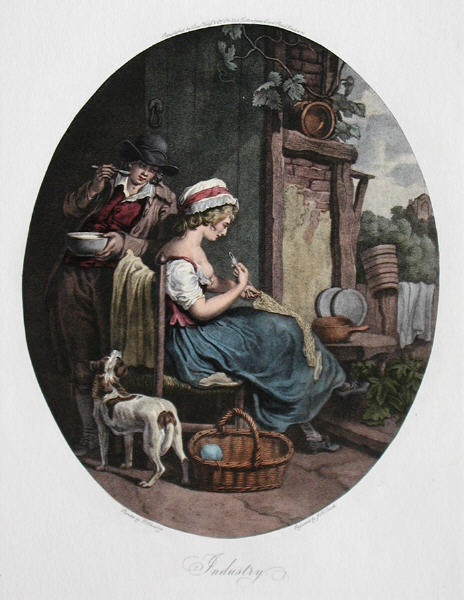
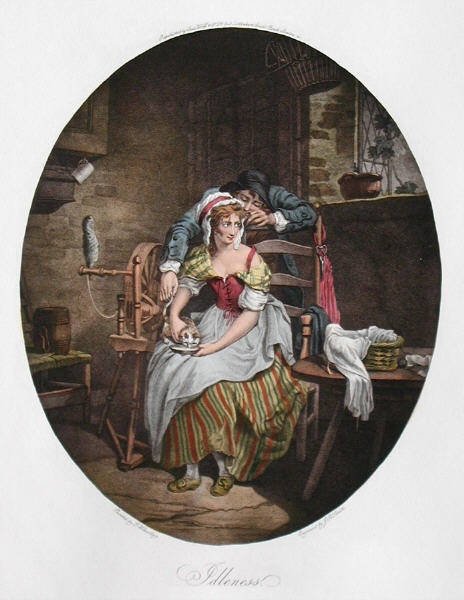
One of Hogarth's famous print series is Industry and Idleness which was a common theme for many prints of the time.  Hogarth's multiple prints followed the many exploits and good deeds of two young men but in the series by the same name put out by lesser artists it was more common to have pretty young ladies symbolizing the foils.  Not only were women more marketable in the print industry, their good or bad deeds tend to have greater repercussions than those of men.


In George Morland's series we have Industry busily tatting away on long lace trimmings.  If you noticed her outfit to be a bit off, you are quite right.  A hat and coat is unusual attire to attend womanly duties but Industry is ever-ready to go out of the house to attend to some other task or errand.  Idleness on the other hand, has plenty of time to engage the viewer with coy eye contact.  Her sewing pouch lies in disarray at her feet, obviously not in use.  Even Idleness' dog can't be bothered to do much.  At the time, idle women tended to be associated with lascivious women.  By the look on Idleness' face and the way she draws the viewer's eye to between her legs by placing her right hand there; we are left to assume she is not just an idle woman but a woman with little morals.

Francis Wheatley's version of the same theme displays Industry and Idleness in the lower classes.  Industry busily works mending a piece of clothing, so busy she can't be bothered by the suave young man attempting to get her attention.  Despite the dog allowing itself to be distracted by the man, Idleness can't be bothered by his presence.  Wheatley's Idleness is interesting in that she is actually doing something (feeding the kitten) but is distracted from her work by what we can assume is the same young man, based on the unfortunate hat he wears in both prints.  Wheatley's definition of the foils derives chiefly from their ability to avoid horny young men, otherwise Idleness might be successful in her to-do list.  Perhaps his series would be more aptly named Easy and Mission Impossible.

Wednesday, August 11, 2010

Bounce to Fop: Stop Being a Bitch

Did you know Alexander Pope's dog was just as poetic as his owner?  It's true!  Pope's dog, Bounce once wrote a poem dedicated to Henrietta Howard's dog, Fop.  Bounce was very critical of Fop's haughty attitude:
We Country Dogs love nobler sport,
And scorn the pranks of Dogs at Court.
Fye, naughty Fop! where  e'er you come
To fart and piss about the room,
To lay your head in every lap,
And, when they think not of you - snap!
I just can't get over how similar Bounce's writing style is to Pope's!

Friday, October 9, 2009

Favorites


Joshua Reynolds, Mrs. George Huddesford, 1776

Wednesday, September 2, 2009

The Rake's Progress, Part 4: Arrested for Debt


It may strike you as surprising to catch our favourite rake out and about in the light of day, but that is where we find Tom is this next edition. My guess is he is finally returning home after a night out. He exits his sedan chair to find out who has the audacity to prevent him from passing only to find it is two Welsh Bailiffs. Uh oh, this can't be good. It would appear that Tom's debts have finally caught up with him and now he must pay. To the debtor's prison with thee! But just as things are about to get messy, aid comes to Tom in a surprising form. Lowly milliner, Sarah Young, the very same pregnant, former-fiancee of Tom's happened to be walking by with her wares when she heard the commotion. Not being able to bare the thought of Tom rotting away in prison, she scraps together what little wagers of a single, working mother can, and pays the bailiffs for Tom's freedom. For some reason I feel this act of charity and compassion was wasted...but what do I know!

In the hustle and bustle of the London street it is easy to miss a few great Hogarthian details. A little dog calmly sits and watches the whole folly. Hogarth commonly added dogs to his paintings to symbolize the calm outside observer. During the commotion, a pickpocket snatches Tom's fancy cane. The lantern-lighter is refilling the oil in the street lamp and oops spills oil on Tom's nice white wig. Not only is this for comic relief but also is a reference to religious blessings (oil on the forehead) and how Sarah's act of charity was a blessing. A blessing soon to be forgotten, no doubt!

The Rake's Progress Part 1
The Rake's Progress Part 2
The Rake's Progress Part 3
Next >>

Wednesday, May 13, 2009

Immortal Companion: Doña María Ana de Pontejos


One of the most noticeable aspects of this paintings is that the sitter's pug was painted with more care than the sitter. Unfortunately, I can't tell you much about either the sitter or her pug, which doesn't stay entirely true to this series I created, but I can tell you that Francisco Goya was another artist obsessed with his dogs. Therefore, the pug probably kept his interest longer than the Marquesa de Pontejos.

María Ana was painted here in 1786 to mark her marriage to Spain's ambassador to Portugal, who also just happened to be the prime minister's brother. Very political. As was typical with a bridal portrait, she holds a pink carnation as a symbol of love. Her beloved pug steps before her in an act of protection, cementing his employment in the painting as a symbol of loyalty.

But, this is also, and very importantly, a painting of fashion!

By 1786, Marie Antoinette's Triannon fashion had finally trickled down to Spain, who seemed to be always be a fashionably late country in the 18th century. Although the marquesa attempts to mimic the free-flowing Triannon style, her gown is still extremely Spanish. After all, that tight corset was what Marie Antoinette strove to get away from with her Gualle gowns. However she does capture the essence of those gowns with the flower details and the thin white muslin fabric. Her 'doo and straw hat are also tres tres Antoinette. Of course, as a fashionable lady, María Ana's pug has an outfit that matches his mistress'. His pink ribbon with bells (so he can't get lost in the garden) is from the same ream of ribbon as the one tied around her waste. As James St James wisely states, fashionable companions should match; "Be sure that your partner doesn't clash with your look. Plan ahead and execute together."

Sunday, April 26, 2009

Immortal Companion: Thomas Coke


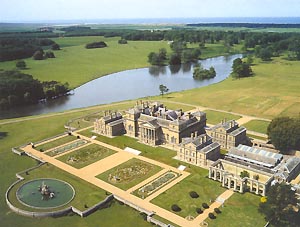
Thomas William Coke was one of the few Georgian men born into money who didn't turn out to be a total brat. Instead of wasting all his money after coming back from the Grand Tour he used it toward, dare I say, productive things. First of all, he set out on improving his estate, Holkham Hall, a task that lasted until his death in 1842. Thomas then involved himself in animal husbandry. He was said to have even made bred a flock a sheep that was superior to the native Norfolk ones, so they soon became all the rage. Thomas' advancements in husbandry were so substantial that he was constantly offered (six times!) a peerage, which he humbly always turned down. It also helped that he was a politician. It was only when Queen Victoria pressed him, that Thomas humbly accepted the earldom of Leicester.

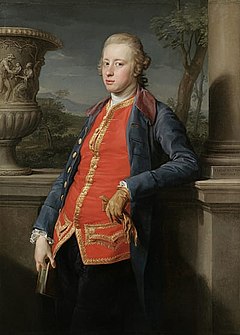
Thomas is pictured here by Batoni in the midst of his Grand Tour. Not only is he quite dashing in his ivory and persimmon Van Dyck-inspired ensamble, he is quite the Enlightened chap as well. Look who stands by his side while he poses. His spaniel, as many dog-owners can relate, is not so interested in posing as he is the fabulous smells coming out of that hat. Is that ostrich, and natural dyes? With a hint of bawdy Roman wench too, I believe! Actually, the dog is a nice compliment to his owner. The flowy qualities of the plumes translates into the dog's fur. The dual-coloured fur mimics Thomas' dual-coloured outfit. He also brings a balance to the painting and aids in the leading the eye to all those important bits. Not only is the spaniel's presence bring a calming sense to the viewer but it also shows the sitter's connection with animals. At this point in Thomas' life his studies in husbandry were just a glimmer of an idea, dogs were more his style at this time.

Wednesday, April 15, 2009

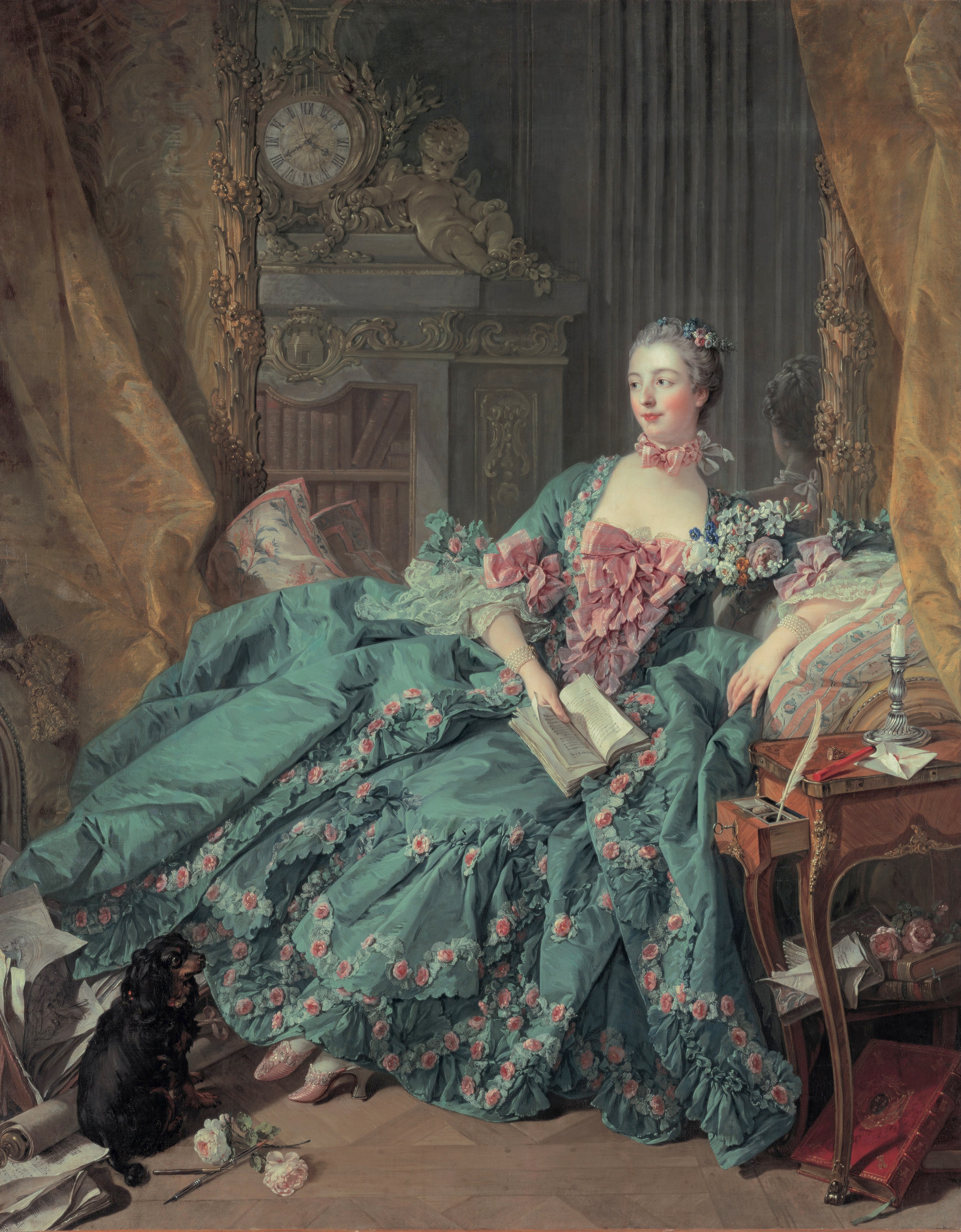
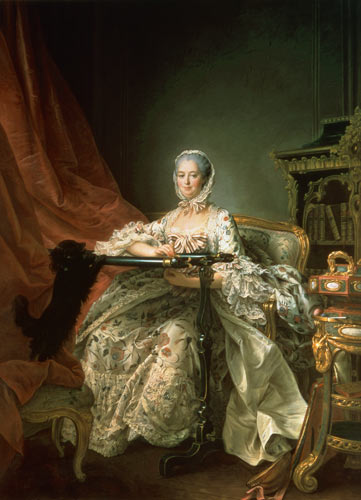
Immortal Companion: Madame de Pompadour


Although I was about to kill my dog today when I found my new shoes out of their box (and bag!) and on the rug; box destroyed, shoes unharmed (thank the fashion gods!)...I will still proceed with my planned entries on man's best friend, even if mine is in the doghouse right now.

Originally, I had planned to go on about an English bloke and his favourite dog but then this whole event got me thinking, "how many times did this happen to Marie Antoinette and Madame de Pompadour?" Just picturing those fabulous heels in pieces can make a fashion-conscious art historian tear up. These two notorious Rococo ladies were both very fond of their pooches. However, Pompadour was usually portrayed with hers.

Madame de Pompadour, or Jean-Antoinette, was depicted with her beloved pooches in most of her portraits. Of course, the dog is a symbol of loyalty so putting them in her portrait could have also served a dual purpose of displaying her loyalty to the king (and boy was she loyal!) and immortalizing her pet. Her two most well known ones were named Mimi and Inés. It was even rumoured that she would deck her dogs in golden collars that were nicer than some of the courtiers' own jewels.

I am pretty sure that in this particular painting by Boucher, Jean-Antoinette is depicted with her own dog, although I wish I knew which one, Mimi or Inés. The fuzzy one in question chaperones his mistress on the garden bench she placed him on while she poses. Notice the collar. He is a papillon, a breed that was portrayed more than once by master artists and loved not only by Jean-Antoinette but also Marie-Antoinette. Although Spanish in origin, the papillions acquired their French name, meaning butterfly, due to their foxy ears which look like butterfly wings. Unlike other portraits of Jean which exert her education, good breeding, and how hot she is; this portrayal shows the marquise in a rococo-girl wonderland. She is enjoying being out in her in garden with her papillon wearing a FABULOUS gown. She has nothing to prove in this picture except perhaps her great wardrobe, her Enlightenment, and how good she and her loyal companion look together.

Tuesday, February 17, 2009

Immortal Companion: Richard Cosway


Richard Cosway is best known as the leading miniature portrait artist of the Georgian era. He was also known for being married to the fashionable Maria Cosway (whom Thomas Jefferson was in love with at one point) and for being the definition of a macaroni. His white hair was arranged in a high point and Cosway was not adversed to wearing the typical macaroni makeup and colorful clothing. Despite his foppish exterior, Cosway was well respected, a favourite artist of the Prince of Wales, and a founding member of the Royal Academy. Like Gainsborough and Reynolds, anyone who was anyone would have Cosway paint their miniature.

So when it came time for Cosway to commision a painting of his beloved he chose the leading animal portraitist, George Stubbs. Of course, the macroni had the most fashionable type of pet, a tiny white dog. Can't you just see the flamboyant Cosway walking through the streets cradling this little white puff ball? His pup is portrayed with every enlightened sensitibility. Romping in the Rousseau wilderness, he is distracted by a moth and poses in an alert stance with his focus on the airborn insect. Here we have an example of a portrait that totally focuses on the dog and not the dog's owner; an example of the value put on pets. And if your pet just happened to be of the upmost fashion, then it really couldn't hurt to put your dog on display!

Wednesday, January 21, 2009

Immortal Companion: Carl Friedrich Abel


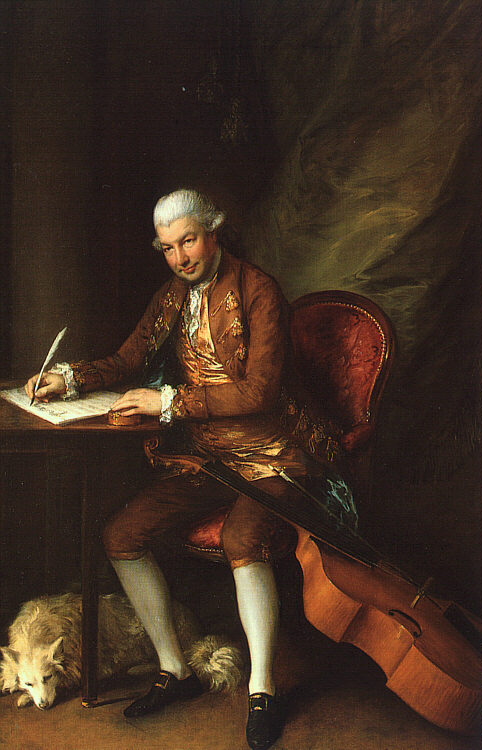
To begin a series on pooches in paintings, I wanted to open with one of my favourite human-dog portraits. Thomas Gainsborough's portrait of the composer Carl Friedrich Abel depicts the music man as if we have just interrupted him in his study. The busy musician looks up from his work that he has been pouring onto paper before the notes leave his head. His cello (musicians, feel free to correct me if I'm wrong!) casually leans against his leg, so he can quickly play the tunes he hears and then go back to recording them on paper. Abel is obviously successful in his musical career. The grandness of his fine chair, the drapery, and even his copper coloured silk vest excrete wealth and success. He is enlightened man because of his connection to music...and nature.

Sleeping calmly at his master's feet is Abel's dog. The faithful companion is the only one allowed in Abel's private study while he works. We can see why, he is a quiet audience. The dog's presence evokes a sense of calm and gives the viewer a sense of comfort about the sitter and his personality. In fact, the dog completes the portrait; it would be unbalanced without him. Gainsborough, a big dog fan, puts a lights source on both Abel's face and the dog's. The rest of his fluffy white body is shadowed under the desk. If you think only a crazy dog-lover would zone in on the pooch in the painting, let me reiterate how much the people of the 18th century loved their dogs. When the painting was exhibited, the St James Chronical reported on "the correctness" of Gainsborough's execution of the dog. Ya know, just in case you were worried that the dog didn't come out right!

If you were wondering about that music Carl was composing in the painting, I put together a sampling of it below. It gave me an excuse to play with the amazon mp3 player! So now you can make like Abel's puppy and relax to the sounds of his strings.


Friday, October 17, 2008

Tart of the Week: The Honourable Mrs. Anne Damer


The adventurous life of Mrs. Damer began in 1748 when she was born to a prominent Whig family as Anne Seymour Conway. Her father, Henry Seymour Conway was a cousin of Horace Walpole and her mother was the extremely Scottish, Caroline Bruce, Lady Ailesbury. While her parents were abroad little Anne experimented with the art of sculpture, as encouraged by her godfather, Horace Walpole. Life seemed pretty normal and boring for young Anne but luckily a dumb husband changed all that (as they usually do for many of our tarts of aristocracy).

John Damer was a drunk and a gambler, which wasn't so unusual for the time. He was also the son of an earl who provided a generous annual income which had to have looked good to 19 year old Anne. This on top of this Anne brought in some fortunes of her own from inheritances. Well, John, being the idiot he was, gambled away most of their money in first six years of their marriage. What he didn't gamble away he spent on his wardrobe. In the seventh year of marriage, he lost it all in one night. He then retired to a room above the Bedford Arms in Covent Garden and shot himself through the head. Anne was now a widow. A widow in a lot of debt.

This put Mrs. Damer in an awful situation. But believe it or not, it was probably the best thing that could happen to her. Walpole not only took her in at his home in Strawberry Hill but he helped to get her on her feet again and allowed freedoms that her marriage lacked. The old bachelor loved her as his own and even willed his Strawberry Hill home to her. Anne took up her childhood hobby of sculpture and honed her skills until she was a reputable artist. Her work reflects the Neoclassicism of the period which helped to gain her many allegorical commissions such as the heads of Isis and Tamesis which still grace the keystones of Henley Bridge today. Her friendships that developed between Sarah Siddons and Elizabeth Farren also earned her some theatrical commissions including reliefs for Boydell Shakespeare Gallery. By 1784 Anne was an honorary exhibitor at the Royal Academy and remained so until 1818.

Her new freedom also allowed her many friendships. Due to her Whig roots, she was naturally drawn to the Devonshire House Circle and became a close friend of Georgiana. She was one of the many devoted canvassers in the 1784 Westminster Election. Mrs. Damer also frequented the masquerades quite often; not the best way to keep a good reputation. In fact, many rumors of Mrs. Damer being a lesbian surfaced, although this could be due to her affinity for male clothing. In truth, Anne was, in all likelihood, a lesbian and enjoyed the company of her female friends. It is thought that Walpole introduced her to the author, Mary Berry, with whom she had a long-standing romantic relationship.

Anne also enjoyed her widowhood because it allowed her travel. She was good friend and regularar guest of the expat, William Hamilton, (of Emma notariety) the ambassador to Naples. At one point in her travels to Europe she was captured by a privateer but released. She also happened to be in Paris during the Treaty of Amiens and met Napoleon himself.

Anne died a happy old lady in 1828. As requested, she was buried with her sculptor's tools and apron as well as with the ashes of her favorite dog.

Sunday, October 5, 2008

Dog Reads

I just keep finding all these great posts today! For the few of you who actually follow this blog, my obsession with the 18th century dog, especially in art, is no secret. Well, Vic, over at Jane Austen's World has written a post about the 19th century dog. This dog wasn't as sacred as the Enlightened 18th century dog, but treasured just the same.
On the topic of dogs, I would also like to recommend this great book, based on the exhibition by the same name, Best in Show. This catalog has a series of essay and a great collection of paintings of dogs in western art history. Another great read would be A Picasso Bestiary, which was co-written by one of my favorite professors, Deborah Povey, who knows so much about animals in art history, you could listen to her for days on end and never get bored.

Wednesday, June 18, 2008

Pugnacious

In continuation of my dogs in the 18th century exhibition (exploration? obsession?) I thought I'd take a moment to talk about the images of Pugs in paintings. As I talked about here, the people of the 18th century were just as fond of their pets as we are, especially their dogs. One of the more popular breeds in England at this time (at least with the upper class) was the Pug due to its convenient size and winning personality.

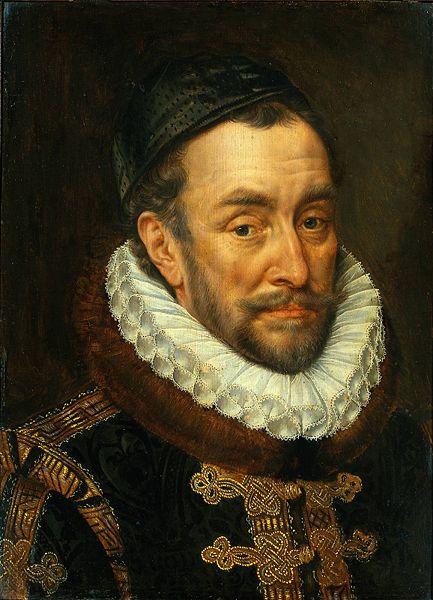
The breed originated in Asia (although due to the ancient history of the breed it is not know where exactly) and throughout the centuries it became more and more common westward. It became the official dog of the House of Orange after one Pug saved the life of William, Prince of Orange by alerting him of the invading Spanish in 1572. When Josephine Bonaparte was imprisoned at Les Carmes her Pug, Fortune, would carry secret messages under his collar to her husband. It was even rumored that Fortune bit Napoleon when he entered Josephine's bedchamber on their wedding night, woof!

As can be seen from Hogarth's Self-Portrait with Pug, the Pug looked different 200 years ago. The snout and body were a bit longer then than they are now. The loyal and beloved Trump was immortalized in William Hogarth's self portrait, and depicted at the same level, and therefore, same importance as his master. This could be because both man and dog were known to be "pugnacious." Trump reappears as the watchful eye in Hogarth's portrait of the Strode Family. Another immortalized 18th century pug is Raton, who sits on his human, George Selwyn's lap in this portrait by Reynolds. Selwyn had an outlandish and rakish reputation so this sentimental portrait with his beloved pet softened how others viewed the crazy bachelor. Selwyn was reputedly totally devoted to his dog. This wasn't extremely unusual, William Duke of Devonshire (Georgiana's husband) was so obsessed with his dogs that his friends and even wife nicknamed him "Canis." Truth be told, they were the only things the man enjoyed spending time with!

Tuesday, June 3, 2008

Because We All Love Dogs...
I could go on forever about dogs. I could go on about my dog, who has nothing to really go on about. I watch dog shows, preach the word of Cesar Milan, and annoy Lauren by announcing the breed of each dog that passes. So I'll try to keep this entry to the minimum because, just about everyone in the 18th century was as big a fan nerd as me when it comes to the canine so there's a lot to go on about.

Take this painting for example. This is Tristam and Fox by Gainsborough. All of London society was paying hundreds of thousands of dollars (in today's terms obviously) to be painted by Gainsborough, this one was on the house. Not only that but it was this painting that was placed in the coveted spot above the mantel. These were Gainsborough's dogs, Fox (center) and Tristam (right) were honored members of the family. Whenever Gainsborough and his wife fought, he would apologize in a letter signed, "Fox" and Fox himself would deliver the letter into Mrs Gainsborough's hands. How adorable is that! I might just have a crush on him, even if he is a dirty Tory.

Speaking of Tories, Fox was named after Charles James Fox, the infamous Whig politician who Georgiana canvassed for in 1784. Given that Gainsborough probably hated Charles Fox's guts it was a name given in humor. Tristam was more literary, he was named after the hero from The Life and Opinions of Tristam Shandy, Gentleman by Laurence Sterne. Based on the title of that book I think thats a great dog name too. My dog is named after Luke Skywalker.