Showing posts with label Jane Austen. Show all posts

Friday, March 4, 2016

Movie Review: Pride and Prejudice and Zombies

Ooo this looks cool
Those of you who read this blog when Jane Austen and Seth Grahame-Smith's Pride and Prejudice and Zombies first arrived in books stores, spawning a series of 'mash-ups' such as Sense and Sensibility and Seamonsters, may recall my delight in the book.  After numerous casting rumours and mishaps the film version finally arrived nearly 7 years (goodness!) later and I was eagerly looking forward to seeing it.  Pride and Prejudice and Zombies the book was clever, witty, and funny.  Pride and Prejudice and Zombies the film was not. 

I suppose what I liked the most about the book was that it took a genteel saga of mistaken first impressions and sprinkled zombies into it.  The plot line remained the same, there was just, let's say, some further hurtles to get in the way of Lizzie bennet and Mr Darcy's love.  Those hurtles happened to be a zombie infestation which forced Regency Britons to be very skilled in martial arts whilst still following the rhetoric of etiquette.  The film, decided this plot line was too familiar and perhaps wasn't enough, and like the horrible, Sense and Sensibility and Seamonsters tried to overcompensate by adding new plot lines that failed miserably.  But there's a reason that we still read Austen's books 200 years later: that plot works!  You can jazz it up with some zombies lusting for brains, but don't confuse it with extra plot lines.  Sometimes this came off as downright sloppy: for example, Wickham shows up to the Netherfield Ball just to tell Lizzie he isn't afraid of Darcy, and then he doesn't feature again in that scene, leaving me going 'why? what?'
Hollywood loves anachronistic pantaloons, doesn't it?

Perhaps the greatest offense was in Sam Riley's role as Darcy - admittedly, big boots to fill; even Colin Firth said that when he got the part for the 1995 miniseries his brother questioned his ability to be sexy enough for the role.  Riley tackles the challenge by speaking in a husky Christen Bale Batman voice which was hilarious at first and then sad for the remaining hour and 45 minutes.  There also seemed to be more of a focus on Mr Darcy - excuse me - COLONEL Darcy, as he kept insisting in the film, as a terminator of zombies than the protagonist, the plucky (and rather angry) Lizzie Bennet (Lily James).  My feminist alarm bells really went off though during the confrontation between Lizzie and Lady Catherine de Bourgh (Lena Headley).  Grahame-Smith extended this verbal garden confrontation in the book to an all-out battle royale, with the two gift sword-women fighting each other for honour.  Although the film tells you Lady C is the most formidable foe, you never actually see her in action.  She has a male crony fight Lizzie instead - so disappointing.

The only redeeming quality I felt the film had was Matt Smith as Mr Parson Collins.  He provided some much needed comic relief but alas, it wasn't enough to save this flaming zombie limb of a movie.

Sunday, November 30, 2014

Bookspotting: Jane Austen's First Love, Blog Tour and Giveaway

I just want to direct the novel-consuming readers out there to the attention of a new Jane Austen inspired novel that may be of interest: Syrie James’ latest book, Jane Austen’s First Love.  Little is known about Austen's  love-interest, Edward Taylor, who may have inspired some of her admired male protagonists, however James has unearthed some new information about him in the process of writing her book.  From the publishers:


In the summer of 1791, fifteen-year-old Miss Jane Austen is determined to accomplish three things: to do something useful, write something worthy, and fall madly in love. While visiting at Goodnestone Park in Kent for a month of festivities in honor of her brother's engagement to Miss Elizabeth Bridges, Jane meets the boy-next-door—the wealthy, worldly, and devilishly handsome Edward Taylor, heir to Bifrons Park, and hopefully her heart! Like many of Jane’s future heroes and heroines, she soon realizes that there are obstacles—social, financial, and otherwise—blocking her path to love and marriage, one of them personified by her beautiful and sweet tempered rival, Charlotte Payler.

Unsure of her own budding romance, but confident in her powers of observation, Jane distracts herself by attempting to maneuver the affections of three other young couples. But when her well-intentioned matchmaking efforts turn into blundering misalliance, Jane must choose between following her own happily-ever-after, or repairing those relationships which, based on erroneous first impressions, she has misaligned.

The book has been receiving great reviews and is currently making the rounds on its blog tour.  There is also an amazing giveaway where you can get all sorts of Austen prizes just by leaving a comment here or on other stops along the tour.  


In the meantime we are lucky enough to have an excerpt from the book on a subject close to my heart: hair powdering:


It is June 1791, and Jane Austen is at Goodnestone Park in Kent visiting the Bridges family. Jane, age fifteen, is not yet “out,” but her mother has allowed her to attend her first ball that evening to celebrate her brother’s engagement to Elizabeth Bridges. Jane is all dressed in her best gown and filled with excitement, her only regret that her mother will not allow her to powder her hair, as her older sister Cassandra and the preponderance of the company is expected to do.

As I emerged into the passage, Louisa and Harriot appeared, attired in their new gowns, their hair elegantly styled with supplementary hair pieces, and fully powdered in bluish gray—the very image of all the fashionable ladies of the age whom I had so long admired.
I had never seen girls so young attired in such a manner except in old paintings, and the picture they presented was very striking. The young girls skipped up to me.
“Do not we look magnificent?” cried Harriot, beaming, as she paused to twirl in all her finery.
“You both look fit to be presented to the queen,” replied I sincerely, to which the girls broke out into giggles and ran off.
I stood still for half a minute, steeped in misery, listening to the laughter from behind the closed doors along the passage, wherein the other young ladies were dressing. Lining the corridor were various ancestral pictures of regal men and ladies, all of them wearing wigs or with powdered hair. I yearned with all my heart to look just like them. My melancholy and despair grew to such a height, that I could no longer bear it. Tears started in my eyes; and, sobbing, I ran down the hall to the bedroom which I knew to be newly occupied by my mother. I rapped urgently on the door, identifying myself; she bid me to come in.
“What is the matter, Jane?” exclaimed my mother from the chair where she was reading. She was fully dressed in her best russet gown and white fichu, her curly hair already powdered beneath her white cap. “What do these tears signify?”
“Oh! Mamma! You cannot mean to humiliate me like this!” I flew to her side and knelt before her, taking one of her hands in mine, as my tears flowed.
She set down her book. “How have I humiliated you?”
In between sobs, I told her about Louisa and Harriot. My mother looked surprised.
“I have wanted this for such a long time, Mamma. It is my only opportunity to feel what it is to be truly grown-up. Will not you consider and relent? Otherwise, I am to be the only person at the ball to-night with natural hair! I will be laughed at!”
My mother was silent for a moment; then she patted my back distractedly. “Well, well, we cannot have that, can we? We are not at Steventon now. If those are the rules of this house—if little Harriot Bridges, at age ten, is to have powdered hair—well!”
I glanced up at her, hope rising. “Do you mean—”
“I have been here but a few hours, Jane, but already I have sized up Lady Bridges. That woman has her nose so high up in the air, it is a wonder she can take a step without falling on her face! We cannot have her looking down on us! Why, her daughters are all so beautiful and accomplished, nobody else’s daughters can hope to hold a candle to them! Even her strawberries are the best in the land, or so she claims, and her precious roses won a prize at some fair or other; well! My own roses are equally as fine, I assure you, for all that they have not been judged and won ribbons! You are a young lady now, Jane! Even if you are not yet out, we cannot have Lady Bridges or any of her ilk looking at you like a child!”
“Oh! Thank you, Mamma!” I threw my arms around her, so filled with relief and happiness that I thought I might burst.
“There, there, Jane,” said my mother, “you will ruin my ensemble. Now dry your tears, and go get your hair powdered. Mind you, this indulgence will apply this one night only.”
“I understand.”
“One thing further: remember what I said, you are not to dance to-night with any strange men, only your brothers or your cousins.”
“Only brothers and cousins?” cried I, distressed once again. “But Mamma, there are but a handful of young men who meet that description! I have been here some days already. I have become good friends with some of the Bridgeses’s friends, and in particular with their cousin, Edward Taylor. He is a remarkable young man, Mamma. I would give anything to dance with him.”
“Edward Taylor?” She pursed her lips. “Is he the young man just come back from abroad, who is heir to that big house down the road, what is it called?”
“Bifrons. Yes. That is he.”
“Well, Lady Bridges has her cap in a twist about that young gentleman; she seems to perceive anyone who is musical, well-educated, or well-travelled as a threat to her own precious progeny. Let us give her something else to fret about, Jane! He is, in any case, soon to be our cousin through marriage, is not he? You have my permission, my dear; you may dance with him—and I suppose with anyone else you call a friend. But I still say: no strangers.”
“Thank you!” cried I again, kissing her cheek with relief; and I flew from the chamber.
I returned to my own room, where the scent of lavender hung heavy in the air, and I found that my sister had been transformed into a regal beauty.
“You look stunning,” cried I, and without pausing added, “and you will never guess what has happened! Mamma has just given her consent for me to powder my hair! And to dance with any friends I like!”
“Has she?” replied Cassandra. “I am happy for you, Jane.”
“Well done, miss,” said Sally, beaming.
I resumed my seat at the dressing-table, my heart drumming with anticipation, as Sally covered my shoulders and upper body with a protective drape; she then applied pomatum to my hair, and liberally added the fragrant, bluish gray starch with a puff. Very quickly, powder filled the air and got up my nose and into my mouth, causing me to choke and sneeze. When she had finished and removed the drape, I was so enveloped by the flowery aroma, I felt slightly ill.
Cassandra, who had been watching from a chair by the hearth, said:
“There, you have achieved your goal. Are you content?”
“I am not sure.” Coughing and brushing off the excess powder from my gown, I added, “I did not realise it was such a messy business.”
“I tried to tell you.” She smiled. “You look very elegant, Jane.”
“Do I?” Turning and glancing in the mirror again, I viewed my reflection with a start. “I hope so. For in truth, I do not recognise myself.”


Jane Austen's First Love is out now where all good books are sold.

Tuesday, October 1, 2013

The City in the North's Assembly Rooms


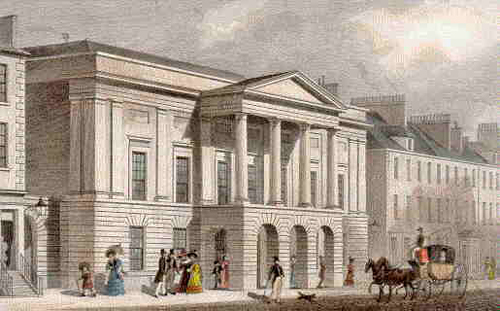
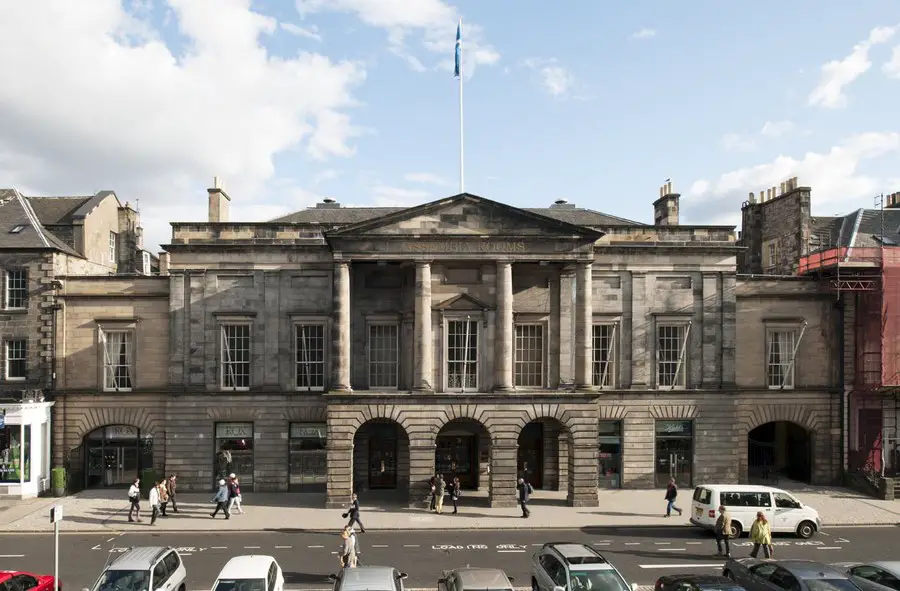
When we think of assembly rooms, we often think of the famous tension-filled dancing scenes from Jane Austen's novels.  However, these early 'function rooms' had been around in some form for some time.  An example of this comes from the story of Edinburgh's Assembly Rooms which had their origins in the 17th century.  The rooms still exist in their Georgian splendor today, but that's only after they had migrated from their original 17th century location.  Before then, balls were held for charity and the matriarchs of Edinburgh organized them, raising funds for noble causes such as the Royal Infirmary.

By the latter-half of the 18th century Edinburgh had established itself as an Enlightenment city and there was a push for it to look as such to reflect its ulta modernity.   The neoclassical suburb of New Town began its constructed in 1765, allowing well-to-do residents an opportunity to get out of the crowded medieval area of the city and establish themselves in new fashionable digs.  This meant there was a new fashion-capital of the town, and an old assembly room would no longer appeal to the targeted clientele; a new, thoroughly modern assembly room must be erected.

Just as with the New Town's plans, a competition was held for the design of the new Assembly Rooms and it was won by John Henderson.  The cost of construction was £6,300 and came from a public subscription.   By 1787 the rooms were finished and could boast being the largest in the country, even surpassing Bath's famous pump room.  Finally, Edinburgh residents felt as though they could rival the entertainments found in the south with the splendor of venues like the Assembly Rooms.  This however, put a bit of pressure on Edinburgh society to maintain this distinction and in 1818 (arguably the height of assembly room entertainment) a grand portico was added because it was thought the building was lacking in splendor.

The Assembly Rooms, much like the rival Bath assembly rooms, still stand today.  After undergoing a recent refurbishment they are now back to the glittering splendor that so impressed guests in 1787.


Wednesday, August 8, 2012

Review: Austentatious

Anyone in town for the Edinburgh Festival this year are in for a real treat; and no, I don't mean wrestling with a bunch of slow-moving dim-witted crowds sort of treat.  Take six funny improvisational comedians with a love for Jane Austen, a few helpful Austenesque title suggestions, and an hour and you have a divinely droll good time.  Austentatious perform every day for free, so there is really no excuse not to go, aside from geological ones!

As mentioned, when you walk in, you're expected to give title suggestions, which will be drawn out of a hat (or basket) for the talented comedians to perform.  This afternoon's selection was, Pride and Pigeons although unfortunately that meant we missed out on other 'clever' suggestions like Midgets and The Pony that Lost its Hat.  The ridiculous plot mixed with the regency language, the players' occasional snafus with names that they came up with on the fly, and the unavoidable sexual innuendos had the audience's stays loosened from laughter.  All in all, the Austenites I attended with all enjoyed themselves, and I think with 18 more shows left, I may just have to go back!

Austentatious: An Improvised Jane Austen Novel is at The Counting House, Edinburgh daily at 1:30 until 26 August.  See the website here.

Friday, December 9, 2011

Book Review: Sense and Sensibility Bath Bicentenary Edition

It has been a year of Sense and Sensibility for me.  Ever since I took part in Austenprose's Bicentenary Challenge at the beginning of the year I have been exposed to many different and colourful versions of this literary classic.  I have been lucky enough to end this special year with a brand new edition of the book, the Bath Bicentenary Edition.

The story is the same classic we have grown to love.  A tale of two sisters dealing with family hardships as well as the toils of love all at once.  The introduction by Katharine Reeve is eye-opening in terms of just how eighteenth century the book actually is.  While it may not have been published until 1811, the manuscript for Sense and Sensibility, or Elinor and Marianne, was written fifteen years before, around the year 1795.  It contained an underlying commentary (or even criticism) on the eighteenth century fashion for sensibility which by the turn of the new century was slowly losing steam.  Yet the book was originally written in the style associated with the sentimental novel, in epistolary form.  Luckily, Jane scrapped that idea to trade it in for the lovely version we have today.

And what a lovely version we are blessed with 200 years later!

The Bicentary edition delivers all sorts of the gooey Austen prettiness that Janites crave.  Now that I work in an office full of Janites I had to keep slapping their hands away from this book! Why? Well firstly, the book is a hardcover edition of Sense and Sensibility.  Within the covers will you not only find Austen's classic tale but the beautiful colour illustrations of Niroot Puttapipat who depicts the characters in the popular fashions of 1795.  Does Puttapipat draw a hot Colonel Brandon? You bet your sweet bonnet he does!  What I especially like was that aside from the large colour plates that are dispersed throughout the book, there are also smaller silhouette illustrations, adding that lovely essence of the Regency period to a Regency book.  For a preview of the illustrations I have been gushing about, check out this video.

The book is out now, just in time for holiday shopping.  It would make a fabulous present for any Janite in your life, even if that Janite is you!

Thursday, August 18, 2011

Movie Review: Sense and Sensibility (1981)

To conclude my Sense and Sensibility Bicentenary Challenge from Austenprose I chose to check out the movie adaption from 1981.  Perhaps the movie is a victim of being dated due to being viewed thirty years after it premiered on Masterpiece Theater.  Or perhaps I am the victim, for I feel it is adaptions such as these that stereotype Austen's work as stuffy and uninteresting because, frankly, that's how this movie came across. 

Many know the story of Jane Austen's 1811 classic, Sense and Sensibility, and those who aren't familiar with it, would do best to avoid this as an introduction.  While the screenplay doesn't stray far from the storyline, with minor exceptions such as there only being two Dashwood sisters, it is is not presented in an engaging way.  It is almost as if there is a wall between the audience and the characters that prevents you from relating to their plights. 

One of the aspects of the movie I did find interesting what the actors' interpretation of the characters particularly Elinor (Irene Richard) and Marianne (Tracey Childs).  Richard's Elinor is not as submissive as she is usually interpreted.  Childs also was more believable as a teenager which I liked.  The sisters also squabbled and butted heads more in this versions than others I have seen. 

As for the superficial elements (hot men and good costuming) those were also a disappointment.  However I did enjoy noticing all the ladies on the screen were given little purses to hold at all times.

My advice is to skip over this one unless you are a true S&S aficionado with some time on their hands and a strong curiosity. 

Tuesday, August 2, 2011

The Grueling Life of a Vicar

While reading Jane Austen's books do you find yourself wondering why so many characters' love interests are either in the clergy or planning to enter the clergy as their career path?  Well, the answer could be as simple as the fact that Jane was the daughter of a rector herself, but I believe it has something to do with most of her books dealing with love interests in the upper classes.

In the age of the aristocrat, younger sons were notoriously out of luck when it came to inheriting titles and lands and all other good things that came with be born into a wealthy family.  That meant they had to get a job.  No, not one where they'd actually have to work, Silly! They were still blue blood after all.  The two common options for these younger sons was a career in the military (like Frederick Tilney in Northanger Abbey) or the clergy (like Henry Tilney or Edmund Bertram from Mansfield Park).  Although the two career paths seem quite opposite, one did not necessarily have to have a strong faith in order to become an Anglican vicar or rector.  In fact, having your own rectory or vicarage was quite easy, hence the blue blood career choice, there were books of sermons which you could read from every Sunday in church (most of England didn't attend regularly at the time anyway so it didn't matter).  Local farmers were forced to pay the salary of the local clergy so quality of work was of little consequence.

It's no wonder so many rich young men chose this "humble" career.  It allowed for a lot of free time in order to pursue other hobbies; hobbies which had nothing to do with being a man of God.  In Bill Bryson's book, At Home, he has laid out what a few of these clergymen managed to accomplish with their free time:
  • Reverend Thomas Bayes (1701-1761) came up with the extremely complex math theorem which is used today to do things like predict stock market behavior and climate change.
  • Laurence Stern (1717-1768) wrote The Life and Opinions of Tristram Shandy, Gentleman.
  • Reverend John Michell (1724–1793) taught William Herschel how to build a telescope, which he did and then discovered Uranus.
  • William Buckland (1784-1856) wrote the first scientific description of dinosaurs, and was the one who named Dr Plot's discovery, Megalosaurus.
  • Reverend Jack Russell (1795-1883) bred a new breed of terrier.
  • Reverend George Garrett (1852–1902) invented the submarine
 The list goes on and on. I wonder what sort of hobbies Henry Tilney and Edmund Bertram picked up after their marriage.

Thursday, March 10, 2011

Book Review: Marvel's Sense and Sensibility

In continuation of Austenprose's Sense and Sensibility Bicentary Challenge I chose for my second book, Marvel's Sense and Sensibilty graphic novel adapted by Nancy Butler and illustrated by Sonny Liew.  As an art historian I tend to categorize myself as a "visual person" so the idea of a comic book version of any Austen work was very appealing.  I am happy to report the Marvel creation did not disappoint.
 
In her lovely introduction, Butler discusses the challenges of adapting dialogue-rich novel into an entertaining, yet concise comic.  In the history of comic books, many tend to focus on action rather than dialogue and Austen's work tends to focus on inner-turmoils of characters (among other things) we have come to understand as a readers instead of a black and white message.  So to combine the two elements, while still staying true to each is not something that can be produced quickly, it takes a lot of care.  I think Butler and Liew succeeded in this endeavor despite Butler noting her anxiety that it would not stand-up to some Janites' high (nit-picking) standards.  Like movie adaptions some details must be lost but the most important are still contained in this illustrated tale.
 
The artwork by Liew was beautiful and historically accurate (Some of the illustrations in Pride and Prejudice and Zombies weren't and that drove me nuts!).  One of his special touches was to make the characters go into chibi form (a technique from manga and anime to display childishness) to visually indicate that some ridiculous characters were in play (cough cough, John and Fanny Dashwood, cough, the Miss Steeles).  Although old farts like myself, whose anime vocabulary doesn't expand beyond Sailor Moon may find this technique a bit odd and disrupting I think it computes to younger readers who are more exposed to it.  And shouldn't we expose young audiences to Jane as early as possible?  Marvel's Sense and Sensibility could just be that gateway drug to Jane Austen!
 
I think any Janite who has long-loved the worlds Jane Austen has painted will enjoy this visual read, it was well-worth the $7 I paid for it.  As noted above, I think Marvel Illustrated Sense and Sensibility would be a great gift for your manga-hoarding middle school niece just looking for an escape route from the norm.  Now all I need is the Marvel Illustrated Pride and Prejudice and to get to work on writing to Marvel to request some Mark Twain adaptions as well.

Thursday, December 16, 2010

Happy Birthday Jane!

It's Jane Austen's 235th birthday which is so much so a landmark that even Google is giving Miss Austen a nod this year.  Also in celebration is a birthday blog tour complete with many posts and prizes.

“'A woman of seven and twenty,’ said Marianne, after pausing a moment, 'can never hope to feel or inspire affection again.’”
Sense and Sensibility, Chapter 8

 ...but one of five and two-hundred and thirty certainly does!

Tuesday, November 23, 2010

Mrs Bennett Receives Word of Lydia's Elopement

Marguerite Gérard, Bad News, Date Unknown
"My poor nerves!"

Thursday, April 22, 2010

Mitchell and Webb Meet Pride and Prejudice

...And this is the result:


I LOVE That Mitchell and Webb Look which you can luckily catch in the colonies, Wednesday nights on BBC America. Excuse me while I conga.

Sunday, January 24, 2010

Squee! Emma Twitter Party!

Don't forget, North American Austen-fans; part one of Emma premieres tonight at 9:00 on PBS!

Also, don't forget to join us for the Twitter party happening at the same time. Mr. Collins would want you to know only the most illustrious people will be there. Here are some that I know are attending:

Yours Truly, @GeorgianaGossip
Lauren of Marie Antoinette's Gossip Guide, @MarieGossip
Vic of Jane Austen's World, @JaneAustenWorld
Laural Ann of Austenprose, @Austenprose
Masterpiece on PBS, the grand MC of the party @masterpiecepbs

What a witty crowd! Don't forget to label your party tweets with #emma_pbs.

For other hilarious Austen giggles I have to include Under the Mad Hat's Pride and Twitterverse.

Will you be joining us? Let me know with your twitter user name. See you at the party!

Wednesday, January 20, 2010

Emma on PBS this Sunday

The wait is over! This Sunday, 24 January, the first episode of Jane Austen's tale of a rich-girl matchmaker, Emma will grace North American televisions. This new version has a delightful cast which includes Romola Gari, Michael Gambon, and the ever-delicious Johnny Lee Miller.

Be sure to tune in this coming Sunday at 9:00 (check your local listings!) to see part one. To make things a little more fun, PBS has invited everyone to partake in a twitter party where you can dish about the movie. It's like a giant, gossipy tea party! You Know Who can't miss that! Will you be there?

Masterpiece's Official Emma Site
Twitter Party Invitation

Wednesday, December 16, 2009

Happy Birthday Jane!

It's Miss Austen's 243th birthday! What would we do without her? Maybe have realistic expectations about men? Either way, Jane Austen is a much beloved author here so this is cause for celebration. So what's going on? Well, I hear Quirk Books is having a big celebration since Miss Austen has given them a very big year. I also suspect Jane Austen's World, Austen Prose, and Jane Austen Today, among others will have big goings on. Happy Birthday Jane!

Monday, December 14, 2009

Implanting 18th Century Love Early-On

I know I never post anything for the kiddies; blame it on being a single gal! But I found some great 18th century books today that I know the little ones will totally be into.

Tea for Ruby by the original Fergie, Sarah Duchess of York
This girly tale, wondrously illustrated by Robin Preiss Glasser, is about a little girl who can't wait to go have tea with the queen. However, others are concerned about her manners, which they hope will improve by the time she has her tea party. It takes place in modern times but Ruby's imagination as to what the tea party will look takes place in our favourite era. The illustrations make this book (just check out the fab inside!), and it's fun for both big girls and little girls. Recognize that dress by the way?

The Beautiful Cassandra by Jane Austen
Transformed from the book that 12 year old Jane wrote for fun, this is an adorably illustrated version that I fell in love with when I saw it at the Morgan Library. Historian Julian McMaster wanted this book to reach more than just the Austen clan and illustrated it for our enjoyment. Cassandra is no longer Jane's sister but a little mouse whose adventures still take place in Regency England. You can get a great preview here. A perfect book for children and Janeites alike.

Magic Tree House #41: Moonlight on the Magic Flute by Mary Pope Osborne
The elementary school kiddies adore these books, and its no wonder, Mary Pope Osbourne has been writing fantasy books for kids for ages. In this book the kids are transported to the imperial Vienese court for a magical mission to look for a certain composer. I wonder if Maria Theresa makes an appearance. This would be a fabulous gift for kids just beginning to get into chapter books.

Tuesday, November 17, 2009

A Woman's Wit at The Morgan Library

As every good Janeite* is probably aware, The Morgan Library in New York City is currently having an exhibition titled, A Woman's Wit: Jane Austen's Life and Legacy. I had the opportunity to see this once in a lifetime display, and Janeites, I was not disappointed!

One of the first things you may notice about this exhibition is how small the space is. Everything is contained in one room, which gives the appearance of it being a small display, but do not be fooled, there is much to be seen. A complaint I would have about the space would be that the displays are too close to each other which makes for a crowded experience. My advice is to avoid the exhibition on the weekend if possible, otherwise you are crowding around small documents with three other people.

The exhibition consists mainly of Jane Austen's letters which are accompanied by visual aids. James Gillray's satirical images serve as tour guides throughout the exhibit seeing as he was a witty contemporary of Austen's. They also serve as a visual breath of fresh air after all the reading you tend to do! The majority of the work on display is from Pierpont Morgan's personal collection. Yes, the Industrial-age banker was quite the Austen fan! He went through leaps and bounds in order to get his hands on anything Jane touched. For years Mr. Morgan searched for original manuscripts and was told more than once that these had all been destroyed. He was finally able to acquire the manuscript to Lady Susan as well as a partial one to an unpublished work. It is these side stories about how Jane Austen's work that affect other's peoples lives that is part of A Woman Wit.

On the opposite spectrum, there are also examples from people who influenced Jane. She was great fan of Fanny Burney, as evidenced through her name appearing in a subscription list -the only occasion in her lifetime when it would appear in print. Jane was also a fan of Lord Byron's poetry which is represented by one of his manuscripts written in his artful hand.

Other items on display were a selection of the various illustrations that would accompany Austen's novels, various book editions, and personal records from the authoress. One of the things I most enjoyed was a print of William Blake's portrait of Mrs. Q which Jane saw and reported to her sister that it was how she pictured Jane in Pride and Prejudice. I also am always entertained/tortured by letters censured by prudish Victorian relatives. One letter is censored right as Austen is about to describe Edward Bertrum. Fill in the blank here: I find Edward to be...

I didn't entirely know what to expect from A Woman's Wit but I left the exhibition very pleased. The Morgan Library does our witty author justice in displaying these small snippets from her personal life in which her snarky, funny, and loving nature come to life. The experience of a non-visual art display is also quite unusual and some may find all the reading (of both the work and descriptions) quite exhausting. But never-fear, that is why The Morgan serves Tea in their cafe; leaving you the perfect opportunity to discuss the experience with your companion. If you are in town up until March 14, this is an exhibition not to be missed.


*One of the many things I learned at this exhibition is that the term "Janeite" has been around since the last century
.

Tuesday, August 11, 2009

Book Review: Mr. Darcy, Vampyre

Now, I will admit when I heard that there was a Pride and Prejudice sequel coming out where my beloved Mr. Darcy was a vampire, I was skeptical. In fact, I went as far as "tweeting" about it, "Would be more open to Mr. Darcy, Vampyre if this massive vampire (cough cough Twilight) craze wasn't going around." That is when the publishers said give it a chance, so I did.

So I attempted to be in a neutral frame of mind when I opened Amanda Grange's book, but the silly concept was still in the back of my mind. Now, I'm quite the fan of vampire films and literature as well as Jane Austen film and literature but combining the two was not what I had in mind. I find vampire stories need three essential elements 1) A sexy vampire 2) Amounting sexual tension 3) A healthy dose of cheese (you can't avoid camp in vampire romances). Luckily for me Grange's book contained all three aspects.

Mr. Darcy, Vampyre begins on the day of Jane and Lizzy's wedding when the two blooming brides are bubbling over with excitement. But as soon as Lizzy is in the carriage after the reception that things begin to get weird. Instead of heading for Pemberley the carriage takes a sudden turn for a honeymoon on the continent, much to Lizzy's surprise. So begins a strange series of events for the Darcys in which Mr. Darcy's mixed signals confuse the new Mrs. Darcy. She begins to think Mr. Darcy has grown indifferent to her. But could it be something else?

I was surprised at how quickly I became engrossed in this novel. Amanda Grange has a nice flow of words which I like. She also knows her settings and (very importantly, I might add) her period clothing. She made a gripping story that sucks you in; although I found it is not the same Lizzy and Darcy we came to know in Austen's work. Still, Grange's talent lies in her ability to tell a very entertaining vampire tale and for that she should be commended.

There was only a few things that bothered me. Darcy and Lizzy would constantly reflect and tease each other about their past which would consist of directly quoting Pride and Prejudice. Whenever this would happen it seemed forced, unnatural, and didn't seem to harmoniously work with the characters. It seemed as if it was inserted to remind readers that this book was, in fact, a Pride and Prejudice sequel. There was also a Je ne sais quoi at the end of the book where it seemed that Grange lost her momentum in the story in hopes to be able to neatly wrap up the ending.

My final consensus on Mr. Darcy, Vampire is that it is a good book and deserves a chance. The book is highly entertaining and well written. I tend to avoid historical novels like the plague because of confusions over what is true and what isn't, but Grange shows her knowledge in the many subjects she covers and harmoniously blends them with her storytelling.

Thursday, July 16, 2009

The Next Quirk Classic

Sense and Sensibility and Sea Monsters. I find this to be an interesting, and curiosity-invoking direction for a Jane Austen alternative universe. After zombies and vampires I figured the next step was werewolves. But sea monsters? Now that's creative! I just wonder if author Ben H. Winters can accomplish the same monster/Austen artistry as Seth Grahme-Smith. I can say this though, once again Quirk Books have produced some amazing cover art!

Wednesday, June 10, 2009

More Book/Zombie News

I just got word that might excite the Pride and Prejudice and Zombies fans out there. The good people at Quirk Books will be coming out with a hardcover edition in November that is up for pre-order now. But it's not just any hardcover edition, its a Deluxe Heirloom Edition which will tell all visitors who enter your personal library "I'm sophisticated" and "I have good taste." As you can see by the sticker, the book contains 30% more zombies. That 30% is in the form of new colour illustrations. How exciting!


**Update**

I was also able to get my hands on a sneak preview in the form of one of the colour illustrations. I am delighted to find the depictions more accurate...fashion-wise. Zombie-slaying in white muslin gowns, why of course! Although, I'm sure the stains are impossible to get out.