Showing posts with label Anne Seymour Damer. Show all posts

Sunday, October 7, 2012

Talks on Daniel Gardner's The Three Witches from Macbeth


In a bit of shameless self-promoting news I will be giving papers in both the US and UK on Daniel Gardner's amazing portrait of Georgiana, Lady Melbourne, and Anne Damer; The Three Witches from Macbeth. 

I'll be in Middleton, CT, USA on October 13 at the NEASECS conference chatting away and then on December 3-4 I will be at Cambridge University for the very exciting conference, Charming Intentions: Occultism, Magic and the History of Art.  If anyone is in the neighborhood I would love to see you there!

Thursday, May 27, 2010

The Sylph, Letters 36-53


Summary
Julia finds her home overrun with bailiffs collecting her possessions. To add to her distress Lord Biddluph pays her a visit to collect what was promised to him from Sir William. Julia is in disbelief at Lord Biddluph’s proposal to exchange sex for paying off her husband’s debts and tries to turn him away but upon seeing the signed contract, feels defeated. Unable to show fortitude in such a situation she gives into her raw emotions and Lord Biddluph seems moved by her tears and apologizes for the offense. She is finally able to get him out of the house by promising to see him the following day and immediately begins packing to run away with the help of Miss Finch. She writes a farewell note to Sir William telling him, “Remember, this is the first instance in which I ever disobeyed your will.”

Lord Biddluph’s show of sympathy was apparently a farce, as he now writes to Colonel Montague excited for his intended victory of Julia the next day. His letter is interrupted when he has to attend on Sir William at a tavern. His letter continues in distress to say that after receiving Julia’s letter Sir William shot himself in the head and is now dead. He renounces all his evil-doing and is traumatized by the affect of his plots.

Julia is accompanied by Mr. Stanley (her “uncle”) and Miss Finch back to her family. She will now live half the year with her father and the other half with Mr. Stanley whom she has built up a good relationship with. For once in a long time, Julia is contented with her life.

Discuss
You can’t help but feel bad for Julia. Just when she thought her husband couldn’t get any lower, the person she hates most in the world comes bearing that contract. I wonder if she would have been more accommodating if it was Baron Tonhausen who came with the indecent proposition. Yes, of course, I know she wouldn’t; I just couldn’t resist! Did anyone buy that Biddluph was actually moved by her display of distress? That he genuinely felt remorse for his shameful actions? I know I did. That made me even more disgusted in the following letter when Biddluph admitted his act was just a farce so that he could get what Sir William signed over to him whether Julia was willing or not.

I also noted something of interest that some of you may have picked up as well. After Biddluph leaves Julia’s faithful servant, Win comes into the room and Julia, “forgetting the distance betwixt us (but misery makes us all equal), I threw my arms around her and shed floods of tears into her faithful bosom.” When Win is mentioned in the book all other times it is with the most grateful affection. Yet, even though Win has served Julia as both friend and servant, Julia is in the state of mind that hugging Win is beneath her. For someone such as the saintly Julia to think that, makes you realize the sort of distance between servant and master/mistress.
The Georgiana Connection
Sir William’s suicide due to mounting debts was inspired by the death of John Damer which occurred two years previous to The Sylph’s release. Damer was the husband of Anne Damer a talented sculptor and friend to Georgiana. Damer was known to be a drunk and gambler, who couldn’t hold on to a shilling. When his debts amounted to obscene amounts of money he, like Sir William, shot himself in the upstairs of a tavern. This left his wife to deal with the debts, but luckily she, like Julia had a fairy god uncle; in Anne’s case it was Horace Walpole who helped her get on her feet again.

The last few chapters end with everyone hooking up. Miss Finch and Sir George Brundenel seemed to of formed an attachment and even Louisa has found love in the form of James Spencer. Love is in the air!

With a few more chapters to go, does anyone have any predictions? Will Julia happily live out her widowhood with Mr. Stanley or is there something else in the cards.

Friday, October 17, 2008

Tart of the Week: The Honourable Mrs. Anne Damer


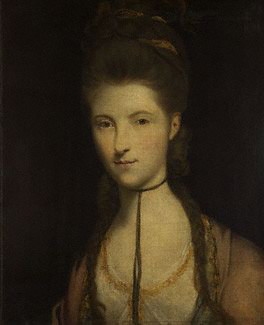
The adventurous life of Mrs. Damer began in 1748 when she was born to a prominent Whig family as Anne Seymour Conway. Her father, Henry Seymour Conway was a cousin of Horace Walpole and her mother was the extremely Scottish, Caroline Bruce, Lady Ailesbury. While her parents were abroad little Anne experimented with the art of sculpture, as encouraged by her godfather, Horace Walpole. Life seemed pretty normal and boring for young Anne but luckily a dumb husband changed all that (as they usually do for many of our tarts of aristocracy).

John Damer was a drunk and a gambler, which wasn't so unusual for the time. He was also the son of an earl who provided a generous annual income which had to have looked good to 19 year old Anne. This on top of this Anne brought in some fortunes of her own from inheritances. Well, John, being the idiot he was, gambled away most of their money in first six years of their marriage. What he didn't gamble away he spent on his wardrobe. In the seventh year of marriage, he lost it all in one night. He then retired to a room above the Bedford Arms in Covent Garden and shot himself through the head. Anne was now a widow. A widow in a lot of debt.

This put Mrs. Damer in an awful situation. But believe it or not, it was probably the best thing that could happen to her. Walpole not only took her in at his home in Strawberry Hill but he helped to get her on her feet again and allowed freedoms that her marriage lacked. The old bachelor loved her as his own and even willed his Strawberry Hill home to her. Anne took up her childhood hobby of sculpture and honed her skills until she was a reputable artist. Her work reflects the Neoclassicism of the period which helped to gain her many allegorical commissions such as the heads of Isis and Tamesis which still grace the keystones of Henley Bridge today. Her friendships that developed between Sarah Siddons and Elizabeth Farren also earned her some theatrical commissions including reliefs for Boydell Shakespeare Gallery. By 1784 Anne was an honorary exhibitor at the Royal Academy and remained so until 1818.

Her new freedom also allowed her many friendships. Due to her Whig roots, she was naturally drawn to the Devonshire House Circle and became a close friend of Georgiana. She was one of the many devoted canvassers in the 1784 Westminster Election. Mrs. Damer also frequented the masquerades quite often; not the best way to keep a good reputation. In fact, many rumors of Mrs. Damer being a lesbian surfaced, although this could be due to her affinity for male clothing. In truth, Anne was, in all likelihood, a lesbian and enjoyed the company of her female friends. It is thought that Walpole introduced her to the author, Mary Berry, with whom she had a long-standing romantic relationship.

Anne also enjoyed her widowhood because it allowed her travel. She was good friend and regularar guest of the expat, William Hamilton, (of Emma notariety) the ambassador to Naples. At one point in her travels to Europe she was captured by a privateer but released. She also happened to be in Paris during the Treaty of Amiens and met Napoleon himself.

Anne died a happy old lady in 1828. As requested, she was buried with her sculptor's tools and apron as well as with the ashes of her favorite dog.