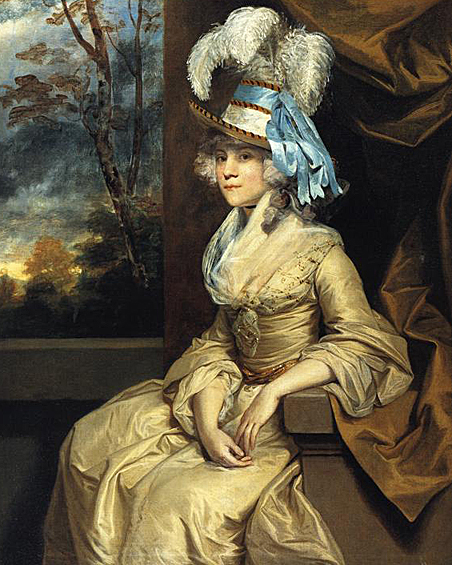
'The King, Queen, and the Three Princesses with two of the younger childred occupied two Boxes fronting the Orchestra. The Duchess of Devonshire and all the women of Fashion in a gallery near them...With regard to the company the Women appeared to disadvantage as being forbid Hats and Feathers they had almost uniformly put on the most disfiguring head-dress I ever saw — A Mob of a most immense size, simply illustrated with blue or yellow ribbons — this over friz'd Heads and sallow complexions had a very bad effect — a few with fair skins and clear brown hair bore the disguise tollerably.'
Showing posts with label Hats. Show all posts
Wednesday, October 2, 2013
Forbidden feathers
On June 1, 1785 Eliza Sheridan wrote of a visit to the theatre where, as usual, eyes were mostly on those off the stage:
Saturday, July 30, 2011
Trouble with Travel: Hats
While scouring for pictures of the royal wedding in Edinburgh today I cam across this gem, which I found rather adorable.
Get in the back, Kate!
Then I looked at it again and realized poor Katie Cambridge is hunched over due to her rather large hat (been there, Honey)!
That instantly brought to mind a satirical print from Matthew Darly in 1776 when hair heights were at their largest. Elegant females were constantly forced to sit on the floor due to their hair; there was no other way to get around it aside from sticking your head out the window. Here's hoping that someday we will have vehicles to accommodate fashion!
Get in the back, Kate!
Then I looked at it again and realized poor Katie Cambridge is hunched over due to her rather large hat (been there, Honey)!
That instantly brought to mind a satirical print from Matthew Darly in 1776 when hair heights were at their largest. Elegant females were constantly forced to sit on the floor due to their hair; there was no other way to get around it aside from sticking your head out the window. Here's hoping that someday we will have vehicles to accommodate fashion!
Sunday, September 19, 2010
Yay or Nay? Mrs Musters
Poor Madame de Genlis. She wore her frilliest bonnet and it was panned, most everyone gave her a big Nay and labeled her a fashion victim. Methinks bonnets are not this crowd's cup of tea, particularly ones will big bows. Perhaps we can try some of the same elements of the rejected bonnet in hat form?
George Romney paints Mrs Musters (detail, 1779-80) in a white chapeau à la Marlborough. Yay or Nay?
[Kenwood]
Sunday, September 12, 2010
Yay or Nay? Madame de Genlis
It was another Yay for haberdashery as Lady Taylor pulled in a victory for her high brimmed hat. We have not seen what French couture has to offer in the realm of headgear. Perhaps we are overdue?
Adelaide Labille-Guiard paints Madame de Genlis (1780) in her bonnet of lace and ribbons. Yay or Nay?
H.W. Blunt Collection
Sunday, September 5, 2010
Yay or Nay? Lady Taylor
Last week we examined the hat of the Duquessa de Nájera and your approval was given. All those ribbons and plumes earned her a Yay. Today we are going to judge a similar hat; this time from England.
Joshua Reynolds paints Lady Elizabeth Taylor (1781-84) in her high crowned ivory and blue hat. Yay or Nay?
[The Frick Collection]
Sunday, August 29, 2010
Yay or Nay? Maria Pilar
Last week we had our first edition of hat Yay or Nays. The panel was torn! But in the end Marie Dauncey and her poodle hair were rewarded with a Yay. Although the curly powdered hair was very much in style, Marie's was very curiously styled for her portrait. I suppose it was all about the hat when she considered her outfit! Now let's journey to Spain for our next hat selection
Vicente López paints the Duquessa de Nájera (1795) as she adds a hint of bold color to the otherwise subtle clothing pallet via her hat. Yay or Nay?
[Prado]
Sunday, August 22, 2010
Yay or Nay? Mrs Marie Dauncey
Please excuse this very late edition or our normally scheduled fashion critique. My recent travels have prevented posting so I have a bit of blogger's guilt which I need to relieve in an immediate Yay or Nay (not to mention, I cannot bear another day without snappy comments). When we last left off Maria Amalia Christina was impressing everyone with her fancy frock and earned herself a Yay. Now for something a little different; let's look at headgear.
James Northcote paints Marie Dauncey (1789) in her towering mauve hat. Yay or Nay?
Saturday, July 11, 2009
For Sale
Sunday, March 29, 2009
Turbans
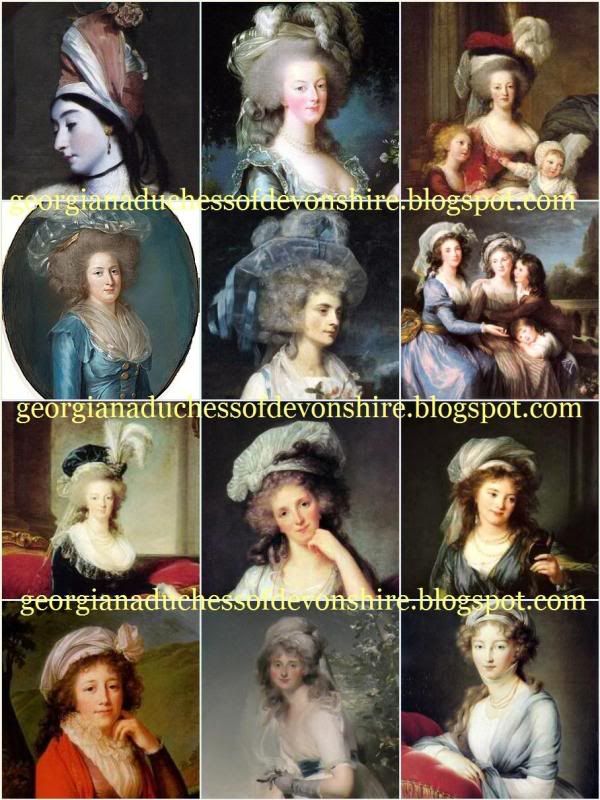
In our continued exploration of hats it would be crazy to exclude the major trend that was the turban. Turbans would appear here or there throughout the 18th century but by the end of the century the vogue simply exploded. Visitors to the mysterious lands of the Orient and Turkey, such as Mary Wortley Montague brought back many of the peoples' mysterious ways (such as the smallpox inoculation) to the curious English. One of the things that made it back to Europe was the curious manner of dress which everyone took a major interest in. Soon Turkish dress was one of the most common costumes seen at the masquerade. Of course this dress was not proper for normal, everyday wear (you couldn't look like a barbarian!) but one aspect did stick and that was the turban. Women found that the rolls of elegant fabric could make for the perfect fashion accessory. One woman particularly loved these headdresses and frequently had herself portrayed wearing them, Marie Antoinette. Even after the queen's fall and subsequent death turbans became increasingly popular, especially in France. They evolved into fabric that would wrap around women's curly, loose hair so that it would show through the fabric. The trend had adapted to the Classical trend to combine the Turkish style with that of the ancient Roman. By the 1790's and into the early 19th century no woman of fashion was complete without a turban, Turk, or chiffonet.
This site has some great fashion plates of Turbans after 1793.

This site has some great fashion plates of Turbans after 1793.
- 1782
- 1783
- 1787
- 1787
- 1787
- 1787
- 1788
- 1789
- 1790
- 1793
- 1794
- 1795
Thursday, March 12, 2009
Hats An Anthology at the V&A
What bothered me a lot, though, was that about 65-75% of the hats exhibited were Stephen
Overall, the exhibition was a feast for the eyes but disappointing in lack of historical hats and in the self-promoting of Jones' work. This caused me to be more impressed with the overall display than the actual content. It is still worth checking out, but not if you are expecting to see a display of hats through the ages.
Sunday, February 22, 2009
Upcoming Exhibitions of Interest
The National Galleries of Scotland and the British Museum have teamed up to present an exploration of the, dare I say, less grand portraits of Georgian England. These often disregarded artworks will be on display in all their glory at the British Museum from 5 March to 31 May.
Hats: An Anthology by Stephen Jones
While I struggle through making a Georgiana anthology of Hats Stephen Jones has brought some of his life's research to fruition at the Victorian & Albert Museum. This exhibition which runs from 23 February to 31 May explores a variety of hats through the centuries and promises to be a must see for mad haberdashers.
Wednesday, January 28, 2009
Straw Hats
Straw hats remained one of the basic and popular types of hats throughout most of the 18th century. Of course there were rules outlining the appropriate time and place to wear such hats, so as to not look like one of, ya know, the common folk. These rules were especially fervent in France (of course) where Lauren tells me, you couldn't wear such hats after 11am. Most of these rules had to do with the style of the hat, which displayed the wearer's connection to nature. However, nature would definitely not be allowed in say, the opera and was not appropriate during the cold months. No sir, these were pastoral hats, meant to evoke the feeling of nature in the warm months. The chapeau a la cérès, named after the goddess of Harvest, contained sprigs of wheat on it. In addition to wheat many straw hats were trimmed with ribbons and flowers and, of course, feathers. This style of hat, was especially popular in the 1780's while Marie Antoinette created crazes with her casual Triannon styles.
- 1760
- 1797
- 1785
- 1783-5
- 1784
- 1789
- 1786
- after 1782
Thursday, January 15, 2009
Picture Hat


Tuesday, January 13, 2009
Caps and Bonnets
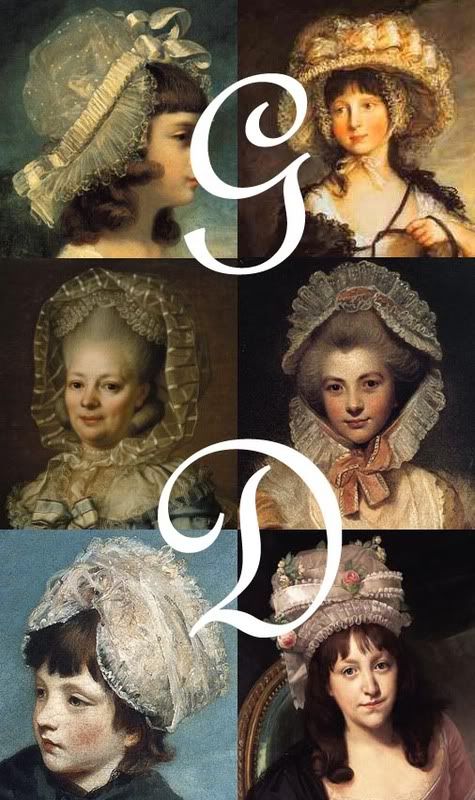
As hair began getting larger and larger toward the end of the century head-wear had to evolve to keep up with the growing coiffures. Pinner caps, little circles of of white fabric and lace pinned to the top of the hair, became less common in England since they could barely be seen on the hair tower. Mob caps were actually known as bonnets in the Georgian period and consisted of a caul covering the hair and a ruffled brim. The Calash bonnet adapted the idea of the collapsible tops of carriages, it was even named after them. Caleche is the french word for "carriages." They were usually made out of black taffeta and ideal for protecting hair-dos from the sometimes unpleasant English weather. And thank goodness for that; imagine showing up to Lady Melbourne's (who had been depicted in a bonnet) with your up-do a down-do! When the weather was fair, so were the bonnets. Springy cotton bonnets were introduced toward the end of the century and reflected the vogue for the simple life. Of course these could be trimmed in a variety of ways so you didn't look too simple. Hats could be worn over the bonnets if the fashionista so chose.
- 1787
- Under hat, 1782
- Thérèse, 1780
- 1781
- 1778
- 1780
Monday, January 12, 2009
Hat Exposition
Sunday, November 23, 2008
Chapeau a la Caravan

Mythosidhe just posted this fabulous portrait and I had to pass on her discovery, Mrs. Daniel Dennison Rogers by John Singleton Copley circa 1784 contains the same English principals of portrait painting but brings an American electricity in the colours and background. Copley brings the drama to this piece that so many English portraitists failed to bring; can't you just hear the Gone with the Wind theme playing behind her? But what got me all excited about Mythosidhe's find is the hat Mrs. Rogers is wearing. Lauren will correct me if I'm wrong, but I believe it is the chapeau a la caravan, which she actually made when we went to the racetrack this summer. I had never seen one in a portrait, so what a pleasant surprise to see it in an American portrait.
Friday, May 16, 2008
A hat for every gown
All I did was a google image search...oh hindsight.
Subscribe to:
Posts (Atom)