Showing posts with label Mary Graham. Show all posts

Monday, March 28, 2011

Fashionably Late

A funny thing happened on the way to Grosvenor Square.  *Begins fanning slowly*

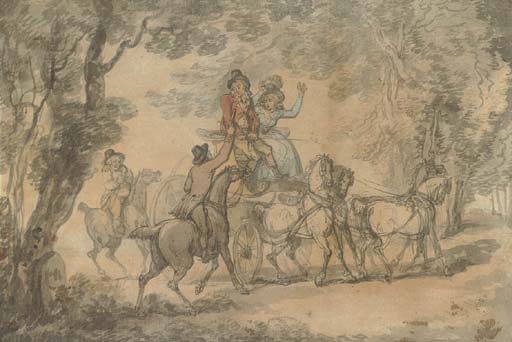
The Duchess of Atholl and her sister, Mrs Mary Graham were attending a party with Mary's husband Mr. Thomas Graham.  The coach came to a sudden stop on Park Lane and the three passengers were shocked when the person opening the door was not the footman but a highwayman wielding a gun.  Two other ruffians held the horses while the pistol-wielder demanded jewels and money.  Unbeknownst to the robber, Mr. Graham had a history of heroism when it came to his wife and her jewels.  He had once ridden all night to retrieve her jewelery box for a ball she was attending, so a brute waving his pistol in the face of his wife was certainly not going to get away with it.  The robber also didn't see Mr. Graham in the corner of the coach amongst all the puffy skirts of the ladies.  With jedi-like reflexes Mr. Graham lept across the ladies and dove for the surprised thief and proceeded to wrestle the pistol away from the thief on the ground.  The two men holding the horses wisely ran away when they realized the coach contained an action hero.  The comontion of the scuffle and the women's alarm drew the attention of the watch who relieved Mr. Graham of his heroic duties and took the purpetrator into custody. 

When everything was straightened away the group realized that this unneccesary affair had made them late for the party.  They proceeded to their destination where Mr Graham bashfully shadowed the ladies the whole night. He wasn't being overly protective, he simply meant to use his wife's skirt to hide his muddy shoes and stockings that he had aquired in the fight.

Wednesday, March 23, 2011

The Depression-Inducing Portrait

Thomas Gainsborough, The Honourable Mrs. Graham, 1775-7
Georgiana and her best friend Mary Graham had many things in common.  One of their commonalities is they were lucky enough to sit for Thomas Gainsborough more than once.  Their portraits by Gainsborough were highly praised during their lifetime yet both portraits were hidden away from eyes for many years after the sitter's death, to only be narrowly saved and revealed in the following century. 

Like many great paintings, elements of mystery surround Mary's portrait.  She sat for the portrait when she returned from her honeymoon.  Many accounts do not refer to Mary showing the symptoms of tuberculosis, the disease which would plague and kill her and her family, yet she was reportedly too weak to sit long for Gainsborough.  Mary is shown wearing an ornate masquerade dress of pink and silver in the Van Dyck style. A jaunty plumed hat is perched on Mary's high tower of hair.  The fantastic outfit dazzled viewers and was made even more impressive by the fact that it was purely a figment of Gainsborough's imagination.  Mary never owned the dress and supposedly her family was upset with her being portrayed in such a harlot-y sort of outfit.  Strangely I have never personally found any thoughts Mary or her husband, Thomas had on the painting which was raved about when it was exhibited at the Royal Academy.

Mary succumbed to consumption in 1792 leaving a devastated husband wrought with grief.  Thomas could not even bring himself to return to the homes he once shared with his wife.  You might imagine the effect that seeing the celebrated portrait would have on him.  Some accounts say that bricks were laid over the hanging portrait where it remained until it was found during renovations.  Most accounts tell of Thomas hiding it in storage in London.  Storage is where it remained until after Thomas' death.

In 1843 Thomas' cousin, Robert Graham received a message about his deceased cousin's paintings still being in the warehouse. He accepting the paintings not even knowing if they were worth the storage fee he had to pay for them.  Robert had the enthusiasm of a child on Christmas morning and intercepted the delivery cart on Dalcrue bridge and immediately began opening the crates of paintings.  Robert felt as if he was seeing a ghost when he drew out Mary's portrait which had been hidden away for fifty years.

In 1859 Robert bequeathed Mary's portrait to the National Gallery of Scotland on the condition that it never leaves the walls of the museum.  He felt that the portrait should never again be housed in darkness and should be regarded as one of Scotland's national treasures.  Visitors to the National Gallery may just feel that way upon being welcomed to museum by the elegant Mary Graham.
Side-Note: There will be a lecture on Thomas Graham at the National Gallery of Scotland on May 17. Details here.

Sunday, March 22, 2009

Hamiltons Hamiltons and MORE Hamiltons!

Are you getting confused by the many Hamiltons you encounter on this site? There's the infamous Emma; Douglas and Elizabeth from the very beginning; and recently, Elizabeth Gunning. It's almost as if every other Scottish person in the 18th century was a Hamilton, but they scurry around so fast causing scandal here and there that it is difficult to keep track of them! Well for both your and my convenience I've arranged a sort of Dummy's Guide to Aristocratic Hamiltons of the 18th Century. Hold on to your hats folks, this could get complicated.

Let's begin with the lady who is responsible for most of the spawning. Yes, lady. Anne Hamilton, 3rd Duchess of Hamilton (1631-1716). Anne was a Duchess of Hamilton in her own right, that is she was given the title through birth rather than marriage. Her father bequeathed her the title because he knew his time was near and he had no heirs. Normally the Duchy of Hamilton would just go extinct during his death but this happened during a messy time with the uprooting of the crown, etc. etc. so the 1st Duke of Hamilton took advantage and gave his daughter the peerage he worked so hard to earn. That also meant all of his minor peerages followed with the duchy making her also the Marchioness of Clydesdale, Countess of Arran, Lanark and Cambridge, the Lady Aven, Innerdale, Machanshire and Polmont. As you can guess, Anne had no problem finding a husband after that. She married William Douglas (those Douglases get around too!) 1st Earl of Selkirk and they had a litter of children. But for sanity's sake we will only follow two, the eldest surviving and the youngest.

Let's begin with the youngest since that line is slightly less complicated. Anne's youngest son was Lord Archibald Hamilton (1673-1754). He didn't do anything of real notoriety excepting the fact that he married three times, two of his wives having the last name of Hamilton. I told you they breed like rabbits! His third and surviving wife, Jane (oh I hope I don't make this any more confusing!) bore him the heirs he wanted and some daughters too. His youngest daughter, Jane was the mother of the Beautiful Mary Graham.

Archibald's third son was named Sir William Hamilton (1730-1803) who became very successful as an ambassador to Naples and was known for his love of antiques. He married Catherine Barlow who gave him no heirs and left him a lonely widower in 1782. William fell in love and married again nine years later to a woman much younger than him, who was better at giving Horatio Nelson children than she was with her own husband, Lady Emma Hamilton (1761?-1815).


Now back to the eldest of Anne's brood, James 4th Duke of Hamilton (1658-1712) was, ah never mind, not important. But his grandson is of some interest, for it was James the 6th Duke of Hamilton (1724-1758) who fell in love with Elizabeth Chudleigh and then madly in love with Elizabeth Gunning, whom he quickly married. At James' death the title passed to his two year old son, James George who died in his teens leaving the duchy to his younger brother, Douglas 8th Duke of Hamilton (1756-1799). A portrait of the dashing Douglas and his stunning wife, Elizabeth by Joshua Reynolds is one of my personal favourites, unfortunately it was destroyed and we only have (luckily) a black and white image of it. The couple divorced in 1794 and Douglas died five years later without an heir.

The last 18th century Duke of Hamilton I will speak of briefly (goodness there were so many!) was Douglas' cousin who was Alexander 10th Duke of Hamilton (1767-1852) was said to be quite the dandy. He also had a keen interest in ancient Egypt. So interested, in fact, that he willed himself mummified and buried in a sarcophagus.

That about does it for Hamiltons in the 18th Century 101, believe me, there has got to be at least one I'm forgetting. And no, it's not that Hamilton on that we see on US currency!

Thursday, December 18, 2008

On the Third Day of Christmas Mary Graham Gave to Me...

Three fainting spells...

Poor little Mary Graham. I do not exaggerate when I say "little" either. Mary was always looked upon with pity because she had such a potential for beauty if only she weren't so skinny. Mary was crippled by tuberculosis which made her weak and constantly seeking relief from the illness in warmer climates. Her trekking also kept Mary from falling victim to the party scene in London like so many other young aristocrats such as her best friend, Georgiana.

Friday, September 5, 2008

Tart of the Week: The Honourable Mary Graham


I might actually be doing an injustice to the Beautiful Mrs Graham by honoring her with being the tart of the week because she was a really sweet little thing. But she is interesting and an extraordinary woman of the times so she is worth writing about. Plus, she did have an affair...with a woman (you may never guess who!) so that makes her tart enough for me!

Mary Cathcart was born to the 9th Earl of Cathcart who just happened to be the ambassador to Catherine the Great in Russia. This meant Mary enjoyed her upbringing with her brothers and sisters in the fashionable country. When she returned to England she was immediately married off to Thomas Graham at the age of 17. Thomas was not a peer but he was distinguished and owned a lot of land. He wasn't the brightest man but he dearly loved Mary. There is a story that when she forgot her jewelery box for a ball Thomas immediately jumped on his horse and raced 90 miles and back to fetch it for her. Indeed, she was beautiful and gentle and many found it hard not to like her which may have earned her the nickname The Beautiful Mrs. Graham.

One of the people to fall under her charms was Thomas Gainsborough. He found her beauty to be exotic and could not help to paint her as much as possible, even if she wasn't there. It is very likely he was head over heels for her. Unfortunately the much-loved Mrs. Graham was very sick. She had tuberculosis which caused her to be very frail. She withered away to a modern dress-size 8 (around size 6, US) which in 18th century terms was emaciated. It also caused her to have sunken eyes and a large upper lip. Indeed, Georgians did not find this attractive at all but she won them over with kind disposition. The disease was crippling for Mary, and while her famous Gainsborough portrait was painted she could only sit for small periods at a time. In fact, she was not even wearing the glamorous masquerade gown, that is all a figment of Gainsborough's imagination and a testament to his skills with the brush. Mary may have never even seen the painting but when her family did they found it to be obscene. Despite this, it was displayed at the Royal Academy in 1777 to great acclaim.

Meanwhile, Mary and Thomas were in Brighton, hoping the sea-air would cure her pneumonia. It was here that the couple ran into another famous couple. It was none other than the Duke and Duchess of Devonshire. The two ladies immediately latched on to each other. They were the same age and had married in the same year too. They quickly became best friends and unlike Georgiana's future best-friendship with Bess, this one was more healthy. Mary was naturally motherly and led a much more subdued life than Georgiana. This balanced Georgiana out a bit and slowed her down. Unfortunately, the two friends had to part Brighton and were forced to reduce their relationship to daily correspondence. It is here that a change can be noticed between the two friends. In fact, Mary and Georgiana became more than friends. Georgiana found in Mary, someone who really loved her, a feeling foreign to her in her marriage. Georgiana was "the love of her life" according to Mary's biographer, Sarah Symmons.

When Mary's health did not improved, she was forced further from her beloved in search of warmer climates. The two women were devastated but Georgiana soon got swept up in her party lifestyle. The were not to meet again until 1792 in Nice while Mary was in the final stage of consumption. She died shortly afterward. In her dying breaths she spoke of her love and friendship with Georgiana. But her sad story does not end there. Since she died on a boat in French waters Thomas hired a barge to take her body to a plot in Bordeaux to be buried. On it's way there her casket was desecrated by french soldiers and her remains molested. Thomas closed the casket and then brought it to the Scottish Highlands where it rests in a mausoleum today.

Upon Mary's death, her famous Gainsborough portrait was covered with white muslin for Thomas could not bare to look at it. He was deeply grieved by his wife's passing. He reacted to her death by joining the army (can we say mid-life crisis?) and became the oldest general in the British army. The years passed and the portrait remained hidden until it was rediscovered in 1857. It was then bequeathed to the National Gallery of Scotland on the condition that it would never leave the museum's walls and there it stays today. For Mary's health took her away from her countrymen and those who loved her but her portrait is not allowed to do so.

Friday, June 27, 2008

The Rubens Wife Phenomenom


A
bout a hundred years after Rubens painted a full-length portrait of his Wife, England discovered it. And for whatever reason they could not get enough of it. The so-called Rubens Wife trend in 18th century English fashion was something that either did not go out of style or kept coming back in style. It also bred the Van Dyck trend in fashion, which did not discriminate between the sexes. Both of these Dutch trends in clothing were pricey and would only be sported by the rich at masquerades and in portraits. These displays in portraits varied from trying to directly mimic Helena Fourment's dress and pose to variations on both. Many of the sitters would hold the ostrich feather to show the connection to the old portrait, such as Lady Oxeden (above) in the 1755 portrait by Thomas Hudson. One of the more famous examples is Gainsborough's The Hon. Mrs Graham from 1775. Interestingly, the dress worn by Mrs. Graham was a figment of the artists vivid imagination. This style borders on the Van Dyck style which can usually be distinguished by the lace collar and 17th century Dutch clothing spin-offs. Again, this style ranges in portraits from about the 1730's to the 1790's. A famous example of this style would be another Gainsborough, now known as The Blue Boy (left) from 1770. The Van Dyck style was very appealing to men for their self-portraits, even Georgiana's brother John 2nd Earl Spencer was depicted in Van Dyck style by Reynolds in 1774. Georgiana, however, choose not to go in the Van Dyck style in her accompanying portrait that was commissioned with it. Soon, the two Dutch Golden Age vogues became so common that they were hardly noticeable as distinctively Dutch. They soon melded with the rest of the English styles to form something, well distinctively 18th century English.