Showing posts with label Dorothy Jordan. Show all posts

Wednesday, October 19, 2011

New Exhibition: The First Actresses

Words cannot express how excited I am about an exhibition opening at London's National Portrait Gallery tomorrow.  The First Actresses is a celebration of the fascinating women (many written about on this blog) who took London by storm, when they ascended to the stage, a short while after it was even allowed for women to do so. According to the NPG's website,
"The First Actresses presents a vivid spectacle of femininity, fashion and theatricality in seventeenth and eighteenth-century Britain.

Taking centre stage are the intriguing and notorious female performers of the period whose lives outside of the theatre ranged from royal mistresses to admired writers and businesswomen. The exhibition reveals the many ways in which these early celebrities used portraiture to enhance their reputations, deflect scandal and create their professional identities."
The exhibition is not only monumental for the oeuvre but has acquired some amazing pieces that have been hidden away in private collections.  An erotically-charged portrait of a topless Nell Gwyn, the self-proclaimed "Protestant Whore," has been restored to its original state of toplessness.  Also on public display for the first time is the NPG's new acquisition, The Three Witches from Macbeth, which is quite special because now the museum finally has a adult depiction of Georgiana Duchess of Devonshire in its collection.

The First Actresses opens tomorrow but I personally will have to patiently bide my time to see the exhibition since I am planning on attending its corresponding conference on 11 November.  Juicy details to follow!  Who else is planning on going?

Amanda Vickery's Review
Laura Barnett's Review

Saturday, June 11, 2011

Coming Exhibitions: The First Actresses

I nearly jumped out of my seat in excitement when I read this announcement from the Nation Portrait Gallery today:

The First Actresses: Nell Gwyn to Sarah Siddons
20 October 2011 - 8 January 2012

Wolfson Gallery
Tickets £11/£10/£9
The First Actresses will explore the vibrant and sometimes controversial relationship between art, gender and the theatre in eighteenth-century England. Combining much-loved masterpieces with newly-discovered works, the exhibition will look at the ways in which actresses used portraiture to enhance their reputations, deflect scandal and increase their popularity and professional status.

The exhibition features portraits by artists such as Joshua Reynolds, Thomas Gainsborough, John Hoppner and James Gillray, with highlights including Reynolds’s famous portrait of Sarah Siddons as the Tragic Muse, Hogarth’s The Beggar’s Opera and Gainsborough’s portrait of Elizabeth Linley. Visitors will discover the fascinating stories of actresses including Nell Gwyn, Kitty Clive, Hester Booth, Lavinia Fenton, Sarah Siddons and Dorothy Jordan.

Starting with the emergence of the actress’s profession in the late seventeenth century, The First Actresses will show how women performers were key figures in celebrity culture. Fuelled by gossipy theatre and art reviews, satirical prints and the growing taste for biography, eighteenth-century society engaged in heated debate about the moral and sexual decorum of women on stage and revelled in the traditional association between actress and prostitute. The exhibition will also look at the resonances with modern celebrity culture and the enduring notion of the actress as fashion icon.

This sounds like an exhibition not to be missed since no museum has ever housed so many tarts at once!  I have never had the pleasure of seeing my favorite portrait of Perdita Robinson (by Hoppner) and it appears it will be one of the highlights of the collection.  Time to begin counting down the days until October.

Friday, October 3, 2008

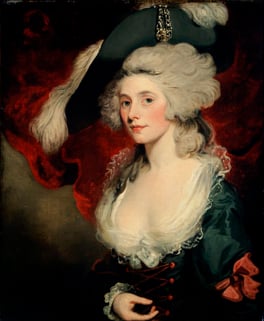
Tart of the Week: Dorothy Jordan


B
elieve it or not, there were tarts that weren't named Elizabeth or Mary! Dorothea Bland was born in 1761 to a stagehand and his Welsh mistress, an actress in Waterford, Ireland. When Dorothea was 13 her father abandoned the family to marry an actress. Although he sent small amounts of money to support the family it was not enough and at 15 Dorothea's mother enlisted Dorothea to the only job she could teach her daughter, acting.

Dorothea had an knack for the art and a pretty face so her new profession proved a success. As with many past tarts, she was also smart and witty. Her first gigs were at the Theatre Royal, in Cork which was managed by Richard Daly. A relationship bloomed between the young actress and her boss and at the age of 20 Dorothea had her first child. Knowing her potential, and now having another mouth to feed, Dorothea made a decision to move to London to reach a greater audience and hopefully make more money. It is here that she transformed into Mrs. Dorothy Jordan. Many actresses would take on a married name so they wouldn't be viewed as a whore. It is rumored that Dorothy chose Jordan as a reference to her escape across the Irish Sea as the River Jordan.

She was met with more success in London. She was also met with more men to fool around with. Some she gave her heart to and some she didn't. She even moved in with one who promised to marry her. After three children and no ring, she said goodbye to him too. But she would move on to bigger men. Meanwhile, she had become one of the biggest names in acting. She was a leading comic actress and was working out of Drury Lane. Because she had hot legs she would get cast in many cross-dressing roles, known as "breeches' roles, which were usually written just as an excuse to show off actresses' legs.

Maybe it was those famous legs that attracted William, Duke of Clarence, and later King William IV to Dorothy. The two fell in love and began their live-in relationship, which would last over 20 years and produce 10 children. Despite the scandal, the common-law couple lived became the examples of domestic bliss. Even stuffy King George didn't seem to mind the scandalous couple because they were the model of loving, functional couple. Soon satirical prints veered from cracking jokes at Dorothy's promiscuity to how she was, shockingly, a good parent.

Unfortunately the affair was forced to come to an end when the amount of legitimate heirs was dwindling and William's debts were increasing. Like his brother with Mrs. Fitzherbert, William agreed to leave Dorothy and marry a princess in order to pay off the debts. They separated on the terms that he would have custody of the boys while she got the girls (typical). She would receive a stipend on the terms that she never acted again (harsh!). Dorothy sadly complied but when a son-in-law fell into debt in 1814 she returned to stage to help support her daughter. When William found out he not only haulted the stipend but took custody of the remaining daughters.

Dorothy had reached a low point in her life. She fled to France to escape debtor's prison and died there in 1816. However, there are rumors that she may not have actually died then and lived a few years longer under a different name.