Showing posts with label Kitty Clive. Show all posts

Wednesday, October 19, 2011

New Exhibition: The First Actresses

Words cannot express how excited I am about an exhibition opening at London's National Portrait Gallery tomorrow.  The First Actresses is a celebration of the fascinating women (many written about on this blog) who took London by storm, when they ascended to the stage, a short while after it was even allowed for women to do so. According to the NPG's website,
"The First Actresses presents a vivid spectacle of femininity, fashion and theatricality in seventeenth and eighteenth-century Britain.

Taking centre stage are the intriguing and notorious female performers of the period whose lives outside of the theatre ranged from royal mistresses to admired writers and businesswomen. The exhibition reveals the many ways in which these early celebrities used portraiture to enhance their reputations, deflect scandal and create their professional identities."
The exhibition is not only monumental for the oeuvre but has acquired some amazing pieces that have been hidden away in private collections.  An erotically-charged portrait of a topless Nell Gwyn, the self-proclaimed "Protestant Whore," has been restored to its original state of toplessness.  Also on public display for the first time is the NPG's new acquisition, The Three Witches from Macbeth, which is quite special because now the museum finally has a adult depiction of Georgiana Duchess of Devonshire in its collection.

The First Actresses opens tomorrow but I personally will have to patiently bide my time to see the exhibition since I am planning on attending its corresponding conference on 11 November.  Juicy details to follow!  Who else is planning on going?

Amanda Vickery's Review
Laura Barnett's Review
Saturday, June 11, 2011

Coming Exhibitions: The First Actresses

I nearly jumped out of my seat in excitement when I read this announcement from the Nation Portrait Gallery today:

The First Actresses: Nell Gwyn to Sarah Siddons
20 October 2011 - 8 January 2012

Wolfson Gallery
Tickets £11/£10/£9
The First Actresses will explore the vibrant and sometimes controversial relationship between art, gender and the theatre in eighteenth-century England. Combining much-loved masterpieces with newly-discovered works, the exhibition will look at the ways in which actresses used portraiture to enhance their reputations, deflect scandal and increase their popularity and professional status.

The exhibition features portraits by artists such as Joshua Reynolds, Thomas Gainsborough, John Hoppner and James Gillray, with highlights including Reynolds’s famous portrait of Sarah Siddons as the Tragic Muse, Hogarth’s The Beggar’s Opera and Gainsborough’s portrait of Elizabeth Linley. Visitors will discover the fascinating stories of actresses including Nell Gwyn, Kitty Clive, Hester Booth, Lavinia Fenton, Sarah Siddons and Dorothy Jordan.

Starting with the emergence of the actress’s profession in the late seventeenth century, The First Actresses will show how women performers were key figures in celebrity culture. Fuelled by gossipy theatre and art reviews, satirical prints and the growing taste for biography, eighteenth-century society engaged in heated debate about the moral and sexual decorum of women on stage and revelled in the traditional association between actress and prostitute. The exhibition will also look at the resonances with modern celebrity culture and the enduring notion of the actress as fashion icon.

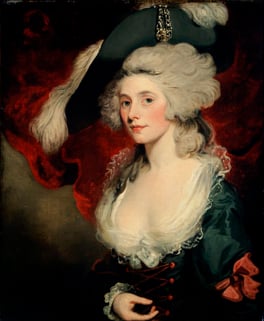
This sounds like an exhibition not to be missed since no museum has ever housed so many tarts at once!  I have never had the pleasure of seeing my favorite portrait of Perdita Robinson (by Hoppner) and it appears it will be one of the highlights of the collection.  Time to begin counting down the days until October.

Wednesday, June 17, 2009

Ladies and Gentlemen, Mrs. Clive

A lovely reader, Kate, found this epilogue of the glorious Kitty Clive, the feisty Irish actress. Kitty closed her play at the Exeter Mercury Theatre with this little piece in 1763, six years before she officially retired. I think you will find the personalized epilogue witty and representative of the times and their values.

LADIES! methinks I hear you all complain,
Lord! Here's the talking creature come again.
The men seem frighted -- for ‘tis on record,
A prattling female will have the last word.
But you're all out; for sure as you’re alive,
Not Mrs. Friendly now, but Mrs. Clive.
No character from fiction will I borrow;
But, if you please, I'll talk again tomorrow.
Then you conclude, from custom long in vogue,
That I come here to speak an epilogue,
With satire, humour, spirit, quite refined,
Double entendre, too, with wit combined;
Not for the ladies, but to please the men:
All this you guess -- and now you're out again.
For to be brief -- our author had me say,
She try’d -- but cou’dn't get one to her play.
No epilogue! Why ma'am you'll spoil your treat;
An Epilogue is the Cordial after Meat;
For when the feast is done, without all Question,
They’ll want liqueors [sic], to help them to Digestion:
And Critics, when they find the banquet light,
Will come next time with better appetite;
So, make your friends to write, for faith ‘tis hard,
If, ‘mongst them all, you cannot find one bard,
She took the hint -- Will you, good sir? Or you, sir?
A sister Scribbler – sure you can’t refuse her!
Some Lawyers try’d – not one cou’d make an end on’t,
They’d now such Work with Plaintiff & Defendant.
A Poet try’d; but he alledg’d for Reason,
The Muses were so busy at this Season
In penning Libels, Politics, and Satires,
They had’nt [sic] Leisure for such trifling Matters.
What’s to be done, she cry’d? Can’t you endeavour
To say some pretty Thing? – I know you’re clever,
I promis’d, - but, unable to succeed,
Beg you’ll accept the Purpose for the Deed.
Tho’ after three long hours in playhouse coop’d,
I fear you’ll say – you’ve all been finely dup’d.

Friday, April 17, 2009

Tart of the Week: Kitty Clive


Catherine Raftor was born in 1711 to a family neither well-off, nor poor. Her Irish father actually served Louis XIV in the french army. However, a soldier's salary was not great means of income so by the age of seventeen Kitty was pursuing acting since she seemed to have a knack for it. It also didn't hurt that she was pretty as well. Kitty was blessed with a light complexion, dark hair, and light eyes. But underneath the pretty facade Kitty had a bad temper that would become slightly notorious.

Kitty, being a Londonite, quickly secured a job at Drury Lane. Her story is similar to many other tartly actresses. Being young and full of life, she quickly grew in popularity and had an affinity for comedic acting. So of course, Kitty decided to put a deterrent on her fame by getting married to a George Clive. What is interesting about Kitty is how she was able to keep most of her private life under wraps. Her marriage quickly disintegrated but instead of George abusing or abandoning her, the two agreed to a mutual separation. They probably just grew sick of each other!

Luckily for Kitty, her dappling with marriage didn't seen to hurt her career. She continued on stage as Mrs. Clive. Of course, Kitty had her dalliances with men, and the press was always suspicious; but Kitty was always clever enough to manage to keep her affairs under wraps. Soon she was beginning to get noticed for a singing talent as well. One of the people who noticed her was Handel who she became close friends with. Another person whose friendship couldn't be avoided on Drury Lane was David Garrick. He also noticed Kitty's talent. She became one of his original company members in 1747. Kitty's temper tried Garrick's patience many a time, but she stayed with the company for twenty-two years.

After over forty healthy years on stage Kitty decided it was time for her to let the new pretty little actresses try their hand in the business. She retired to a cozy house in Twickenham that her friend Horace Walpole had secured for her. He called it Clive's Den but she dubbed it "Little Strawberry Hill" after his estate. Kitty died in 1785, after 75 happy years of life.

Friday, October 10, 2008

Tart of the Week: Peg Woffington


Margaret Woffington's career began began at an early age when her bricklayer father suddenly died. She roamed the streets of Dublin singling for money or selling watercress door to door to support her family. It was in these humble beginnings that she was 'discovered' at the age of ten, and given her start on the stage.

For about 10 years Peg acted and danced in various theaters around Dublin in order to get by. Her big break came in 1737 (probably age 17) when her Ophelia met great acclaim in a production of Hamlet. This allowed her the prestige and money to travel to London in 1740 to attempt to make it big there. She luckily was immediately met with success, although this could be because she took a breeches role. It never hurts to show some skin in showbiz!

Not only did Peg show a skill in playing breeches roles, which she was given quite frequently, but she took to playing aristocrats well. An interesting fact considering her voice was described as "harsh." Peg quickly gained the reputation of being a leading comic actress and began having friends in high places such as the Gunning Sisters and one of the most famous actors in history, David Garrick. In fact, a love bloomed between the two thespians and they lived together (in sin!) for a while. The couple had planned to wed but Peg ended up dumping him.

She went on to have numerous public affairs with men in high places such as the Earl of Darnley and MP Charles Hanbury Williams but managed not to have any children. A smart tart, I say! Actually she was known for being a kind, genuine person, however tart-like. In fact, she was so well-liked she was even the president of Thomas Sheridan's Beefsteak Club in Dublin. Normally clubs were a place for men to gamble and and be debaucherous so women were not allowed. Peg was actually the only woman member in the Beefsteak Club as well as President. It was whispered, however, that Peg didn't get along with fellow popular actresses George Anne Bellamy and Kitty Clive. Many heated arguments are said to have erupted between the actresses up until Peg's death.

Like any good actress, Peg left with a dramatic exit. While playing Rosalind in a Covent Garden production of As You Like It, she suddenly collapsed and was said to be paralyzed. Although she recovered from her accident, it forced her retirement. She spent the next three years in ill-health under the care of an army officer, until she died in 1760 at the age of 40.