The White Swan may sound like a pure sot of establishment but anyone who would have walked into it in the late 18th and early 19th centuries would probably know that was not the case. It seems as though the tavern had a reputation as a seedy motel where one could conduct an illicit affair, away from prying eyes. The White Swan offered more services than just a rendezvous point, though. If you didn’t have a prearranged partner to meet up with, there were plenty of males mulling about on the second floor to entertain you...for a price.
While male prostitution isn’t so wholly unusual in this place and time, the names these men picked for themselves is. Like our modern-day strippers with names like “Sapphire,” the White Swan prostitutes went by names that their mothers obviously did not give them: Miss Selina, Harriet, and even Kitty Fisher (a nod to the original, perhaps) could be found loitering about the tavern looking for customers. But perhaps the most grandiose of these gay prostitutes was one man who must have been pretty confident in his abilities for he went by the name, the Duchess of Devonshire.
Perhaps the most delightful bit of this juicy gossip is that these colorful tavern workers only took this role by night. If you needed to find the Duchess of Devonshire before the sun set, you could find her (or him) at her day job as a blacksmith.
Showing posts with label Homosexuality. Show all posts
Wednesday, June 29, 2011
Monday, January 10, 2011
Girl, I Want to Take you to a Gay Bar
The concept of a gay bar is not what you would call new. You could easily say that they had been around for quite a while. Eighteenth-century London was a city of sex. Gentlemen had to put in little effort to find a prostitute to their liking, whether a woman, man, or even child. Men searching for the intimate company of other men would find it in molly houses (quite literally meaning gay houses).
Were molly houses gay brothels? Well, I suppose that depends on which molly house you would be going to. Some of the houses were in fact a place to find a male prostitute and like any other brothel you could be supplied with a room, liquor, or even a delicious meal if you so pleased. Other molly houses were gathering places for the gay man, the equivalent of a gay bar. Liquor, dancing, music and drag queens would be found here, as well as a good time. Additionally, there were several rooms for rent so if things got hot and heavy on the dance floor you could take the romance to a place more private and equally nonjudgmental- for a price of course. Margaret "Mother" Clap was a notorious molly house procuress, who presumably ran her business out of her own home and did it for the pleasure of the company; a true fag hag.
Many similarities exist between our contemporary and ancestral gay hang-outs. Just as metropolises now tend to have regions that the gay community make their own so did London. Moorfields was one of the notable gay haunts of the city, so much so that it had a "Sodomite's Walk." Like today, many gay men were known to refer to each other as "queens" which I personally find interesting since many female sovereigns existed at the time. Queenly spats were also not wholly unusual either as Joseph Sellers describes from personal experience:
Spats could be the least of problems regulars at molly houses could have. Sodomy was a very serious offense, punishable by death (as seen above). Luckily, evidence was needed in order to charge someone with that offense and that could be a tricky task for the law. Molly houses were prone to raids which famously happened to Mother Clap's house in 1726 leading to her arrest. Thank goodness today the only raids that gay bars may suffer from would be those used to catch serving minors!
Were molly houses gay brothels? Well, I suppose that depends on which molly house you would be going to. Some of the houses were in fact a place to find a male prostitute and like any other brothel you could be supplied with a room, liquor, or even a delicious meal if you so pleased. Other molly houses were gathering places for the gay man, the equivalent of a gay bar. Liquor, dancing, music and drag queens would be found here, as well as a good time. Additionally, there were several rooms for rent so if things got hot and heavy on the dance floor you could take the romance to a place more private and equally nonjudgmental- for a price of course. Margaret "Mother" Clap was a notorious molly house procuress, who presumably ran her business out of her own home and did it for the pleasure of the company; a true fag hag.
Many similarities exist between our contemporary and ancestral gay hang-outs. Just as metropolises now tend to have regions that the gay community make their own so did London. Moorfields was one of the notable gay haunts of the city, so much so that it had a "Sodomite's Walk." Like today, many gay men were known to refer to each other as "queens" which I personally find interesting since many female sovereigns existed at the time. Queenly spats were also not wholly unusual either as Joseph Sellers describes from personal experience:
"As soon as we came in, Gabriel Lawrence (since hang'd for Sodomy) began to scold at Mark Patridge, calling him a vile Dog, a blowing-up Bitch and other ill Names because Partridge had blab'd out something about one Harrington's being concern'd with him in such Practice."Oh the dramz! Don't you hate when someone has to cause a scene at the bar?
Spats could be the least of problems regulars at molly houses could have. Sodomy was a very serious offense, punishable by death (as seen above). Luckily, evidence was needed in order to charge someone with that offense and that could be a tricky task for the law. Molly houses were prone to raids which famously happened to Mother Clap's house in 1726 leading to her arrest. Thank goodness today the only raids that gay bars may suffer from would be those used to catch serving minors!
Saturday, February 27, 2010
Some Fabulous Light Reading Before February Ends
Just before it is too late, I wanted to point out some great 18th century resources for LGBT topics in honor of February being LGBT Month in the Colonies. I have written on Princess Seraphina and the Chevalier d'Eon before but the best possible resource for enlightening information on this interesting subject is Rictor Norton's site. Reader, Jamie also pointed out this fabulous article about gay subcultures of the time. There are also some tarts (and Duchesses!) who had both suspected and obvious feelings for other women. Do you remember who those women in question are?
Friday, July 10, 2009
Tart of the Week: Charlotte Charke

Charlotte Cibber, daughter of the famous poet laureate Colley Cibber, was a curious creature of many talents. She was an actress, author, transvestite, puppeteer, playwright, and even a sausage maker at one point. Charlotte was born in 1713 and received her education at a girl's school. When she later moved away to live with her mother she continued her education independently by teaching herself skills a women's education usually neglected such as shooting and horse racing. At thirteen she developed an interest in medicine and began studying to be a doctor. As soon as her father began receiving the supply bills, he immediately put a stop to her independent studies.
Time for a new career goal.
Charlotte married musician, Richard Charke and used her new marital status in order to secure a job. This time she tried her hand at acting; her father was the purveyor of Drury Lane, after all. She took to the art and soon was taking on my roles, including breeches roles, where she would have to dress as a boy. Usually young, attractive actresses like Mary Robinson were given these roles as an excuse to show off their legs. After five years on stage, Charlotte had had enough of theatre bureaucracy and went off to start HER OWN theater company. Soon afterward, Parliment passed a censorship law, making it illegal to perform any play that hadn't been approved by them. Charlotte venomously opposed the bill and was left without a job soon afterward. By this time her husband had run off to Jamaica and died shortly thereafter. Charlotte was now
a single mother who was unemployed.The next chapter of Charlotte's life was quite different. She took up puppeteering, eventually owning her own Punch and Judy theatre. She also wasn't just playing the breeches role on stage; now she was dressing as a man in public and would even go by the name of Charles Brown. Whether this was because she identified as a man more than a tart or just a means of escaping debt we do not know. At one point a young heiress fell in love with "Charles" and "he" proposed. Sadly, the engagment fell through. Once she was taken to debtor's prison, but the prostitutes of Covent Garden banded together to spring "Master Charles'" bail Girl power!
After many years of ups and downs with the theatre business, Charlotte decided she was too old for the business and settled down to be an author. After two successful novels, Charlotte wrote her memoirs, which, as that genre tended to be, were eagarly snatched up by the gossip-loving public. Charlotte died at age 47 in 1760, a mere two years after her famous father died.
Friday, October 17, 2008
Tart of the Week: The Honourable Mrs. Anne Damer

The adventurous life of Mrs. Damer began in 1748 when she was born to a prominent Whig family as Anne Seymour Conway. Her father, Henry Seymour Conway was a cousin of Horace Walpole and her mother was the extremely Scottish, Caroline Bruce, Lady
John Damer was a drunk and a gambler, which wasn't so unusual for the time. He was also the son of an earl who provided a generous annual income which had to have looked good to 19 year old Anne. This on top of this Anne brought in some fortunes of her own from inheritances. Well, John, being the idiot he was, gambled away most of their money in first six years of their marriage. What he didn't gamble away he spent on his wardrobe. In the seventh year of marriage, he lost it all in one night. He then retired to a room above the Bedford Arms in Covent Garden and shot himself through the head. Anne was now a widow. A widow in a lot of debt.
This put Mrs. Damer in an awful situation. But believe it or not, it was probably the best thing that could happen to her. Walpole not only took her in at his home in Strawberry Hill but he helped to get her on her feet again and allowed freedoms that her marriage lacked. The old bachelor loved her as his own and even willed his Strawberry Hill home to her. Anne took up her childhood hobby of sculpture and honed her skills until she was a reputable artist. Her work reflects the Neoclassicism of the period which helped to gain her many allegorical commissions such as the heads of Isis and Tamesis which still grace the keystones of Henley Bridge today. Her friendships that developed between Sarah Siddons and Elizabeth Farren also earned her some theatrical commissions including reliefs for Boydell Shakespeare Gallery. By 1784 Anne was an honorary exhibitor at the Royal Academy and remained so until 1818.Her new freedom also allowed her many friendships. Due to her Whig roots, she was
naturally drawn to the Devonshire House Circle and became a close friend of Georgiana. She was one of the many devoted canvassers in the 1784 Westminster Election. Mrs. Damer also frequented the masquerades quite often; not the best way to keep a good reputation. In fact, many rumors of Mrs. Damer being a lesbian surfaced, although this could be due to her affinity for male clothing. In truth, Anne was, in all likelihood, a lesbian and enjoyed the company of her female friends. It is thought that Walpole introduced her to the author, Mary Berry, with whom she had a long-standing romantic relationship.
Anne also enjoyed her widowhood because it allowed her travel. She was good friend and regularar guest of the expat, William Hamilton, (of Emma notariety) the ambassador to Naples. At one point in her travels to Europe she was captured by a privateer but released. She also happened to be in Paris during the Treaty of Amiens and met Napoleon himself.
Anne died a happy old lady in 1828. As requested, she was buried with her sculptor's tools and apron as well as with the ashes of her favorite dog.
Wednesday, October 8, 2008
Princess Seraphina and the Transvestite Escapades
The Age of Enlightenment brought with it a huge fad for the masquerade. Where else could you, for one night, be something you were not? And get totally trashed in the process. Harlequins, dominos, and shepherdesses were some of the most popular costumes to grace the party halls. Another popular costume? The queen. Not the kind with a crown.Masquerades also allowed those who never felt comfortable in their own bodies to try out the clothes of the opposite sex for a night. In fact, every masquerade could be a chance to enter public in drag and not be ostracized. The masked balls had a reputation for lasciviousness to begin with; some only went to get laid, and this went for those seeking the same sex as well. In fact, to be blunt, they tended to be parties full of horny people. So what was a little cross-dressing?

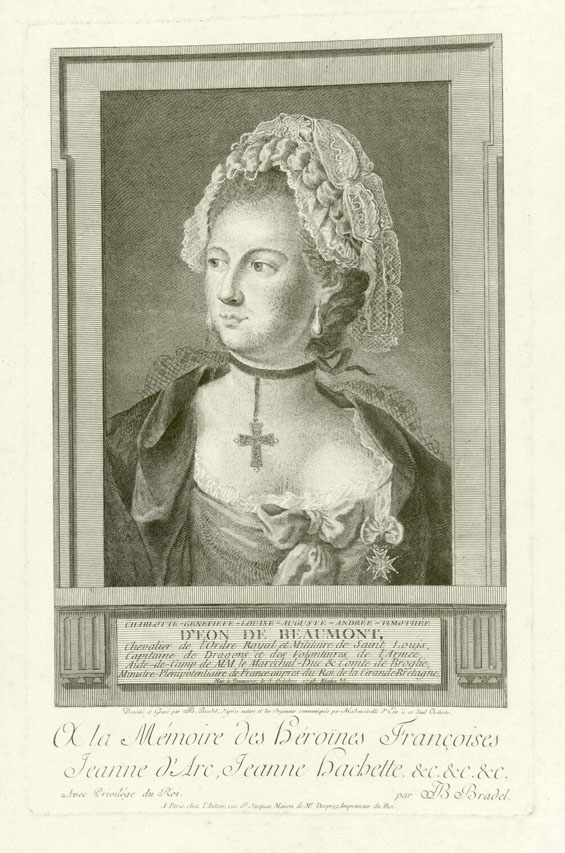
In France, the Chevalier d'Eon became a famous transgender person who was also a spy. She sported both elegant gowns and her dragoon uniform. You could put money into a betting pool at the London Stock Exchange whether you thought she was a woman or man. She fenced like a man but walked like a woman.
That brings us to Princess Seraphina. Back in these dark ages, gay men were yet to be referred to as "queens," they were merely "princesses." They have apparently moved up in rank. Princess Seraphina is the first recognized English drag queen in history. That means that like the drag queens of today, Seraphina was out and about in public regularly as a female. Even when she wasn't in drag people called her Seraphina. It was her identity. She was a servant for a "molly" (another term for a gay male) and hustled on the side a bit. But drama erupted in 1732 when a Tom Gordon stole Girlfriend's clothes and then threatened that if she charged him he would accuse her of sodomy. Well, that didn't scare Seraphina she sued him (yay!) but lost (boo!). Interesting enough, the clothing was her male garb.
But I do not bring this up because drag queens are funny or "hot tranny messes". Crossdressers, homosexual and gender dysmorphic people have been around forever. But here we see a time and a place in western civilization where it is beginning to be okay for them to be themselves in public. We also see a gay culture developing with "Molly Houses" (gay clubs) being established and sexual relations more easily found. Of course, as with most developments in the 18th century, these advancements in Enlightened thought were dashed in the Victorian age and had to be re-established in the 20th century.
To end this expose, I would like to close with a excerpt from a witness at the trial. Elizabeth Jones' account gives you a little glimpse into how others reacted to Seraphina as a transsexual in the 18th century:
"I saw the Princess Seraphina standing at Mr. Poplet's Door. "What, have you been robb'd, Princess?" says I, "Has Tom Gordon stripp'd your Highness stark naked? An impudent Rogue! And yet, Ma'm, I think, your Highness had better make it up with him, than expose yourself, for some say it was only an Exchange." "Why," says he, "at first I would have made it up, and taken my Cloaths again, but now it's too late, and I must prosecute, for those that were concerned in taking him up, expect their Share in the Reward, and won't let me drop the Prosecution."
[Rictor Norton]
Subscribe to:
Posts (Atom)