 To view the complete series of William Hogarth's Marriage a la Mode the links have been provided below.
Showing posts with label Marriage a la Mode. Show all posts
Showing posts with label Marriage a la Mode. Show all posts
Wednesday, August 20, 2008
Marriage a la Mode en Complete
To view the complete series of William Hogarth's Marriage a la Mode the links have been provided below.Tuesday, August 19, 2008
Marriage a la Mode, Part 6: The Lady's Death

Alas! All good things must come to an end, and so it is here that Hogarth concludes his painted tale of a fashionable marriage.
When we last saw the couple, the Earl was dying by the hands of his wife's lover, the lawyer, Silvertongue. Now it appears that the lover has been found guilty of his crime and was hanged. His dying speech lies at our mistress' feet. Speaking of dying, she doesn't look too good either! In her despair over her lost love, the lovely wife had ordered her daft servant to fetch her laudanum so that she may do away with herself. Her lost love being Silvertongue, not her Doherty-looking husband, the earl. Her suicide is here discovered, in the moments before her death. While the poor mentally-challenged servant is punished for his fatal error, the nursemaid brings the couples' only child, a daughter, to bid farewell to her mother. The child itself is rather sickly. It seems to have caught syphilis from one of its parents, as indicated by the black spot on her neck. She also has the misfortune of being crippled; probably due to rickets: the children's version of gout. While she kisses her mother one last time her grandfather slips his daughter's wedding ring off her finger before she goes all stiff. Suicides' possessions were forfeited to the state, so he has to make sure he gets what is left of her wealth. The deeper symbolism here ultimately describes the father's lack of compassion and guilt in his daughter's untimely death. While her soul slowly drifts into the hands of the devil, her own father is still only thinking of the money which she can bring him. But what money? The splendor of her atmosphere seems to have gone by the time of this last edition. It appears that the finery that once surrounded the countess has been replaced with a quaint little house on the Thames. Cobwebs decorate the space instead of gilded edges and curtains.

Some reoccurring themes once again appear in this painting. The art on the wall, as always, leaves clues as to what else is happening in the scene. Instead of the rich Italian masters, the walls are now graced with Dutch genre scenes. These were popular market paintings in the 17th century, but not suitable for a wife of a peerage. They depict the poorer classes being amused by simple things; which also references the dim-witted servant. Another reoccurring theme seen here is that of the dog. This dog, is unlike the others, it is a skin and bones street dog who is taking advantage of the the commotion to steal food (a pig's head) off the table. The symbolism isn't that deep here. The family is now poverty-stricken and has resorted to less-than-stellar food.
To finish this circle of sad events Hogarth reminds us of the first scene in which the marriage was formed. A family tree was displayed by the earl's father to indicate his intentions for the marriage. Now, the only legitimate child of the couple is a daughter, severing the growth of the family and marking it's untimely end. Even the Countess' greedy father did not gain wealth from the match because his daughter's suicide forfeits all of her possessions to the state. The loveless match created with no respect to the peoples involved has sown exactly what was planted in it: greed, stupidity, and misfortune. Nothing good was produced from the foul seed. As always Hogarth makes his point in his very decided and opinionated manner. Fashionable marriages were common and usually had disastrous results. Two easy examples of this is both Marie Antoinette and Georgiana's marriages. Hogarth's opinion is delivered alongside his great humor but the message, however exaggerated, is not to be made light of. It is from his satires in paint and print that we have discovered much about 18th century culture. Marriage a la Mode is one of the more historically significant of Hogarth's works because it criticizes the age-old tradition of arranged marriages and perhaps aided in it becoming unfashionable.
Marriage a la Mode, Part 1
Marriage a la Mode, Part 2
Marriage a la Mode, Part 3
Marriage a la Mode, Part 4
Marriage a la Mode, Part 5
Tuesday, August 5, 2008
Marriage a la Mode, Part 5: The Bagnio

When we last left off, our Lady was in her toilette among "friends," contemplating the idea of going to a masked soirée. We now happen upon the couple together again...but in much darker circumstances. It appears that the Countess did take the lawyer, Silvertongue up on his offer of going to the masquerade, judging by the mask on the floor by the window. It also appears that she didn't return home after the party. The Countess and Silvertongue have checked into The Turk's Head, a bagnio that actually existed in Hogath's time. Bagnios were no-questions-asked hotels; similar to roadside motels today. Apparently our favorite Pete Doherty-like Earl somehow discovered his wife's infidelities and followed her to the bagnio where he discovered her in bed with Silvertongue. Her panniers and masks are strew about near the bed; the adulterous couple were obviously in a rush to consummate their lust. When the Earl discovered them, a fight broke out and swords were drawn. But unfortunately for our hero, he spent more of his spoiled life gambling and womanizing than fencing and has lost with a fatal wound to the heart. Seeing what he has done, Silvertongue immediately drops his bloody sword and escapes out the window in his nightdress. It is at this fatal moment that the Countess falls on her knees and cries out for forgiveness for her wicked ways. The master of the house bursts in after hearing the commotion and sees the scene before us.

The background does not contain as many hints as with the previous paintings in the series. Instead, it implies more hindsight than foresight. The tapestry covering the wall depicts the Judgment of Solomon in which Solomon decrees a baby should be split in two to appease two mothers claiming the baby was theirs. This story is reference to the couple's destruction of each other for their own selfish pleasures. Hogarth adds his own style of humor by placing a 3/4th length portrait of a prostitute over a figure in the tapestry so only the legs show. The masks on the floor take on the appearance of skulls to simulate doom and death. The mirror behind the Earl refers to the first painting in the series where the madness begins, and the Earl can only be occupied looking at himself in a mirror. Will the couple learn from the culmination of their errors and find happiness in one another? Or is the Countess' plea for forgiveness too late?
Next, Part 6 >>
Marriage a la Mode Part 1
Marriage a la Mode Part 2
Marriage a la Mode Part 3
Marriage a la Mode Part 4
Wednesday, July 30, 2008
Marriage a la Mode, Part 4: The Toilette

When we last left off in Hogarth's series, it seemed the viscount had run into some trouble with a venereal disease or two. What has become of his wife? We rejoin her in her morning toilette. Toilettes or Levees were something only the extremely rich could afford, they made a party out of waking up in the morning. And why not? Life is a party! Our unfortunate wife is now a countess (the old earl must have died), as indicated by the coronet above her bed. This explains why she can afford such frivolities such as a morning levee. A large array of visitors are part of this party and are entertained by a singer and flautist. One woman seems to be in raptures over the music, a macaroni appears unaffected as he sips his tea, a man in the back yawns. The mistress of the house is not paying attention to the music at all. Instead she is engrossed in conversation with the lounging lawyer, Silvertongue. Remember him? He smiles and invites her to a masquerade as indicated by his gesture towards her screen depicting a masque. The countess seems bemused; her hairdresser: totally engrossed in the scandal about to unfold. Masquerades were known for their scandalous implications. Under disguise, much debauchery could take place, especially affairs.
To further hint at the outcome of this situation, Hogarth, once again, dresses his composition with clues. The paintings hanging in the Countess' bedroom not only tells us how obscenely rich she is, it also contain messages. Correggio's Zeus and Io hangs above her; a highly eroticized depiction of Zeus' seduction of the nymph, Io by impregnating her in the form of a cloud. On the adjacent wall is a painting of the abduction of Ganymede, in which Zeus falls in love with a young man and brings him to Mount Olympus, in the form of an eagle, to be the cup-bearer for the gods. Above Silvertongue hangs a painting of the biblical story of Lot and His Daughters, who attempted to seduce their father. In the foreground, a young African page unloads a collection of curiosities. He holds in his hands an statue of Actaeon, the unfortunate huntsman who spied on Artemis bathing and whom she punished by turning into a stag. In this case, it is not the story that Hogarth is referencing but the actual image of Actaeon: a man with a stag's head. The allegory of a cuckold is a man with horns, usually that of a deer. If things continue to pan out as they seem to be, the countess will be making a cuckold of her husband.


Next, Part 5 >>
Marriage a la Mode Part 1
Marriage a la Mode Part 2
Marriage a la Mode Part 3
Friday, July 18, 2008
Marriage a la Mode, Part 3: The Inspection

In our continued journey through Hogarth's Marriage a la Mode, we rejoin the couple...wait a minute, that is not our couple. It appears that our Doherty-predecessor Viscount has taken up with a mistress. A rather young mistress. Once again, Hogarth's snarky sense of humor takes satire to a whole new level.

The Viscount's sexual appetite has landed him and his young mistress in the French doctor, M. de la Pillule's office looking for a cure to an STD or two. The Viscount is looking quite jovial despite his situation. The child-mistress, on the other hand looks extremely upset. It seems that the medicine prescribed to rid them of their venereal diseases hasn't been working and they are search of an alternative remedy. They exchange different pill boxes with the dirty-looking quack doctor. Many morbid symbols are housed in this office including sarcophagi and skulls. In fact this "doctor" seems to be more of a collector of the marvelous than a pharmacist. The office is littered with masks, and bones, and narwhal horns. Inside the cabinet behind the viscount, a skeleton embraces a muscle model; could this be a chilling omen? The overbearing figure in the composition is a rather wide, angry woman. She seems to be afflicted with a venereal diseases of her own, judging from the black spot on her face. It is supposed that she is the child-mistress' mother. But could she both the mother of the mistress and the mistress? The viscount does seem at ease with her.
Next, Part 4 >>
Marriage a la Mode Part 1
Marriage a la Mode Part 2
Sunday, July 13, 2008
Marriage a la Mode, Part 2: The Tête à Tête
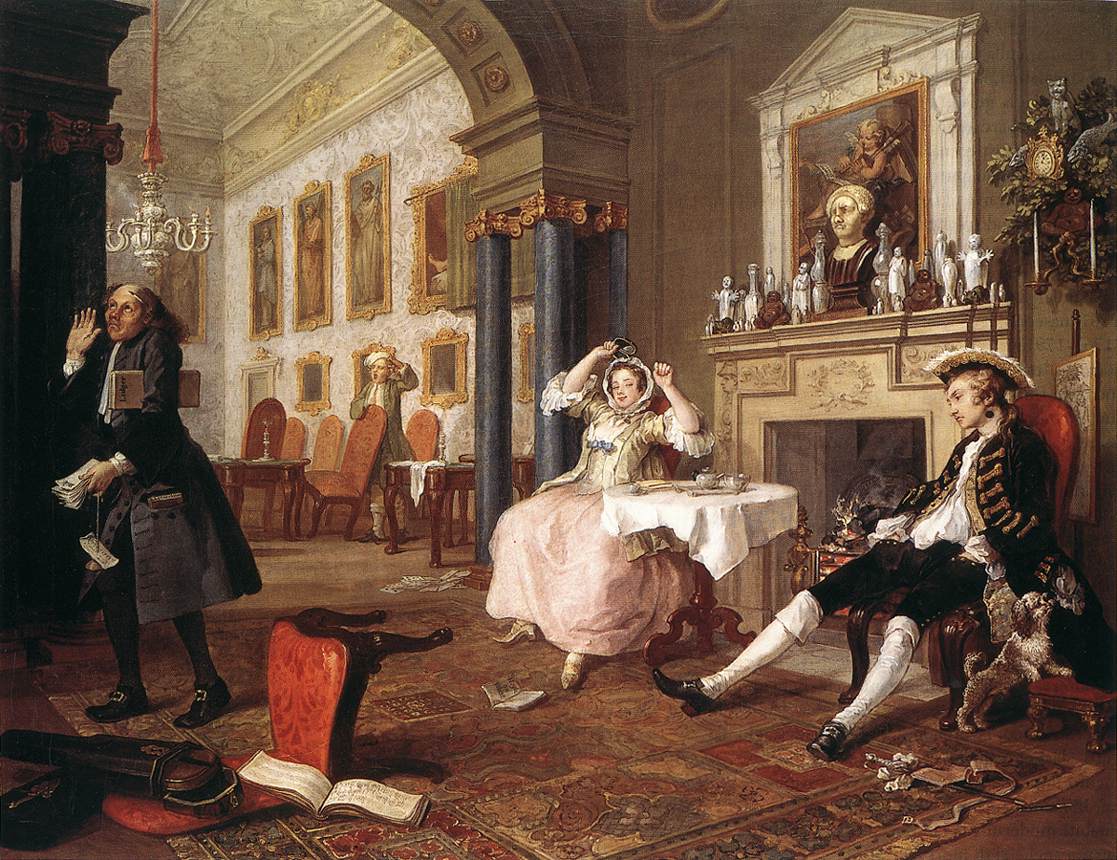
We return to see how our happy couple are doing after last seeing them at their marriage arrangement. Well how nice, they do look happy!
Kinda.
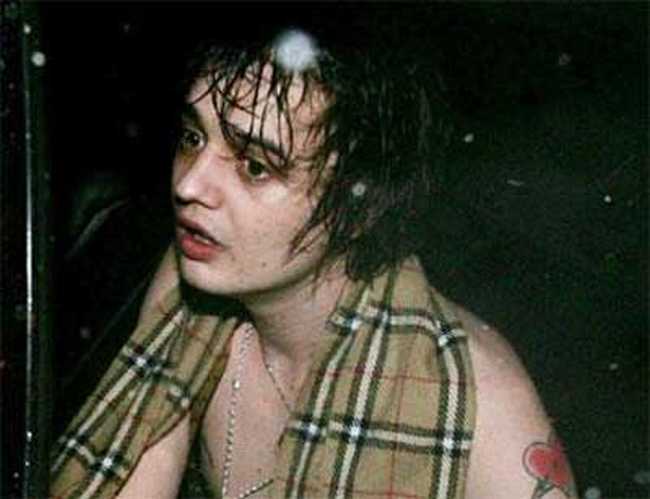
Actually doesn't the Viscount look a bit like Pete Doherty? Funnily enough, he is not a far cry from our favorite trainwreck rocker. This morning, the viscount has returned home to find his house in disarray. No matter; he slumps in his chair exhausted from night time adventures. His vacant expression of upset is not due to the messy home but, as can be seen from from his hands in his pockets, his massive gambling losses. His broken sword lies at his feet, implying a lost duel was part of the night's antics.
His wife's upset at being married appears to have disappeared...at least for the time being. Her night time adventures have just ended as well and now she's looking for some action! She coyly stretches and gives her husband the eye. She hasn't yet noticed what her dog has: a lady's cap in his pocket. Once again, Hogarth's dog show us the truth we as viewers may not see right away. Another one of Hogarth's favorite signs of sexual deviance is the black syphilis mark on the Viscount's neck. Yuck, you're better off just going to bed, Honey. But as can be seen from Hogarth's clues, the Viscountess has developed a strong sexual appetite. Phallic statuettes litter the mantel that lies between the couple. Even the firescreen post is phallic.
In the adjacent room, a servant tidys up from his mistress' card party the night before. Paintings of the Apostles hang on the wall, showing the couples' distance from God. The couple prefer the more carnally-themed room. Their steward walks away in disgust. Trying to reason with this couple about the amounting bills is just no use. They are already well on the path of destruction.
Next, Part 3 >>
Marriage a la Mode Part 1
Wednesday, July 9, 2008
Marriage a la Mode, Part 1: The Marriage Settlement

Where to even begin with William Hogarth? The man was genius. A printmaker by trade, he brought a distinctively British sense of humor to fine art which has left us with amazing insight into the mid-18th century. Marriage a la Mode is arguably his most famous work, a series of six paintings intended to be mass-produced in engravings of equal skill. The series satirizes arranged marriages and the disasters that follow, hence, Marriage a la Mode.
In this introductory piece, we are find ourselves in Earl Squander's mansion. The earl sits on the right with his leg in bandages due to gout. Gout was common among the rich due to eating fine foods in abundance so in Hogarth's work it was used as an indicator of status and personality. Squander points to his family tree while the plainly dressed father of the bride hands over a marriage contract. He is a simple merchant, and his daughter is now the wares he is selling. This is a marriage of business otherwise the series would begin with the actual wedding. Behind the merchant sits his daughter, the victim in this cruel custom of greed. She sits distraught, wringing her handkerchief. He clothing and manner expresses to the viewers that she is a simple, naive young girl. The young lawyer, Silvertongue's sniveling words of assurance fall on deaf ears, she is miserable about her marriage prospect. Next to her sits her future husband, the Viscount. He couldn't be any more opposite from her. The viscount is over-dressed in a rakish manner and is not even concerned about the marriage. In fact, he is incredibly more distracted with the mirror.
As is usual with Hogarth's work, the composition is riddled with symbols and hints to support the story being painted. An additional businessman or architect looks out the window to observe the Earl's new house being erected. The marriage is just another business arrangement that has to be taken care of in the course of the day along with bills and building arrangements. The Earl's wealth is additionally depicted through his fine art collection hanging on the walls. Caravaggio's Medusa is one of those on display. It hangs over the doomed couple.

Perhaps one of the most indicative of the symbols would be the dogs in left corner. Hogarth was a huge fan of dogs and would constantly use them as a narrative caption as to what is really going on in the work. An example of this would be in the Strode Family which contains his own pug in this position. Two dogs are in this piece. One lies down and the other looks off-composition; they are chained to each other. No good can come of this match....

Next, Part 2 >>
Subscribe to:
Posts (Atom)