Showing posts with label Tyburn. Show all posts

Friday, March 25, 2011

Crimes of Fashion

When picturing the highly romanticized notions of highwaymen one tends to picture a man in black, under a heavy coat and tricorn hat. That may have been how John Rann, aka Sixteen-String Jack, looked while he was committing highway robbery but underneath the black was a wardrobe that Lady Gaga would have gone nuts for.

Jack was born just outside Bath in 1750 to humble yet innocent beginnings. He worked as a child and by the age of twelve was working as a postilion which paved the way for him to take various coachman jobs, eventually leading him to London. Jack felt alive in the busy metropolis. He was young, good looking and there was plenty in the city to keep him entertained...especially when it came to fashion. Jack soon earned himself the nickname of Sixteen-String Jack from his trademark pants which had eight strings hanging down each leg, each one a different color. When Jack couldn't keep up his fashion expenditures with his wages he turned to pickpocketing which evolved to highway robbery, which he found he was quite good at.

Fashionable Jack's new career allowed him the comforts of attending balls, picking up women, and of course buying all that wacky designer clothing. Jack was arrested several times but always seemed to get off due to lack of evidence. He once took the stand in front of Magistrate John Fielding wearing a bouquet of flowers blooming from the breast of his coat and accessorized his shackles with some comely blue ribbons. Next time he was in court for being caught breaking into a woman's window into her bedroom (was it the future Lady Lade, I wonder?) but was acquitted due to the fact that she was expecting him but had fallen asleep. A week later Jack had waltzed into an establishment, in a scarlet coat, silks stockings, and a lace hat and announced that he was a highwayman and proceeded to pick fights with everyone until a brawl broke out. I think it safe to say Jack was not just a highwayman but a macaroni.
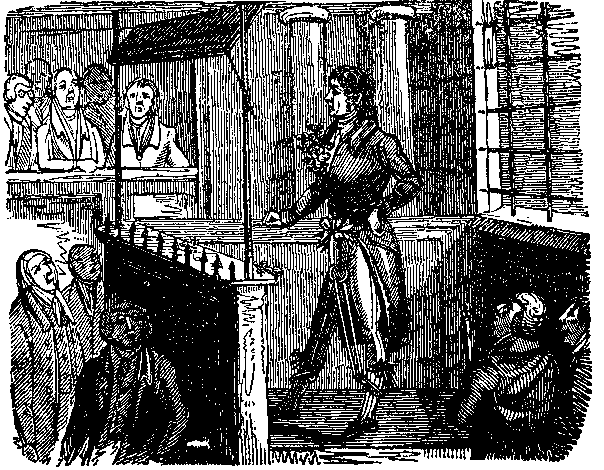
The twenty-four year old robbed his last victim in 1774 when he was tried for heisting Princess Amelia's Chaplain. Jack showed up to the trial in a pea-green suit, fully expecting to get off due to lack of evidence again. He was quite shocked when he received the guilty sentence. Still, what's a rake to do? Make the most of the situation is the answer. He held a farewell dinner in jail with seven lovely ladies and when he arrived at Tyburn he joked with his executioner and danced a jig before his last drop.

Tuesday, August 3, 2010

Tyburn, the 'Triple Tree' of Death


For those familiar with London, "Marble Arch" is a familiar facet of the city, whether you know it by the tube stop or by the randomly placed monument.  But long before tourists were wandering the area to gaze on the triumphal arch they were gathering by the hundreds to witness public executions.  For the current location of Marble Arch is roughly located in the same place as the Triple Tree, the massive gallows designed for multiple and very public hangings. 

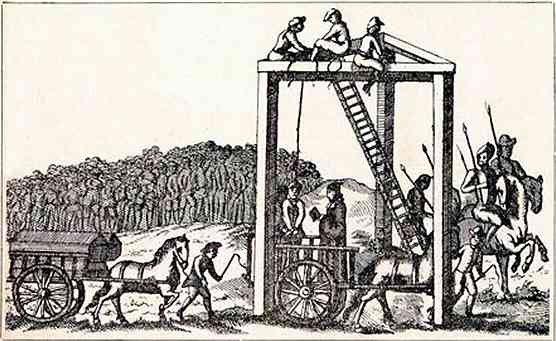
While many an 18th century highwayman met his end at Tyburn the site had been used for hangings since the medieval period.  At first people would be lynched on the trees bordering the Tyburn river (a lost river which supposedly now flows underground).  In 1571 a more efficient gallows was constructed, its unique form came to be iconic.  Three posts eighteen feet high reached to the sky and met at the top to form a triangle.  The horizontal crossbeams were nine feet across allowing for multiple people to be strung across.  Not only was this design meant to be efficient in executing multiple people (rarely was there only one person executed at Tyburn) but it was also created with public viewing kept in mind.

Public executions were always a popular event to attend and Tyburn hangings always drew in a big crowd.  William Hogarth immortalized the Tyburn crowds in his Industry and Idleness series.  Monday was the big execution day, and for a fee you could get a seat in the stands specially built just to attend the hangings.  Other spectators had to push and shove in the crowd to get a glimpse while pickpockets and prostitutes made use of the spectacle to get some money in their pockets.

Although the posts were extremely high, the condemned wouldn't fall far.  The long fall, resulting in a broken neck from hanging wasn't utilized in public hangings until the mid 19th century.  Criminals were drawn up to the gallows in a cart with a noose around their neck.  The horse would be then be whipped so that the cart would be drawn away from the condemned and they would be left to swing and suffocate to their death.  A tip to the carter would hopefully get the horses going slightly faster...not that it mattered much.  Family members or hired persons would then grab on to the hanging bodies to add their weight in order to make the death swifter, otherwise a long agonizing death was imminent.

After the execution was performed the hangman would get your clothing, so choose your last outfit wisely (a nice waistcoat could mean a quicker execution).  The bodies would then be given to the family to be buried or the hospital to be dissected. 

The legendary triple tree was taken down in 1759 because it obstructed the roads.  The large gallows was replaced by a movable one yet the spectacle of the hangings was still causing traffic problems in a city already burdened by traffic jams so public hangings at Tyburn officially ended in 1783 and were moved to Newgate Prison (where the condemned came from anyway). 

While a nice marble triumphal arch is not as much of an eyesore as the Tyburn Tree, London still gives a nod to the legendary place where so many died and so many more were entertained by the criminals' demise.  In the sidewalk, in front of gorgeous white-stone homes, a memorial stone lies on the site beside three bronze squares marking where each of the iconic eighteen foot posts once stood.