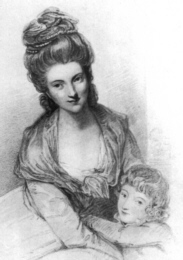
Like her predecessor, Mary Robinson, before her Harriette Wilson became famous for her sex appeal, tenacity, and her uncanny ability to blackmail.
Born in 1786, Hariette Dubouchet, teeters on being an official 18th  century tart since most of work was done during the Regency period. But I will not let that disqualify her from her prestigious title, especially since this blog is more about the long 18th century. Harriette grew up surrounded by the sounds of constant ticking, her father being a Swiss clockmaker who set roots in England. She was also surround by her fourteen siblings. So like many people born into a large family, she was eager to get out.
Perhaps when her father changed their name to Wilson, in 1801, Harriette saw the change as an opportunity to start anew, and escape a mundane existence. She was no beauty and had little education. But what she lacked she made up in determination. By the time Harriette was fifteen she found the means to escape out of her crowded, ticking home. She became the mistress of Lord William Craven, the son of lovable Lady Craven; and so launched her career as courtesan which would also tempt three of her sisters to follow in her footsteps.

But fame can not last forever. Harriette bowed out and retired in her thirties, and debts began piling up. What's a girl to do? Time to write a tell-all memoir which discusses all the famous men she slept with and ever some dirt on other ladies of society. She sent letters to everyone mentioned in her manuscript asking for a mere 200 pounds to have their names blacked out. This caused quite the ordeal among politicians, noblemen, and anyone else who was a household name. Although, it really shouldn't have considering just about everyone had slept with Harriette. One of the people who refused to pay for her silence was the celebrated Duke of Wellington who famously backfired at her, "publish and be damned." Ooo those sound like fighting words to me! She published alright, and next to the Duke of Wellington's name was this little tid-bit, "[he] has sighed over me and groaned over me by the hour..." Me-ow!
When she died in 1845 Harriette had just converted to Catholicism. One of her few mourners was her old fling, Henry Brougham, former Lord Chancellor, who arranged her funeral.
Harriette remains proof that the pen is mightier than the sword, or at least, just as scary.
century tart since most of work was done during the Regency period. But I will not let that disqualify her from her prestigious title, especially since this blog is more about the long 18th century. Harriette grew up surrounded by the sounds of constant ticking, her father being a Swiss clockmaker who set roots in England. She was also surround by her fourteen siblings. So like many people born into a large family, she was eager to get out.Perhaps when her father changed their name to Wilson, in 1801, Harriette saw the change as an opportunity to start anew, and escape a mundane existence. She was no beauty and had little education. But what she lacked she made up in determination. By the time Harriette was fifteen she found the means to escape out of her crowded, ticking home. She became the mistress of Lord William Craven, the son of lovable Lady Craven; and so launched her career as courtesan which would also tempt three of her sisters to follow in her footsteps.
Harriette turned out to be a natural. In fact, I would go so far as to say she was born a couple of decades too early and should have had her heyday at the same time as Elizabeth Armistead, Grace Elliott, Perdita and the Bird of Paradise. Just like these famous courtesans of the 1770-80s, Harriette partied hard, was wracked with debt, was followed in the press, and was the most sought after woman. Not to mention, she also became the mistress of, you guessed it, the Prince of Wales. Many famous men entered the bed of Harriette and many more sought it out. While she spent her money unwisely, Hariette used her position wisely by feverishly educating herself every chance she got. She also became a fashion icon of her time, and was known to be very picky when it came to what to wear, on both her and her men.
But fame can not last forever. Harriette bowed out and retired in her thirties, and debts began piling up. What's a girl to do? Time to write a tell-all memoir which discusses all the famous men she slept with and ever some dirt on other ladies of society. She sent letters to everyone mentioned in her manuscript asking for a mere 200 pounds to have their names blacked out. This caused quite the ordeal among politicians, noblemen, and anyone else who was a household name. Although, it really shouldn't have considering just about everyone had slept with Harriette. One of the people who refused to pay for her silence was the celebrated Duke of Wellington who famously backfired at her, "publish and be damned." Ooo those sound like fighting words to me! She published alright, and next to the Duke of Wellington's name was this little tid-bit, "[he] has sighed over me and groaned over me by the hour..." Me-ow!
When she died in 1845 Harriette had just converted to Catholicism. One of her few mourners was her old fling, Henry Brougham, former Lord Chancellor, who arranged her funeral.
Harriette remains proof that the pen is mightier than the sword, or at least, just as scary.