Showing posts with label Hygiene. Show all posts

Tuesday, August 23, 2011

Flushing Your Troubles Away

Normally when the term "toilet" is used in a Georgian context the image of a lady sitting at a dressing table comes to mind.  Did you know, though, that the flushing toilet existed at the time?  It's difficult to picture when we know this was the time period when these were still popular.  But believe it or not, the likes of Thomas Jefferson were sitting upon this flushing water closet.

The flushing water closet is very English.  The first flushing toilet was made for Queen Elizabeth, who was delighted by the new, yet unreliable invention.  I suppose that means "throne" is a rather accurate nickname.  The model obviously didn't catch on, despite Liz's affection for it.  Next, a real Renaissance man, Alexander Cummings took the idea and improved upon it.  He installed a lever on the primitive toilet which you would slide aside and therefore create an exit for the unwanted waste.  New water would come in as the waste would hopefully move into the sewers.  Perhaps the smartest part about the invention was that Cummings got a patent for it in 1775.  It is always good to protect yourself!

Bramah's useful contraption
Three years later a clever locksmith/plumber by the name of Joseph Bramah was installing some of Cummings' patented invention and couldn't help but notice that the water in the toilet would freeze on especially cold days which didn't help anyone.  He replaced the sliding valve with a flap that sealed off the bottom of the bowl.  Now the toilet water wouldn't freeze and as an added bonus: those sewer smells stopped traveling up the pipes and into your house.  The description reminds me a bit of those frightening airplane bathrooms that we so enjoy while in mid-air. 

Of course the modern flush toilet as we know it wasn't to arrive until the following century.  Ironically, the inventor who is responsible for that was named Thomas Crapper.

Monday, July 25, 2011

A Stanky Subject

Fashion and wit may have been more of a priority than hygiene in the age of Enlightenment, with the subjects of Britain having a reputation for being...well, rather gross.  Casanova's sensibilities were shaken as he toured St James's Park and saw, "hinder parts of persons relieving nature in the bushes..." Casanova was rather shocked at the Bosh-like qualities of the metropolis and went on to say that people were even relieving themselves in the middles of the street rather than hiding themselves to do their business.  Visitors to the royal court would find much of the same behavior.  The French ambassador's wife was known to use the court chamber pots in view of everyone, "...at least ten times a day amongst a cloud of witnesses."  Yup, England had no shame.  The little shame that they did have could easily be covered up with powder and perhaps a few patches.

To add insult to injury, defecating in public was the least of England's hygiene problems.  Bathing tended to only include the washing of hands and the face.  Most everything else was neglected, resulting in course commentary about the sort of odors emitted from body parts.  As much as sex was enjoyed as a recreational activity, the appendages needed for the act didn't get much love from the bath tub.  Due to this transgression 18th-century lovers tended to avoid putting their mouth on anything they didn't have to, and clothing tended to stay on in the bedroom.  If that doesn't leave horrible enough images in your imagination, just ask John Wilkes who was especially harsh on poor Scottish girls,
"it is shocking how much of [the vagina] is neglected, especially in the Northern part of this Island.  The Face, the neck, the Hands, I owe are clean, but of a Whiteness which would rival Leda's lover.  All the rest, alas! is hid in mysterious Sluttishness."  
Wilkes was also known to famously say, "the nobler parts are never in this island washed by women; they are left to be lathered by men." This naturally leaves one to wonder how clean Mr. Wilkes' gentlemen-bits were.

In the last quarter of the century bath basins became slightly more widespread, at least in the homes of the more well-to-do.  Dr James Graham who would be dismissed as a quack (and was Scottish) for his work in the sexual field was a strong advocate of frequent bathing.  When childless couples came to him for help in the bedroom, a relaxing bath was usually part of the procedure.  Graham's novel advice seemed to catch on, for one of the prostitutes in Harris' List of Covent Garden Ladies's trademark was her hygiene which, "from a practical knowledge of its increase of pleasure, from motives of cleanliness, or as a certain preventative we will not pretend to say; but we know it makes her the more desirable bed-fellow."  Based on this evidence it is safe to say that there were prostitutes that were cleaner than heads of state, yikes!

Thursday, March 11, 2010

Those Pearly Whites

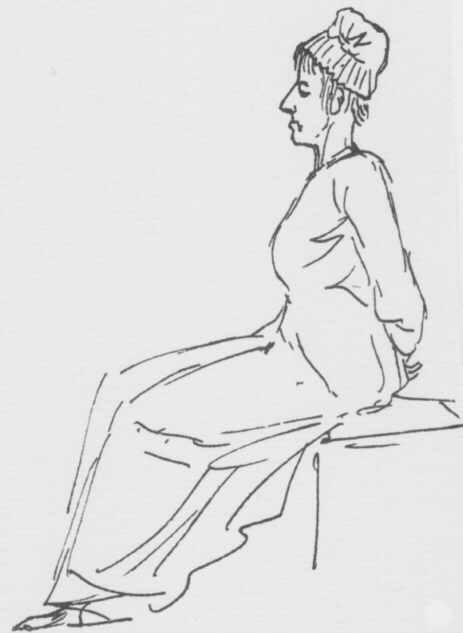
When I think of tooth care in the 18th century one of the first images that pops into my mind is David's sketch of Marie Antoinette as her cart was wheeled by on the way to the guillotine. It has been criticized by some as being inaccurate; David was biased in his feelings for the doomed queen and therefore portrayed her as haggard and the opposite of the many colorful portrayals of her during her rein. But in this case I believe bitterness did not fuel David's pen and we see the results of the stress Antoinette went through in her final years. This is most notable in her jawline which looks too haggardly for a 37 year old to our modern eyes. But the truth is that even the queen of France, like many people of the age was missing a few teeth.
Heads of Nations and Their Missing Teeth
Marie Antoinette was in good company with her dental dilemma. George Washington has long been known for having wooden teeth. The wooden part is a myth (Mr. Washington had ivory dentures) but the lack of teeth is quite true; poor George began loosing his teeth in his 20s. And so was the case for many due to lack of proper nutrients, vitamins (especially in the case of pregnant women) and of course, sweets! While the ancient Greeks were the first to discover the connection with sugary foods and bad teeth, this useful information was forgotten and it wasn't until the 18th century that dentist, Thomas Berdmore was the first to print his hypothesis about sugar being bad for teeth. So, like gout, cavities also plagued the well-to-do due to their being able to indulge in fancy foods.

Tooth Care
It wasn't like George Washington didn't take care of his teeth. He actually brushed them every day! Mount Vernon still has the president's silver toothbrush and tongue scraper. The first mass-produced toothbrush came from England in the 1780s although I can't tell you how popular it was. Bad breath was certainly unpopular and people were criticized for the unbecoming attribute.
Lack-of-Tooth Care
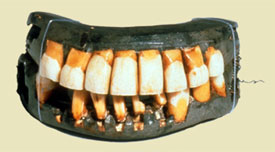
False teeth were a common solution for those teeth that wouldn't stay in place. They also were probably more ornamental than functional. Another 18th century invention was denture paste which came out of France in the 1790s. Nicholas Dubois de Chemant created the paste to go with his new porcelain dentures which were one solid piece, no separate teeth. Although this sounds quite frightful, the dentures were quite popular. If you were only missing a few teeth, you could have real or fake ones transplanted. Your tooth would be pulled and someone else's would be inserted into its place. A string or silver wire would then be used to anchor the tooth, by tying it to the others. Hopefully the root would take to the new location, in which case, you had to try another tooth.

A Visit to the Dentist
The word "dentist" was still not exactly being used in the 18th century, and it was more of a side-job still at the time. For instance, Paul Revere the silversmith also advertised his abilities in dental work. Why a silversmith? Well, cavities needed fillings after being drilled. The best and most pricey filling was a gold filling. Alternatives were pitch, beeswax, and even lead which I can't imagine as being too successful. Porcelain fillings seemed like a good idea since they were white and but their acidity killed the tooth nerve, leaving the filling white but the rest of the tooth black.
Without modern anesthesia, you might imagine a trip to the dentist to be far more unpleasant than it is today. Jane Austen described one such trip with her nieces in 1813 who had to get their teeth cleaned, filed, and fillings. Austen described hearing her niece's screams from an adjacent room while her teeth were drilled, going on to claim the dentist was "...a Lover of Teeth & Money & Mischief."

Say Cheese
But usually these various treatments were all in vain and people like George Washington's teeth would fall out. This made for an awkward trip to get your portrait painted. Many portraitists found that the awkward dentures made for an equally awkward shape of the face. Padding would be put in your mouth to fill in the cheeks for a more natural, teeth-filled mouth look.

It may be surprising how advanced dentistry was in the 18th century. The century saw the first dental chair, foot powered drill, and even orthodontics. Thomas Berdmore recommended jerry-rigging a wire insert to adjust out of place teeth. At the same time, dentistry was also extremely painful and the improvements came with many risks. Perhaps I would have just let my royal teeth fall out too!

Further Reading:
Time line
A Visit to the Dentist
The 18th century dentist's guide to 'a brilliant smile'

Thursday, February 11, 2010

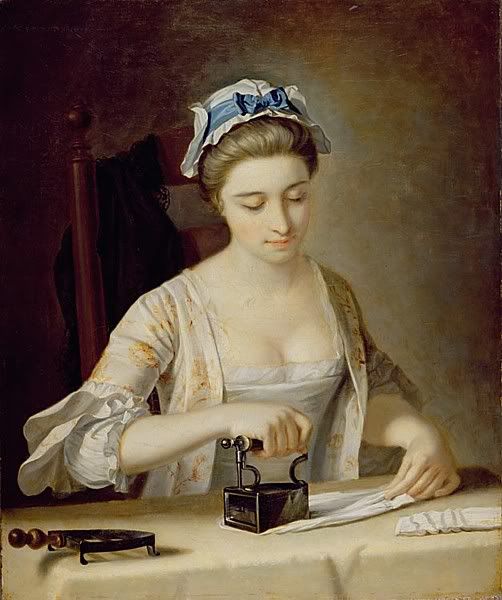
Washerwomen and Laundresses

While you wait at the nauseatingly retro laundromat, praying for your clothing to be fully dried so you can get home before 1:00 am, I hope I can enlighten you as to the convenience of these coin-operated communal cleaning devices. Clean clothing was a lot more inconvenient in the past which is why many people went without. A woman of wealth had many fine articles of clothing and a man of taste requires at least seven clean shirts a week. That is unless you were Charles James Fox, in which case you were lucky if he even made it outside his house in something other than his nightshirt. But for those who enjoy good hygiene, an essential article of your household would have to be a laundress or a washerwoman in the least.

Linen was to the 18th century as cotton is today. Not only was it what men's shirts were made with but also many undergarments and linens. Cleaning the pure white material was not as simple as throwing it in the wash on a warm/cold setting. Linen particularly had to be boiled in vats. Clothing also couldn't be considered clean until you had scrubbed it until your knuckles were raw. Soap, bleach, lye, and starch were used in the laundering process. The various materials also had to be dried and ironed. Some garments had to literally taken apart and sewn together again to prevent damage in the washing process. The whole process was back-breaking and extremely time consuming. If normal household servants took on the laundry for the whole house, you could depend on none of the regular tasks of the day being completed.

Due to the overall hassle of "doing the laundry" washerwomen were quite the essential. Just as our contemporary colleges provide launderettes for students to learn firsthand about mixing colors and whites, men going to university in the 18th century were provided with a laundress to keep their bed linens and clothing clean and mended. Of course this meant any young laundresses with easy access to bachelors' dorms were common victims to upper class charms and would find themselves doing more than laundering.

But beside resisting the charms of dashing young students, being a laundress or washerwoman wasn't the worst way for a woman to make a living. There was always a steady stream of work, and although it was difficult and time consuming it would feed you and your children. Washing and mending clothing for a living was one of the top occupations for women for around 600 years. Of course those statistics exclude the most ancient of female professions, but that was for those who couldn't take the (steaming) heat!

Wednesday, November 11, 2009

A Note on Hygiene

Now there have been rumors forever about how many baths Marie Antoinette took a year and the amount of powder used to cover unpleasant scents. That leads me to believe the 18th century had a reputation for being quite stinky! And the truth is...yeah, it kind of was. But the reason we know that is because contemporaries of the time would describe, in detail, how bad certain individuals smelled. I suppose that means, not everyone smelled bad! Yes there was glitz and glam, but that came with the use of a lot of glitter and what lay underneath could be quite repulsive.

Peoples of a Notorious Stink
Hygiene
  • John Wilkes complained that women's "nobler parts are never in this island washed...they are left to be lathered by men."
  • The stuffy Charles Geville said he only took the future Emma Hamilton as his live-in mistress because she was "the only woman he slept with without offending his senses."
  • The Prince of Wales only slept with his wife one time because he couldn't get past her smell and the "marks of filth on the fore and hide of her."
  • Most people would only occasionally wash their hands, feet, and or faces.
  • Prince Leopold was forced to take a bath before his wedding to Princess Charlotte because his hygiene was so bad.
  • Mary Wollstonecraft stated women had no regard for cleanliness.
  • Charles James Fox and the Duke of Norfolk were known to not change their clothing often. Especially personal linens.
  • Toothpicks were the only form of dental hygiene; breath was putrid due to decaying teeth and gums. Women tended to loose teeth after pregnancies due to calcium deficiencies.
  • Some countries smelled better than others. A French proverb was, "The more a ram smells, the more the goat loves him.
Temporary Solutions
  • Lice would be killed with mercury. Safe!
  • Pock-marks were covered up with white makeup, which was made out of lead. Hmm also safe!
  • Perfume, essences, oils, and powders would be used as deodorants.
  • Marie Antoinette supposedly introduced polished iron bed frames to Versailles in order to cut down on bed bugs which tended to enjoy wooden bed frames.
  • Black silk beauty marks were used to cover up blemishes and pock marks.