Showing posts with label Scotland. Show all posts

Tuesday, October 1, 2013

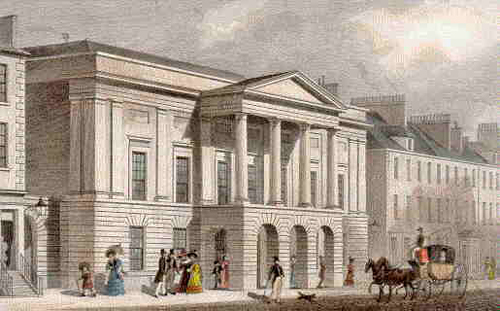
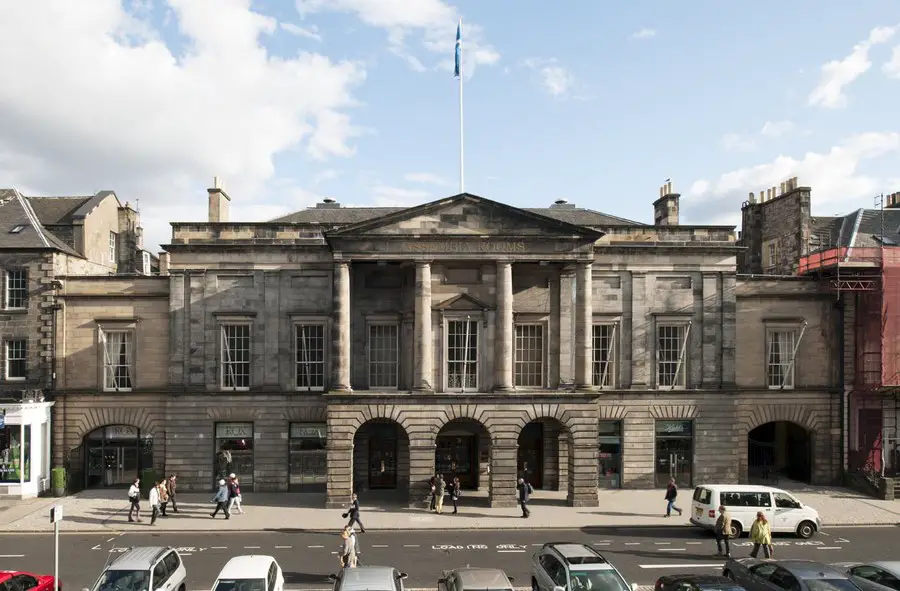
The City in the North's Assembly Rooms


When we think of assembly rooms, we often think of the famous tension-filled dancing scenes from Jane Austen's novels.  However, these early 'function rooms' had been around in some form for some time.  An example of this comes from the story of Edinburgh's Assembly Rooms which had their origins in the 17th century.  The rooms still exist in their Georgian splendor today, but that's only after they had migrated from their original 17th century location.  Before then, balls were held for charity and the matriarchs of Edinburgh organized them, raising funds for noble causes such as the Royal Infirmary.

By the latter-half of the 18th century Edinburgh had established itself as an Enlightenment city and there was a push for it to look as such to reflect its ulta modernity.   The neoclassical suburb of New Town began its constructed in 1765, allowing well-to-do residents an opportunity to get out of the crowded medieval area of the city and establish themselves in new fashionable digs.  This meant there was a new fashion-capital of the town, and an old assembly room would no longer appeal to the targeted clientele; a new, thoroughly modern assembly room must be erected.

Just as with the New Town's plans, a competition was held for the design of the new Assembly Rooms and it was won by John Henderson.  The cost of construction was £6,300 and came from a public subscription.   By 1787 the rooms were finished and could boast being the largest in the country, even surpassing Bath's famous pump room.  Finally, Edinburgh residents felt as though they could rival the entertainments found in the south with the splendor of venues like the Assembly Rooms.  This however, put a bit of pressure on Edinburgh society to maintain this distinction and in 1818 (arguably the height of assembly room entertainment) a grand portico was added because it was thought the building was lacking in splendor.

The Assembly Rooms, much like the rival Bath assembly rooms, still stand today.  After undergoing a recent refurbishment they are now back to the glittering splendor that so impressed guests in 1787.


Sunday, June 9, 2013

Art Fund Visit: Mellerstain House


This past weekend was beautiful in Scotland which meant everyone had to take advantage of the sun and go outside.  I ventured to one of the lesser-known stately homes in Britain, Mellerstain, which despite not having the fame of a house like Chatsworth or Goodwood, is absolutely gorgeous and well-worth a visit.

This was the first time I got to put my Art Pass to use which I must gush about because it is such a glorious thing for artsy-fartsy types, history nuts, and everyone in between.  It is put out by the Art Fund, a charity that helps UK museums acquire works of art to add to their collection.  When you get an Art Fund card, you're not only helping a good cause but you are getting into a lot of museum exhibitions and stately homes for free or discounted rates.  So for those connoisseurs of art and history living in the UK, this card saves you a good amount of money and its accompanying guidebook is great for keeping you in-the-know of places and events that you can pop in with the Art Pass - next on my list is an eighteenth-century brewery, I'll keep you updated!

So through the Art pass guide, I was alerted to Mellerstain, which I was unfamiliar with and decided to check out because of its portrait collection and Robert Adam interiors.  Mellerstain is the seat of the Earls of Haddington, and as you walk thought the gorgeous rooms you'll see photographs of the children of the current earl as well as the magazines the family has been reading (I love when you can tell that people still live in these homes).  Almost every room had breathtaking Adam interiors in the neoclassical style and the family portraits by the likes of Allan Ramsay and Thomas Gainsborough are on view.  The top story displays the family's personal items such as Adam's designs for the house,  fans, clothing, toys, and letters from the 18-19th centuries.  One of the best bits of my visit was that all the Mellerstain employees were so incredibly nice and informative; you could tell they loved working in this beautiful house.

But I'll let the pictures speak for me:
The library
Drawing Room ceiling

One of the first bathrooms
Original clothing on display
Back of the house and gardens

The Music Room
 Mellerstain is in the Borders of Scotland.  See here or here for opening times and further information.

Monday, July 9, 2012

The Butcher Kissing Duchess of...Gordon?

The Tory Queen, Jane Gordon was known for doing as she damn-well pleased as a little girl and marrying into the aristocracy and becoming a duchess didn't change that at all.  One of the things Jane would never compromise on was her love of Scotland.  She spoke in a brogue, encouraged social events in the Highlands, and encouraged her children to share her love for their country as well.  When her son, the Marquess of Huntly raised a company for the Black Watch, a regiment of Highland soldiers, Jane could have died of pride. 

Like a soccer mom on a mission, Jane wanted to help her wee one with his big project.  She appeared at public events and offered to men willing to join the regiment a King's Shilling from between her teeth for enlisting.  That way they got paid and got to say they kissed a duchess.  Funnily, eight years prior, her rival, Georgiana was accused of both bribing and kissing butchers in exchange for votes for Charles James Fox.  The Tories created the rumors in order to curtail Georgiana's success and force her to hide in shame and yet here was Jane obstinately doing exactly what her rival was only rumored to do.  Ballsy!  But Jane wasn't quite done with her parade yet.

At a London Ball in 1792 Jane barged in dressed head to foot in Black Watch tartan taffeta, which I can only imagine looking absolutely amazing.  Well, it must have looked amazing, because Jane started a trend for tartan with her bold look.  Soon it was reported that 'scarce a respectable female but wore a tartan waist to her gown at least, and there was hardly a waiter at any inn in London but appeared in his tartan waistcoat.' Hmm, perhaps that was an exaggeration, but as a life-long fan of plaid, I can't blame the fad!  Not bad to be a trend-setter in your 40s!

Monday, May 7, 2012

Inveraray Castle

I was lucky enough to visit one of the homes previously featured in my Country Homes collection this past weekend and it was so gorgeous I could not resist sharing.

Inveraray Castle is the current seat of the Duke and Duchess of Argyll but this fairy-tale castle was built in 1746 and rebuilt again in the Victorian era after a fire.  On the outside it looks like a gothic fortress but inside you will find it to be covered in gorgeous Neo-Classic splendor.  Inveraray was the home of one of the beautiful Gunnings sisters, Elizabeth who was so taken with her that he married her on the same day that he met her despite the fact that she was low-born.  One does not have to try hard to imagine the elegant duchess wafting from room to room in her newly-built castle in the Scottish countryside.

My favorite room was the tapestry room. In the center was a portrait by Hoppner of Elizabeth's daughter as Aurora
There was also what I like to call a "man room" which tend to entertain gentleman friends moreso than tapestries.
The dining room was all sorts of Neo-Classical
I was also surprised to find the portrait of Georgiana's granddaughter, Lady Sutherland, who followed in her grandmother's political footsteps was housed in Inveraray.  It literally took my breath away!
The residential quarters of the house where I managed to see Elizabeth's portrait through a window.  How could they hide such a thing from public view!

An entry-bridge fit for a duchess


Saturday, January 28, 2012

The Duchess of Gordon's Sim City

The Duchess of Gordon was known as being the quintessential Tory political hostess in fashionable London society.  However, like many politicians today, she had a soft spot that didn't get exposed in the public area as much.  The duchess was an economic stimulator! 

The little highland estates of Badenoch and Strathspey didn't have much going on in terms of economy but when Jane Gordon looked across those rolling fields she saw an opportunity to roll in the pounds.  Either that or this was how eighteenth century aristocrats played Sim City.  She hired instructors to teach the locals how to raise crops of flaxen and linen (to make all those fashionable gualle gowns Marie Antoinette had popularized!).  The duchess then pulled some threads to get supplies to the area. 

There was only one problem, Badenoch and Strathspey weren't actual towns and therefore couldn't sustain this new influx of economy.  So what did Jane do?  She damn-well built a village.  Because she was a duchess and duchesses have money to build their own villages if it suits their fancy.

Jane seems to have been very good at establishing and tending to villages for Kingussie (look you can have a pretty wedding there and eat haggis in the pubs and other fun things!) is still alive and well today thanks to the Duchess of Gordon.

Monday, May 23, 2011

Plaid

Major James Fraser of Castle Leathers, 1720

detail Lord George Murray, first quarter of 18th Century
Domenico Duprà, John Drummond, 1739
Charles Campbell of Lochlane, ca 1745
Richard Wilson, Flora MacDonald, 1747
William Mosman, Sir James Sir Alexander Macdonald, 1749

Cosmo Alexander, A Jacobite Lady (Jenny Cameron), ca 1745
William Mosman, Prince Charles Edward Stuart, ca 1750
George Chalmers, Sir Alexander Macdonald
Joshua Reynolds, John Murray 4th Earl of Dunmore, 1765

Henry Raeburn, Niel Gow, 1787
Henry Raeburn, Colonel Alastair Ranaldson Macdonell of Glengarry, ca 1812

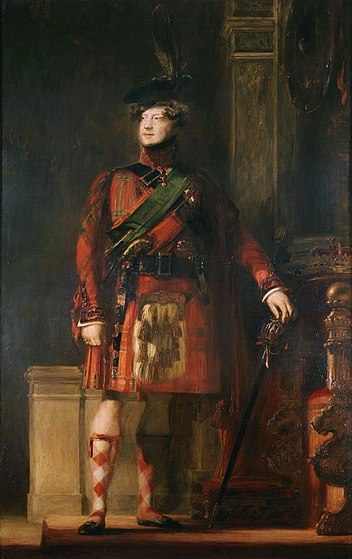
David Wilkie, George IV, 1829
In eighteenth-century England tartans were outlawed, but that didn't prevent sitters from being portrayed in them in their portraits.  Noble rebels such as the Duchess of Gordon and Frederick Prince of Wales (who much like a goth kid, wore it just to annoy his parents) were known for sporting plaid and getting away with it.  For more on these portraits of Scottish pride check out Portrait of the Nation now at the National Gallery of Scotland.

Thursday, February 17, 2011

Scottish Giants

Dog dorks like myself tuned in to the Westminster Dog Show this week.  Big shaggy dog fans like myself also may have shrieked like a banshee when the the underdog (though never underfoot), Hickory, the Scottish Deerhound won Best in Show.  Big dogs never seem to win, and a Deerhound has never won the Westminster despite the breed having the advantage of being one of the firsts to show (Bonnie Robin, 1886). 

The Deerhound, like my personal favorite, the Irish Wolfhound, has been around since the time of the Romans, perhaps even longer.  They became "deerhounds" for their skill in hunting bumblebees deer.  The dogs became so valued for their hunting ability that to own a Deerhound became a reserved right for VIPs.  By the eighteenth century those VIPs were Highland Chieftans since the highlands were one of the only places you could still find a healthy heard of deer.  You know how some snooty dog-breeders sometimes have special requirements for those who buy their pups? The chieftains were the same way and wouldn't give out their beloved Deerhounds to just anyone!

When the Jacobites lost the battle of Culloden the English made the Scottish pay with their clan system which collapsed, and with it, the breeding of Deerhounds.  By 1769 the breed, so valued for its deer-hunting skills was close to extinction.  The Deerhound however, is a comeback kid, and in 1825 a restoration of the breed was undertaken by the 1st Baron Colonsay and his brother.  The restoration was successful and if it weren't we couldn't have been celebrating Hickory's victory today.  Enjoy that Sardi's steak, Hickory!

Wednesday, January 27, 2010

Sunday, January 24, 2010

Yay or Nay? Niel Gow

There was a resounding Yay for the classic look of Maria Anoinetta's grand display of a robe a la francaise. I am happy that many were in agreement with me that she could do without the cherubs in her ensemble though. The selection this week I couldn't resist putting up, based on its small reaction from a post of last week.


Henry Raeburn paints Niel Gow (1787) in his Prussian blue wool coat and waistcoat, plaid pants, and plaid stockings; no doubt celebrating the uplifting of the tartan ban. Yay or Nay?

[National Galleries Scotland]

Tuesday, January 19, 2010

When Plaid Wasn't 'In'

The British have a nasty history of trying to ruin the Celtic spirit with crazy psychological laws and bans. During the Jacobian uprising of 1745 George II began to worry about Scotland revolting and decided to implement another spirit-crushing law intended for a certain nationality. The law declared that no one
"shall, on any pretext whatsoever, wear or put on the clothes commonly called Highland clothes the Plaid, Philabeg, or little Kilt, Trowse, Shoulder-belts, or any part whatsoever of what peculiarly belongs to the Highland Garb; and that no tartan or party-coloured plaid or stuff shall be used for the Great Coats or upper Coats..."
No plaid? I wouldn't survive. The ban on plaid didn't apply to soldiers uniforms. The reason for this: the sight of plaid struck fear into enemies. But Scottish peasant and noble alike were forbidden from donning the fabric of their heritage. Those who dared challenge this decree faced a prison sentence. Well, I happen to know one such daring individual, Jane Duchess of Gordon. The Duchess didn't fear the law and was known to wear plaid; and she got away with it too! No doubt she escaped persecution due to her constant sucking up to the king! It didn't matter too much anyway because by 1782 George III lifted the silly fashion ban.

Friday, January 8, 2010

Tart of the Week: Flora MacDonald


In 1722 in the northern islands of Scotland a little girl named Flora MacDonald was born, destined to become an icon of Scottish patriotism. Her father died while she was a child and her mother remarried another MacDonald (there weren't many other clans on the sparsley populated island). Gossip has it, that new Husband MacDonald actually abducted Mrs. MacDonald to marry her! That would explain why Flora was raised by the head of the clan instead of her mother. When she was thirteen, a friend of her mother had Flora join her own daughter in receiving a lady's education in Edinburgh.

Scotland was politically abuzz in the early eighteenth century. The Jacobite political movement had been afoot, trying to restore a Stuart king to the throne of England, ever since Queen Mary (with her Dutch husband) took the throne from her Catholic father in 1688. Prince Charles Stuart was the grandson of King James II and known as Bonnie Prince Charlie to the affectionate Scots and the Old Pretender to those who opposed his claim to the throne. Charles himself, fancied the English throne and fought for his right to it, therefore becoming the newest mascot of the Jacobite movement. The young prince was also just two years older than Miss Flora MacDonald.

In 1745 Flora was back in the northern islands of Scotland when Charles ended up hiding out there after a defeat at the Battle of Culloden. He wasn't safe there and needed to get out before the local militias discovered him. The person willing to do that job was Flora. She dragged- up the prince, disguising him as her Irish maid, Betty Burke, and secured a passport to the mainland. That is how Bonnie Prince Charlie passed right under England's nose, thereby saving Charles' life as well as preserving the Jacobean sense of hope. However, the plan wasn't foolproof and after arousing some suspicion in trying to arrange further transport for Charles, Flora was summoned for questioning. By then Charles was safe and Flora proudly confessed to her crime, stating that it was an act of humanity, one which she would have done to any soul in peril. But just look at that tartan gown she wears, Flora was feisty, daring, lass willing to risk everything for a cause she believed in.

Her actions landed her on a nasty ship ride to London to be thrown into the Tower of London. Flora was only there briefly before she was allowed to live on parole before being released. The people of England seemed to take pity on her due to her excellent tale of female heroism. As we all know, the English public loved good stories, especially when they concerned someone sticking it to the king. Flora's new celebrity welcomed her into society and even allowed her to meet people such as Samuel Johnson and even the son of the king she allegedly took action to dethrone. When the prince asked her why she did it, her response was that she would have done the same for him if he had been in need. She obviously had no problem being blunt!

After all that Prince Charlie fuss died down, Flora decided to settle down and marry. The man was yet another MacDonald, Captain Allan. The two would eventually move to North Carolina. When the American Revolutionary War broke out, the couple surprising sided with the loyalists, thinking the Colonies would loose. With Flora's history with the monarchy, she feared what would happen to her and her family if King George found out her treasonous ways hadn't died. Luckily, her family survived the war. However, by 1779 she had decided that living in the newly formed United States wasn't for her and it was time to move back to her beloved Scotland. During the voyage, pirates attacked the ship and the ever-stubborn and spirited tart refused to leave the deck, sustaining an arm injury.
Flora eventually did make it back to her native land and remained there until her death in 1790, at the age of 68 -two years after her former partner-in-crime, Bonnie Prince Charlie died.