Showing posts with label William Duke of Devonshire. Show all posts

Tuesday, March 11, 2014

Quotables

'Ly. Eliz. [Bess] came, the first time I have seen her since her marriage with [the] Duke of Devonshire; I could not utter a congratulation upon the occasion.'

-Elizabeth Lady Holland

Saturday, December 8, 2012

The Duke of Puppies

As we all know the Duke of Devonshire was the definition of socially awkward.  We also know he  preferred the company of dogs to men ( no blame there!) which is why he was known as Canis to his close friends.  This was an affection that did not wane with age, according to his daughter, Harryo (probably the most opinionated of the Devonshire brood).  After Georgiana's death, the duke was more aware of his mortality and put in a last-ditch effort to get to know his adult children.  The olive branch he extended to Harryo came in the form of a puppy, which must have had the middle-child rolling her eyes at her senile old dad.  She wrote,
he really thinks of little else [besides puppies] and the whole time of dinner and supper he feeds and watches them, laughs excessively every time they squeak or run and listens to no conversation with half the pleasure as he does when these puppies are the subject.
Despite his many, many flaws, there are just some aspects of the duke that I can't help but relate to.  Puppies > Dinner conversation.

Tuesday, April 10, 2012

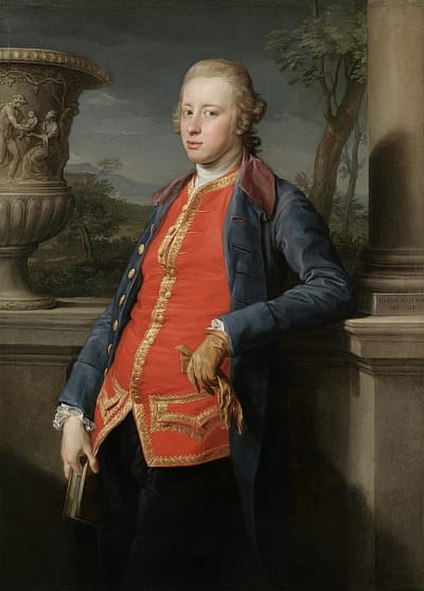
Depicting the Duke of Devonshire

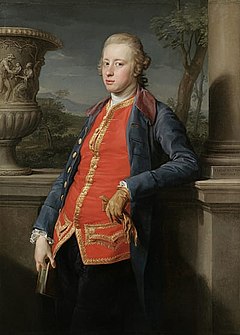
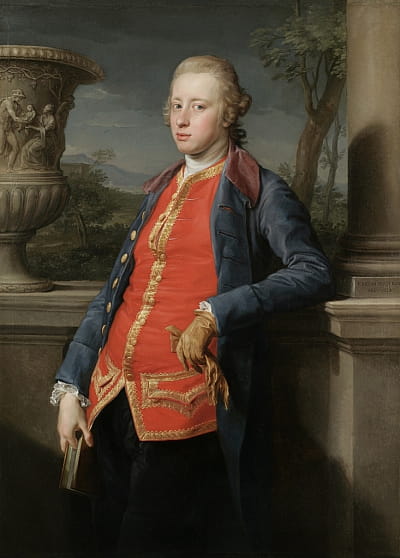
When it comes to images of Canis, otherwise known as William Duke of Devonshire, there is generally one that floats around on the web by Batoni showing the Duke on his grand tour adventure. And let's all be honest, most of you probably looked at it and went, "How did he get all that eighteenth-century tail?!"  Which is a totally legitimate question being that the Duke lacked social skills to be smooth with the ladies.  He just looks a bit plain and awkward.  When Anton von Maron painted him at the age of 20 the result was also pretty bad.
Hart would write almost 80 years later that the painting of his father was "so very bad" that Bess "had it altered by (I believe) Mr Rising, the cleaner of pictures..."  I'm sure it surprises none of you that Bess took charge on that!

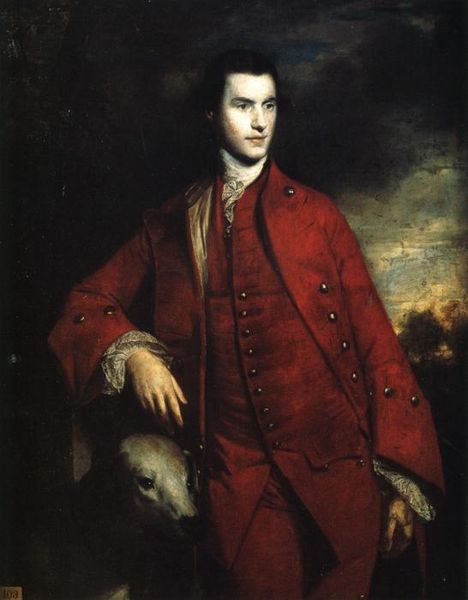
But my favorite images of the Duke are the lesser-known ones which, ironically, are by one of the two most famous artists of the time, Joshua Reynolds.  One shows how handsome the Duke was around the time that he married Georgiana.  I believe the painting is in bad condition now, but you get a good idea from the print (love that coat!):
However my favorite of the two is rarely seen due to it being hidden away in a private collection.  It shows the Duke at age 19 or 20 although he looks much older and more sophisticated

Friday, July 9, 2010

Tart of the Week: Georgiana Fawkener Townshend


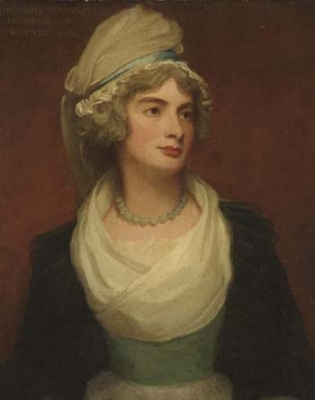
Another famous victim of a bad aristocratic marriage was Georgiana's own cousin, Georgiana Poyntz.  Georgiana, or 'Jockey' was born in 1763, the second of seven children who all had the Poyntz longevity.  Jockey had the misfortune of being the first daughter presented with a marriage opportunity.  The lucky man was the boring William Fawkener who was rich and therefore a perfect match for Jockey in her parents' eyes.  Jockey, however, was disgusted by the man and made her disinterest known.  Sadly though, she was forced into the marriage. 

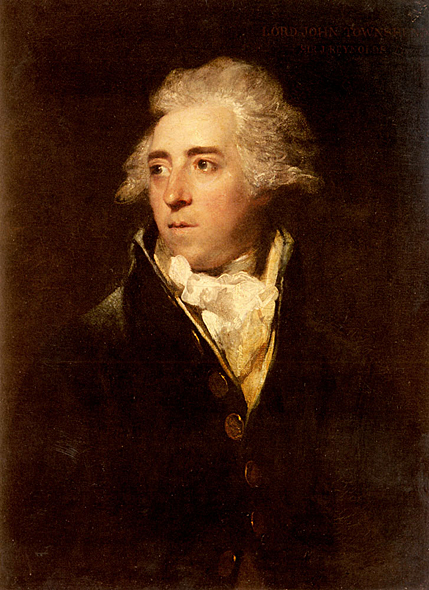
Jockey took her mind off her unhappy marriage by spending time with her friends.  Too bad Jockey's friends had a reputation as being the 'bad crowd,' Jockey hung out with her cousins at Devonshire House. It was there that she met the rather dashing and witty Whig, Lord John Townshend.  The two fell for each other and felt comfortable enough in the lax environment of the Devonshire Set to enter into a hot and heavy affair.  By 1786 the two could no longer take the strain of the affair and revealed themselves which created some major dramz.

Fawkener flew into a fury upon realizing he had been cuckolded.  He actually even accused Georgiana of aiding the couple in their adultery.  Georgiana was enraged at the accusation and her husband was equally as upset, writing to Fawkener to stop pointing the finger at his innocent wife.  Fawkener then accused Lord Melbourne of having something to do with the affair, resulting in a duel (which he lost but not at the price of his life).  Meanwhile Jockey's parent's and aunt kept her prisoner in their home, trying to force her to give up Townshend.  Jockey never relented. 

If Fawkener was a clever man with a mind for revenge, he would have kept his married to Jockey.  However, he gave his wife exactly what she was looking for.  Fawkener sued for Crim Con (in which the Duke of Devonshire testified at the trial- I'm sure he loved that) and then had Parliament grant him a divorce.  Jockey and Lord Townshend promptly married.  Although Jockey caused a scandal, alienating herself from polite circles, I would say she found an even more advantageous marriage than her parents could get her; now she had a title!

Monday, May 24, 2010

The Sylph, Letters 36-45


Summary
Julia writes a very distressed letter to Louisa after a fight with Sir William. Sir William must settle his gambling debts with Lord Biddluph because of Julia’s request to not associate with him any more. He blames Julia for this inconvenience and forces her to give up the last of her marriage articles (a house) to pay off the debts. Julia is very frightened by the discovery of the violent side of Sir William. The Sylph writes to chastise her for giving up the last of her securities and Julia is upset further.

Things get worse for Julia when she finds that Lady Anne’s tongue has been wagging. The nasty nobless has been spreading rumors about Julia having a more than platonic relationship with Baron Tonhausen and that this is causing a rift in her friendship with Miss Finch. The rumor causes Baron Tonhausen to flee in order to protect Julia’s reputation. To disprove Lady Anne’s gossip, Miss Finch forces a depressed Julia to go out with her instead of moping at home.
While at breakfast, Sir William receives a letter informing him that he has no claim to the house he attempted to sell to pay off the debts; it goes to his uncle after Julia’s death. He then admits to Julia just how far into ruin he is and how he has already sold her diamonds and replaced them with false ones in order to pay debts. He leaves Julia to discuss the issue with Lord Biddluph who proposes to Sir William an exchange of sleeping with Julia in order to repay his debts. Sir William is aghast at the proposal and Lord Biddluph then explains that he can divorce Julia and make back his money in suing for crim con. After much debate Sir William signs a contract allowing Lord Biddluph marital rights to Julia.

Discuss
Is your jaw on the floor? I know mine is. Poor Julia! But before we get to the obvious, let’s reflect on the series of unfortunate events that our heroine just went through.
There’s nothing like getting a guilt trip from your husband for not allowing him to associate with the man who attempted to rape you. But then again, should I really be surprised that Sir William blames Julia for his gambling debts? It makes one wonder just how many society ladies may have been date raped and how their husbands reacted. No wonder there were duels.

Just when you thought Lady Anne had gone away, she appears welding different weapons. Apparently Julia’s secret crush on Tonhausen is not as secret as she thought. So for as moralistic as she is, her true feeling have betrayed her and appeared on the vindictive Lady Anne’s radar. I thought Miss Finch was very smart to deal with the rumors the way that she did. But wouldn’t Tonhausen leaving London confirm the malicious gossip about him?

And what can one even begin to say about the horrible deal that Sir William just struck with Lord Biddluph. It seemed as if Sir William was more worried about being cuckolded than he was about Julia’s feelings and well being. I was relieved for him to say his only unselfish line in the whole novel, “Julia is virtuous, and deserves a better fate than she has met with me,” which shows that he is aware of things that aren't Sir William. In fact, up until this point I really was questioning whether Sir William actually loved his wife, or if she was merely a prize (just as she is to Lord Biddluph who also claims to “love” her) but I think this shows that he does have some, if even just a little love for his wife.
The Georgiana Connection
Although Georgiana’s husband, also named William, has gone down as sort of a bad guy because of his indifference to her, Sir William doesn’t share too many of the Duke of Devonshire’s qualities. While they were both members of the ton, were older than their wives, had various mistresses, and mistreated their wives, their personalities are extremely different. The Duke of Devonshire was introverted and was not as conscious of what was fashionable or socially acceptable as Sir William. While he may have enjoyed gambling he didn’t suffer from the crippling addiction that his wife did. Although the duke wasn’t the best of husbands to Georgiana he was known to come to her defense. He also was very close to Georgiana’s sister, Harriet and helped her out of a scrap or two. If you recall, Julia complains, about the cruelty of Sir William not allowing Louisa to visit, luckily that wasn’t a problem Georgiana had to deal with.

I believe that Sir William is a creation of multiple personalities from Georgiana’s life. I see a lot of Richard Sheridan in him, who was a notoriously awful to his wife, Eliza. He also has a lot of Harriet’s husband’s unlikeable qualities in him but Harriet was still single at the publication of The Sylph, making him a grim foreshadowing of much of what Harriet would go through.

For those who have seen The Duchess and found Georgiana portrayed quite differently than she was in Amanda Foreman's biography, do you notice many similarities between Julia and The Duchess' version of Georgiana? Do you think The Sylph influenced the screenwriter?

Monday, March 30, 2009

The Death of a Duchess

Today marks the 203rd anniversary of Georgiana's death. Much of Georgiana's 48 years of life were marked with health issues and in the second week of March 1806 it appeared that she had contracted jaundice. Rather than her health improving over the next few days, Georgiana grew worse and everyone became more and more concerned. The yellow/orange colour of skin was not due to jaundice but another liver ailment. Unbeknownst to the doctors an abscess had formed on her liver and was killing her. Harriet moved into Devonshire House to tend to her sister and "crowds" of people came to inquire daily after the state of Georgiana's health. Doctors felt that the sickness would pass but her friends and family were gravely concerned.

By the 26th, Georgiana was seizing for eight hours. The doctors shaved off all her lovely hair and put blister plasters on her skin which did nothing but cause her more pain. Amanda Foreman writes that,
"By the twenty-seventh everyone in Devonshire House knew that Georgiana was dying. The family, friends, and servants waited for the end to come. The crowd outside the gates grew in size."
Harriet watched as her sister struggled to speak and constantly seized for days, feeling as though she was dying with her. At 3:30 in the morning of 30 March Georgiana died surround by some of the most important people in her life, her husband, mother, sister, Bess, and Little G.

Reactions
The loss of Georgiana shook everyone. The crowds continued to visit Devonshire House to pay their respects, but those closest to Georgiana were the most effected. Charles Fox sat by himself at his former canvasser's home with big, fat tears rolling down his cheeks. Little G wrote that she wished she could strew violets over her dying bed as Georgiana had strewn sweets over her life. The Prince of Wales was in a state of shock, almost not believing that she was gone. Lady Spencer had to deal with watching her favourite child die. Bess was devastated as well and also concerned that her friends' death meant that she had no valid reason to be living with the Cavendishes. She and Harriet bonded to each other in a means of support for the devastating loss

But perhaps the most affected person may be the most shocking. The Duke of Devonshire was inconsolable. In the final years of Georgiana's life the two had finally become close, and dare I say, even loving. Of course they would have their typical married-people bickering but it was if the calmer, more matronly Georgiana was the wife that Canis had always wanted. Her loss was a blow that the Duke, with his famous countenance, never really recovered from and put him in a sort of numb state until his own death. Guilt as well as the realization that Georgiana would not be holding his hand on his deathbed ate away at him. He locked himself in his room and then one night snapped. Bess stayed up all night with him and described the Duke as "hysterical." He never truly recovered from the blow.
"A woman more exalted in every accomplishment of rapturous beauty, of elevated genius, and of angelic temper, has not adorned the present age..."

The Morning Chronicle, 31 March 1806

Monday, February 2, 2009

He's Not Such A Bad Guy!

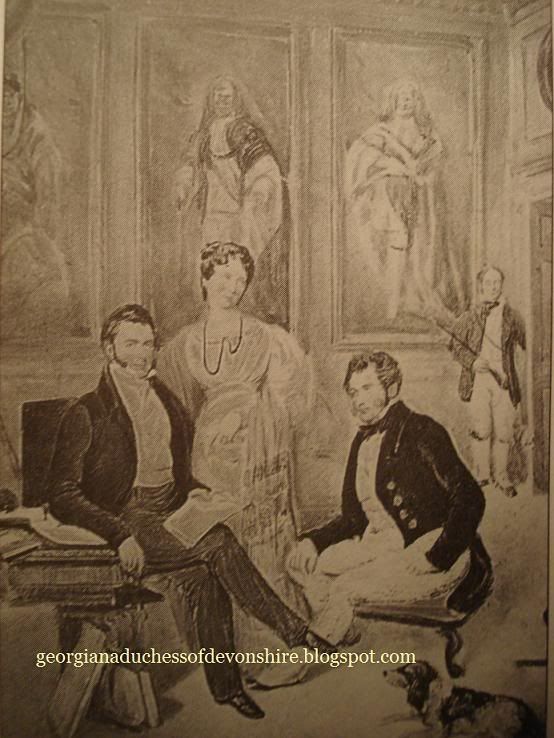
Ya know, poor Canis gets a bad rep. And while I'm not saying he wasn't a big jerk, I can say he wasn't constantly one. Many of Georgiana's letters make the Duke of Devonshire out to be a normal guy. Although you do sense a bit of an awkwardness in his letters he doesn't come off as the Ice King all the time. In a letter to Georgiana in 1775 he scolds her for not writing to him enough, "What a naughty little wretch you are..." While this shows his need for doting female attention, as Foreman talks about in the biography, it also is kind of cute at the same time!

I really like this letter Georgiana wrote to her mother in 1784 because it shows the Duke's sense of humour:
"The Duke made us laugh very much by teazing Cl Crawfurd, who is very lazy, in trying to make him run up the hill. Cl Crawfurd is, you know, very gallant and had been saying all matter of fine things to Ly Eliz [Bess], so the Duke threw her whip down the steepest part of the hill that he might fetch it, but his gallantry did not reach so far for he would not go..."
I hope Bess had to pick up her whip herself.
Monday, December 1, 2008

Devonshire Progeny: Caroline St Jules


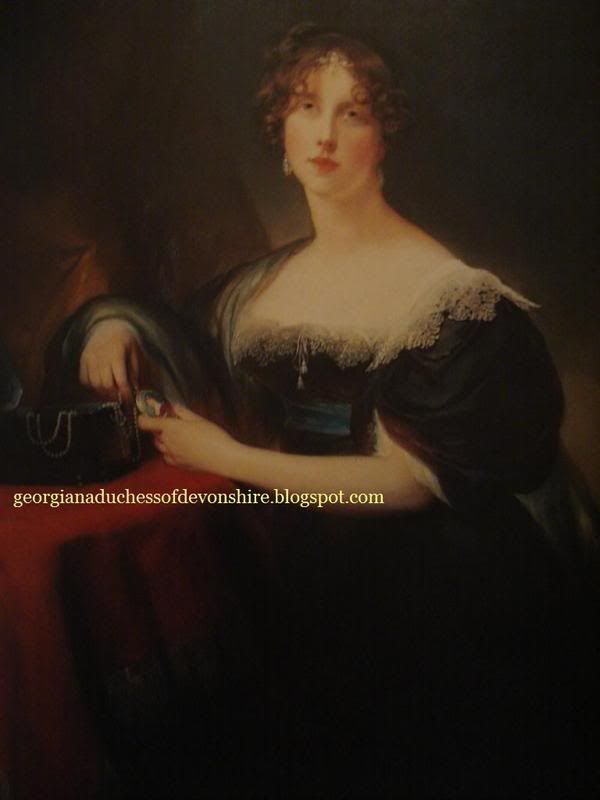
It was 1785 and Bess was in Paris, romping around with the Duke of Dorset, whom she knew very well was the object of Georgiana's affection. She was also a bit stressed: Bess was three months pregnant with the Duke of Devonshire's child. A letter had just arrived from her best friend. The Duchess of Devonshire wrote that she was happily expecting her child; she was also three months pregnant. Bess did the math, the children had been conceived within days of each other, possibly even hours.

On 16 August 1785 in a brothel/hostel in Italy the Duke and Bess' first child was born and named Caroline Rosalie. Not long afterward, Georgiana gave birth to her second daughter, Harriet, in a much more suitable setting. Caroline spent her first weeks with poor people her mother didn't even know before getting shipped off to a more middle-class family. Bess promptly went back to partying (guiltily). Somehow, she convinced the elderly Comte St Jules to adopt Caroline. It is unknown how the two knew each other but by convincing the comte to do this that meant that Caroline was being raised as the comte's illegitimate daughter, Bess always did have a way with convincing others to do things they normally wouldn't. It also meant that Caroline St Jules would be brought up with foster parents not the old comte.

As time went on Bess also schemed sneaking the girl into England to be raised with Georgiana's two daughters but that was not to be. Instead, she was sent away to Paris to be educated with Charlotte, the Duke's other illegitimate daughter. This didn't deter Bess from making many attempts to bring her daughter back to England to be with her. Her relief came in the form of a very unexpected person, the formidable Lady Spencer, who never made it a secret that she despised Bess. When Georgiana and her family were in Paris during the birth of Hart, Lady Spencer was eager to get out of revolutionary France ASAP, this meant taking her grandchildren with her. She was in such a rush she allowed for Charlotte and Caroline to be included in her escape party. Caroline, the little french girl, had made it into her parent's home-country and soon, their home.

Personality-wise Caroline took after her mother. Perhaps this is why she was her father's favourite child. Fanny Burney found her to be "fat and full of mincing little affections and airs." Hmmm, sounds familiar doesn't it? Burney was no fool, and also very suspicious. She found Georgiana's daughters much more agreeable (despite being biased against Georgiana). Strangely enough, Caroline still managed to win Lady Spencer's approval. Lady Spencer was torn by her hate for Bess but seemed to like that Caroline was obedient, especially in comparison to her grand-daughter, Caroline (later Lamb) who she found to be "very naughty."

Despite the setback of being an illegitimate child Caroline managed to nab herself a very good husband. George Lamb was the son of Lady Melbourne and the younger brother of William Lamb, later Lord Melbourne (Caroline Lamb's husband). Because the two Carolines married the Lamb brothers they were often referred to as Caro William and Caro George. At the time of her marriage, the Duke's favourtism shined through when he blessed Caroline with a whopping £30,000 for her dowery, more than he gave to his other daughters. Despite their dislike of Bess, the Cavendish children accepted Caroline and were very close to her. When writing her memoirs years later, Caroline gives a very poignant account of her childhood as Devonshire progeny that would probably have broken Bess' heart,
"I became reserved myself; the strangeness of my situation in that house, the not knowing who I was, the not having a human being to whom I could speak, made me so. Everything seemed full of secrets. I did not know the natural ties that bound me to my M[other], but I loved her as my protectress, my adopted mother, yet with a mixture of fear."

Thursday, November 13, 2008

Devonshire Progeny: Charlotte


Charlotte was not the daughter of the Duke and Duchess of Devonshire but she was raised by both of them. She was actually the Duke's first (known) child and was born of the commoner Charlotte Spencer (no relation of Georgiana or her Spencer family). Charlotte was born in 1774, the same year that Georgiana married William so he technically hadn't committed adultery in Charlotte's conception. However, he did keep Charlotte's mother as his mistress after her birth, so we can't totally clear him of those early adultery charges.

Charlotte's early life was likely comfortably lived with her mother by the grace (and wallet) of the Duke. He likely provided them with a decent home and even paid for Charlotte to have a nurse. By 1778 he had tired of his mistress, and unfortunately for the the tot, Charlotte Spencer died not too long after the breakup. Now Charlotte was both motherless and a bastard-child. Most children in this situation were doomed a horrible and short existence unless they were charitably recognized by their father. Despite his coldness, and awkwardness with human affection, William was no monster and took his illegitimate daughter, and her nurse, into his home.

By the time the four or five-year-old came into the Devonshires' home, Georgiana and the Duke had been married at least four years and still had no children of their own. You may think that having the illegitimate daughter of her husband in her home would send Georgiana into a rage, but it did not. She immediately doted on the child and gushed about her as if she were her own, much to her mother's horror. Georgiana seemed impertinently ignorant of the whispers about welcoming the little girl into her family. At the time little Charlotte had no surname so the last name of Williams was created for her to distinct her as her father's child-though not legetimate child.

Charlotte grew up dearly loved by both Georgiana and William but with the arrival of Bess she became a neccessary tool in order to keep Bess close to the Devonshires without causing too much scandal. Lady Bess Foster was given the position of Charlotte's governess when the girl was about nine years old. As soon as this arrangement was settled the two set off for France to further Charlotte's education and refine her as a proper little lady (with Bess!? Dear lord, they should recheck her papers...). When Bess got bored with her task at hand and went partying in Europe poor, introverted Charlotte was dragged with her. Georgiana was horrified when word got to her that Bess and Charlotte were living in Naples with two of Bess' lovers. Eventually it was decided that Bess might not be the best fit for Charlotte, who seemed traumatised by her experiances abroad with Bess rather than "much improved." She was left in Paris to continue her education, even through the Revolution.

In 1794 the Devonshires were happy (and relieved) when their agent's nephew asked for Charlotte's hand in marriage. He was no aristocrat, but it was a good and secure marriage, especially considering Charlotte's unfortunate background. Nothing else can really be known of her after that, but Charlotte was likely relieved to settle down to the quiet life of a wife after her circus-like life as a Devonshire.

Tuesday, October 28, 2008

Devonshire Progeny: Little G


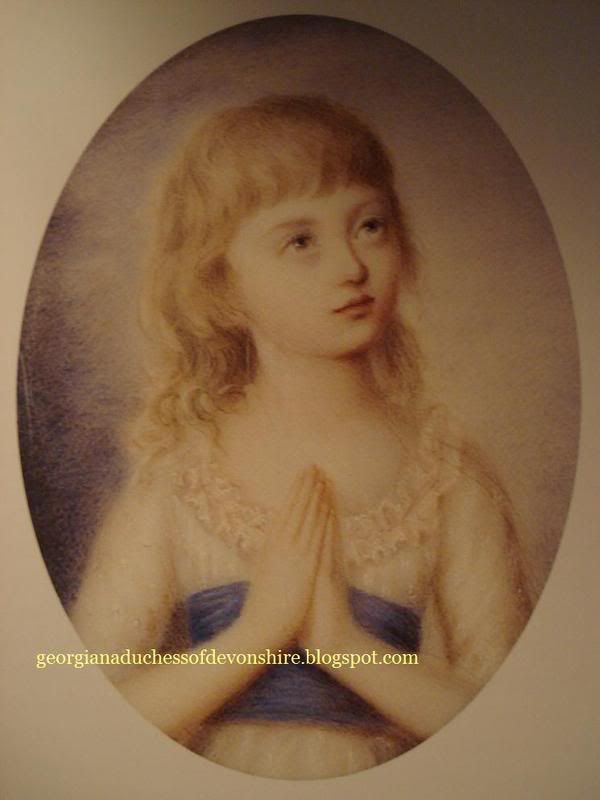
After many years of miscarriages, Georgiana was finally round with a nine-month pregnancy. Her sister Harriet had given birth to her second boy a week before and Georgiana was hoping for the same thing, or at least for a healthy delivery. The Duke was less than optimistic and had already convinced himself that the much-awaited for child would be a girl. His premonition proved to be correct and on July 12, 1783 a healthy baby girl was born to the couple. The labour was stressful for both, and while the Duke watched, Georgiana was in near hysterics after thinking she had delivered a dead baby. Georgiana Dorothy Cavendish was born to her mother's cries of, "only let it be alive!" Despite Little G, as she was to be called, not being the heir that both parents wished for, they both doted on her, especially Georgiana. At first, a wet nurse had been hired but when she came to work after a bender and puked and fell down the stairs, Georgiana thought it best if she breastfed her child herself, something extremely unusual among the aristocracy.

Little G may have been her mother's namesake but she never seemed to inherit her mother's outgoing nature. She was more introverted like her father and this seemed to translate into quiet shyness. Her mother's exile after the affair with Charles Grey also seemed to have a damaging impact on Little G. Georgiana returned to find her even more reserved and now insecure; she followed Georgiana wherever she went, worried that she would disappear again if left out of her sight. She had also developed a crippling fear of being sinful. Despite these reserves she was a clever girl and a bibliophile. She was probably her mother's favourite child of her three/four.
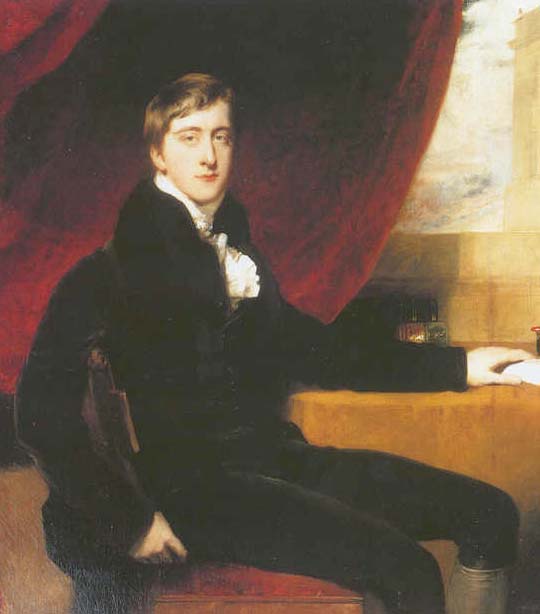
After Little G's coming out, she had two notable admirers, The Duke of Bedford and the young Lord Morpeth. The 35 year old Bedford was a Whig, which recommended him to Georgiana, but he already had a slew of illegitimate children and kept two mistresses, one being Lady Melbourne. Morpeth, at 27, was a fine choice, but Georgiana had a difficult time envisioning her favourite child married off to a Tory. In the end, the Tory won the heart and hand of Little G and she became the Countess of Carlisle. As it turned out, Little G spent her marriage in much different way than her mother: having lots of children and avoiding the spotlight. One of her daughters even married a son of Charles Grey....kind of weird.

Georgiana's death in 1806 devastated her daughter, who seemed to have codependency issues and also saw her mother as her best friend. In her portrait above she holds a miniature of her beloved mother and looks to her in the heavens.

Wednesday, October 15, 2008

Devonshire Progeny: Hart


Many children scampered through the halls of Devonshire House during the days of Georgiana. These consisted of her own, her husband's (with mistresses), her sister's, or Bess'. Their personalities and histories are as diverse as their genetic makeup.

William was the much awaited son and heir of William and Georgiana. He was born after 16 years of marriage and miscarriages. Upon his birth he was given the title of Marquess of Hartington which earned him the nickname of Hart. An appropriate nickname also because the heads of three harts adorn the Devonshire coat of arms.

The journey leading up to his birth was not an easy one. He was born in Paris during the Revolution. Georgiana was told to seek warmer climates due to her history with miscarriages. Maybe she should have tried Spain? When news arrived that a healthy baby boy had been delivered the bells in Derbyshire tolled all day. As you can imagine, Hart's father was ecstatic. A few months later, when Georgiana went to attend to her sick sister in Bath, the Duke rented two homes: one for Hart and his nurse and one for everyone else. Sadly, when Hart was barely speaking his mother was sent away due to her affair with Charles Grey. The one year old repeatedly screamed, "Mama gone, Mama gone!" and couldn't be consoled. When Georgiana was finally allowed to return to her beloved children two years later, Hart did not recognize her and screamed whenever she touched him. It nearly broke her heart. It also did not help that Hart had lost most of his hearing to an infection, although this would not be discovered until later.

Eventually Hart grew into a handsome boy and in his mother's final years the two became very close. He fell in love with his cousin, Harriet's daughter, Caroline. But she, being a tease, went on to marry William Lamb (much to both mothers' disappointment)...and we all know how that worked out. Hart was devastated by the rejection. Then he wanted to marry Princess Mary, who was much older than him, but she married Prince William Henry instead (at the tender age of 40, too!). After this second rejection Hart was like, "screw this!" and lived the rest of his life as a swinging single. That is how he became known as the Bachelor Duke. He kept his mistresses, but never married, causing the Dukedom to go to his cousin upon his death in 1858. It is thought that Hart's deafness may have been the cause for him being introverted and lacking confidence with the ladies.

Hart is not only remembered for being a sexy bachelor but also for his improvements on Chatsworth inside and out. He also did well in clearing up both of his parents debts after their deaths. Actually, he was a pretty good businessman. It was left in his hands to get rid of Bess, who wanted money and titles, after his father's death and he was able to do so gracefully. Bess, on the other hand, was being very un-classy. Although his disability prevented him from entering politics as his mother wished, Hart had many colorful friends such as Czar Nicholas and Charles Dickens. These friends would hang out with Hart in his beloved country estate so he would never feel lonely and they would always be entertained. He definately took after his mother!

Monday, September 8, 2008

"I Don't Think He's a Villain"

Have I mentioned yet how I love Ralph Fiennes? That was his response when the dumbass interviewer asked him about playing "the villain" in The Duchess. Pleb. Check out the interview here.

In related news, the Toronto premiere of the film was last night and although Knightly was wearing a very pretty Alexander McQueen gown she's been getting some criticism about her weight. Yikes!! I can see why. Someone feed that girl a croquembouche! It puts me to mind about Georgiana's battle with bulimia. However, I can safely assume she wasn't this thin at her unhealthiest.

On the Duchess of Devonshire...

"...if the Dss had been married to --- or to any man who had shown her proper attention and done justice to her merits she would have been one of the most perfect women in England."


-Dudley North as quoted by Thomas Pelham

Friday, July 25, 2008

Tart of the Week: Frances, Countess of Jersey


The insufferable Lady Jersey was not only a trollop, she was just plain nasty-mean. This wild Irish rose was the daughter of the Bishop of Raphoe, although he died before she was born. His death was the result of him trying to rob a stagecoach in London unsuccessfully. It remains unclear how the simple Frances Twysden was able to nab George Villiers, the next in line for the Earldom of Jersey. He was more than 20 years her senior and she was only 17 at the time of their marriage. George would later become the Master of Horse and Lord of the Bedchamber to the Prince of Wales. You probably know where this is going already.

Frances' marriage proved to be fruitful and she had ten children from 1771 to 1788. In between the children she made a hobby (and reputation) of wrecking her friends' marriages. She was a definitive member of the ton and one of the elite members of the Devonshire House Circle. This allowed her even more access to her friends' husbands and lovers. She was like a really evil version of Lady Melbourne. During Georgiana's first years of marriage she naively considered Lady Jersey to be one of her friends. Frances felt the same way, but she had an odd way of showing it. While Georgiana and her friends paraded in their gowns en militaire in Coxheath, Frances took advantage of the Duchess' brief absences from her husband to visit him alone in his tent...frequently. Worst of all, both parties made no secret of it; in fact they both seemed to flaunt the affair to poor Georgiana. The affair was ended by Georgiana's parents, Lord and Lady Spencer, who threatened Frances if she decided to continue the affair as well as told the Duke how disgusted they were with his behavior.

No matter to Frances, she moved on to other lovers very quickly, not worried at all about her reputation. When an article ran in the paper about her infidelities, this only caught her husband by surprise. The couple was visiting Chatsworth at the time and during dinner George jumped up and declared he would show the world he did not believe the press' slander against his wife. Everyone must have rolled their eyes. She continued to have affairs with the likes of Lord Morpeth and the Earl of Carlisle.

Her most famous affair was, of course, with the Prince of Wales. From 1794 to 1798 she was his main squeeze. In fact, it was she who broke up the prince's relationship with Mrs. Fitzherbert. The satirical cartoonists had a field day depicting the chubby prince canoodling with a haggish grandmother (Frances was over 40 when the affair began). Frances turned out to be more than just an outlet for the prince's carnal desires. Like Camilla with Prince Charles, she convinced Prince George to marry Caroline of Brunswick because she didn't think her to be a threat. She even became Caroline's Lady of the Bedchamber, much to Caroline's dislike. Frances continued her habit of torturing wives. The Prince took two pearl bracelets from Caroline's wedding jewels on the wedding day and gave them to Frances who made sure to always wear them in Caroline's presence. From day one, Frances was involved in the marriage and therefore a huge reason for it's ill-success.
Harriet Lady Bessborough (Georgiana's sister) made the comment that Lady Jersey could not be happy unless she had some rival to torment. Frances' hate for Caroline reached a point where she went out of her way to torment the poor princess. This caused her downfall, she became the most hated woman in England while the crowds cheered for poor Caroline. When she arrived at the Duchess of Gordon's ball, no one greeted her and every time she went up to a group of people to chat, the talking immediately stopped and the crowd dispersed. This wasn't as bad as her treatment by the lower classes who threw rocks at her house and drove her away in embarrassment by parading figures dressed as her and the prince on donkeys. Her golden age of snobbery and evil had come to an end.

Wednesday, July 23, 2008

Mrs Rat and her Friends

Nicknames were prevalent in the age of letters. In fact, whole new dialects seem to be created by the aristocracy, such as the "Cavendish drawl" which the Devonshire House circle spoke in. each member of the circle seemed to have a nickname. Although some origins are obvious, others are quite perplexing. These nicknames were the usual form of address in casual letters, although we cannot be so sure how often they were used vocally.


Duchess of Devonshire Mrs. Rat


Duke of Devonshire Canis, due to his affection for dogs.


Lady Bess Foster Racky


Duchess de Polignac Little Po


Marie Antoinette, Mrs. B[rown], Louis was, of course, Mr. B


Richard Brinsley Sheridan Argus


Charles James Fox The Eyebrow, due to his enormous eyebrows


Lady Jersey The Infernal


Duke of Richmond Goodwin


Prince of Wales Prinny


Charles, Earl Grey Black


Duke of Dorset Pride


Frederick, Viscount Duncannon (Harriet's husband) Harum, due to his love of pranks

Bess had her own unique nickname with the Spencers: the Chief Councellor.

Wednesday, June 18, 2008

Pugnacious

In continuation of my dogs in the 18th century exhibition (exploration? obsession?) I thought I'd take a moment to talk about the images of Pugs in paintings. As I talked about here, the people of the 18th century were just as fond of their pets as we are, especially their dogs. One of the more popular breeds in England at this time (at least with the upper class) was the Pug due to its convenient size and winning personality.

The breed originated in Asia (although due to the ancient history of the breed it is not know where exactly) and throughout the centuries it became more and more common westward. It became the official dog of the House of Orange after one Pug saved the life of William, Prince of Orange by alerting him of the invading Spanish in 1572. When Josephine Bonaparte was imprisoned at Les Carmes her Pug, Fortune, would carry secret messages under his collar to her husband. It was even rumored that Fortune bit Napoleon when he entered Josephine's bedchamber on their wedding night, woof!

As can be seen from Hogarth's Self-Portrait with Pug, the Pug looked different 200 years ago. The snout and body were a bit longer then than they are now. The loyal and beloved Trump was immortalized in William Hogarth's self portrait, and depicted at the same level, and therefore, same importance as his master. This could be because both man and dog were known to be "pugnacious." Trump reappears as the watchful eye in Hogarth's portrait of the Strode Family. Another immortalized 18th century pug is Raton, who sits on his human, George Selwyn's lap in this portrait by Reynolds. Selwyn had an outlandish and rakish reputation so this sentimental portrait with his beloved pet softened how others viewed the crazy bachelor. Selwyn was reputedly totally devoted to his dog. This wasn't extremely unusual, William Duke of Devonshire (Georgiana's husband) was so obsessed with his dogs that his friends and even wife nicknamed him "Canis." Truth be told, they were the only things the man enjoyed spending time with!
Monday, June 16, 2008

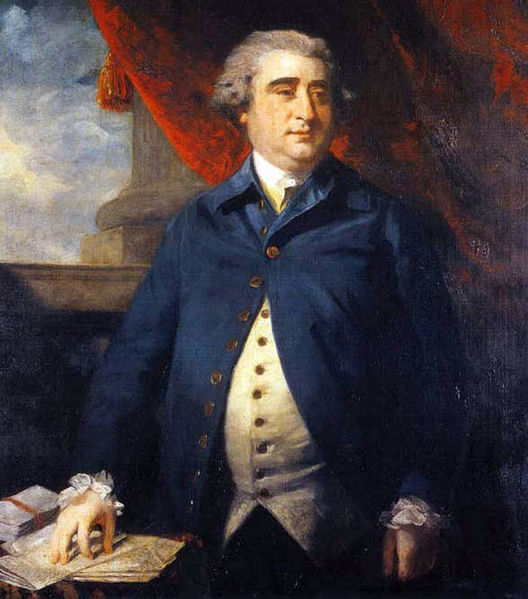
Charles James Fox

I've been putting off profiling Fox for a while, don't ask me why. He is a key player in this blog seeing as I have already mentioned him here, here and here; heck, he already has his own tag.

Fox was the result of the scandalous elopement of Henry Fox, 1st Baron Holland the politician and Lady Caroline Lennox, one of the Lennox sisters, daughter of the Duke of Richmond. He and his brothers were raised in a libertine Whig household with little to no boundaries. Despite not inheriting a title, Fox became a favorite of his father and therefore extremely spoiled. There are stories of Fox burning his father's speeches and smashing his watch, with no consequences.

Fox grew into a fat macaroni, with a taste for gambling, politics, and women. He also liked fashion and in the macaroni tastes, powder his hair different colors every day and wear multi-colored shoes embellished with velvet frills. He was just plain outrageous! Fox began his career in parliament at the tender age of 19. Being a Whig, he tended to oppose anything the monarchy liked and vice-verse. He supported both the French and American revolutions.

Despite his outrageousness, he was extremely well spoken and when he came into contact with Georgiana in 1777 a friendship bloomed that last until both their deaths in 1806. The two friends (and possibly lovers) found in each other a certain understanding and camaraderie that they couldn't find with others in their circle. Both were huge celebrities and common characters in political satires. For the Westminster election of 1784 Georgiana made history by being the first woman to canvass when she canvassed Fox.

King George III and Queen Charlotte hated Fox, so naturally the Prince of Wales was drawn to him. I was about to list other friends of Fox, but the list would be never-ending. So I will just leave it at, if you were a Whig, such as the Duke of Devonshire, you were friends with Fox. Not only did Fox have a lot of famous friends but famous, or infamous, girlfriends. And they were all gorgeous! Aside from rumors about Georgiana, he had relations the most notorious tarts such as Elizabeth Armistead, Grace Dalrymple Elliot, and Mary 'Perdita' Robinson. He was a notorious bachelor, but toward the end of his life suddenly everyone was surprised to find out he had been married to Elizabeth Armistead (a notorious...well, you know) for years. His last words were to her: "It don't signify my dearest, dearest Liz."

Friday, June 13, 2008

Tart of the Week: Bess Foster


Okay. It's time to get down and dirty. If the tarts were having a party, this one would be the belle of the ball. So what better way to "celebrate" my most paranoid of days than to introduce a key player in the life of Georgiana, Lady Elizabeth 'Bess' Foster.

In 1782 on a healing trip to bath, Georgiana and the Duke met Bess, who would become a key player in the theatrics of their lives forever more. Instantly she analyzed them for what they were: lonely. Immediately she put a plan into action, and told her sob story. She was born to the notorious Herveys, an aristocratic family with barely any money. She married John Thomas Foster, whom she later claimed frightened her and consequently resisted the match. However, records show she was happy about it at the time. By the time she had her second son (her first son Augustus is an ancestor to Anna Wintour) the marriage was a disaster. Foster seduced Bess' maid and then shortly afterward kicked her (Bess) out, securing the custody of his two sons. I am sure she retold this harrowing tale with many embellishments to the Duke and Duchess who immediately took her in. So began 20 plus years worth of puppetry in the Devonshire home.

Bess manipulated everyone around her with her damsel in distress act (she was one of those, 'I know I am cute types'). Unfortunately the Duke and Duchess never seemed to see it. Many others did including Georgiana's mother Lady Spencer, who spent many years criticizing Bess verbally and through letters. Bess was even bold enough to add post-scripts on Georgiana's letters to her mother, the nerve! Bess quickly became Georgiana's best friend and a permanent guest in her homes. Given Georgiana's tendencies they could have been more than just friends, but thanks to Victorian ancestors censoring old letters, we will never fully know the truth. With the enthusiasm of a girl in Elementary school, Lady Bess would even attempt to dress like Georgiana (well who didn't) reusing her clothes. Just as quickly as a friendship developed with Georgiana, an affair developed with the Duke. Two children were the result of this affair that continued throughout the years in front of Georgiana. "Why would she put up with this shit?" you might be asking. Well my friends, that is the art of manipulation. I can tell you she didn't like it but her dependency on the friendship (Bess manipulated Georgiana through her insecurities) made her very forgiving of this fault.

Bess, like her Duke-lover, is said to have had affairs with many including Ercole Cardinal Consalvi (a man of the cloth), John Sackville, 3rd Duke of Dorset (well, who hadn't slept with him), Count Axel von Fersen (Marie's Man), Charles Lennox, 3rd Duke of Richmond, and Valentine Richard Quin, 1st Earl of Dunraven (married). She really lived in a fantasy thinking she was some sort of gift from God because she was bff with Georgiana and the Duke, but really that was the only reason people tolerated her. Once when she needed a place to stay in France, Georgiana wrote her references to her dear friends the Polignacs (who would do anything for her). The Polignacs, being a fun bunch welcomed Bess in but soon despised her. Bess left confused.

When Georgiana died in 1806 Bess quickly swooped in and forced the sad Duke to marry her, against his legit children's wishes. She then proceeded to bully him into making their bastards legitimate. When the Duke finally died (not in peace obviously!) Georgiana's children had to bribe Bess to just leave them alone finally. They never considered her a Duchess of Devonshire and just wanted to be rid of her and her nasty ways.

Wednesday, June 4, 2008

Quotables


"[She is welcome to do as she likes as long as she doesn't think it] necessary that I should wear any ornaments on my head in compliment to her notions of taste and dress."

-William, 5th Duke of Devonshire as quoted by the Morning Post