Showing posts with label The Ton. Show all posts

Tuesday, September 29, 2009

Georgiana the Author

"I should be very happy if I could borrow some friendly Sylph (if any are so kind to hover about Hardwick)..."
-Georgiana, in a letter to her mother

When Georgiana was a naive, young girl of sixteen with her whole life ahead of her she did something unusual for a daughter of an aristocrat: she wrote a book. Emma was published anonymously and tells a story similar to Austen's Pride and Prejudice in that first impressions are not always reliable. It tells of a young woman who finds herself in love with a man but forced to marry another. The book is often forgotten and there is little knowledge it in history.

Georgiana's second book was published during the height of her popularity when she was newly married and had just made her name for herself as a fashion icon (think: Victoria Beckham when she was a newlywed). Again, she published it anonymously, which given the scandalous details, could have ruined the reputation Georgiana was enjoying. It was called The Sylph and was so popular it went through four editions quickly. It was written in the form of letters, just like Fanny Burney's Evelina.* The story is that of the naive country girl, Julia, who marries a rich aristocrat but soon discovers him to be a rake who spends all his money on gambling and mistresses. To distract herself from her woes, Julia involves herself in the ton and fashion, making friends and frenimies with the elite. Meanwhile her home life only gets worse when her husband gets more and more abusive. Her fellow wives of the ton bring little consolidation because they are just as ill-used by their husbands. In her worst time of need an anonymous person calling himself The Slyph (a sylph was a mythical invisible spirit) writes to her offering her advice. Eventually, Julia is forced to run away from her husband (who promptly commits suicide) and she discovers the true identity of The Slyph and the two wed. Does the story sound familiar? The first half it anyway.

The Sylph was based on Georgiana's personal experiences as a debutant in high society. It didn't take a genius to recognize the similarity between the fictional Julia and the young Duchess of Devonshire so it wasn't long before everyone had figured out who the author was, although Georgiana would never publicly admit it. This only helped sales. Another part of the book's success was its scandalous details which were were labeled "obscene" by the Blue Stocking Group (one of the first feminists groups). The Gentleman's Magazine was made uncomfortable by the author's knowledge of the ton and the details of the physical and sexual abuse.

Although fiction, The Sylph stands as a great contemporary document into the ton. It is made up of many stories from Georgiana's personal life, stories of the abuse her friends suffered and the snobbery she herself was involved in. That, is possibly why the book was received with such shock. People to this day, always seem more frightened by fact than fiction; even if that fiction is fact.

pollcode.com free polls
Would you be interested if we began reading The Sylph here? (ie: a chapter a week)
Yes! I need more scandal! No thanks, it doesn't tempt me.


*When it was first published, many thought The Sylph was Burney's work which her publisher didn't negate, only boosting sales further.


Monday, April 13, 2009

The Ton: A Unit of Measuring Notoriety


So what exactly is the ton? The tag has been on this blog forever but I do not think I ever took the time to explain what exactly the ton is. I've found varying sources on the origin of the name. Amanda Foreman states that it means "The World" whereas other sources take to its literal french translation which means "taste." Sometimes this would be proceed by "bon," so le bon ton, "the good taste." Both of those translations accurately convey what the ton was.

The ton was an elite group of high society. They were the popular kids in high school. They decided what was in and what was out. In essence, the ton decided what was in good taste and their decisions affected the fashionable world. Think: Meryl Streep in The Devil Wears Prada. This didn't just mean fashion, in meant plays, artists, and especially people. Just as with the popular cliques in high school, people both made fun of the silliness of the ton and wanted to become part of it. Members were both friends and enemies and frenemies.

The leading matriarch of the ton when Georgiana first became the Duchess of Devonshire was Lady Melbourne. She gracefully stepped down and allowed Georgiana to take her place as leader of the ton, figuring someone young, full of energy, and more importantly, naive, would be more apt at the position. The position meant hosting many social social events and allowing themself to be the most publically scrutinized of the group. Georgiana rose to the challenge and quickly established herself as having an eye for the next fad; whether that was feathers or fiddlers.

Friday, July 25, 2008

Tart of the Week: Frances, Countess of Jersey


The insufferable Lady Jersey was not only a trollop, she was just plain nasty-mean. This wild Irish rose was the daughter of the Bishop of Raphoe, although he died before she was born. His death was the result of him trying to rob a stagecoach in London unsuccessfully. It remains unclear how the simple Frances Twysden was able to nab George Villiers, the next in line for the Earldom of Jersey. He was more than 20 years her senior and she was only 17 at the time of their marriage. George would later become the Master of Horse and Lord of the Bedchamber to the Prince of Wales. You probably know where this is going already.

Frances' marriage proved to be fruitful and she had ten children from 1771 to 1788. In between the children she made a hobby (and reputation) of wrecking her friends' marriages. She was a definitive member of the ton and one of the elite members of the Devonshire House Circle. This allowed her even more access to her friends' husbands and lovers. She was like a really evil version of Lady Melbourne. During Georgiana's first years of marriage she naively considered Lady Jersey to be one of her friends. Frances felt the same way, but she had an odd way of showing it. While Georgiana and her friends paraded in their gowns en militaire in Coxheath, Frances took advantage of the Duchess' brief absences from her husband to visit him alone in his tent...frequently. Worst of all, both parties made no secret of it; in fact they both seemed to flaunt the affair to poor Georgiana. The affair was ended by Georgiana's parents, Lord and Lady Spencer, who threatened Frances if she decided to continue the affair as well as told the Duke how disgusted they were with his behavior.

No matter to Frances, she moved on to other lovers very quickly, not worried at all about her reputation. When an article ran in the paper about her infidelities, this only caught her husband by surprise. The couple was visiting Chatsworth at the time and during dinner George jumped up and declared he would show the world he did not believe the press' slander against his wife. Everyone must have rolled their eyes. She continued to have affairs with the likes of Lord Morpeth and the Earl of Carlisle.

Her most famous affair was, of course, with the Prince of Wales. From 1794 to 1798 she was his main squeeze. In fact, it was she who broke up the prince's relationship with Mrs. Fitzherbert. The satirical cartoonists had a field day depicting the chubby prince canoodling with a haggish grandmother (Frances was over 40 when the affair began). Frances turned out to be more than just an outlet for the prince's carnal desires. Like Camilla with Prince Charles, she convinced Prince George to marry Caroline of Brunswick because she didn't think her to be a threat. She even became Caroline's Lady of the Bedchamber, much to Caroline's dislike. Frances continued her habit of torturing wives. The Prince took two pearl bracelets from Caroline's wedding jewels on the wedding day and gave them to Frances who made sure to always wear them in Caroline's presence. From day one, Frances was involved in the marriage and therefore a huge reason for it's ill-success.

Harriet Lady Bessborough (Georgiana's sister) made the comment that Lady Jersey could not be happy unless she had some rival to torment. Frances' hate for Caroline reached a point where she went out of her way to torment the poor princess. This caused her downfall, she became the most hated woman in England while the crowds cheered for poor Caroline. When she arrived at the Duchess of Gordon's ball, no one greeted her and every time she went up to a group of people to chat, the talking immediately stopped and the crowd dispersed. This wasn't as bad as her treatment by the lower classes who threw rocks at her house and drove her away in embarrassment by parading figures dressed as her and the prince on donkeys. Her golden age of snobbery and evil had come to an end.

Wednesday, June 11, 2008

Devonshire House

Devonshire House was not just a fantastic mansion, it was an elite social club and a state of mind. It was the be all and end all of the ton, a gathering place for Whigs, and where Georgiana spent most of her life.

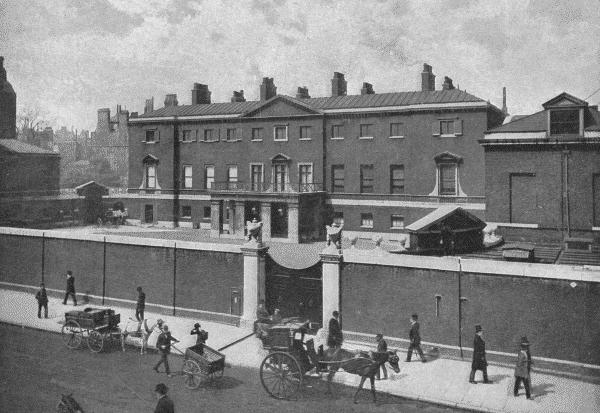
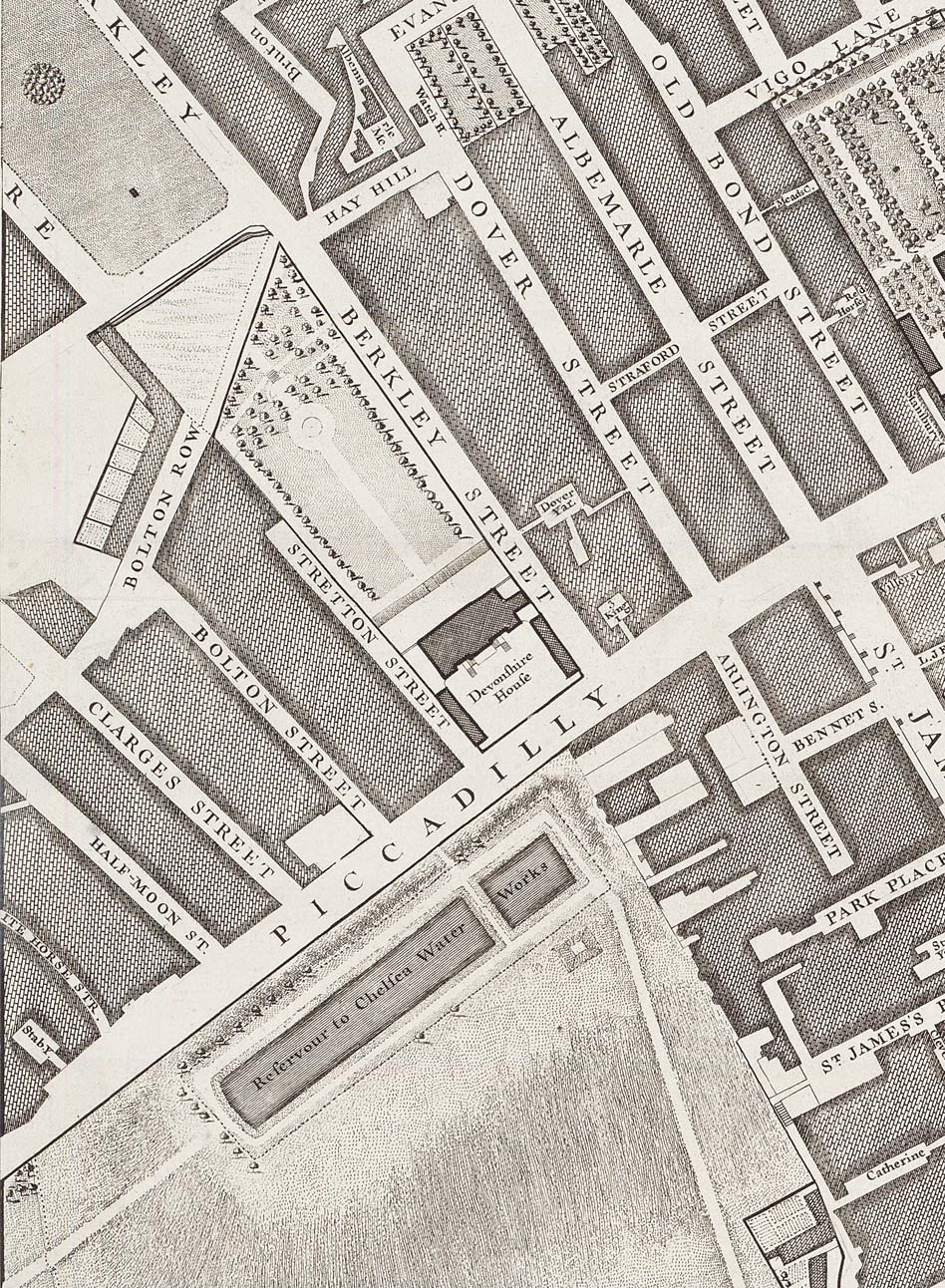
Before I get into that, I would like to talk about the more physical aspects of the Devonshire House. It was built on the site of Berkeley House, the home of the most conniving (and kind of bitchy) of King Charles II's mistresses, Barbara, Duchess of Cleveland. It was in prime location on Piccadilly Street, across from Green Park. Anyone who has been to London has likely walked past its ghost; before it was demolished (in 1925), Devonshire House was located across from the present day Ritz Hotel. The building was huge and aesthetically unappealing. Worst of all it had a massive brick wall encircling it which clashed with the architectural line of Piccadilly and attracted only graffiti.

Many complained of the ugliness of the structure in the wittiest of ways but what mostly interested people was what was on the inside. Devonshire House had one of the greatest collections of art and some of the grandest rooms, in both size and decor. However it was the people inside that was of the most curiosity. Not only was the leading lady celebrity housed behind it's doors, but all her friends, the ton. The Devonshire House circle consisted of the young, rich, talented and snobby with people such as Charles Fox, the Prince of Wales, Richard Brinsley Sheridan, and too many others to name. They were the coolest social club and Devonshire House was their clubhouse, perfect for dancing and gambling and any other debauchery one could think of. Devonshire House remained a great place for entertainment up into the Victorian Age; Queen Victoria's Diamond Jubilee Ball was celebrated in the house's ornate public rooms.

With the demolition of the house, we loose a stunning visual into the life of Georgiana, her friends and family; as well as an important puzzle piece in the social structure of London high society.