Monday, March 30, 2009

The Death of a Duchess

Today marks the 203rd anniversary of Georgiana's death. Much of Georgiana's 48 years of life were marked with health issues and in the second week of March 1806 it appeared that she had contracted jaundice. Rather than her health improving over the next few days, Georgiana grew worse and everyone became more and more concerned. The yellow/orange colour of skin was not due to jaundice but another liver ailment. Unbeknownst to the doctors an abscess had formed on her liver and was killing her. Harriet moved into Devonshire House to tend to her sister and "crowds" of people came to inquire daily after the state of Georgiana's health. Doctors felt that the sickness would pass but her friends and family were gravely concerned.

By the 26th, Georgiana was seizing for eight hours. The doctors shaved off all her lovely hair and put blister plasters on her skin which did nothing but cause her more pain. Amanda Foreman writes that,
"By the twenty-seventh everyone in Devonshire House knew that Georgiana was dying. The family, friends, and servants waited for the end to come. The crowd outside the gates grew in size."
Harriet watched as her sister struggled to speak and constantly seized for days, feeling as though she was dying with her. At 3:30 in the morning of 30 March Georgiana died surround by some of the most important people in her life, her husband, mother, sister, Bess, and Little G.

Reactions
The loss of Georgiana shook everyone. The crowds continued to visit Devonshire House to pay their respects, but those closest to Georgiana were the most effected. Charles Fox sat by himself at his former canvasser's home with big, fat tears rolling down his cheeks. Little G wrote that she wished she could strew violets over her dying bed as Georgiana had strewn sweets over her life. The Prince of Wales was in a state of shock, almost not believing that she was gone. Lady Spencer had to deal with watching her favourite child die. Bess was devastated as well and also concerned that her friends' death meant that she had no valid reason to be living with the Cavendishes. She and Harriet bonded to each other in a means of support for the devastating loss

But perhaps the most affected person may be the most shocking. The Duke of Devonshire was inconsolable. In the final years of Georgiana's life the two had finally become close, and dare I say, even loving. Of course they would have their typical married-people bickering but it was if the calmer, more matronly Georgiana was the wife that Canis had always wanted. Her loss was a blow that the Duke, with his famous countenance, never really recovered from and put him in a sort of numb state until his own death. Guilt as well as the realization that Georgiana would not be holding his hand on his deathbed ate away at him. He locked himself in his room and then one night snapped. Bess stayed up all night with him and described the Duke as "hysterical." He never truly recovered from the blow.
"A woman more exalted in every accomplishment of rapturous beauty, of elevated genius, and of angelic temper, has not adorned the present age..."

The Morning Chronicle, 31 March 1806
Sunday, March 29, 2009

Turbans

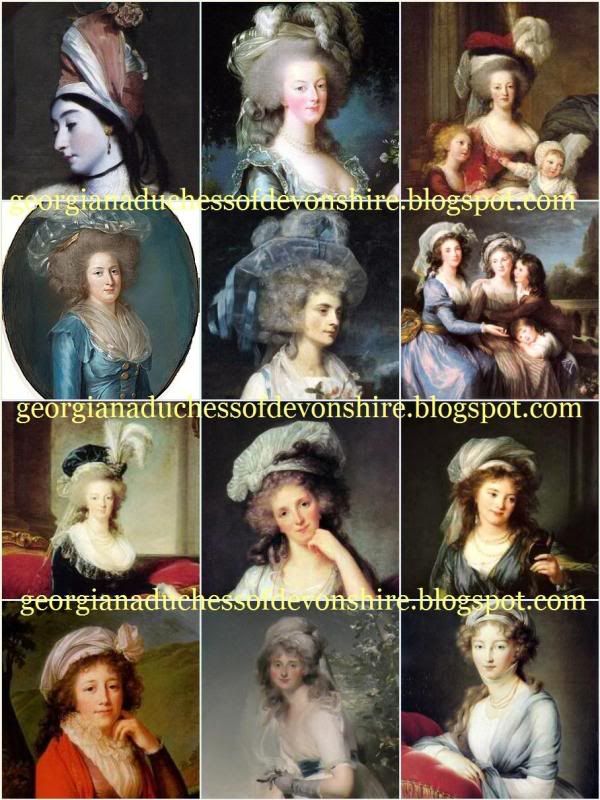
In our continued exploration of hats it would be crazy to exclude the major trend that was the turban. Turbans would appear here or there throughout the 18th century but by the end of the century the vogue simply exploded. Visitors to the mysterious lands of the Orient and Turkey, such as Mary Wortley Montague brought back many of the peoples' mysterious ways (such as the smallpox inoculation) to the curious English. One of the things that made it back to Europe was the curious manner of dress which everyone took a major interest in. Soon Turkish dress was one of the most common costumes seen at the masquerade. Of course this dress was not proper for normal, everyday wear (you couldn't look like a barbarian!) but one aspect did stick and that was the turban. Women found that the rolls of elegant fabric could make for the perfect fashion accessory. One woman particularly loved these headdresses and frequently had herself portrayed wearing them, Marie Antoinette. Even after the queen's fall and subsequent death turbans became increasingly popular, especially in France. They evolved into fabric that would wrap around women's curly, loose hair so that it would show through the fabric. The trend had adapted to the Classical trend to combine the Turkish style with that of the ancient Roman. By the 1790's and into the early 19th century no woman of fashion was complete without a turban, Turk, or chiffonet.
This site has some great fashion plates of Turbans after 1793.


  1. 1782
  2. 1783
  3. 1787
  4. 1787
  5. 1787
  6. 1787
  7. 1788
  8. 1789
  9. 1790
  10. 1793
  11. 1794
  12. 1795

Friday, March 27, 2009

Tart of the Week: Elizabeth Linley Sheridan


One of the most beautiful and musically-gifted women of the late 18th century was Elizabeth Linley. Elizabeth, or Betsy (and even Eliza on occasion) as she was commonly known, was born in 1754 to the composer Thomas Linley and his wife Mary. Together, Thomas and Mary raised their twelve children to be just as musically talented as themselves. Think: Von Trapp family of Bath. Adorable little Betsy would stand outside the Pump Room selling tickets to her father's concerts. Betsy grew gracefully into a stunning Soprano and soon drew her own crowds in with her beautiful voice. By the time Betsey was barely fourteen she had all the guys drooling over her. She had a tall, slim figure, dark hair, and gorgeous porcelain skin. Thomas Gainsborough took notice of her right away. The artist had painted more than one portrait of the musical Linleys but he especially took notice of Betsy. His many portraits of her, flaunt her natural beauty.

Among the many admirers and young men begging for Betsey's hand was twenty year-old Richard Brinsley Sheridan. Sheridan was perhaps more interested in the chase, and the prize at the end was something he could rub in everyone's face. However, a certain Walter Long stood in his way. Long was really wealthy and about four times the age of Betsy. Thomas Linley pressured his daughter into the match for both the money and for the assurance than she would retire from the stage. God forbid she become an actress! The two were about to marry when Long randomly cut off the engagement, causing Thomas to fly into a rage. Rumors surfaced that Betsy had begged him to break it off. The whole drama resulted in a comedy to premiere at the Haymarket Theater called The Maid of Bath.

Another drama quickly followed Betsy's broken engagement with Thomas Long. Sheridan saw his chance and swept Betsy off her feet. She agreed to marry him and the two eloped to France in 1772. Since both were underage, the marriage was invalid, and neither father approved. To save his daughter's reputation Thomas gave his blessing a month later and the two were accepted into polite society as a very talented and good-looking young couple.

While absconding away to France Betsy became very sick and almost died. Sheridan began to realize just how much Betsy meant to him and how he truly did love her, she wasn't just a prize anymore. Although Betsy survived, her illness was to be a precursor to the many that would follow throughout her life. Miscarriages soon burdened the new couple and it wasn't long before Sheridan began wandering into other women's beds. Betsy was devastated; the man she had chosen above others and at a huge risk, couldn't even be faithful to her. Still, they attended the political events and masquerades and men still marveled at her.

It was only a matter of time before Betsy finally had the courage to have her own affair. Her choice: the hunky Lord Edward Fitzgerald. Unfortunately the affair resulted in a pregnancy. Not only would her infidelity be discovered, it would put her life at serious risk. When Sheridan found out he had an usual reaction for a Georgian male with a big ego: he blamed himself. Instead of casting her out, he spent more time with her and helped her through the pregnancy which proved to be difficult. In fact after Eliza managed to deliver a baby girl her health depleted further and she succumbed to tuberculosis.

Betsy was dying and both she and Sheridan knew it. They went to Bristol in hopes that the hot wells would improve her health. Sheridan tried to support his wife but seeing her dying in front of him torn him up from the inside. One night he found her playing piano, "with tears dripping on her thin arms," a shadow of her former self. Not long afterward Elizabeth died. Sheridan, in tears, held her hand, while she told him to stop crying or to leave the room, for she could not bear the sight when she needed fortitude. The guilt after her death sent Sheridan into the realms of madness. He wasn't the only one to morn her. The crowds at her funeral were so large that the carriage could barely get through the street to Wells Cathedral. Everyone crowded one last time to pay tribute to the maid of Bath whose voice was now silenced forever.

Thursday, March 26, 2009

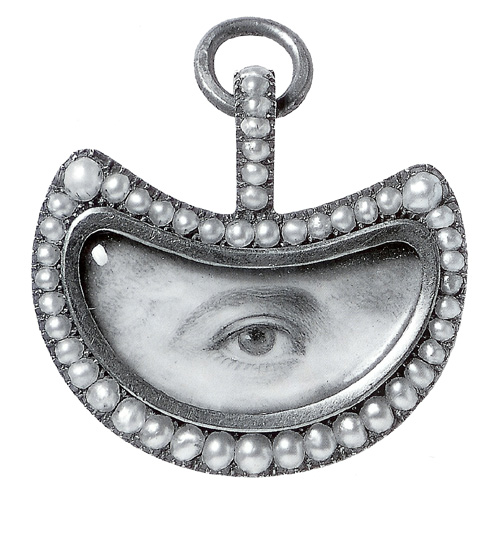
Preserving Those 'Fine Eyes' in Miniature

Supposedly it is a person's eyes that we first notice when we fall in love. I'm sure that's what the Prince of Wales was looking at when he first became smitten with the busty Mrs. Fitzherbert. Either way, he presented his shy lover a token of his affection in the form of an eye miniature. Eye portraits became a common lovers' token in the late eighteenth century and into the Regency period. After all, eyes are not as conspicuous as a full miniature. This makes them difficult to identify today. If you find one of these rare miniatures in a museum they seldom know whose eye is depicted. Many letters from the time talk of how supposed lovers had "exchanged eyes."

Eye portraits were created the same way miniatures were and usually by miniature artists such a Richard Cosway (who painted the eye for the prince to give to Mrs. Fitzherbert). The eyes would be placed on jewelery such as brooches or rings to display that the wearer's heart belonged to someone. Some settings even have a wife's eye surrounded by her childrens'. Other eyes were not put on constant display and only shown to select parties, but that usually meant that they already had someone else's eye, if you get my drift, wink wink.