Showing posts with label Buildings. Show all posts

Tuesday, December 22, 2009

Book Review: Behind Closed Doors

When I saw Amanda Vickery's new book, Behind Closed Doors: At Home in Georgian England I gasped dramatically; or maybe even squealed obnoxiously. Either way, I was in public and I was very excited. Vickery's book, The Gentleman's Daughter, was a study of the lives of women in Georgian England and packed with great information on the daily lives of women. Now the eighteenth century historian is venturing into the comforts of the Georgian house to paint a picture of people's relationship with and within the home. The result is enlightening.

Behind Closed Doors opens with a description of the average day of a landlady, which to some, might not sound incredibly exciting, but to me was packed with information I had rarely thought about. And that is kind of how Behind Closed Doors is; you pick it up wondering just how Georgians lived their day-to-day life and you get the details of things you wouldn't normally wonder at, such as the fact that a landlady domineered your living space if you were a renter. The book is just packed with information. Vickery takes you through the ins and outs of living in the time; her feminist background surfaces every once in a while to deliver information specific to women's perspective. Topics include, but are not limited to the actual house, people's relationship with the house, bachelor life, wallpaper obsessions, and so on and so forth.

One of my favourite chapters was titled, Setting Up Home and was all about how women found a freedom in marrying because it allowed them to redecorate and therefore put an ownership in their new home. This was both an important and acknowledged part of a well-bred woman's life. Vickery uses examples from famous spinster, Jane Austen's novels which made me begin to question that it wasn't just the men our Austen heroines fell in love with, but their dwellings, for as Vickery puts, "It was a truth universally acknowledged that a Georgian house with a drawing room, French windows and a lawn must be in want of a mistress." Amen to that; I'd say that still holds true today! After Vickery cites multiple examples from Pride and Prejudice, Sense and Sensibility, Persuasion, and Mansfield Park she moves on to real life examples, one of which was a household in the same place I once lived, to my own personal delight. Her amazing research shines through with specific examples of how that particular mistress badgered store-keepers in the neighboring town so as to have the house fitted to her liking. Most chapters take a similar path, combining evidence from personal diaries, documents and contemporary writings to discuss the many aspects of the Georgian home.

I found this book to be a delight. Although the topic of the book may not be in everyone's interest, it should be picked up by those interested in social history, women of the eighteenth century, and historical homes. Those that enjoyed City of Laughter will likely enjoy this read. Vickery's research on individuals read like short stories of a novel, weren't stuffy or boring, and were always conducive to the point she was trying to portray. I think readers of this blog will especially appreciate the sarcastic little remarks she manages to sneak in her descriptions of those she researched. It just goes to show how well she got to know them and isn't it nice when an author-researcher knows their subject? Behind Closed Doors is on shelves now and will compliment anyone's eighteenth century library.

Thursday, December 17, 2009

The Foundling Hospital


Establishing a large metropolitan orphanage seems to have marked a city and its society's arrival at their own Renaissance. They came to symbolize a time of wealth and an new found interest in the welfare of its people. During the Italian Renaissance foundling hospitals (remember, hospital-hospitality) sprung up, one even had a large wheel that you could place your baby on and rotate into the building so as not to show your shamed face when your dropped your child off. Amsterdam's beautiful History Museum is housed in the former old Civil Orphanage, established during the Dutch Golden Age. The English were very stuffy about the topic of illegitimate children. They saw orphanages in the same way many people now see giving condoms to teenagers: if we provide a place for whores to put their unwanted children it's condoning bad behavior. It wasn't until the Enlightenment that there was a call to finally do something about the orphan problem.

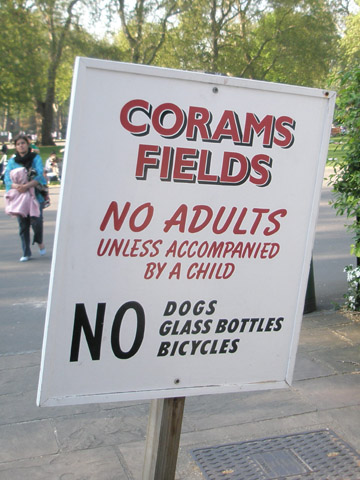
If a family or individual couldn't afford to take care of their child, it tended to end up in a workhouse; think: Oliver Twist. Only 10% of the children sent here would survive. Those that were too young to work would be on the streets. Dead babies in the street were a common, early-morning sight. This was a sight that Captain Thomas Coram couldn't bear to see. For years he petitioned the king for a foundling hospital with no success. Luckily, King George II ascended to the throne in 1727 and his wife, Queen Caroline had the same concerns as Coram about the children. Coram's petition for a hospital that would turn forgotten children into useful citizens seemed like a good idea to this king and he approved it. The nobility and the wealthy also thought it sounded good and many became subscribers, that is, donated their money to build the hospital.

Those who couldn't spare money were able to help in other ways. The idea of the Foundling Hospital appealed to William Hogarth, who often critiqued society in his artwork. He became one of the hospital's founding Governors and would go on to foster some of the children with his wife since they had none of their own. Hogarth brought artwork to the hospital, donated by himself and other artists such as Gainsborough and Reynolds, and even designed the uniforms and the Coat of Arms. Another artistic supporter was George Frideric Handel. The musician was in the height of his career and used his popularity to his advantage by holding charitable performances in order to raise money for the hospital.

The Foundling Hospital wouldn't take all babies at first, but by 1756 a basket was hung outside its door to symbolize the law passed in the House of Commons deeming that the hospital would turn away any child under twelve months old. Many times, the babies would be dropped off with some sort of token by their mother, perhaps symbols of sacrifice or remembrance. A key, a more pricey and meaningful token of ownership, were often left to symbolize that the mother meant to reclaim the child if fortune ever was to smile on her. Babies' lives began at the hospital with wet nurses, who lived outside the actual hospital. One of Hogarth's duties was to supervise the wet nurses. When old enough, children were tended to inside the hospital, girls and boys on opposite wings as was traditional in orphanages. Here the children were tended to when they were ill, given food and amenities, and an education. There was an apprenticing program, so that when the children became teenagers they became apprentices and began their journey into the outside world.

Today the hospital doesn't exist. The 20th century saw the end of orphanages in England and the demolishing of the actual building which was once described as being, "the most imposing single monument erected by eighteenth century benevolence." Traces of this symbol of humanity can still be seen on the former site. A playground sits on seven acres of the site, which is commonly used by children from the modern hospital nearby, Great Ormond Street Hospital. The Foundling Museum stands to tell the Foundling Hospital's story and houses the art collection William Hogarth put together to bring the joy of art into forgotten children's everyday lives.

Monday, December 22, 2008

The Bedlam of Bethlam


bed⋅lam [bed-luhm]
–noun
1. a scene or state of wild uproar and confusion.
2. Archaic. an insane asylum or madhouse.

Are the holidays driving you nuts? Inspired by fabulous reader Kristi, who always sends me awesome emails, I thought what better a time to talk about "the mad" then the holiday season.

Because insanity or mental illness were misunderstood throughout much of history the people who suffered from these conditions were usually mistreated. This also meant those with mental handicaps were thought to be "mad" as well. These unfortunate souls would be put in madhouses, hidden away from public view where they spent their lives being beaten or even killed.

In 1247 the Sisters of the Order of the Star of Bethlehem founded a priory on the site of what is now London Liverpool Street Station. Hmm I wonder if I can say that my friend Erin spent a night there since she was stranded at that station overnight. The building went through many changes throughout the centuries. But the Enlightenment brought a new thinking about these castaways and Bethlam Royal Hospital (as it was now called) began attempts to improve the treatment of the inhabitants. The hospital was also called Bedlam which turned into a word to mean [see above] and that's exactly how the old Bethlam was. The screaming and noise that came from the building was said to drive anyone who heard, mad themselves. Now with the Enlightenment the great thinkers set about trying to, perhaps, quiet those inside.

Firstly, they began referring to those inside as patients. After-all, Bethlam was a royal hospital. Then someone realized that the patients actually exhibited different symptoms; most notably, screaming versus not screaming. So they considerately divided these patients from each other. They made "curable" and "incurable" wings and divided the patients by sex. Bethlam was intended for short stays but if after a year the patients remained uncured they were just discharged, unless of course, someone lost track of how long a patient was there. The uncured wing allowed an alternative to giving up on the patients.

Bethlam was commended by Europe for their advancements with the mad, but of course they weren't perfect. As a means of generating more funding, you could pay a penny and view the "lunatics." Crowds peered through iron bars hoping to get a glimpse of the patients unusal looks and behavior, especially if their antics included anything of a sexual nature or violence. They were even allowed sticks to prod the poor patients. Asylum conditions were improving but they still had a long way to go.

The above figures of raving and melancholy madness graced the entrance gate of of Old Bethlam. These two allegories show how limited knowledge was of the different patients' conditions and needs.

Wednesday, June 11, 2008

Devonshire House

Devonshire House was not just a fantastic mansion, it was an elite social club and a state of mind. It was the be all and end all of the ton, a gathering place for Whigs, and where Georgiana spent most of her life.

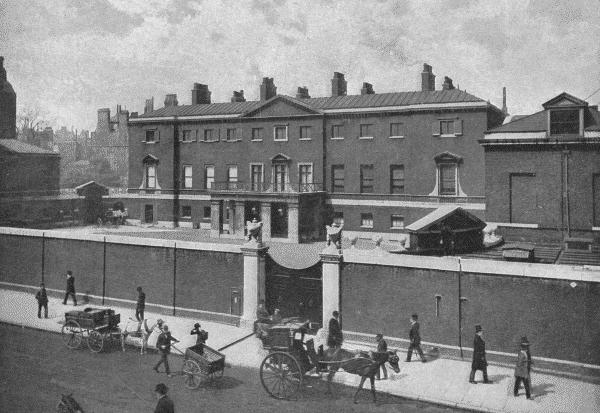
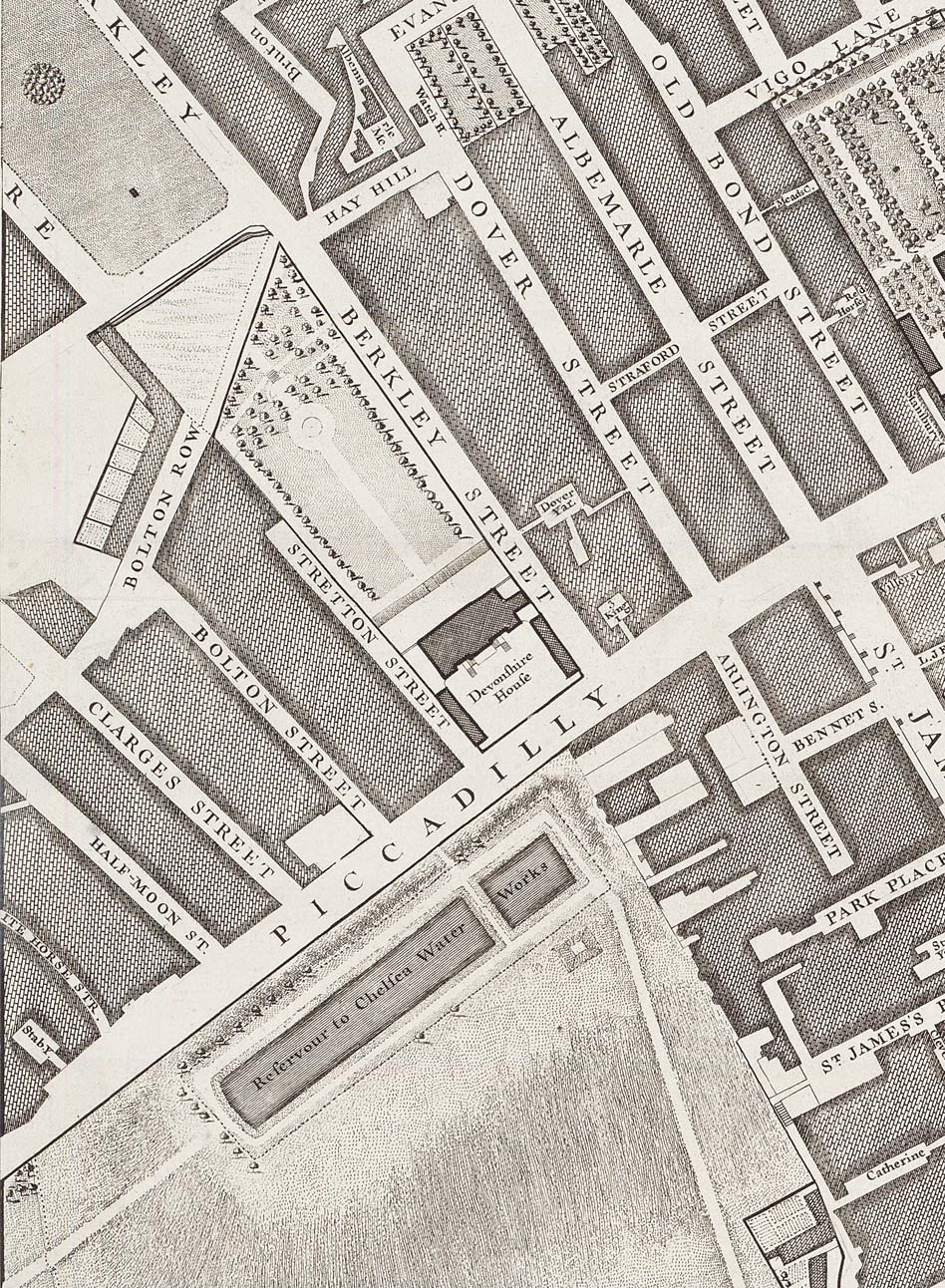
Before I get into that, I would like to talk about the more physical aspects of the Devonshire House. It was built on the site of Berkeley House, the home of the most conniving (and kind of bitchy) of King Charles II's mistresses, Barbara, Duchess of Cleveland. It was in prime location on Piccadilly Street, across from Green Park. Anyone who has been to London has likely walked past its ghost; before it was demolished (in 1925), Devonshire House was located across from the present day Ritz Hotel. The building was huge and aesthetically unappealing. Worst of all it had a massive brick wall encircling it which clashed with the architectural line of Piccadilly and attracted only graffiti.

Many complained of the ugliness of the structure in the wittiest of ways but what mostly interested people was what was on the inside. Devonshire House had one of the greatest collections of art and some of the grandest rooms, in both size and decor. However it was the people inside that was of the most curiosity. Not only was the leading lady celebrity housed behind it's doors, but all her friends, the ton. The Devonshire House circle consisted of the young, rich, talented and snobby with people such as Charles Fox, the Prince of Wales, Richard Brinsley Sheridan, and too many others to name. They were the coolest social club and Devonshire House was their clubhouse, perfect for dancing and gambling and any other debauchery one could think of. Devonshire House remained a great place for entertainment up into the Victorian Age; Queen Victoria's Diamond Jubilee Ball was celebrated in the house's ornate public rooms.

With the demolition of the house, we loose a stunning visual into the life of Georgiana, her friends and family; as well as an important puzzle piece in the social structure of London high society.