Many of us have heard/used the phrase, "rule of thumb." Some may even know the phrase's notorious origin. It is yet another phrase, still used today, that we can thank 18th century England for.
Sir Francis Buller at the age of 32 was the youngest justice ever appointed to the King's Bench, a mere six years after he was called to the bar. You may think this would mean his actions as a judge to be just and good but that wasn't necessarily the case. He was known to be bull-headed and impulsive in his judgments. Justice Buller was most known for his stance on domestic abuse. Supposedly, he believe there should be a "rule of thumb," that is, a husband could beat his wife, as long as it was with a stick no longer than his thumb. This rule was never adopted legally. As silly as the rule sounds now, it sounded just as foolish in 1782. James Gillray especially thought so and dubbed Justice Buller, "Judge Thumb," making him quite the laughing stock of the justice system.
Ironically, Buller was one of the judges which presided over Mary Eleanor Bowes' extreme case of domestic abuse. However, Mary's horrid husband, Andrew Stoney's abuse shocked even Judge Thumb who was disgusted by Stoney's actions and threw him into prison. So although he was a bit medieval in his ideas on domestic felicity, Buller wasn't a complete misogynist!
Showing posts with label Mary Eleanor Bowes. Show all posts
Monday, January 31, 2011
Friday, December 3, 2010
Royalty Descended from Tarts
There's been much fuss over the upcoming movie, The King's Speech, starring Colin Firth as George VI, Queen Elizabeth's father. Enchanted Serenity has a great post on George VI's relationship with his wife, Elizabeth, the Queen Mother who died at 101 in 2002. Before she was queen, Elizabeth was Lady Elizabeth Bowes-Lyon. Does that last name sound familiar?
The late Queen Mother is a decedent of Mary Eleanor Bowes the heiress with the amazing tale of domestic issues and survival. Elizabeth's last name, Bowes-Lyons was created when Mary's first husband, John Lyon, Earl of Strathmore married her in order to secure the Bowes fortune. As a condition for inheriting the fortune, John had to legally change his name to Bowes-Lyons which the Earls of Strathmore continue to carry to this day.
Glamis Castle, the childhood home of the current queen which features on the back of Scottish 10-pound notes is also the former home of Mary Eleanor.
The King's Speech is in select US theaters now, will be released in Canadian theaters 10 December, and in UK theaters 7 January.
The late Queen Mother is a decedent of Mary Eleanor Bowes the heiress with the amazing tale of domestic issues and survival. Elizabeth's last name, Bowes-Lyons was created when Mary's first husband, John Lyon, Earl of Strathmore married her in order to secure the Bowes fortune. As a condition for inheriting the fortune, John had to legally change his name to Bowes-Lyons which the Earls of Strathmore continue to carry to this day.
Glamis Castle, the childhood home of the current queen which features on the back of Scottish 10-pound notes is also the former home of Mary Eleanor.
The King's Speech is in select US theaters now, will be released in Canadian theaters 10 December, and in UK theaters 7 January.
Friday, May 29, 2009
Tart of the Week: Sarah Countess of Tyrconnel
Sarah Hussey was born into money which meant two thing: a prestigious marriage and scandal. Being a grand heiress, poor-ish nobles were lining up to marry Sarah by the time she was sixteen. The man who won Sarah's hand (and money) was George Carpenter, the earl of Tyrconnel, an Irish peer. George has already
been married, which made Sarah his second countess. What happened to the first countess you may ask. Well, Lady Frances was still very much alive; she had just gone through the pricey process of divorce, or rather, George had gone through it, to do away with her.Sarah picked up where the former Lady Tyrconnel left off. She quickly got bored with her older husband and went out partying and man-scouting. She seemed to have hit the jackpot in 1788 when she began an affair with Prince Frederick, Duke of York. As with just about all royal affairs, the press had a field day, boosting Sarah up to celebrity status. The strangest aspect of the whole affair: both Sarah's father and husband were blooming with pride. When Frederick broke off the affair a year later, the two men were more upset than Sarah. It sounds like something out of The Tudors, no?
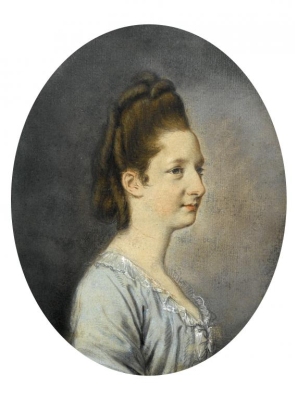
Sarah wasn't one to mope around about broken relationships. She moved on. The next man in her life was John, Earl of Strathmore, son of none other than Mary Eleanor Bowes. Once again, satirical prints loved the pretty little countess' affair and it publicized for all to see. But this time, the affair seemed to mean a little more to Sarah, she loved John. Finally, one day she just up and left George and went away to live in sin with John. Afterall, she was an independant woman. When the artist John Downman was portraying her, he noted such. Sadly, Sarah's legacy was not to last very long. She died in 1800 from a bad cold at the age of thirty-seven. Her final resting place is the illustrious Westminster Abbey.
Tuesday, February 24, 2009
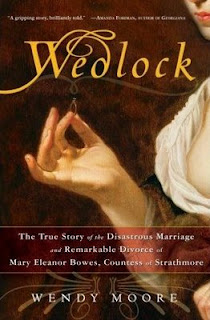
Book Review: Wedlock
Mary was the richest heiress in Great Britain at the time of her marriage to the Earl of Strathmore. She settled down to married life and to motherhood, which proved to be disappointing. When her husband died not long afterward, the widowed (and still filthy rich) countess made up for lost time by partying in London, having numerous boyfriends, and finally engrossing herself in her educational interests. Unfortunately, one of her lovers turned out to be a schemer who would form a series of the most diabolical plots in order to capture her wealth. Andrew Robinson Stoney faked a duel in her honour and a fatal wound in order for her promise to marry him. Mary, wanting to grant a dying man his last wish, obliged. This proved to be a
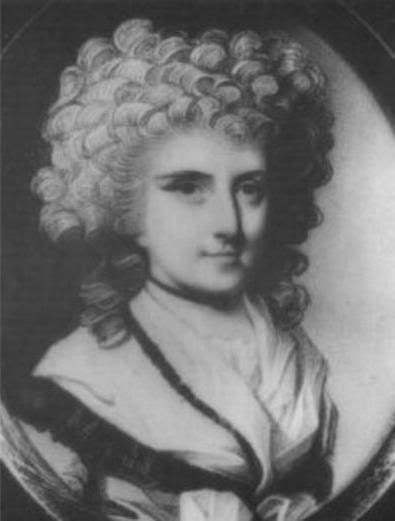
near fatal error. Mary soon became a prisoner to her new husband who tortured her for the fun of it. The once glamourous countess was forced to wear rags and be severely beaten on a daily basis [pictured right during the height of her abuse] while her husband brought home mistress after mistress and raped their servants. As jaw dropping as Mary's abuse is, her divorce trial is even more amazing, considering the little rights women had in this era."...[Judge] Buller had become the laughingstock by suggesting that a husband could lawfully beat his wife as long as he used a stick no bigger than his thumb. Yet even "Judge Thumb" was scandalized at the depraved extremes of [Andrew Robinson Stoney]'s conduct, which now unfolded before the court."
I will admit, this book started out slow, and therefore disappointingly for me. Moore has a good sense of narrative but also a tendency to drone on about all sorts of things in an effort not to leave out any information. A totally understandable concern, but not always the best commodity for non-fiction. This would gradually bore and then veer me away from the main context. But with introductions out of the way the book picked up and the real dirt began to be revealed; that's when Moore began to shine.
There are many challenges in writing Bowe's biography. Moore documents almost every case of the poor woman's abuse that she could find. She does this all while avoiding making the individual cases sound too repetitive or like a Lifetime movie. The true and awful nature of Stoney is also revealed in full force and with thoughtful analysis. Where Georgian court trials can get long-winded and tedious, Moore manages to cut out the dispensable aspects to keep the story going.
Wedlock is definitely worth reading, even if it is a little tough to get through the first third of the book. Mary Eleanor is an amazing woman, who, without realizing it, became a pioneer in women's divorce settlements, and therefore, individual rights. I'm proud to say that her biographer does her justice. Wedlock is already available in the UK under the sumptuous subtitle: How Britain's Worst Husband Met His Match and will be on US Shelves on 10 March.
Monday, February 16, 2009
Quotables
"...You may shoot me, or beat me to a mummy: my person is in your power, but my mind is beyond your reach."
-Mary Eleanor Bowes, Countess of Strathmore when faced by her husband's pistol after he kidnapped her.
Friday, June 6, 2008
Tart of the Week: Mary Eleanor Bowes

Mary Bowes was many of the many female antagonists in English media. For whatever reason she was made out to be the biggest bitch on the block, and maybe that's why I like her so much.
Raised by a libertine rake, Mary became one of England's richest heiresses upon her father's death when she was merely 11. She was extremely smart and rather than spending all her money frivolously she would put it towards advancing her knowledge by buying things such as experimental hothouses to raise exotic plants. She also hung out in bluestocking groups and spoke her mind and didn't care who that bothered. At 18 she married the Earl of Strathmore who would complain about every aspect of her except the fact that she slept around. He thought she had a sharp tongue, was malicious, and had an unhealthy love of cats and dogs. Don't you love Mary? The press hated Mary and capitalized on her love of cats and known
dislike of her young son.Then some real dramz began.
After her husband's death from consumption Mary met Andrew Robinson Stoney whom she fell in love with. She married him and he took her last name in order to secure some of her inheritance. No sooner had they married than Stoney became a total bastard. He beat her, had numerous affairs, sold her beloved greenhouses to pay off his gambling debts, and controlled her every movement including her personal letters. He even forced her to write a memoir called Confessions in which he had her lie about her past life so he could have something to blackmail her with. Finally Mary found an escape and was able to have him arrested and tried for abuse.
But that wasn't the end of Stoney.
He began stalking her, becoming increasingly obsessed with her. He began to commission more damaging satires of her to publicize her sinful and malicious ways. Hired goons watched her every move. One day she was assaulted and kidnapped in her own coach which quickly exited London to the cries of "Murder!" Stoney had kidnapped her and for 11 days drove all over the country torturing and beating his former wife. The abduction was highly publicized and Mary was saved and Stoney captured. He was tried and found guilty but continued to burden her life, eventually publishing her Confessions that he had forced her to write. Mary was now safe but she never gained a positive reputation despite the empathy she received from her abduction.
Subscribe to:
Posts (Atom)